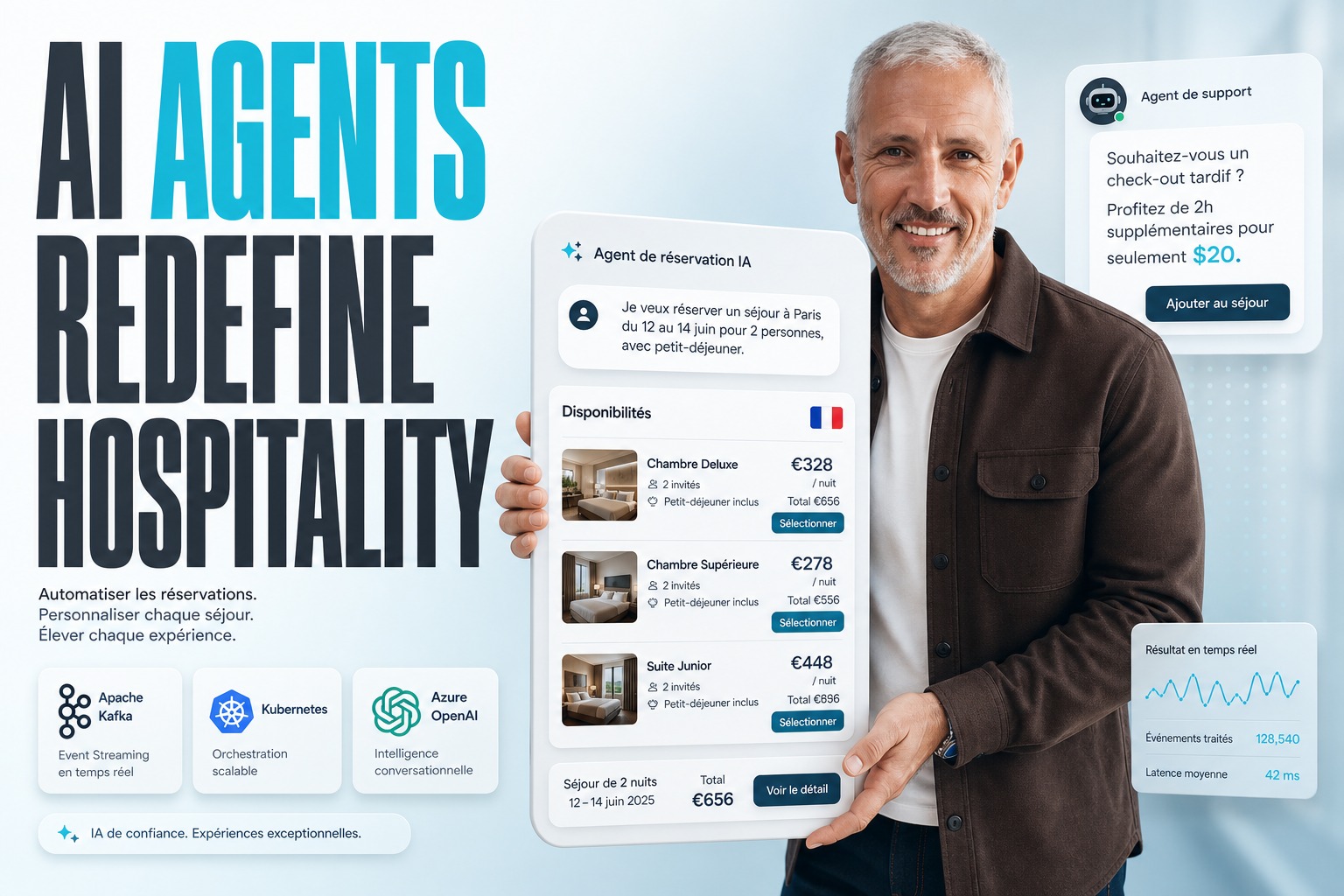
Travel operators still lose up to 30 % of potential revenue because front‑desk systems cannot keep pace with the volume and nuance of guest interactions, especially across time zones and languages. Replacing static rule‑bases with AI for hospitality unlocks real‑time, context‑aware assistance that turns a fragmented booking funnel into a single, frictionless conversation.
Industry challenge & market context
- Legacy PMS and CRS integrations require manual data entry, leading to 15‑20 minutes of staff time per reservation.
- Multilingual guest queries spike 40 % during peak seasons; rule‑based bots fail at intent disambiguation.
- Operational dashboards lack event‑level granularity, causing delayed response to over‑booking or service disruptions.
- Compliance regimes (GDPR, PCI‑DSS) demand audit‑ready logs that many existing platforms do not emit.
- Scaling point‑of‑sale APIs in a global cloud environment introduces latency spikes >300 ms, which erodes conversion rates.
Technical architecture and how AI for hospitality works in practice
At a high level, an AI for hospitality platform consists of four layers: ingestion, orchestration, model execution, and persistence. Below is a concrete reference architecture that scales to 100 k + concurrent sessions across three continents.
- API Gateway – Envoy or AWS API Gateway terminates TLS, enforces OAuth2 scopes, and routes inbound REST/GraphQL calls to the orchestration engine.
- Orchestration Layer – Implemented with CrewAI or AutoGen pipelines written in Python. It receives the request payload, normalizes it, and decides which agent (booking, support, operations) should handle the turn.
- Model Layer – A hybrid of large language models (GPT‑4, Claude) accessed via Azure OpenAI or self‑hosted Llama 2. Retrieval‑augmented generation (RAG) is powered by LlamaIndex against a vector DB such as Pinecone or Milvus. Embeddings are stored with a 1536‑dimensional OpenAI embedding model.
- Tooling & Plugins – Agents expose functions via JSON‑RPC over gRPC or HTTP. Examples include
check_availability(date, room_type), process_payment(token, amount), and fetch_local_attractions(language). The orchestration engine injects these as "tools" into the LLM’s tool‑use capability. - Data Store – PostgreSQL for transactional booking data, Redis for session cache (TTL 30 min), and an event store (Kafka) for audit trails and eventual consistency between micro‑services.
- Observability Stack – OpenTelemetry collectors ship traces to Jaeger, metrics to Prometheus, and logs to Loki. Circuit‑breaker patterns via Istio prevent cascade failures when a downstream payment gateway throttles.
- Deployment Model – Docker images built with multi‑stage Go/Python builds, orchestrated by Kubernetes (EKS or GKE). Stateless agents run as Knative serverless functions for bursty traffic, while the orchestration pods are horizontally auto‑scaled (target CPU 60 %).
- Security & Governance – All inbound calls require signed JWTs verified against an OAuth2 provider. Secrets (API keys, DB passwords) are injected via Kubernetes Secrets and sealed with SealedSecrets. GDPR data residency is enforced by routing EU guest sessions to the Eu‑central‑1 region.
Mini‑scenario 1 – Multilingual booking assistance
A French‑speaking guest asks, “Je veux réserver une chambre double du 12 au 15 juillet, proche du centre‑ville.” The request hits the API Gateway, which extracts the language header (fr-FR) and forwards the payload to the orchestration layer. The orchestrator selects the BookingAgent, which calls the check_availability tool. The tool queries the PMS over a GraphQL endpoint, returns a JSON list of rooms, and the LLM formats a natural‑language response in French, including a dynamic price breakdown. End‑to‑end latency stays under 250 ms thanks to Redis caching of room‑type embeddings.
Mini‑scenario 2 – Guest support AI with proactive upsell
During check‑in, a guest texts “Can I get a late checkout?” The chatbot (built on LangChain) routes the intent to the SupportAgent. The agent invokes fetch_loyalty_tier from the CRM (via a REST webhook) and discovers the guest is Gold tier. The LLM then proposes a “late checkout for $20” and simultaneously triggers a create_upsell_offer function that writes to the offers micro‑service. The entire flow is logged with an immutable audit entry in Kafka, satisfying compliance auditors.
Mini‑scenario 3 – Operations automation
A housekeeping sensor publishes a “room_cleaned” event to Kafka. An event‑driven consumer in the orchestration layer updates the room status in PostgreSQL and notifies the FrontDeskAgent via a webhook. The agent, using a short‑term memory buffer, automatically pushes a “ready for check‑in” notification to the guest’s mobile app. Latency from sensor to guest is typically <100 ms, enabling real‑time occupancy dashboards.
Most enterprises underestimate the context‑window cost of naive RAG; a 4‑KB retrieval chunk can double token usage and inflate LLM spend without delivering additional relevance.
Business impact & measurable ROI
- Booking automation reduces manual entry time by 85 %, translating to an average cost saving of $0.45 per reservation processed.
- Guest support AI lowers average handle time from 4 minutes to 45 seconds, increasing first‑contact resolution by 32 % and boosting Net Promoter Score (NPS) by 5 points.
- Multilingual capability expands market reach; a pilot in Southeast Asia saw a 12 % lift in conversion for non‑English browsers.
- Operations event‑driven pipelines cut room‑turnover reporting latency from 15 minutes to <30 seconds, enabling dynamic pricing adjustments that added $1.2 M annual revenue in a 500‑property portfolio.
- Compliance‑by‑design audit logs reduce audit preparation effort by 70 % and avoid potential fines exceeding $500 k per breach.
Implementation strategy
- Phase 1 – Discovery & data mapping: inventory PMS, CRS, CRM APIs; define data residency zones; prototype a “hello‑world” booking intent using LangChain.
- Phase 2 – Core agent development: build BookingAgent and SupportAgent with tool‑use integration; set up vector store and generate embeddings for all property descriptions.
- Phase 3 – Multilingual layer: fine‑tune a smaller LLM (e.g., Mistral‑7B) on domain‑specific translations; configure language detection middleware.
- Phase 4 – Event‑driven operations: integrate Kafka streams from IoT sensors; implement idempotent handlers with exactly‑once semantics.
- Phase 5 – Security hardening & observability: enforce OAuth2 scopes, enable SealedSecrets, roll out OpenTelemetry dashboards.
- Phase 6 – Scale‑out & multi‑tenant rollout: deploy to additional regions, enable tenant isolation via namespace per client, apply autoscaling policies.
Common pitfalls
- Skipping token‑budget planning – RAG queries can exceed model context windows, causing truncation.
- Hard‑coding API keys in code – leads to secret leakage; always use secret managers.
- Neglecting idempotency on webhooks – duplicate events cause double bookings.
- Over‑relying on a single LLM provider – provider outages can halt the entire booking flow.
Why Plavno’s approach works
Plavno builds AI for hospitality with an engineering‑first mindset: each component is version‑controlled, container‑native, and observable from day one. Our teams combine deep domain expertise in travel software with proven AI stacks (CrewAI, AutoGen, LangChain) and a disciplined delivery model that aligns with enterprise governance.
We partner through custom AI assistant development, delivering end‑to‑end pipelines that integrate with existing PMS/CRS while meeting PCI‑DSS and GDPR audit requirements. Our voice‑assistant solutions enable hands‑free check‑in kiosks, and our travel‑hospitality expertise ensures the data model respects industry standards (OTA, OpenTravel Alliance).
A well‑architected AI agent stack – with separate orchestration, model, and persistence layers – reduces mean‑time‑to‑recovery by 4× compared to monolithic chatbot deployments.
Conclusion
Deploying AI for hospitality is no longer a futuristic experiment; it is a concrete lever for revenue growth, cost reduction, and compliance assurance. By embracing a modular, observability‑rich architecture that unites booking automation, guest support AI, multilingual NLU, and operations event‑driven pipelines, enterprises can turn fragmented guest journeys into seamless, data‑driven experiences. Ready to see how Plavno can accelerate your AI‑first transformation? Get in touch and let’s blueprint a production‑grade solution today.