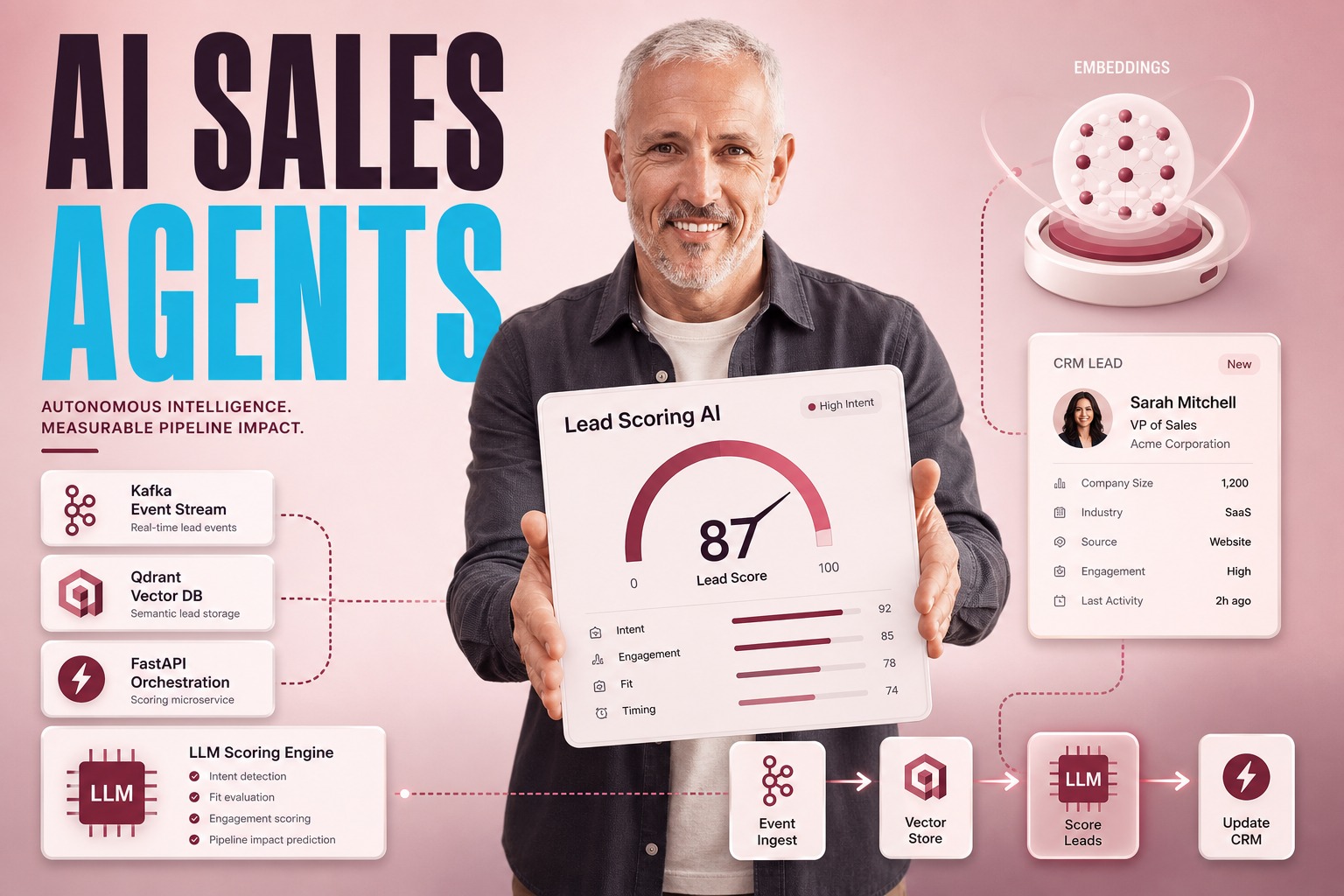
Enterprise sales teams still spend 80 percent of their time on low‑value admin work—updating pipelines, chasing stale leads, and manually scoring prospects—while the market demands real‑time insight and hyper‑personalized follow‑ups. AI agents for sales operations turn that friction into a data‑driven feedback loop: they ingest CRM events, score leads with a fine‑tuned model, draft next‑step notes, and push updates back to the system—all within milliseconds. The net effect is a leaner funnel, higher conversion rates, and a team that can focus on relationship building rather than spreadsheet hygiene.
Industry challenge & market context
Legacy sales stacks were built for human‑in‑the‑loop processes; they struggle to keep pace with today’s volume and velocity.
- Manual lead scoring introduces bias and delays; 30 % of qualified opportunities slip through because the score never gets refreshed.
- CRM automation rules are brittle; a change in field names or a new integration can break dozens of workflows.
- Follow‑up cadence is inconsistent; sales reps forget to log calls, leading to a 25 % drop in pipeline visibility.
- Data residency and compliance (GDPR, CCPA) limit where third‑party SaaS can operate, forcing enterprises to keep sensitive sales data on‑premise.
- Scaling sales automation AI across multiple business units creates “spaghetti” integration layers that are costly to maintain.
Technical architecture and how AI agents for sales operations works in practice
At the core, an AI‑enabled sales automation platform is a collection of interchangeable services that talk over well‑defined contracts. Below is a reference architecture that balances flexibility, observability, and enterprise‑grade security.
- API Gateway – Terminates external traffic, enforces OAuth2 scopes, and routes requests to the orchestration layer.
- Orchestration Layer – A lightweight Python (FastAPI) or Node (NestJS) service that composes calls to LLMs, retrieval engines, and downstream CRMs. It uses AI agents development patterns from LangChain, CrewAI, or AutoGen.
- Model Layer – Hosts fine‑tuned LLMs (e.g., Llama‑2‑70B) in a containerized inference service (Docker + NVIDIA Triton). Embeddings are generated via OpenAI or Cohere and stored in a vector DB like Pinecone or Qdrant.
- Data Store – PostgreSQL for transactional CRM data, Redis for caching recent lead contexts, and a Kafka topic for event streaming.
- Tooling Plugins – Wrappers that expose CRM actions (create task, update opportunity) as LangChain tools, plus a web‑search plugin for external enrichment.
- Observability Stack – OpenTelemetry tracing (Jaeger), Prometheus metrics, and Loki log aggregation to monitor latency (< 150 ms per agent call) and error rates.
Data flows follow an event‑driven pattern:
- Salesforce or Microsoft Dynamics emits a webhook on
LeadCreated → API Gateway validates the payload. - Orchestration Layer writes the raw event to Kafka (topic
sales.events) and acknowledges the source. - A consumer microservice extracts the lead, enriches it with third‑party firmographic APIs, and writes embeddings to the vector DB.
- The Lead Scoring AI agent pulls the embedding, runs a few‑shot prompt against the LLM, and returns a confidence score (0‑100). The score is persisted back to the CRM via a tool call.
- Parallel to scoring, a Follow‑Up Scheduler agent decides the next action (email, call, meeting) based on the score and the rep’s cadence preferences, then creates a task in the CRM.
- All state transitions are idempotent: each action includes a UUID, and the consumer checks a deduplication store (Redis) before proceeding.
Below is a concise view of the main components and their responsibilities:
- LangChain / CrewAI orchestration – Handles prompt chaining, tool selection, and retries with exponential backoff.
- Vector Retrieval – Retrieves top‑k similar leads for context (k = 5, max 2 KB per retrieval) to stay within the LLM’s context window.
- Rate‑limit guardrails – Circuit breakers protect the LLM API (e.g., OpenAI 60 RPS limit) and trigger fallback to a heuristic scoring model.
- Security envelope – Mutual TLS between services, rotation of API keys every 30 days, and audit logs stored in immutable S3 buckets for compliance.
- Deployment options – Kubernetes (EKS, GKE) for multi‑tenant clusters, Docker‑Compose for on‑prem proof‑of‑concept, or serverless Functions (AWS Lambda) for low‑traffic units.
Embedding the lead’s historical interactions as vector context lets the LLM generate a score that reflects both static attributes and dynamic behavior—something rule‑based engines can’t achieve without massive hand‑coding.
Business impact & measurable ROI
When enterprises replace spreadsheet‑based scoring with AI agents, the performance needle moves in three measurable dimensions.
- Conversion uplift – Early pilots report a 12‑18 % increase in qualified pipeline because high‑potential leads are prioritized in real time.
- Operational efficiency – Automation of note‑taking and task creation reduces admin time per rep by 2 hours per week, translating to ≈ $150 K annual savings for a 50‑person team.
- Data quality – CRM automation driven by AI agents enforces schema consistency, lowering duplicate records by 40 % and improving forecast accuracy.
- Cost levers – Serverless mode for low‑volume agents drops compute spend to under $0.02 per 1,000 requests; scaling to peak loads (< 10 k RPS) on Kubernetes costs roughly $0.15 per 1,000 calls, still cheaper than SaaS licensing.
- Risk reduction – Idempotent event processing and audit trails ensure every score change is traceable, satisfying internal compliance auditors and external regulators.
The real ROI comes from the feedback loop: AI‑generated scores feed the next interaction, continuously improving lead quality without additional human effort.
Implementation strategy
A pragmatic rollout balances speed with governance. Follow this roadmap:
- Phase 1 – Discovery & data mapping: Catalog all CRM entities, webhook sources, and existing automation rules. Identify PII fields and define residency requirements.
- Phase 2 – MVP prototype: Build a single‑tenant LangChain pipeline that scores new leads and writes the score back to a sandbox CRM. Deploy on Docker‑Compose for rapid iteration.
- Phase 3 – Platformization: Extract reusable components (event bus, vector store, tool wrappers) into a Helm chart. Move to a multi‑tenant Kubernetes cluster with namespace isolation.
- Phase 4 – Scale & monitor: Add Kafka for high‑throughput ingestion, configure auto‑scaling HPA based on CPU and queue depth, and enable OpenTelemetry dashboards.
- Phase 5 – Governance & handoff: Implement role‑based access control (RBAC) in the API gateway, set up automated compliance reports, and train sales ops on interpreting AI scores.
Common pitfalls to watch out for:
- Over‑reliance on a single LLM provider → lock‑in risk; mitigate with fallback models.
- Neglecting token limits → prompts that exceed context window cause truncation and inaccurate scores.
- Missing idempotency → duplicate tasks inflate rep workload.
- Insufficient observability → silent failures lead to stale scores and lost opportunities.
- Compliance gaps → failing to encrypt data in transit or at rest can breach GDPR.
Why Plavno’s approach works
Plavno blends an engineering‑first mindset with enterprise‑grade delivery practices:
- Our teams specialize in AI agents development using proven stacks (LangChain, CrewAI, AutoGen) and can fine‑tune LLMs on your proprietary sales data.
- We embed AI automation best practices—circuit breakers, retry policies, and zero‑downtime deployment pipelines—so your sales AI scales with traffic spikes.
- Through our sales‑voice AI assistant platform, we’ve already delivered end‑to‑end pipelines that handle voice‑to‑text transcription, sentiment analysis, and automated follow‑up creation for Fortune 500 firms.
- Our cloud software development expertise ensures the solution runs securely on your preferred provider (AWS, Azure, GCP) or on‑prem Kubernetes, respecting data residency.
- We adopt a transparent outsourcing and outstaffing model that lets you retain architecture ownership while scaling engineering capacity on demand.
Conclusion
Deploying AI agents for sales operations turns fragmented CRM data into a living intelligence layer that scores leads, schedules follow‑ups, and keeps the pipeline pristine. The architecture—event‑driven, containerized, and observability‑rich—delivers measurable ROI while satisfying the strict compliance regimes of modern enterprises. Partnering with Plavno gives you a proven, scalable path from prototype to production, backed by deep expertise in sales automation AI and enterprise‑grade engineering.
Ready to automate your pipeline? Get in touch and let’s build the AI sales engine that powers your next growth wave.