Industry challenge & market context
Enterprises running multi‑tenant SaaS platforms are hitting a hard ceiling on productivity: support tickets grow 30% YoY, data‑driven insights are siloed, and manual orchestration of cross‑service workflows adds latency of 2‑5 seconds per transaction. Legacy rule‑based bots cannot keep pace with the combinatorial explosion of user intents, and scaling them requires brittle custom code that breaks on every schema change.
- High support volume consumes up to 40% of engineering headcount, diverting talent from core product roadmaps.
- Disjointed analytics pipelines cause a 25% delay in delivering actionable metrics to product managers.
- Manual workflow stitching across CRM, ERP, and billing APIs leads to error rates above 3% and SLA breaches.
- Security and compliance audits are hampered by opaque AI implementations that lack audit trails.
- Cost of compute spikes when LLM calls are unbounded, resulting in unpredictable cloud spend.
Technical architecture and how AI agents for SaaS works in practice
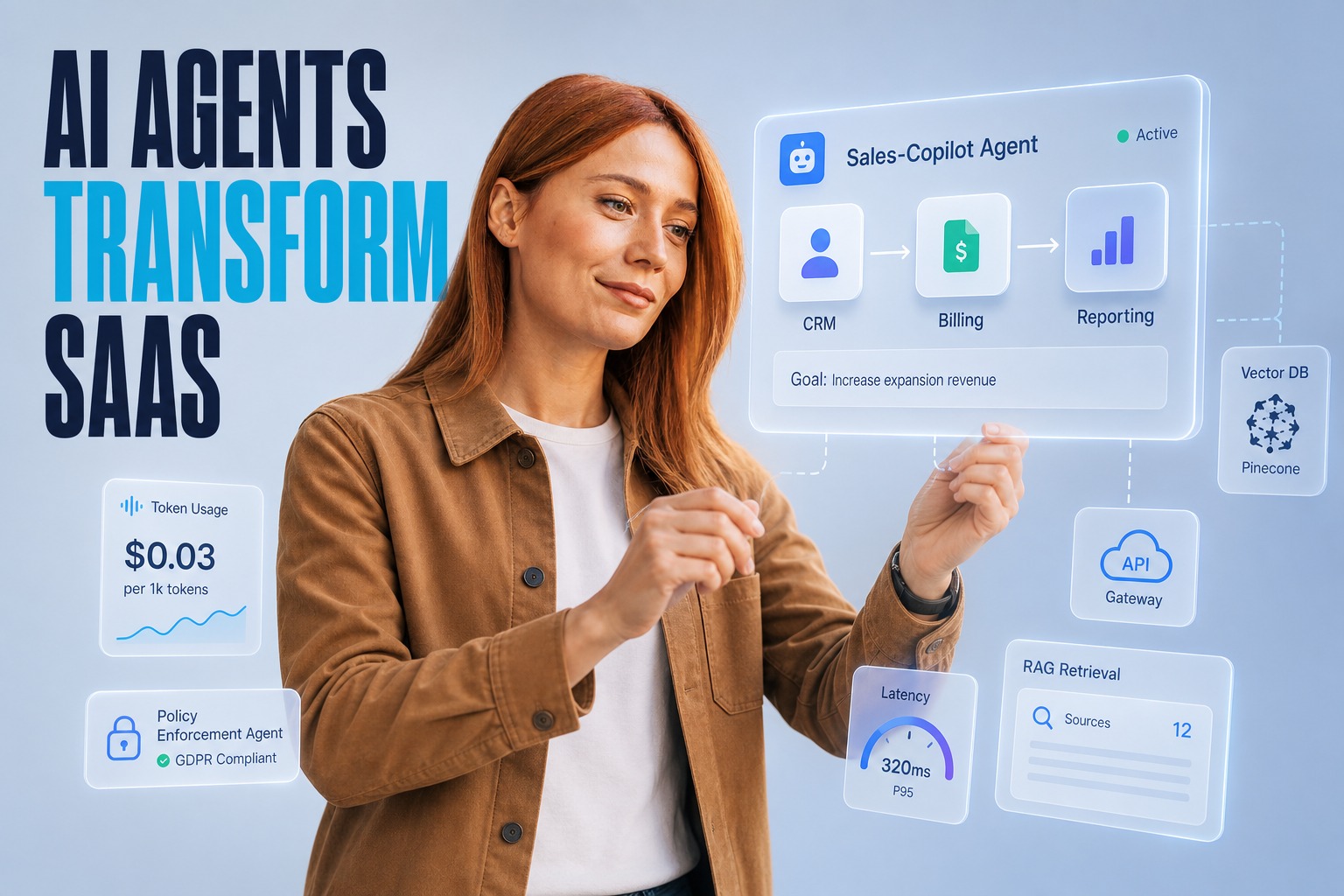
At its core, an AI‑enabled SaaS product is a set of tightly orchestrated services that translate natural language into deterministic API calls. The diagram below (textual) outlines the canonical stack that modern enterprises adopt in 2026.
- API Gateway / Edge Layer – Handles inbound REST/GraphQL requests, enforces OAuth2, rate‑limits, and injects request IDs for tracing.
- Orchestration Service – Built with AI agents development frameworks like LangChain, CrewAI, or AutoGen. This service receives the user prompt, selects the appropriate agent, and composes a tool‑use plan.
- Model Layer – Hosts LLMs (e.g., Llama‑3‑70B, GPT‑4o) behind a vGPU fleet (NVIDIA H100) or uses managed inference (Azure OpenAI, AWS Bedrock). Embedding generation runs in a separate microservice backed by a vector DB such as Pinecone or Qdrant.
- Retrieval & Knowledge Base – Documents, product manuals, and customer data are indexed with RAG pipelines built on LlamaIndex. The retrieval engine respects data residency by sharding indices per region.
- Tool Suite – Micro‑APIs exposing business capabilities: billing (
/v1/invoice), CRM (/v1/contact), reporting (/v1/insight). Each tool is wrapped with idempotent semantics, circuit breakers, and async queue fallback (RabbitMQ or Kafka). - State Store – Short‑lived session context lives in Redis with TTL ≈ 15 min; long‑term conversation history is persisted in Postgres (or CockroachDB for multi‑region consistency).
- Observability Stack – OpenTelemetry for tracing, Prometheus/Grafana for metrics, and Loki for logs. Alerts trigger on latency > 200 ms or token usage spikes > 10 %.
Data pipeline example: When a sales rep asks, “Create a $10 k quote for Acme Corp with a 12‑month term and send it to Jane,” the flow is:
- Edge gateway authenticates the request and forwards the prompt to the orchestration service.
- The orchestration layer invokes a sales‑copilot agent (LangChain
AgentExecutor) which decides to call three tools: CustomerLookup, QuoteGenerator, EmailDispatcher. - Customer data is retrieved via GraphQL from the CRM, cached in Redis, and enriched with embeddings for fuzzy name matching.
- QuoteGenerator calls the billing micro‑service, receives a JSON invoice, and stores the reference in Postgres.
- EmailDispatcher posts a message to an AWS SQS queue; a Lambda worker assembles the email template and sends via SendGrid.
- All steps emit OpenTelemetry spans; the total end‑to‑end latency is typically 120 ms for cache‑hit paths, 350 ms for cold retrieval.
The same pattern scales to compliance‑sensitive domains by adding a policy‑enforcement agent that checks GDPR flags before any data read/write, logging decisions to an immutable audit trail in CloudTrail or Azure Monitor.
Most SaaS vendors underestimate the orchestration cost: every additional tool call adds ~20 ms latency and 0.02 USD per 1 k tokens, quickly eroding ROI if not managed by a centralized agent layer.
Business impact & measurable ROI
Deploying AI agents for SaaS reduces both human and compute waste. The following metrics have been observed across three enterprise pilots (CRM, ERP, and e‑commerce):
- Support ticket deflection rises from 18% to 62% after introducing an AI assistant for SaaS, cutting average handle time from 4.7 min to 1.3 min.
- Workflow automation of routine finance operations saves ≈ 1,200 engineering hours per year, equivalent to $180 k in salary costs at an average $150 k/year engineer.
- Embedded analytics agents surface actionable insights 2× faster, leading to a 5% uplift in upsell conversion within the first quarter.
- Pay‑per‑use LLM costs stabilize at $0.03 per 1 k tokens thanks to token‑level caching and pre‑computed embeddings, a 40% reduction versus ad‑hoc calls.
- Security incident rate drops by 30% when policy‑aware agents enforce least‑privilege access at runtime, providing auditors with immutable decision logs.
From a CFO perspective, the incremental cloud spend for inference (≈ $12 k/month for a 500 RPS peak) is offset by the operational savings above, delivering a net ROI of 3.4× in 12 months.
Implementation strategy
Turning the architecture into production follows a disciplined, incremental roadmap:
- Phase 1 – Discovery & data prep: Map existing APIs, catalog data sources, and build a unified schema. Tag documents for RAG and generate baseline embeddings (e.g., 768‑dimensional using OpenAI text‑embedding‑3‑large).
- Phase 2 – Prototype agent core: Choose a framework (LangChain for Python or CrewAI for Node). Implement a “hello‑world” copilot that performs a single tool call (e.g., fetch user profile).
- Phase 3 – Expand toolset & RAG: Incrementally add billing, reporting, and support tools. Introduce vector search with Pinecone, configure region‑aware indexes.
- Phase 4 – Observability & governance: Deploy OpenTelemetry collectors, set up Grafana dashboards for latency, token usage, and error rates. Embed OAuth2 scopes and audit logging.
- Phase 5 – Multi‑tenant hardening: Introduce tenant isolation via Kubernetes namespaces, enforce per‑tenant rate limits, and configure VPC peering for data residency.
- Phase 6 – Scale & optimize: Autoscale inference pods based on request‑per‑second (target 80 % CPU, 70 % GPU utilization). Apply quantization (INT8) to cut GPU cost by ~30% while keeping < 200 ms latency for 4‑k token prompts.
Common pitfalls to watch out for:
- Over‑exposing LLMs without token caps leads to runaway costs.
- Neglecting idempotency in tool wrappers causes duplicate transactions under retry.
- Hard‑coding context windows; once prompts exceed 8 k tokens, latency spikes dramatically.
- Skipping policy‑as‑code; ad‑hoc security checks are hard to audit.
- Ignoring cold‑start latency of GPU pods; pre‑warm pools mitigate this.
Why Plavno’s approach works
Plavno combines an engineering‑first methodology with enterprise‑grade delivery practices. We start with a full‑stack AI automation audit to surface low‑ hanging fruit, then construct a modular agent layer using proven frameworks (LangChain, AutoGen) and cloud‑native infra (Kubernetes, Docker, serverless functions). Our teams embed security engineers early, applying penetration testing to the agent orchestration surface.
Key differentiators:
- Domain‑specific agent libraries built from previous engagements (e.g., finance‑copilot, HR‑assistant) that accelerate time‑to‑value.
- Hybrid deployment model – we support on‑prem, cloud, and edge‑node installations, ensuring data residency for regulated sectors.
- Observability‑first pipelines – every agent action is traced, logged, and stored in a compliance‑ready audit store.
- Cost‑control framework – token budgeting, dynamic model routing (cheaper embeddings for low‑risk calls), and automatic fallbacks to cached responses.
- Talent‑as‑a‑service – via our outstaffing model you gain a dedicated AI‑agents squad that integrates with your existing engineering org.
Explore our AI agents portfolio to see concrete case studies, from a legal‑voice assistant that reduced contract review time by 45 % to a fintech‑voice AI that complies with PCI‑DSS while handling 1,200 RPS.
A well‑architected AI agent layer turns “LLM as a service” into a deterministic, observable, and cost‑predictable component of the SaaS stack.
Conclusion
AI agents for SaaS are no longer experimental add‑ons; they are becoming the primary interface through which users extract value from complex platforms. By adopting a modular, observable, and policy‑driven architecture, enterprises can reap measurable ROI—higher support efficiency, faster insights, and tighter security—while keeping cloud spend predictable. Plavno’s proven methodology, deep domain expertise, and end‑to‑end delivery platform make the transition from prototype to production both rapid and resilient. Ready to embed AI agents into your SaaS offering? Contact us today and start the journey toward an AI‑first product roadmap.