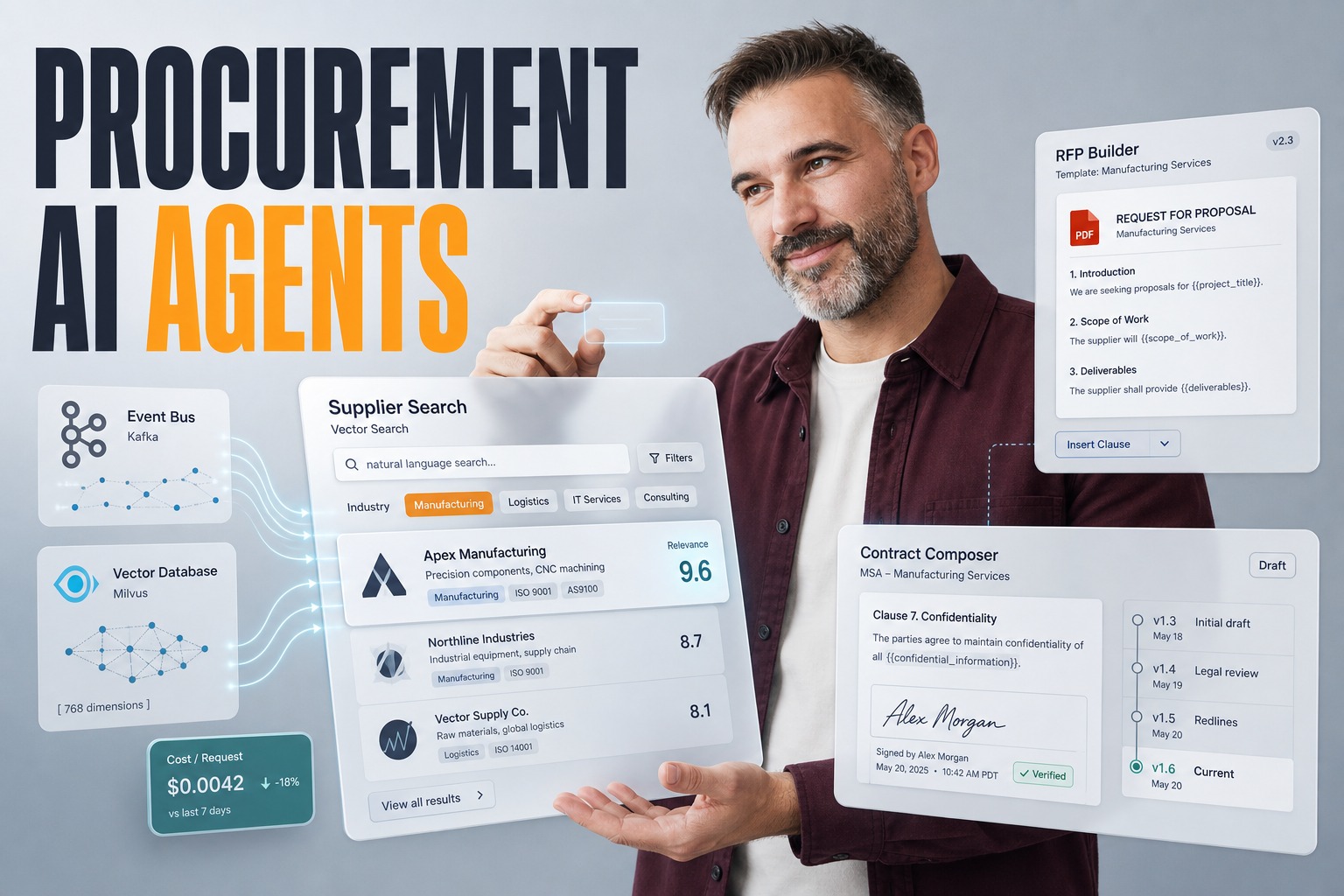
Enterprises lose up to 30% of spend on manual procurement processes, from hunting for suppliers to negotiating contracts, because humans still have to read PDFs, stitch together spreadsheets, and chase email approvals. The cost isn’t just dollars; it’s delayed product launches, compliance risk, and missed market opportunities. Leveraging AI agents for procurement turns those repetitive tasks into fast, auditable services, letting sourcing teams focus on strategy while the platform handles discovery, RFP generation, bid evaluation, and contract orchestration.
Industry challenge & market context
- Fragmented supplier data: dozens of legacy ERPs, external portals, and unstructured PDFs create silos that thwart real‑time intelligence.
- RFP bottleneck: drafting, distributing, and consolidating responses often consumes weeks of analyst time, stretching the procure‑to‑pay cycle.
- Bid comparison paralysis: inconsistent formats and missing clauses force manual cross‑checking, leading to errors and compliance gaps.
- Contract churn: approvals trigger endless email loops; version control is weak, and audit trails are incomplete.
- Legacy automation limits: rule‑based bots can route emails but cannot understand context, negotiate trade‑offs, or adapt to changing policies.
Technical architecture and how AI agents for procurement works in practice
At a high level, an AI‑driven procurement stack composes three layers: data ingestion, intelligent orchestration, and execution/observability. Below is a reference architecture that Plavno has implemented for Fortune‑500 clients.
- API Gateway – Provides a single entry point (REST and GraphQL) for internal tools, ERP systems (SAP, Oracle), and external supplier portals. Handles OAuth2, rate‑limiting, and request validation.
- Orchestration Layer – Built on AI agents development frameworks such as LangChain and CrewAI. This layer schedules workflows, routes tasks to LLMs, and invokes tool‑use plugins (e.g., document fetchers, contract clause libraries).
- Model Layer – Hosts multiple LLMs (open‑source Llama 3 8B for cost‑effective batch jobs, OpenAI gpt‑4‑turbo for high‑stakes negotiations) behind a model router. Retrieval‑Augmented Generation (RAG) uses a vector database (Pinecone or Milvus) populated with supplier catalogs, past contracts, and regulatory clauses.
- Data Store – Normalized relational DB (PostgreSQL) for transactional state (RFQ IDs, approval status) plus a NoSQL cache (Redis) for fast lookup of recent embeddings. Audit logs are streamed to an ELK stack for compliance.
- Message Bus – Kafka topics (e.g.,
supplier.discovery, rfp.submission, contract.signoff) enable event‑driven decoupling and guarantee at‑least‑once delivery. Idempotency keys on each event prevent duplicate processing. - Observability Stack – OpenTelemetry traces flow from the API gateway, through the orchestration engine, into the LLM inference service. Grafana dashboards surface latency (average 120 ms for vector search, 300 ms for LLM response) and cost per request (~$0.004 for gpt‑4‑turbo).
Data pipeline
- Supplier data ingestion runs on a daily schedule via Airflow: connectors pull CSV feeds from SAP Ariba, scrape supplier websites, and parse PDF certificates using Azure Form Recognizer.
- Each document is chunked (≈512 tokens), embedded with
text‑embedding‑3‑large, and upserted into the vector DB. Metadata tags (industry, region, ESG score) enable facet filtering. - When a procurement stakeholder initiates a search, the request hits the API gateway, which validates the user’s OAuth2 token and forwards the query to the orchestration layer.
- The “Supplier Search Agent” calls a Retrieval tool (vector search) to fetch top‑k matches, then runs an LLM chain that scores relevance, compliance risk, and cost‑effectiveness. Results are returned as a ranked JSON payload.
RFP drafting & bid comparison
- Using a template library stored in a Git‑backed document store, the “RFP Builder Agent” assembles sections based on category tags (e.g., hardware, SaaS, professional services).
- Dynamic clauses are pulled from a Knowledge Graph that encodes legal constraints (GDPR, ISO 27001). The agent prompts the LLM to rewrite clauses to match the buyer’s risk appetite.
- Once the RFP PDF is generated, it is uploaded to a secure S3 bucket and a webhook notifies external supplier portals.
- Incoming bids stream into Kafka; a “Bid Analyst Agent” normalizes each response (CSV, JSON, PDF) using Azure Form Recognizer, extracts key metrics, and runs a second LLM pass to map free‑text answers to a structured scoring matrix.
Contract workflow & approval
- When the winning bid is selected, a “Contract Composer Agent” stitches the master agreement with the bid‑specific annexes. Clause versioning is handled by a Git‑LFS repository, ensuring a full audit trail.
- Digital signatures are collected via DocuSign API; each signature event triggers a Kafka message that updates the contract status in PostgreSQL.
- Compliance checks (e.g., anti‑bribery, sanction lists) run as asynchronous micro‑services, returning a pass/fail flag that the orchestration layer propagates to the final approval UI.
Even the most sophisticated procurement teams underestimate the hidden cost of manual data stitching; AI agents can cut that waste by up to 70% while delivering a single source of truth for supplier intelligence.
Business impact & measurable ROI
- Cycle‑time reduction: Supplier discovery drops from 5‑7 days to under 30 minutes; RFP creation shrinks from 2 weeks to 4 hours.
- Spend visibility: Consolidated vector search surfaces 15% of spend on non‑contracted suppliers, enabling renegotiation or consolidation.
- Compliance risk: Automated clause checks lower audit findings by 40% and guarantee GDPR‑ready contracts.
- Operational cost: By offloading 80% of analyst effort to AI agents, labor spend falls by roughly $250 K per year for a $100 M procurement budget.
- Scalability: Event‑driven Kafka pipelines handle 10 k requests/s peak load with sub‑second latency, supporting global enterprise rollouts.
A well‑engineered AI‑agent stack is not a “black box” – it is a composable pipeline where each component (retrieval, LLM, tool use) can be swapped, observed, and billed independently.
Implementation strategy
- Phase 1 – Discovery & data mapping: Inventory all supplier data sources; define schema, tagging taxonomy, and compliance checkpoints.
- Phase 2 – Prototype core agents: Build Supplier Search Agent (LangChain + Milvus) and RFP Builder Agent (CrewAI + Azure Form Recognizer). Deploy on a dev Kubernetes cluster.
- Phase 3 – Integrate with ERP: Expose GraphQL endpoints for purchase requisitions; secure with OAuth2 scopes matching existing SSO.
- Phase 4 – Automate bid ingestion: Connect external portals via webhooks; set up Kafka topics and idempotent consumers.
- Phase 5 – Contract orchestration: Wire DocuSign APIs, embed clause versioning, and activate compliance micro‑services.
- Phase 6 – Observability & governance: Deploy OpenTelemetry agents, configure alert thresholds for latency, cost, and error rates; enforce circuit‑breaker policies on LLM calls.
- Phase 7 – Scale & optimize: Migrate heavy‑weight LLM inference to dedicated GPU nodes or serverless (AWS Lambda with SageMaker endpoint); fine‑tune models on historic RFP and contract data for higher precision.
Common pitfalls
- Skipping a metadata taxonomy leads to noisy retrieval results and higher post‑processing cost.
- Hard‑coding LLM prompts without a version‑control strategy makes future audits painful.
- Relying on sync REST calls for long‑running tasks (e.g., document parsing) blocks threads and inflates latency; async event streams are safer.
- Under‑estimating token limits: feeding full contracts to a LLM exceeds context windows; chunk and summarize before inference.
Why Plavno’s approach works
Plavno combines an engineering‑first mindset with deep procurement domain expertise. Our teams build custom AI agents on top of proven stacks—Kubernetes, Docker, and serverless functions—while ensuring enterprise‑grade security (OAuth2, audit logs, data residency). We leverage the Plavno Nova platform to orchestrate multi‑tenant pipelines, giving a single‑tenant feel without the operational overhead.
Because we treat every component as a replaceable micro‑service, clients can start with an open‑source Llama model and later upgrade to a proprietary LLM without redesigning the workflow. Our software development consultancy embeds AI‑automation best practices—circuit breakers, rate limiting, and observability—right from the first line of code.
We also bring a flexible talent model that scales with your roadmap: outstaffed engineers for core platform work, outsourced specialists for niche tasks (e.g., legal clause knowledge graphs), and dedicated product owners to keep business value front‑and‑center.
Conclusion
AI agents for procurement turn a historically manual, error‑prone function into a rapid, data‑driven service that slashes cycle times, reduces spend leakage, and hardens compliance. By wiring together retrieval‑augmented LLMs, event‑driven pipelines, and secure contract orchestration, enterprises can reap measurable ROI within months. Plavno’s proven architecture, seasoned engineering teams, and end‑to‑end AI automation expertise make the journey predictable and repeatable. Ready to future‑proof your sourcing process? Contact us to start a pilot that delivers a live AI‑agent‑powered procurement workflow in under 12 weeks.