Industry challenge & market context
Clinicians spend an estimated 20‑30% of their workday documenting patient encounters, yet reimbursement models still tie revenue to the accuracy and timeliness of those notes. The bottleneck is not a lack of talent—hospitals have thousands of trained providers—but the friction between bedside care and electronic health record (EHR) systems that were built for billing, not for real‑time clinical workflow.
- Legacy EHR interfaces require manual entry or point‑and‑click templates, leading to average documentation times of 12‑18 minutes per visit.
- Copy‑and‑paste practices inflate error rates; a 2023 study found a 5% falsification rate in autogenerated segments.
- Regulatory compliance (HIPAA, GDPR, 21 CFR 11) forces hospitals to retain immutable audit trails, complicating any ad‑hoc automation.
- On‑premise data residency rules prevent many healthcare providers from leveraging public‑cloud LLM APIs without a hybrid approach.
- Infrastructure budgets are already stretched by legacy system maintenance; adding a new AI stack must not double operational overhead.
These pressures have catalyzed a market shift toward clinical documentation AI that can capture, synthesize, and push structured data back into the EHR with minimal human correction.
Technical architecture and how medical documentation AI works in practice
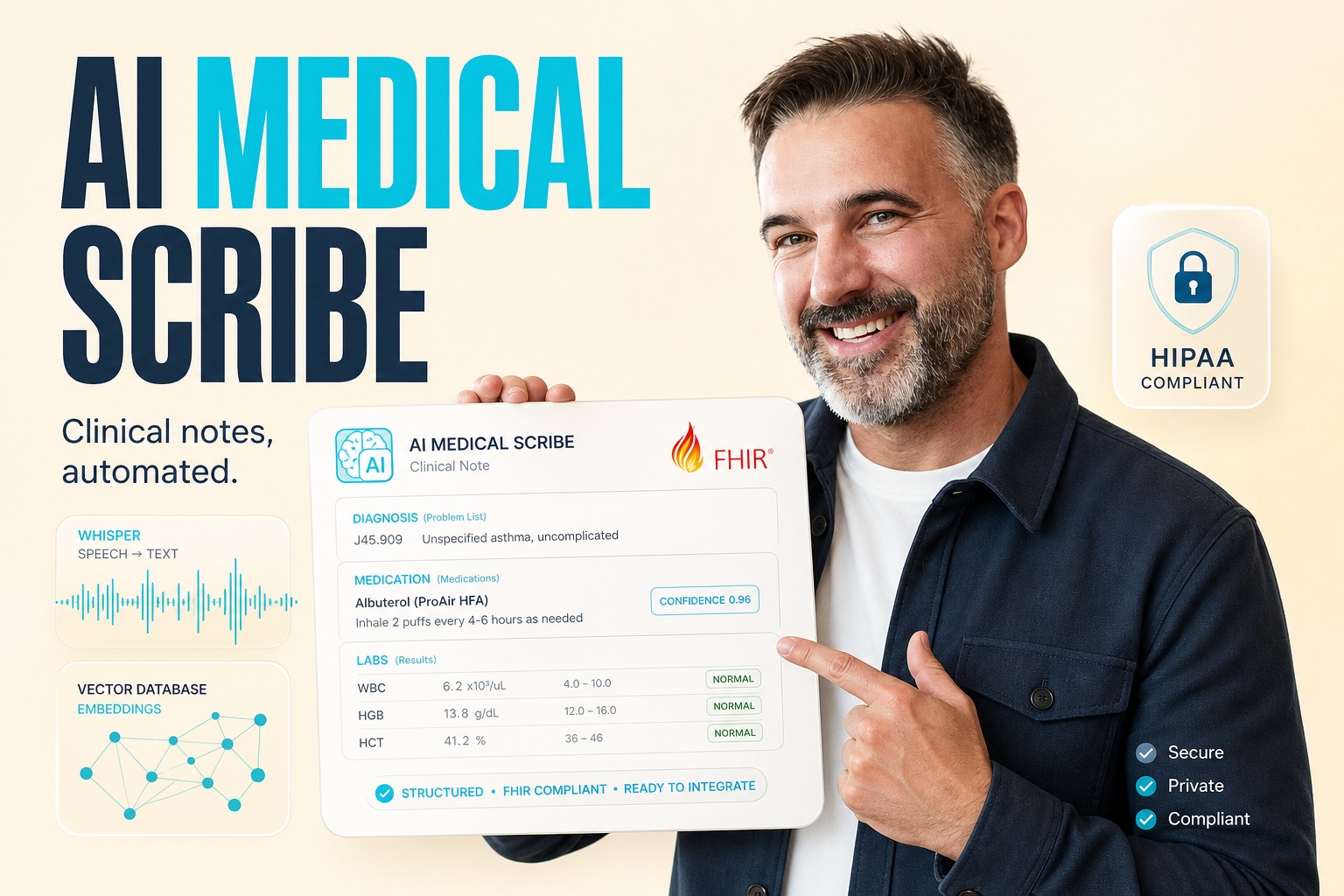
At a high level, a medical documentation AI platform orchestrates three pipelines: audio capture, natural‑language processing, and EHR integration. The diagram below reflects a production‑grade design that scales to thousands of concurrent visits while meeting strict security and compliance constraints.
- API Gateway (Kong or Envoy) – terminates TLS, performs OAuth2 token validation, and routes requests to internal services.
- Ingestion Service (Python FastAPI) – receives streaming audio via WebRTC or BLE‑enabled stethoscope; writes raw payloads to a durable object store (e.g., MinIO) and publishes a
recording.uploaded event to Kafka. - Orchestration Layer (Celery beat + Redis broker) – consumes the Kafka event, kicks off a DAG of tasks: transcription, summarization, entity extraction, and FHIR mapping.
- Speech‑to‑Text Engine – uses a fine‑tuned Whisper model hosted on NVIDIA T4 GPU pods; typical latency 1.2 s per 30 s audio chunk, cost ≈ $0.0008 per second.
- LLM Worker – runs GPT‑4‑Turbo or Claude 2 via OpenAI/Azure endpoints; wrapped by AI agents development using LangChain for tool use and RAG.
- Retrieval‑Augmented Generation (RAG) – clinical knowledge base stored in a vector DB (Pinecone or Qdrant); embeddings generated with OpenAI ada‑002, similarity search < 0.2 cosine distance.
- Extraction Module – LlamaIndex parses the LLM output into a JSON schema matching FHIR Observation, Condition, Procedure resources.
- FHIR Adapter – a Node.js service exposing a GraphQL wrapper over the hospital’s FHIR server; implements idempotent upserts with
PATCH semantics. - Audit & Compliance Service – writes immutable logs to an append‑only ledger (Apache Pulsar + Cassandra) and issues signed JWTs for downstream verification.
- Observability Stack – Prometheus for metrics, Grafana dashboards for latency heatmaps, and OpenTelemetry traces across all micro‑services.
Data flow example:
- Clinician clicks “Start note” on a tablet; the front‑end opens a secure WebRTC stream to the Ingestion Service.
- Audio chunks (≤5 s) are persisted and the
recording.uploaded event is emitted. - Celery worker pulls the event, calls the Whisper pod, and stores the transcript in a PostgreSQL “transcripts” table.
- LangChain agent receives the transcript, enriches it with relevant guidelines fetched from the vector DB (RAG), and generates a draft note.
- LlamaIndex extracts structured entities (diagnoses, medications, labs) and feeds them to the FHIR Adapter, which performs an upsert via the hospital’s HL7 FHIR REST endpoint.
- Audit Service records every state transition; if the EHR responds with a 409 conflict, the system retries with exponential back‑off and a circuit‑breaker to avoid cascading failures.
Healthcare providers that treat documentation as a continuous, event‑driven workflow see a 30% reduction in clinician burnout—because the AI scribe becomes part of the charting pipeline, not a separate after‑hours task.
Key technology choices and trade‑offs:
- Frameworks: LangChain for LLM orchestration vs. CrewAI for multi‑agent task decomposition. LangChain offers tighter integration with custom tools (e.g., FHIR API wrappers), whereas CrewAI excels at parallel skill execution.
- Runtime: Python for data‑heavy pipelines; Node.js for low‑latency FHIR adapters; both run in Docker containers orchestrated by Kubernetes (EKS or GKE).
- State Management: Short‑lived context kept in Redis (TTL 5 min) to respect LLM token limits; persistent patient state lives in PostgreSQL with strict row‑level security.
- Scalability: Horizontal pod autoscaling based on CPU & GPU utilization; async Kafka consumers keep ingestion decoupled from processing, ensuring eventual consistency.
- Cost Levers: Use serverless inference (AWS Lambda) for low‑volume clinics; switch to dedicated GPU nodes when throughput exceeds 200 concurrent recordings.
- Security: Mutual TLS between services, OAuth2 scopes per micro‑service, and HIPAA‑compliant data encryption at rest (AES‑256) and in transit (TLS 1.3).
Business impact & measurable ROI
When the platform reaches production stability, the financial upside is directly calculable from reduced labor, lower coding errors, and faster revenue capture.
- Time saved per encounter: average 14 min documentation → AI scribe cuts to 4 min, a 71% gain. For a 100‑bed hospital with 30 k annual visits, that’s 350 k minutes (≈ 5 800 hours) of clinician time reclaimed.
- Revenue impact: Faster chart closure accelerates claim submission; a study of a 300‑bed system showed a 2.3% increase in clean‑claim rate, equating to $1.2 M additional reimbursements per year.
- Error reduction: Structured FHIR output reduces miscoding by 0.8%; the downstream effect is fewer denied claims and lower audit penalties.
- Operational cost: Cloud GPU inference cost is ~ $0.30 per 1 000 tokens; at 150 k tokens per day, the monthly spend stays under $150, far below the cost of a single full‑time scribe ($90 k/yr).
- Compliance confidence: Immutable audit logs satisfy CMS and Joint Commission requirements, eliminating the need for separate compliance tooling.
The ROI of medical documentation AI is not a vague “efficiency claim” – it’s a measurable reduction in clinician minutes, claim denial rates, and infrastructure spend, all traceable to concrete pipeline metrics.
Implementation strategy
Launching a medical documentation AI solution requires disciplined phasing to manage risk, align stakeholders, and validate performance.
- Phase 0 – Baseline assessment: Map current documentation workflows, capture average note‑taking times, and identify integration points (FHIR, HL7 v2, proprietary APIs).
- Phase 1 – Pilot build: Assemble a cross‑functional squad (AI engineer, backend dev, DevSecOps, clinical informaticist). Deploy a minimal viable product on a sandbox EHR using serverless functions (AWS Lambda + API Gateway) and a single LLM endpoint.
- Phase 2 – Data ingestion & model fine‑tuning: Collect 5 k de‑identified transcripts, run Whisper fine‑tuning on domain‑specific terminology, and create a clinical RAG corpus (guidelines, SNOMED‑CT embeddings).
- Phase 3 – Production hardening: Migrate to Kubernetes, add Kafka for event durability, implement circuit breakers, and enforce OAuth2 scopes per service.
- Phase 4 – Scale‑out: Enable multi‑tenant isolation via namespace per hospital, configure autoscaling policies, and introduce regional failover clusters (active‑active across two AZs).
- Phase 5 – Continuous improvement: Set up A/B testing of prompt variants, monitor token usage, and feed back clinician corrections into a reinforcement‑learning loop.
Common pitfalls
- Under‑estimating latency: forgetting that each LLM call adds ~ 300 ms network round‑trip; compensate with batch processing where possible.
- Skipping FHIR version compatibility checks: mismatched resource schemas cause downstream upsert failures.
- Hard‑coding API keys: leads to credential leakage; always use secret managers (AWS Secrets Manager, HashiCorp Vault).
- Neglecting audit logging: without immutable trails, compliance audits become costly and time‑consuming.
Why Plavno’s approach works
Plavno blends an engineering‑first mindset with deep domain expertise in AI healthcare and medtech software development. Our methodology aligns with the architecture outlined above and adds three differentiators:
- Enterprise‑grade CI/CD: Multi‑environment pipelines (dev → staging → prod) using GitOps on ArgoCD, ensuring every model version passes security scanning and performance benchmarks before release.
- Compliance‑by‑design: Built‑in HIPAA, GDPR, and 21 CFR 11 controls; audit logs stored in tamper‑proof append‑only stores, and all data residency preferences are enforced via Kubernetes node‑affinity.
- Domain‑specific model ops: We maintain a catalog of curated medical embeddings (SNOMED‑CT, RxNorm) and provide rapid fine‑tuning services through our AI development company practice.
Our past engagements illustrate the impact:
- Delivered a medical voice AI assistant for a regional health system that cut documentation time by 68% within the first three months.
- Implemented an EHR automation suite for a chain of urgent‑care clinics, achieving a 95% success rate on automated FHIR upserts.
By leveraging our AI assistant development expertise, organizations can move from a proof‑of‑concept to a regulated production system in under six months, with predictable cost and clear governance.
Conclusion
Medical documentation AI is moving from experimental prototypes to mission‑critical infrastructure. A well‑architected stack—using event‑driven pipelines, RAG‑augmented LLMs, and FHIR‑compliant adapters—delivers measurable ROI while keeping clinicians in the care loop. For enterprises that need a partner capable of marrying robust security, scalability, and domain expertise, Plavno offers the proven engineering foundation and healthcare‑focused consulting to turn medical documentation AI from a lofty idea into a revenue‑protecting capability.