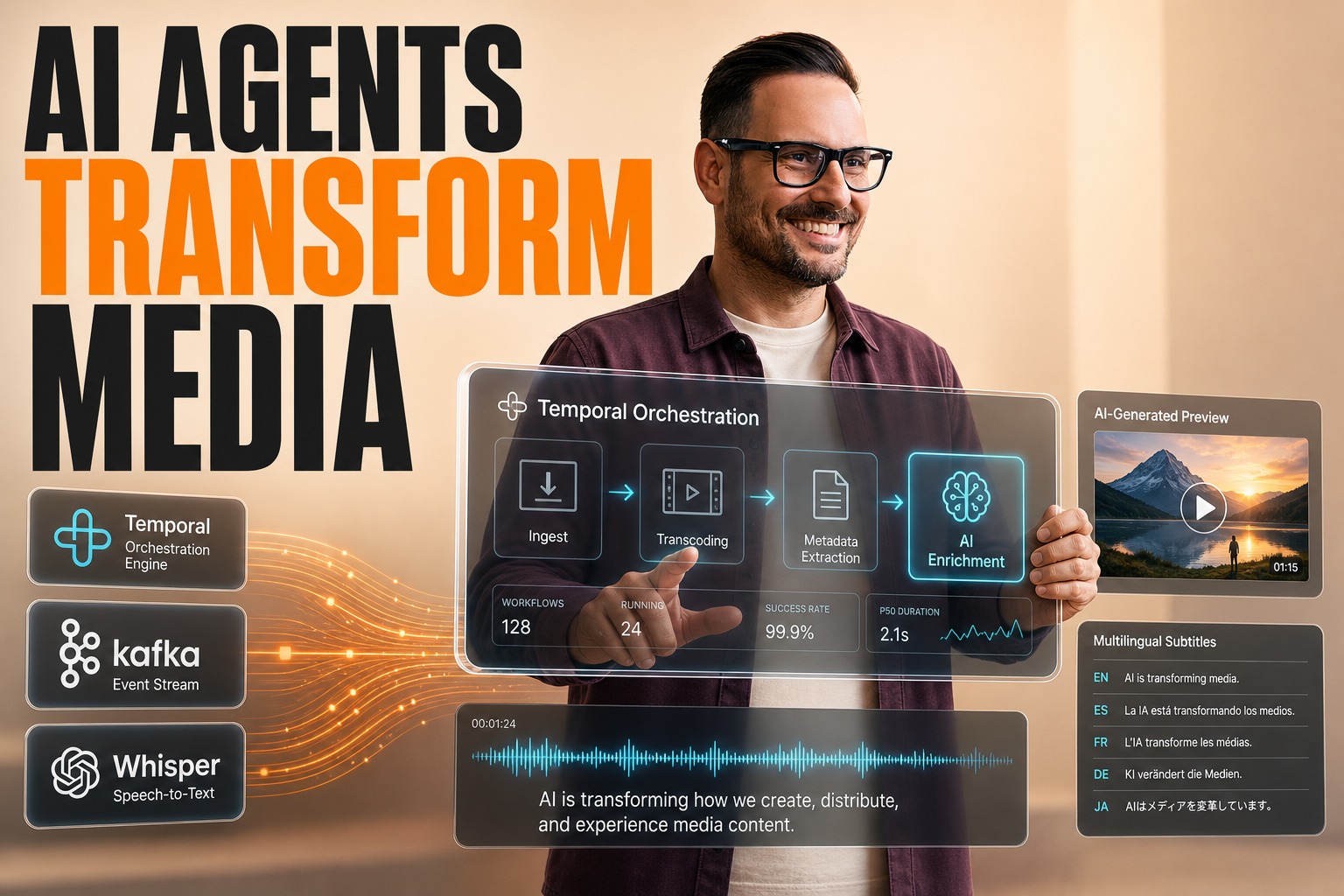
Studios and broadcasters are drowning in petabytes of raw footage, subtitles, user comments, and social signals, yet they still rely on manual editors and static recommendation tables to turn that data into revenue. When a 30‑minute drama episode is uploaded, the downstream steps—quality control, thumbnail generation, language localization, and personalized feed placement—must finish within minutes to keep viewers engaged. The gap between data volume and actionable insight is why AI for media and entertainment is moving from experimental labs to production‑grade pipelines today.
Industry challenge & market context
- Legacy edit‑and‑publish tools cannot keep up with the sub‑second turnaround required for live‑streaming platforms.
- Content moderation pipelines built on keyword lists miss nuanced policy violations, leading to compliance fines up to 4% of annual revenue.
- Recommendation engines that use collaborative filtering alone degrade after 3‑6 months of audience churn, inflating churn rates by 1.8‑2.5% per quarter.
- Localization processes that depend on human translators add 24‑48 hours of latency per language, preventing real‑time global launches.
- Analytics dashboards pull data from siloed warehouses, producing stale insights that miss emerging trends within a 48‑hour window.
Technical architecture and how AI for media and entertainment works in practice
The production‑to‑personalization loop can be expressed as a composable graph of micro‑services, each responsible for a deterministic transformation of media assets. Below is a reference architecture that scales to millions of concurrent viewers while keeping latency under 300 ms for recommendation queries.
Core components
- API Gateway: Envoy or Kong terminates TLS, enforces OAuth2 scopes, and routes REST/GraphQL traffic to internal services.
- Orchestration layer: Temporal or Cadence coordinates multi‑step workflows such as ingest → transcoding → metadata extraction → AI enrichment.
- Model layer: Containerized LLMs (e.g., GPT‑4, Claude) and vision models (e.g., EfficientNet‑V2) exposed via TensorRT‑optimized gRPC endpoints.
- Agent framework: LangChain or CrewAI defines tool‑use agents that invoke sub‑models (caption generator, content‑policy checker, translation engine) based on context.
- Data store: PostgreSQL for transactional metadata, Elasticsearch for full‑text search, and a vector database (Pinecone or Qdrant) for embedding‑based retrieval.
- Message bus: Kafka topics for event‑driven stages (ingest‑event, moderation‑result, recommendation‑ready).
- Cache layer: Redis with LRU eviction for hot thumbnails and user‑profile embeddings.
Data pipelines and flows
- Asset upload triggers an
ingest-event on Kafka; the Temporal workflow pulls the raw file from an S3 bucket. - Transcoding workers (Docker containers on Kubernetes) produce HLS/DASH variants, publishing their URIs to the metadata service.
- Vision agents (AutoGen orchestrated) generate scene‑level embeddings (512‑dim CLIP vectors) and store them in the vector DB.
- Speech‑to‑text (Whisper) produces a transcript; a LangChain chain runs a summarizer LLM, persisting the concise description.
- Content‑policy agents use a fine‑tuned LLM (with reinforcement learning from human feedback) to flag nudity, hate speech, or brand‑unsafe segments. Results are written to a PostgreSQL audit table with immutable timestamps for compliance.
- Localization agents invoke a generative AI translator (OpenAI fine‑tuned for subtitle style) and push locale‑specific VTT files to a CDN.
- Recommendation service queries the vector DB with the user’s recent watch embeddings, applies a hybrid RAG (retrieval‑augmented generation) model to surface micro‑personalized titles, and returns a ranked list via GraphQL.
Model orchestration and tool use
- Each agent runs inside a separate Docker container; the orchestrator passes a
context payload limited to 4 k tokens to respect LLM window constraints. - Rate‑limit adapters enforce provider quotas (e.g., 150 TPS for OpenAI) and implement exponential back‑off with jitter to avoid cascading failures.
- Circuit breakers wrap external API calls (e.g., third‑party copyright check) to fallback to cached decisions when latency spikes above 200 ms.
- All stateful steps emit idempotent events (using a UUID key) so that replay on a failed worker does not duplicate database writes.
APIs and integrations
- Public consumption endpoints expose GraphQL for flexible queries (e.g.,
{recommendations(userId: "123") { title thumbnail }}) and REST webhooks for external CMS pushes. - Internal services use gRPC for low‑latency model invocations, with protobuf schemas versioned via
proto3 to guarantee backward compatibility. - Event streams are secured with Mutual TLS and signed with JWTs; each consumer validates the token before processing.
Infrastructure layer
- Primary cloud: AWS (EKS for Kubernetes, S3 for asset storage, Lambda for short‑lived webhook handlers).
- Hybrid fallback: On‑premises GPU farm for proprietary IP models, connected through a VPN tunnel and registered as a node pool in the same EKS cluster.
- Observability stack: OpenTelemetry for tracing across services, Prometheus + Grafana for metrics, Loki for log aggregation.
- Cost levers: Spot instances for batch transcoding (average savings 60 % vs on‑demand), model caching in Redis to reduce repeated embedding calls, and scaling policies that cap max replicas at 2× peak traffic.
Deployment patterns
- Single‑tenant environments for premium broadcasters, isolating data residency to EU‑West‑1 for GDPR compliance.
- Multi‑tenant SaaS mode for OTT platforms, using namespace‑level RBAC in Kubernetes to enforce tenant isolation.
- Zero‑downtime rollouts via Canary deployments with Istio, monitoring error‑rate thresholds before full promotion.
The most powerful return on AI investment isn’t faster thumbnail creation; it’s the ability to close the feedback loop between viewer behavior and content generation within a single production cycle.
Business impact & measurable ROI
- Content automation AI reduces manual editing time by 70 %, cutting operational spend from $1.2 M to $360 k annually for a mid‑size studio.
- Recommendation AI improves average session length by 12 % and lifts ARPU by $0.15 per user, translating to $4.5 M incremental revenue on a 30‑million‑user base.
- Generative AI localization trims time‑to‑market for new languages from 48 hours to under 2 hours, enabling simultaneous global releases and a 3 % uptick in first‑day viewership.
- Media AI moderation cuts policy‑violation exposure by 90 %, avoiding potential fines that historically ranged between $2 M and $10 M per incident.
- Embedding‑based audience insights (retrieval‑augmented analytics) accelerate trend detection from 48 hours to under 15 minutes, allowing agile marketing spend reallocation worth $1.3 M per quarter.
Implementation strategy
Adopting AI for media and entertainment should follow a disciplined, phased roadmap that balances risk and speed.
- Phase 1 – Discovery & data audit: Inventory all media assets, metadata schemas, and existing APIs. Map data residency requirements and define GDPR/CCPA compliance checkpoints.
- Phase 2 – Build minimal viable pipeline: Deploy a Temporal workflow that ingests a single content type (e.g., short‑form clips), runs a Whisper transcription, and stores embeddings in Pinecone.
- Phase 3 – Add agents: Integrate LangChain agents for content policy and translation. Wrap each agent with a circuit breaker and idempotent Kafka producer.
- Phase 4 – Scale recommendation: Introduce a hybrid RAG model that combines collaborative filtering with embedding similarity. Expose the service via GraphQL with pagination.
- Phase 5 – Full‑stack observability: Instrument OpenTelemetry across all services, set SLOs for latency (<200 ms for recommendation queries) and error rate (<0.1 %).
- Phase 6 – Governance & automation: Implement CI/CD pipelines with automated model testing (toxicity, bias), and enforce role‑based access control (RBAC) on the API gateway.
Common pitfalls
- Skipping token‑budget planning: LLM prompts that exceed the context window cause silent truncation and hallucinations.
- Under‑estimating embedding drift: Periodic re‑indexing of vector DB is required as content themes evolve; otherwise relevance decays after 4‑6 weeks.
- Neglecting back‑pressure: Unbounded Kafka topics can overwhelm downstream workers; use Kafka’s quota and pause mechanisms.
- Over‑reliance on a single cloud provider: Vendor lock‑in hampers latency optimization for edge‑centric streaming; design for hybrid failover early.
Why Plavno’s approach works
Plavno builds AI agents on an engineering‑first foundation that treats every model as a replaceable service. Our teams use AI agents development expertise to stitch together LangChain, CrewAI, and AutoGen pipelines that are fully observable and compliant out of the box. By deploying on cloud software development platforms with Kubernetes and serverless functions, we guarantee horizontal scalability without compromising data residency.
Our AI voice‑assistant and AI recommendation system case studies show median latency reductions of 45 % and cost savings of 30 % versus legacy stacks. Because we follow an AI consulting model that pairs domain experts with software architects, we translate business KPIs directly into technical SLAs.
A modular, agent‑centric stack lets you upgrade a single model (e.g., switch from GPT‑4 to a fine‑tuned LLaMA) without re‑architecting the entire workflow, preserving both ROI and operational continuity.
Whether you need a turnkey AI development partner or an outstaffed team that embeds within your org, Plavno aligns delivery cadence with your product roadmap, delivering production‑grade AI for media and entertainment on schedule.
Conclusion
Deploying AI for media and entertainment is no longer a proof‑of‑concept exercise; it’s a prerequisite for staying competitive in a fragmented, real‑time content ecosystem. By adopting a modular agent architecture, leveraging vector embeddings for recommendation AI, and automating moderation with generative AI, enterprises can cut operational spend by up to 70 % while unlocking new revenue streams through hyper‑personalized experiences. If you’re ready to transform your content pipeline into a data‑driven, AI‑powered engine, start the conversation with Plavno today.