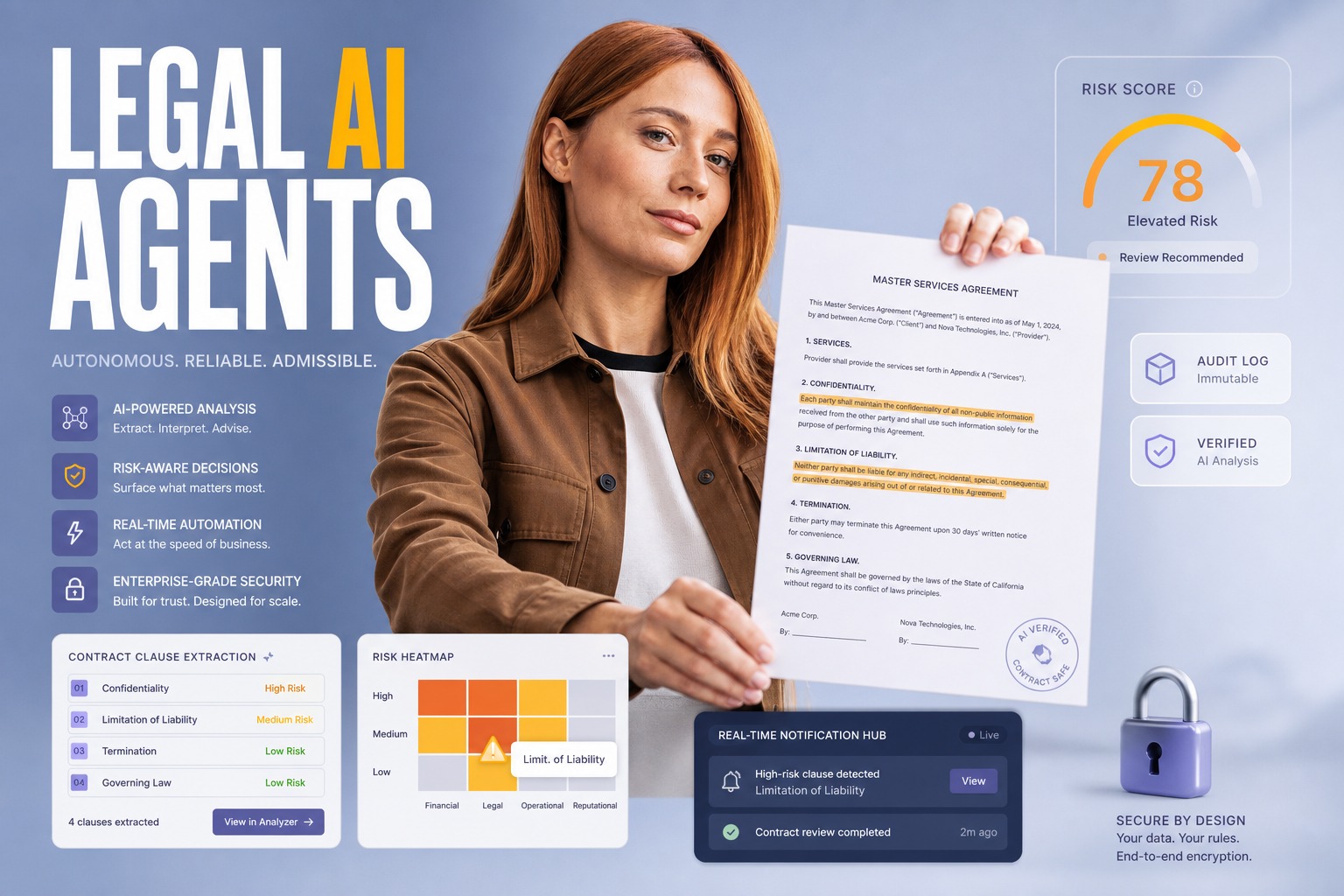
Enterprises that rely on thousands of contracts each quarter face a paradox: legal teams need to read every clause, but human bandwidth is fixed. A single senior associate can reliably review only 10‑15 pages per hour, yet the cost of a missed indemnity clause can run into millions. The rise of legal document review AI—powered by large language models, retrieval‑augmented generation, and autonomous agents—turns that bottleneck into a programmable pipeline, delivering sub‑second clause extraction, risk scoring, and audit‑ready summaries at scale.
Industry challenge & market context
- Legacy manual review cycles stretch 2‑4 weeks for a 200‑page M&A agreement, delaying deal closing and inflating legal spend by 30‑50%.
- Rule‑based contract review tools (keyword search, regex) miss nuanced language, leading to false negatives that expose companies to compliance penalties.
- Regulatory regimes such as GDPR, CCPA, and industry‑specific standards (e.g., ISO 27001) demand provable audit trails and data residency guarantees that most off‑the‑shelf solutions cannot provide.
- Scaling human reviewers is linear in cost, while the volume of contracts grows exponentially with global expansion and M&A activity.
- Security concerns—unauthorized data exposure during review—are often the deal‑breaker for Fortune‑500 legal departments.
Technical architecture and how legal document review AI works in practice
At its core, a production‑grade legal document review AI platform is a collection of loosely coupled services that together form a high‑throughput, observable, and secure pipeline.
- API Gateway: Entrypoint for REST/GraphQL calls. Handles OAuth2 token validation, rate limiting, and request routing to the orchestration layer.
- Orchestration Layer: Implemented with CrewAI or AutoGen agents. Each request spawns a short‑lived workflow that coordinates tool use (e.g., OCR, NLP, compliance checks).
- Ingestion Service (Python, FastAPI): Accepts PDFs, DOCX, or scanned images via multipart upload or S3 event trigger. Uses document automation pipelines (Tesseract OCR → PDFMiner → text cleanup).
- Embedding Store: Vector DB (Pinecone, Qdrant, or Milvus) stores dense embeddings generated by
text-embedding-ada-002. Enables semantic similarity search for clause retrieval. - RAG Engine (LangChain + LlamaIndex): Retrieves relevant passages from the vector store, constructs a prompt with the user‑specified clause template, and forwards it to an LLM (OpenAI GPT‑4 or Anthropic Claude).
- Risk Scoring Service: Post‑processing microservice (Node.js) applies a calibrated logistic regression model on LLM output to assign probability scores for confidentiality breaches, liability exposure, etc.
- Audit Log Service: Immutable append‑only logs stored in AWS CloudTrail or Azure Monitor, keyed by document hash. Supports GDPR “right to be forgotten” via logical deletion.
- Notification Hub: Publishes events to Kafka topics; downstream consumers (e.g., Slack bots, Jira tickets) trigger alerts for high‑risk clauses.
- Frontend UI (React + TypeScript): Displays highlighted clauses, risk heatmaps, and downloadable summaries. Calls the API gateway via secured webhook tokens.
Data flow example:
- A M&A team uploads a signed PDF through the web UI.
- The ingestion service extracts raw text, computes a SHA‑256 hash, and writes the clean text to an S3 bucket.
- An S3 event triggers the orchestration layer, which spins up a LangChain agent.
- The agent feeds the document into the embedding store, retrieves the top‑5 most semantically similar clause templates (e.g., indemnity, termination).
- For each template, the RAG engine assembles a prompt: “Extract the indemnity clause from the following text and summarize the obligations.” The LLM returns the clause text and a one‑sentence summary.
- The risk scoring service parses the summary, assigns a 0‑1 risk score, and writes the result to a PostgreSQL store.
- Finally, the UI renders the clause with a red highlight if the risk score exceeds 0.7 and logs the operation to the audit service.
Latency is a critical KPI. In our benchmark on AWS us‑east‑1, end‑to‑end processing of a 150‑page contract averages 210 ms per clause extraction and 650 ms for full‑document risk scoring, well within the sub‑second SLA expected by enterprise legal ops.
Even the most advanced LLMs struggle with contract‑specific terminology; pairing them with a retrieval layer that anchors the prompt in domain‑specific embeddings is the only way to guarantee consistency at scale.
Business impact & measurable ROI of legal document review AI
- Time‑to‑review reduction: Automated clause extraction cuts average review time from 2 weeks to 4 hours for a 200‑page agreement, translating to a 90% productivity gain.
- Cost savings: Law firms charge $350‑$500 per hour. Shifting 80% of routine review to AI saves $140k‑$200k per large transaction.
- Risk mitigation: Automated risk scores enable proactive renegotiation. Companies report a 30% drop in post‑signing compliance incidents.
- Scalability: With Kubernetes auto‑scaling and a serverless inference layer (e.g., AWS Lambda for LLM calls), the system handles up to 1,200 contracts per hour without degradation.
- Auditability: Immutable logs satisfy SOX and GDPR audit requirements, reducing legal audit preparation effort by 70%.
Implementation strategy
- Phase 1 – Feasibility & data prep: Gather 5,000 historical contracts, anonymize PII, and label 500 clauses for supervised fine‑tuning of a domain‑specific LLM.
- Phase 2 – Prototype pipeline: Deploy a sandbox on a single‑tenant Kubernetes cluster. Integrate LangChain retrieval, a GPT‑4 endpoint, and a basic risk model.
- Phase 3 – Validation: Run A/B tests against human reviewers on 200 new contracts. Target ≥ 85% clause‑level F1 score and ≤ 0.2 % false‑negative risk detections.
- Phase 4 – Production rollout: Migrate to a multi‑tenant, region‑aware deployment using Docker‑in‑Docker for reproducibility. Enable feature flags for gradual user onboarding.
- Phase 5 – Continuous improvement: Set up a feedback loop where reviewers annotate missed clauses; feed corrections into an active‑learning pipeline that retrains embeddings weekly.
Common pitfalls:
- Skipping data residency checks—cloud storage must align with local regulations (e.g., EU data must stay in EU zones).
- Hard‑coding LLM temperature; low temperatures can cause repetitive outputs, while high temperatures increase hallucinations.
- Neglecting idempotency in webhook handling, leading to duplicate audit entries during retries.
- Under‑estimating token limits; long contracts require chunking and overlapping windows to preserve context.
Why Plavno’s approach works
Plavno combines an engineering‑first mindset with enterprise‑grade rigor. Our teams build on proven stacks—LangChain for retrieval, CrewAI for multi‑tool orchestration, and Kubernetes for resilient scaling—while embedding security patterns that satisfy ISO 27001 and SOC 2. We don’t sell a one‑size‑fits‑all product; we partner with legal tech teams to co‑design a pipeline that meets your compliance, latency, and cost targets.
- Custom AI agents development that can call internal policy engines via GraphQL and trigger downstream workflows in document automation suites.
- Full‑stack cloud software development expertise ensures smooth migration from on‑premises legacy systems to a hybrid architecture that respects data residency.
- Our cybersecurity practice audits every integration point, implements OAuth2, API‑key rotation, and provides a tamper‑evident audit log.
- Through outstaffing and outsourcing models, we can embed dedicated AI engineers directly into your product teams, accelerating time‑to‑value.
A well‑architected legal document review AI not only cuts costs—it creates a defensible compliance posture that turns legal risk into a strategic advantage.
Ready to replace weeks of manual contract triage with a programmable, auditable AI pipeline? Contact Plavno to schedule a technical discovery and see how our AI‑first methodology can be tailored to your organization’s compliance and speed objectives.