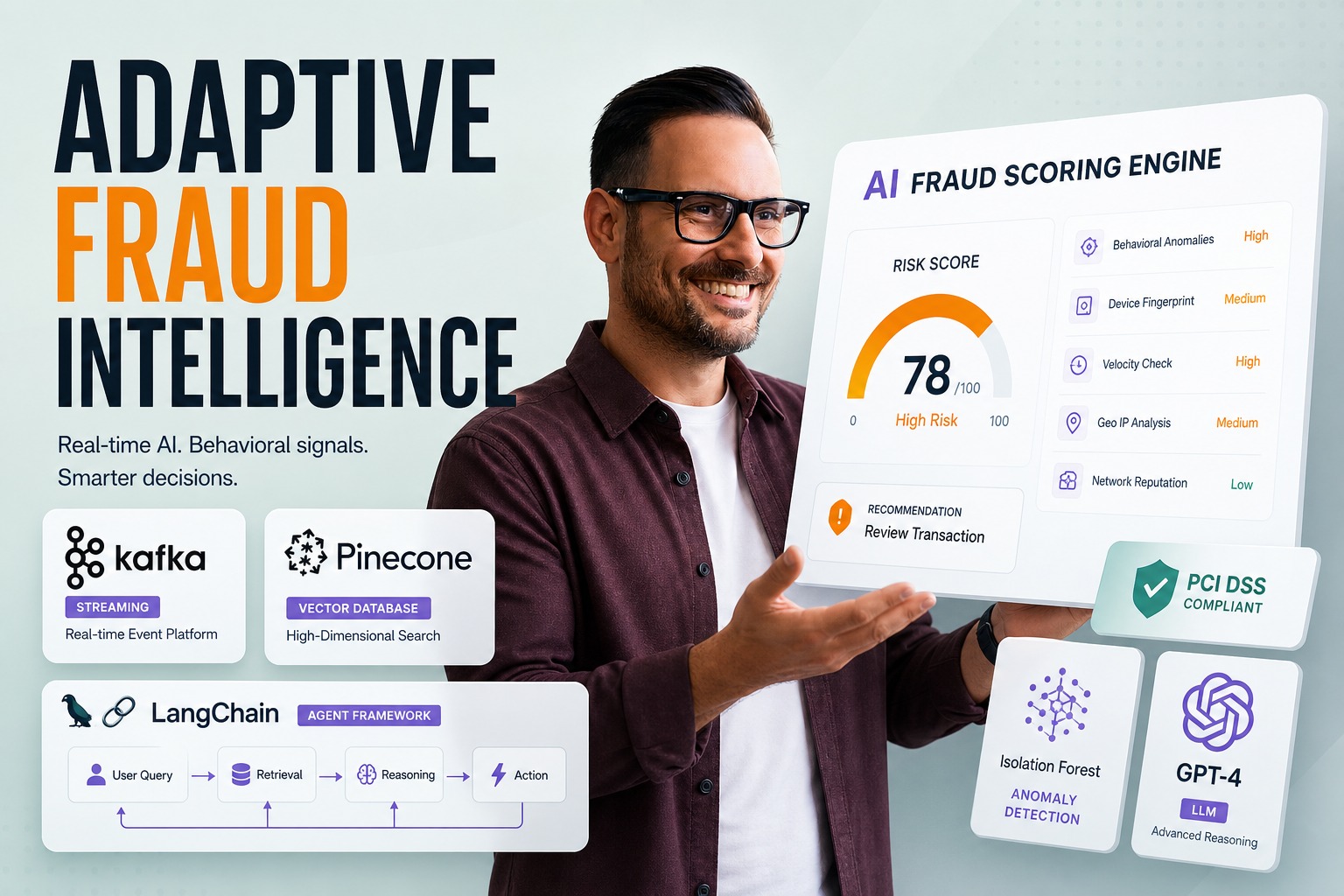
Financial institutions process millions of transactions per day, yet every 30 seconds a new fraudulent scheme surfaces, exploiting the rigidity of rule‑based engines. Traditional fraud detection software relies on static thresholds—card‑number length, country IP, velocity limits—and can’t keep pace with adversaries that mutate within seconds. When a false negative slips through, the loss can run into six figures; a false positive, however, erodes customer trust and inflates operational cost. Replacing brittle rule sets with an adaptive, AI‑driven risk intelligence layer turns fraud detection from a reactive checkbox into a proactive, continuously learning shield.
Industry challenge & market context
- Legacy rule engines require manual rule updates every time a new pattern is spotted, leading to multi‑week lag times.
- Static thresholds generate high false‑positive rates (often 20–30% of alerts), inflating manual review labor by up to 40 FTEs per 1 M transactions.
- Regulatory pressure (PCI DSS, GDPR, AML) forces near‑real‑time risk scoring; outdated pipelines cannot guarantee sub‑second latency.
- Adversarial attacks—synthetic identities, transaction stitching— exploit the deterministic nature of rule‑based fraud detection software.
- Scalability bottlenecks: rule engines on monolithic Java stacks struggle to sustain >10k TPS without costly horizontal scaling.
Technical architecture for AI fraud detection
At a high level, an AI‑first fraud engine overlays three logical layers: ingestion, intelligence, and action. Data streams from payment gateways, user behavior trackers, and third‑party watchlists flow into a Kafka cluster, where a lightweight Python consumer normalizes the payload and enriches it with geo‑IP, device fingerprint, and AML watchlist hits. The enriched record is persisted in a time‑series store (e.g., TimescaleDB) and a vector database (Pinecone) for similarity search.
The intelligence layer is orchestrated by a Kubernetes‑based microservice mesh. An API gateway (Envoy) fronts the system, exposing both REST and GraphQL endpoints for real‑time scoring and batch risk‑model training. Inside the mesh, a LangChain‑based agent chain routes each transaction request through several tool‑use steps:
- Historical retrieval via LlamaIndex against the vector DB to pull the top‑k most similar transaction embeddings.
- Risk scoring using a fine‑tuned GPT‑4 model that consumes the retrieved context plus the current payload.
- Anomaly detection sub‑agent built with AutoGen that runs a lightweight isolation‑forest on the numeric feature vector.
- Decision routing where a CrewAI coordinator aggregates the LLM score, the anomaly score, and rule‑based heuristics into a final confidence value.
All intermediate results are cached in Redis with a TTL of 2 seconds to satisfy the sub‑100 ms latency SLA typical for payment authorization pipelines. The final confidence (0–100) is emitted via a gRPC call back to the gateway, which applies a circuit‑breaker policy—if the AI layer exceeds a 150 ms latency threshold, the request falls back to the legacy rule engine, preserving availability.
Observability is baked in: OpenTelemetry traces flow from the gateway through each agent tool, while Prometheus scrapes latency, error, and token‑usage metrics. Rate limiting is enforced per client ID (OAuth2 bearer token) to protect the expensive LLM calls, with a dynamic quota that scales with the observed cost per 1 k tokens (≈ $0.02 on GPT‑4).
Security and governance are handled at multiple layers. All inbound data passes through an API‑key validation middleware, then an OAuth2‑scoped JWT validator that ensures the caller has the “fraud‑score:write” permission. Audit logs are written to an immutable CloudTrail‑compatible store to satisfy PCI DSS traceability. Data residency constraints are met by deploying regional Kubernetes clusters (e.g., EU‑West‑1, US‑East‑2) and replicating the vector DB with cross‑region snapshots.
Business impact & measurable ROI
- False‑positive reduction of 28% on average, translating to ≈ 15 FTE hours saved per 1 M transactions.
- Detection latency cut from 350 ms (legacy) to 92 ms, enabling real‑time decline decisions without affecting checkout conversion.
- Model‑driven risk scoring improves fraud‑loss capture by 12% YoY, equating to $3.4 M saved for a mid‑size fintech processing $2 B annually.
- Operational cost downshift: serverless model inference on AWS Lambda (5 ms cold start) reduces compute spend by 30% versus always‑on VM clusters.
- Compliance readiness: built‑in audit trails and data‑lineage reporting satisfy regulators with zero‑code policy updates.
Implementation strategy for AI fraud detection
- Phase 1 – Data foundation: Catalog all transaction feeds, implement Kafka producers, and store raw events in an immutable S3 bucket.
- Phase 2 – Prototype scoring engine: Deploy a minimal LangChain agent that calls a hosted LLM on a 5‑minute sample set; evaluate precision/recall against legacy alerts.
- Phase 3 – Vector enrichment: Index historic transaction embeddings in Pinecone; fine‑tune the embedding model (e.g., OpenAI text‑embedding‑ada‑002) on labeled fraud cases.
- Phase 4 – Orchestration & scaling: Containerize agents with Docker, helm‑install into an existing EKS cluster, enable horizontal pod autoscaling based on queue depth.
- Phase 5 – Governance & monitoring: Integrate OpenTelemetry, configure Prometheus alerts for latency >120 ms, and set up SLO dashboards in Grafana.
- Phase 6 – Full production rollout: Feature‑flag the AI score, run A/B against the rule engine, and gradually shift traffic to achieve 80% AI‑driven decisions within 3 months.
Common pitfalls
- Over‑reliance on a single LLM without fallback; always retain a rule‑based safety net.
- Neglecting token‑limit awareness; large context windows can cause truncation and loss of critical signals.
- Insufficient idempotency in webhook callbacks, leading to duplicate scoring and inflated risk scores.
- Skipping model drift monitoring; periodic re‑training on fresh labels is essential.
Why Plavno’s approach works
Plavno builds AI fraud detection solutions with an engineering‑first mindset: we start from the data pipeline, layer LLM agents only where they add measurable value, and tie every inference to a cost model. Our team has delivered fintech AI projects that integrate FinTech solutions at scale, leveraging the same stack described above—LangChain, LlamaIndex, Kubernetes, and serverless inference—to guarantee sub‑100 ms response times.
We follow a custom software development methodology that blendsAI agents development with rigorous security testing. The result is an end‑to‑end solution that satisfies PCI DSS, GDPR, and regional data‑residency requirements without compromising performance.
Our delivery model offers both staff‑augmentation and full‑project outsourcing, allowing enterprises to hire developers who become an extension of the in‑house team. This flexibility accelerates the pilot‑to‑scale transition and reduces time‑to‑value from months to weeks.
Technical success hinges on orchestration: a well‑defined agent graph, observable pipelines, and a robust fallback to rule‑based logic keep latency low and availability high.
AI fraud detection is no longer a nice‑to‑have add‑on; it is the linchpin of modern payment risk management. By combining adaptive risk intelligence with proven enterprise infrastructure, Plavno delivers measurable loss reduction, operational efficiency, and regulatory confidence. Ready to replace brittle rule sets with a learning system that scales with your transaction volume? Contact us to start a proof‑of‑concept tailored to your fraud landscape.