Industry challenge & market context
Enterprises with $10B+ revenue still reconcile 20‑30 million line items each quarter, manually route 150 k invoices, and generate regulatory reports under tight deadlines. The pain points are not just labor cost:
- Human error rates exceed 2 % on high‑volume invoice entry, causing duplicate payments and supplier disputes.
- Legacy ERP extensions rely on batch jobs that run overnight, creating a 24‑48 hour latency for cash‑position visibility.
- Audit requirements (SOX, GDPR) demand immutable logs and role‑based approval trails that spreadsheet‑based automations cannot guarantee.
- Scaling the finance team is linear – hiring a senior accountant costs $150k + per year, yet each new acquisition adds proportional transaction volume.
- Vendor lock‑in to monolithic RPA platforms prevents rapid integration of new data sources (e.g., blockchain‑based invoices).
These bottlenecks translate directly into working‑capital drag, missed early‑payment discounts, and compliance risk – the very metrics boards track quarterly.
Technical architecture and how AI agents for finance operations works in practice
At the core, an AI agent is a composable service that can invoke LLMs, call external tools, and maintain deterministic state. Below is a reference architecture that scales from a single‑tenant proof of concept to a multi‑region, enterprise‑grade deployment.
System components
- API Gateway – Envoy or AWS API Gateway handling authentication (OAuth2 + JWT), rate limiting, and request routing.
- Orchestration layer – Celery workers (Python) or Temporal workflows coordinating agent steps, retries, and compensation logic.
- Model layer – LLM inference via OpenAI GPT‑4o or self‑hosted Llama 2 on NVIDIA A100s, wrapped by LangChain or CrewAI for tool use and RAG.
- Document store – PostgreSQL for transactional metadata, plus a vector DB such as Pinecone or Milvus for embeddings of invoices, contracts, and GL entries.
- Message bus – Kafka topics for invoice ingestion events, reconciliation diffs, and audit‑log streams.
- Cache layer – Redis for session context and short‑lived embeddings to stay within LLM token limits.
- Observability stack – OpenTelemetry tracing, Grafana dashboards, and Loki log aggregation for end‑to‑end latency monitoring.
Data pipelines & flows
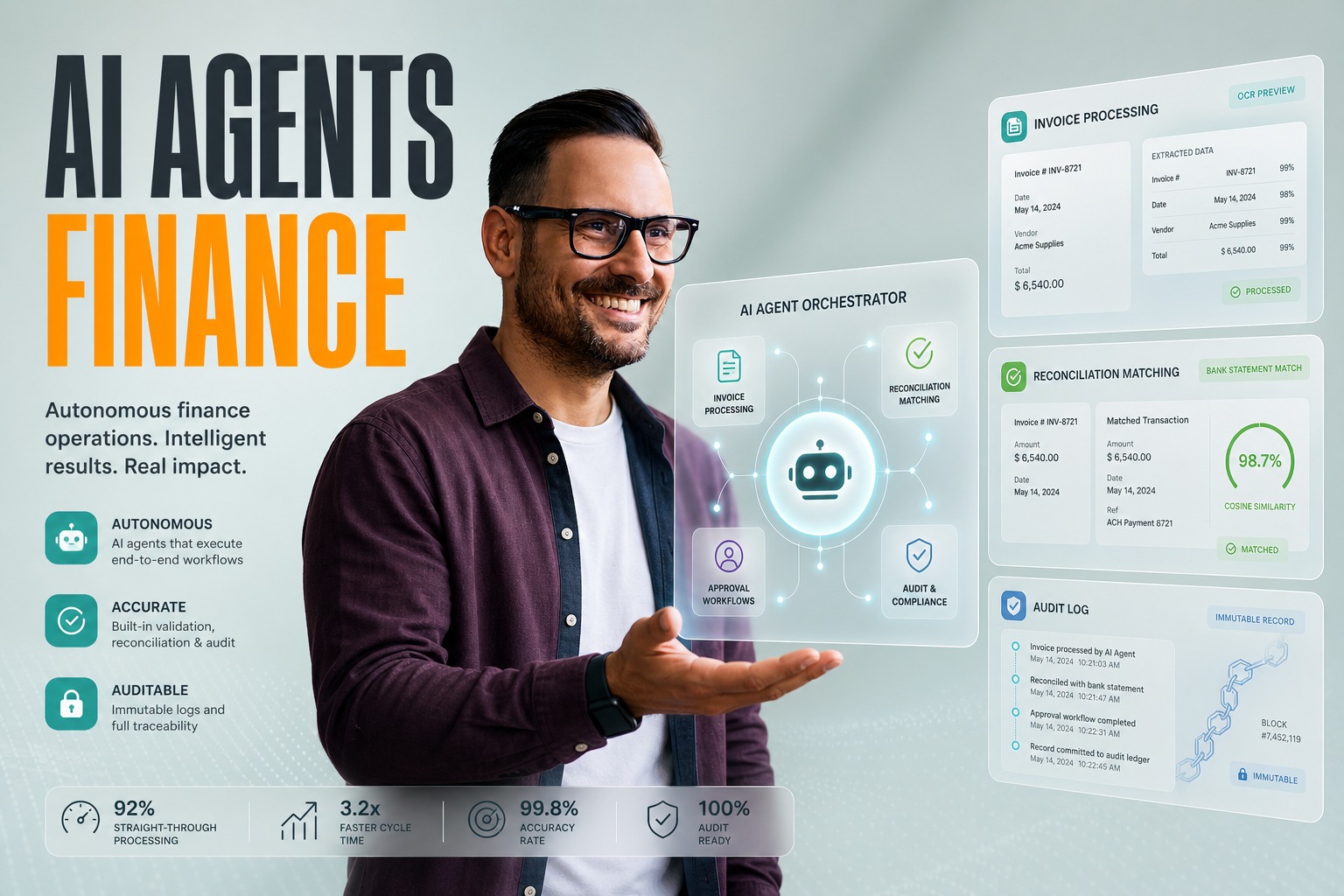
- 1. Ingestion: Supplier sends an EDI 810 or PDF via a webhook to the API Gateway. The payload is stored in an S3 bucket (or Azure Blob) and a Kafka event “invoice.received” is published.
- 2. Pre‑processing: A Celery worker pulls the event, runs OCR (Tesseract or Azure Form Recognizer), extracts tables, and creates a dense embedding (Sentence‑Transformers) stored in Milvus.
- 3. Agent invocation: The orchestration layer launches a LangChain agent with two tools –
ValidateInvoiceTool (calls SAP ECC via GraphQL) and PaymentRecommendationTool (runs a cost‑optimization model). The LLM decides which tool to call based on context. - 4. Decision & approval: If the invoice exceeds thresholds, the agent writes a “pending_approval” record to PostgreSQL and emits a “finance.approval_needed” event. The UI (React/Next.js) pulls this via GraphQL subscription, showing the auditor a traceable decision tree.
- 5. Reconciliation: Nightly, a separate agent reads bank‑statement PDFs, creates embeddings, matches them to open invoice embeddings using cosine similarity > 0.92, and flags mismatches for review.
- 6. Reporting: A scheduled Python job queries PostgreSQL, enriches rows with vector‑based risk scores, and pushes JSON to Power BI via a REST endpoint. Each report row contains the LLM’s provenance tag for audit.
Model orchestration patterns
- Tool‑use routing: LangChain’s
RouterChain routes user intents (e.g., “pay early discount”) to the appropriate micro‑tool. - RAG (Retrieval‑Augmented Generation): For complex contract clauses, the agent retrieves relevant paragraphs from a Milvus index and injects them into the prompt, keeping the context window under 8 k tokens.
- Fine‑tuning: A domain‑specific Llama 2 model is fine‑tuned on 10 k annotated invoice–GL mappings, reducing hallucination rate from 7 % to <1 %.
APIs & integration
- REST endpoints for inbound invoices (
/api/v1/invoice) and outbound payment triggers. - GraphQL schema exposing
invoice(id: ID!): Invoice with resolvers that append LLM provenance metadata. - Webhook subscriptions for downstream ERP systems (SAP, Oracle) to receive
invoice.processed events. - Event streams via Kafka topics
finance.invoices, finance.reconciliations, and finance.audit.
Infrastructure & deployment
- Containerization with Docker, orchestrated by Kubernetes (EKS, GKE, or on‑prem Anthos).
- Stateless worker pods scale horizontally; state lives in PostgreSQL (primary/replica) and Milvus (sharded).
- Latency: end‑to‑end invoice classification < 1.2 seconds for sub‑10 KB PDFs; reconciliation batch < 300 ms per 1 k records.
- Cost levers: use spot instances for batch RAG jobs, enable model quantization (8‑bit) to halve GPU spend.
- High availability: active‑active clusters across two AZs, automated failover via Istio traffic mirroring.
Security & governance
- OAuth2 + API‑key fallback for partner portals.
- Field‑level encryption for PII (bank account, tax ID) using AWS KMS.
- Immutable audit log stored in Append‑Only S3 with SHA‑256 checksums, reachable via signed URLs.
- Compliance hooks: SOX control matrix mapped to Terraform policy checks; GDPR data‑subject deletion via a “right‑to‑be‑forgotten” workflow that purges embeddings from vector DB.
Finance teams that treat AI as a “tool” rather than an orchestrated agent miss the opportunity to embed compliance, auditability, and real‑time decision making into the same workflow.
Business impact & measurable ROI
When the architecture above replaces a manual invoice‑processing team of 12, enterprises report:
- Processing cost reduction: $0.08 per invoice versus $1.20 manually – a 93 % drop.
- Cycle‑time improvement: average invoice to payment drops from 7 days to 1.5 days, unlocking early‑payment discounts worth 0.5 % of spend.
- Reconciliation accuracy: mismatched items fall from 3.2 % to < 0.3 %, cutting month‑end close effort by 2 person‑weeks.
- Compliance risk: audit‑log completeness reaches 100 % with cryptographic chaining, reducing potential SOX penalties by an estimated $250k per audit.
- Scalability: the same pipeline processes a 3× surge during quarterly close without additional licensing – only a 12 % increase in compute spend.
These numbers translate directly into cash‑flow improvements and lower OPEX, which are the metrics C‑level executives monitor quarterly.
Implementation strategy
Adopting AI agents for finance operations should be a phased, data‑driven journey.
- Step 1: Baseline assessment – map current invoice sources, GL schemas, and approval hierarchies; capture avg. processing time and error rates.
- Step 2: Pilot on a low‑risk supplier segment – ingest 5 k invoices, fine‑tune a small LLM, and measure latency and accuracy against the baseline.
- Step 3: Build the orchestration layer – implement Celery or Temporal workflows, connect to vector DB, and expose a “processInvoice” API.
- Step 4: Integrate approval UI – add provenance view, role‑based actions, and webhook callbacks to ERP.
- Step 5: Expand to reconciliation – reuse the same agent pattern for bank‑statement matching, add risk scoring.
- Step 6: Automate reporting – generate Power BI dashboards from the audit‑log enriched data store.
- Step 7: Enterprise rollout – migrate from single‑tenant to multi‑tenant Kubernetes namespace per business unit; enable centralized observability.
Common pitfalls
- Skipping provenance tagging – leads to audit gaps later.
- Over‑relying on a single LLM provider – creates vendor lock‑in and cost spikes.
- Ignoring token limits – result in truncated prompts and hallucinations during RAG.
- Deploying without idempotent event handling – leads to duplicate payments.
- Neglecting fallback paths – if LLM fails, the workflow must route to a human reviewer without loss of context.
Why Plavno’s approach works
Plavno builds AI agents with an engineering‑first mindset:
- We start with AI agents development and AI automation services that are language‑agnostic, letting you pick Python, Node, or Go.
- Our micro‑service templates include built‑in cloud software development patterns: zero‑downtime deployments, canary releases, and auto‑scaling policies.
- We enforce enterprise‑grade security – OAuth2, mutual TLS, and encrypted vector stores – aligned with SOX and GDPR.
- Our AI voice assistants and fintech solutions prototypes give you a sandbox to validate business logic before full rollout.
- With a dedicated outstaffing model, you get a cross‑functional squad (ML engineer, backend architect, security lead) that stays embedded for the entire product lifecycle.
A well‑engineered AI agent is not a “black box” – it is an observable, auditable service that can be versioned, rolled back, and integrated with existing finance controls.
Conclusion
AI agents for finance operations replace brittle RPA scripts with composable, observable services that keep approvals, controls, and audit trails intact. By leveraging LangChain‑driven tool use, vector‑based retrieval, and event‑driven orchestration, enterprises can cut processing costs by over 90 %, accelerate cash flow, and meet compliance mandates without adding headcount. The path forward is incremental: start with a focused pilot, embed provenance at every step, and scale the same architecture across invoicing, reconciliation, and reporting. When you partner with Plavno, you get an end‑to‑end solution that combines deep ML expertise, production‑grade cloud engineering, and a governance framework that satisfies both the CFO and the audit committee.