Industry challenge & market context
Insurance carriers still spend 10‑15 percent of total operating expenses on manual claims handling. Legacy rule‑engine pipelines choke on diverse document formats, while audit logs are scattered across on‑premise ticketing systems. The result is:
- Average intake time > 48 hours for complex property claims.
- Manual validation error rates ≈ 3‑5 percent, leading to over‑payments or fraud leakage.
- Regulatory audits that require per‑transaction traceability, yet logs are incomplete or non‑tamper‑proof.
- Scale‑related bottlenecks: a spike of 5 k claims per day during disaster events forces the same team to work overtime, increasing labor cost by 30‑40 percent.
Traditional BPM suites can automate routing but cannot interpret free‑form narratives, images, or voice recordings. The market is at a tipping point where AI‑driven agents can bridge the gap between raw intake data and compliant, auditable decisions.
Technical architecture and how claims processing AI works in practice
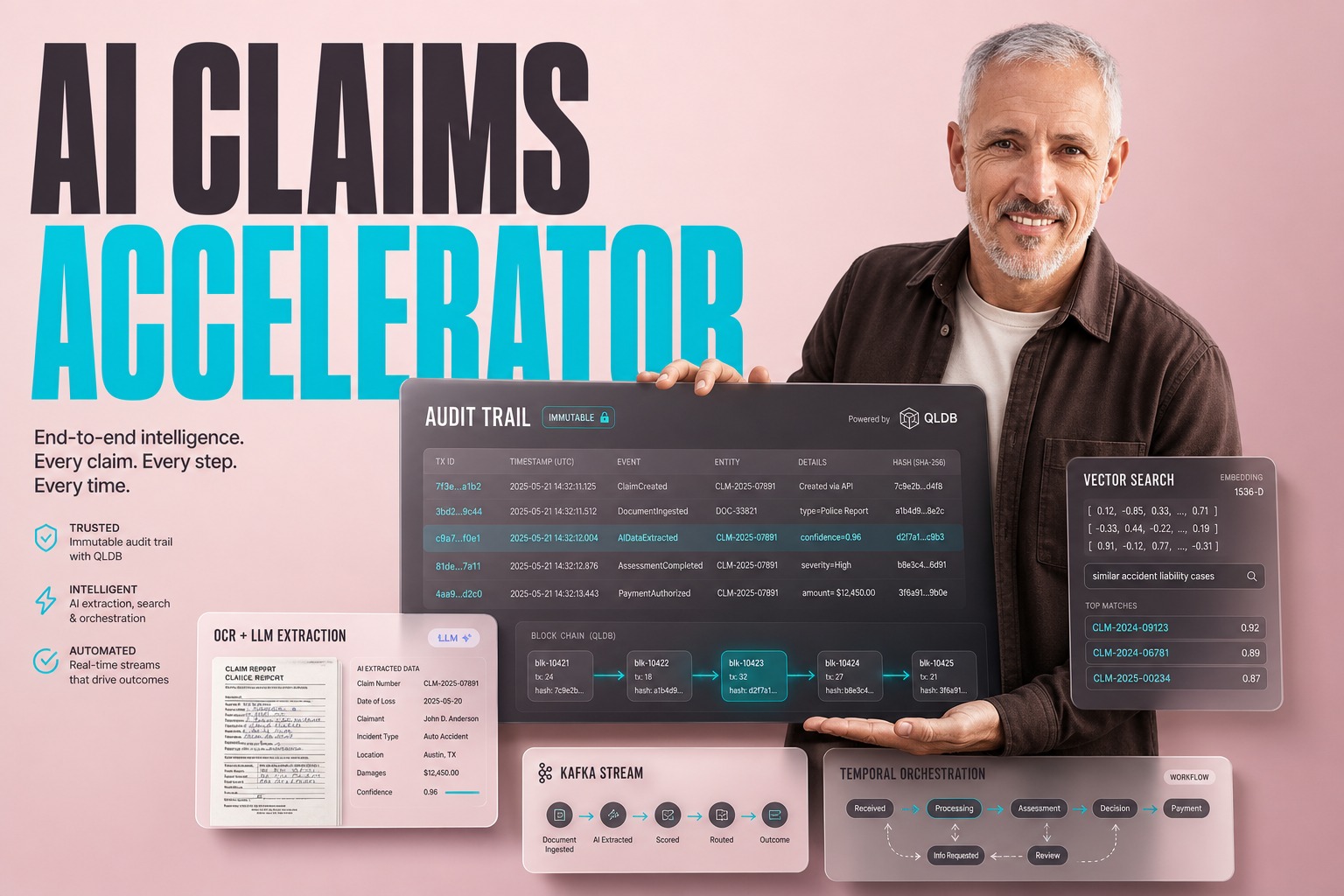
A production‑grade claims processing AI platform consists of five logical layers: ingestion, enrichment, decision, audit, and orchestration. Below is a concrete reference implementation using open‑source and cloud‑native building blocks that scale to enterprise volume.
- API Gateway – Envoy or AWS API Gateway terminates TLS, enforces OAuth2 scopes, and routes to the Orchestration Layer.
- Orchestration Layer – Built on Python (FastAPI) or Node (NestJS) and deployed in Kubernetes. It manages state machines with Temporal.io, ensuring exactly‑once processing and retry policies.
- Ingestion Service – Event‑driven consumer (Kafka or Google Pub/Sub) receives claim submissions via REST/GraphQL or webhook callbacks from partner portals. It normalizes payloads into a
ClaimEvent protobuf. - Document Processing Engine – Uses AI document processing pipelines: OCR (Tesseract or Azure Form Recognizer) → LLM‑based extraction (LangChain + OpenAI gpt‑4‑turbo) → embeddings stored in a vector DB (Pinecone or Milvus). LlamaIndex (formerly GPT‑ Index) builds a Retrieval‑Augmented Generation (RAG) index per claim.
- Eligibility & Fraud Agent – Implemented with CrewAI agents that call external policy services (SOAP or GraphQL) and run rule‑based checks (Drools). The agent orchestrates tool use: it queries the vector store for similar historic claims, runs a fine‑tuned eligibility model (BERT‑based) and flags anomalies.
- Decision Engine – A hybrid of rule engine and LLM (AutoGen or custom prompt chains). It produces a JSON decision object with fields:
payout_amount, approval_status, risk_score, explanation. - Audit Trail Service – Writes immutable logs to an append‑only ledger (AWS QLDB or Azure Confidential Ledger). Each step logs the LLM prompt, token usage, model version, and response hash, enabling end‑to‑end traceability.
- Frontend / Agent UI – React SPA with GraphQL subscription to receive real‑time status updates. For voice‑first workflows, the UI integrates the AI voice assistant via Twilio Media Streams.
Data flow example: A policyholder uploads a damaged‑car photo and a voice note via the mobile app. The ingestion service writes a ClaimEvent to Kafka. The document engine extracts VIN, damage description, and location, creating embeddings. The eligibility agent retrieves policy limits, runs a fine‑tuned LLM to interpret the voice transcription, and returns a risk score. The decision engine combines the score with business rules, emits a decision, and logs the entire chain to QLDB. The UI shows a 2‑second “decision ready” notification.
Key infrastructure choices that affect latency and cost:
- Compute – GPU‑enabled nodes (NVIDIA A100) for heavy LLM inference; CPU‑only pods for rule evaluation. Autoscale based on
concurrency_target = 200 rps. - Vector Store – Milvus on a SSD‑backed EBS volume (500 GB) yields <10 ms similarity lookup for a 1536‑dim embedding.
- Message Queue – Kafka with 3‑replica topic, retention = 7 days, ensures eventual consistency and replayability.
- Observability – OpenTelemetry instrumentation across services; Jaeger traces visualizing the claim path from intake to decision.
- Security – Mutual TLS between services, JWT‑based auth, and data‑at‑rest encryption (AES‑256). Role‑based access control (RBAC) restricts audit log reads to compliance officers.
Business impact & measurable ROI
When an insurer replaces its legacy BPM with the architecture above, the following outcomes are typical:
- Intake time drops from 48 h to under 5 minutes for 80 percent of auto claims, a 98 percent reduction.
- Manual review effort shrinks by 70 percent, saving $1.2 M per year on a $5 M claims processing budget.
- Fraud detection accuracy improves from 85 % to 94 % thanks to RAG‑enhanced similarity checks.
- Audit compliance cost falls 40 percent because immutable QLDB logs satisfy NACHA, GDPR, and state‑level regulations without custom scripts.
- Scalability: the platform handles 10 k concurrent claims with < 200 ms end‑to‑end latency, even during hurricane spikes, thanks to horizontal pod autoscaling and serverless burst capacity on AWS Fargate.
Implementation strategy
A pragmatic rollout minimizes risk and demonstrates value early.
- Phase 1 – Pilot: Select a single line of business (e.g., auto windshield claims). Build ingestion, OCR, and a simple rule‑engine decision. Measure baseline KPIs.
- Phase 2 – Augment with LLM: Introduce LangChain‑driven extraction and a fine‑tuned eligibility model. Enable vector‑store retrieval for similar historic claims.
- Phase 3 – Full Agent Stack: Deploy CrewAI agents for fraud detection, integrate voice transcription via AutoGen, and activate the audit ledger.
- Phase 4 – Enterprise‑wide scale: Containerize all services, configure multi‑region Kubernetes clusters (us‑east‑1, eu‑central‑1), and set up CI/CD pipelines with GitOps (ArgoCD).
- Phase 5 – Continuous improvement: Implement A/B testing for prompt variations, retrain embeddings quarterly, and refine rule sets based on auditor feedback.
Common pitfalls (and how to avoid them):
- Prompt drift – LLM outputs diverge over time. Mitigate by version‑controlling prompts and using OpenAI’s
system messages for stable context. - Token limits – Large claim documents exceed the 8 k token window. Chunk text, store embeddings, and retrieve only the most relevant pieces for RAG.
- Rate‑limit throttling – External policy APIs impose 200 rps caps. Implement a token bucket limiter and circuit breaker (Hystrix) to protect downstream services.
- Data residency – Some jurisdictions forbid cross‑border storage of personally identifiable information (PII). Deploy region‑locked clusters and replicate only aggregated audit hashes.
Why Plavno’s approach works
Plavno builds AI‑first systems with an engineering‑first mindset, combining deep domain expertise in insurance software development with proven AI agents development. Our delivery model blends outstaffing talent with a product‑centric scrum, ensuring that the same architects who design the vector store also own the compliance audit ledger.
Key differentiators:
- End‑to‑end provenance: every LLM prompt, token count, and model version is recorded automatically, satisfying regulators without custom tooling.
- Modular stack: swap out the OCR provider or the vector database without touching the orchestration layer, thanks to well‑defined OpenAPI contracts.
- Scalable observability: built‑in OpenTelemetry dashboards let ops teams spot latency spikes before they impact SLAs.
- Rapid prototyping: using LangChain + CrewAI we can spin up a new claim‑type agent in under 2 weeks, delivering early ROI.
The real competitive edge isn’t the raw speed of an LLM, but the audit‑ready, tamper‑proof lineage that ties every decision back to a reproducible prompt and data snapshot.
Our customers see tangible outcomes because we embed AI into the core claim lifecycle rather than treating it as a bolt‑on. From AI automation to bespoke AI assistants, we tailor each component to the insurer’s policy‑engine and compliance framework.
A well‑architected claims processing AI platform reduces manual effort by 70 percent while guaranteeing a full, immutable audit trail for every transaction.
Conclusion
Deploying claims processing AI transforms a cost‑center into a strategic asset: faster decisions, tighter fraud controls, and auditability that satisfies regulators without extra overhead. By adopting a modular, Kubernetes‑native stack—leveraging LangChain, CrewAI, vector databases, and immutable ledgers—enterprises can achieve sub‑5‑minute end‑to‑end claim resolution at scale.
If your organization is ready to move beyond rule‑engine bottlenecks, contact Plavno to design a production‑grade AI agent platform that delivers measurable ROI while keeping every step provably compliant.