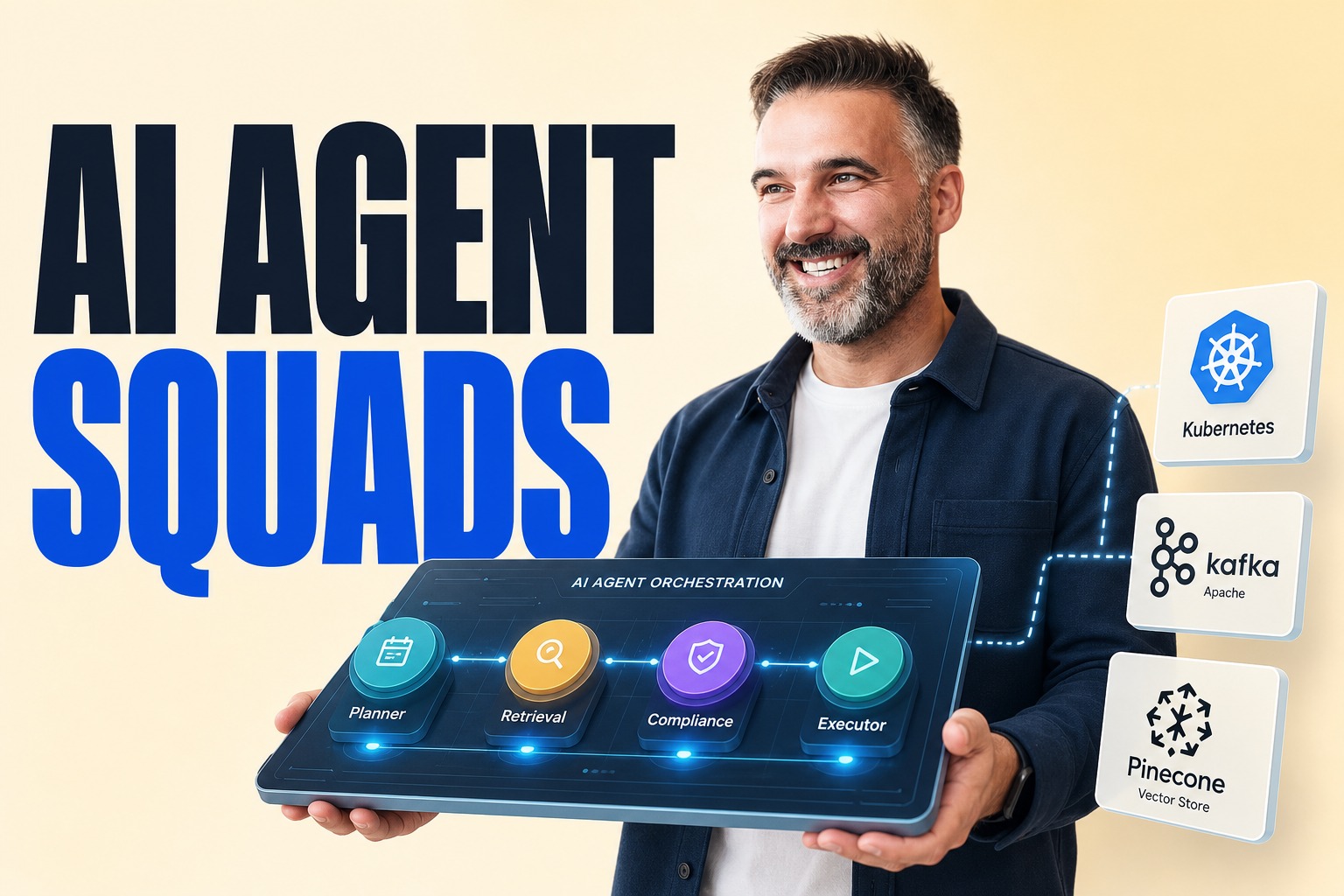
Agent Squads: Why Enterprises Are Moving from Single Agents to Coordinated Teams of Agents
Agent Squads: Why Enterprises Are Moving from Single Agents to Coordinated Teams of Agents
August 20, 2026· min read·#AI#Tech·Reviewed by Plavno AI Engineering Team
Enterprises shift from single LLM agents to coordinated multi‑agent squads to overcome token limits, latency, and fragile integrations.
Share this post
Enterprises that once automated a single decision point with a lone LLM now watch that agent choke on token limits, latency spikes, and fragile tool integrations—especially when the workflow spans supply‑chain orchestration, returns processing, and R&D experimentation. The remedy is not a bigger model but a squad of coordinated AI agents, each purpose‑built to own a slice of the problem while a supervisory layer stitches the results together.
Industry challenge & market context
Single‑agent bottlenecks: context overflow, token‑budget exhaustion, and inability to parallelise high‑volume event streams.
Legacy orchestration: ad‑hoc scripts, brittle RPA, and manual hand‑offs that explode as transaction volume grows (e.g., 1 M+ SKU updates per day).
Risk profile: silent failures cascade, audit trails are incomplete, and compliance teams cannot trace decisions back to source data.
Performance ceiling: latency jumps from sub‑second to >5 seconds when the same agent must query ERP, render embeddings, and call external APIs sequentially.
QUICK ANSWER
Enterprises adopt multi‑agent squads because they isolate context, enable parallel tool use, and reduce end‑to‑end latency from several seconds to sub‑second for high‑throughput workflows, delivering up to 70% faster response times.
Technical architecture and how multi-agent squads enterprise works in practice
At the core of a multi‑agent squad is a supervisory orchestration layer that routes requests, maintains global state, and enforces policies. The typical stack for an enterprise‑grade deployment looks like this:
API Gateway – Envoy or Amazon API Gateway exposing a unified /v1/execute endpoint (REST or GraphQL).
Orchestration Service – A Python (FastAPI) or Node.js (Nest) microservice that runs the squad manager. It stores transient workflow state in Redis (TTL‑based) and persists audit trails in PostgreSQL.
Agent Pool – Containerised LLM workers (e.g., LangChain‑based agents) running on Kubernetes pods behind a Horizontal Pod Autoscaler. Each pod hosts a single specialized agent (planning, data retrieval, compliance check, execution).
Tool Interfaces – gRPC or HTTP wrappers around ERP, WMS, CRM, and external SaaS (e.g., Snowflake, ServiceNow). Each tool call is declared idempotent and wrapped with a circuit‑breaker (Polly‑style).
Vector Store – Pinecone or Milvus holds embeddings for RAG (retrieval‑augmented generation). The retrieval agent queries the store with a k‑nearest‑neighbors call, bounded to 4 k tokens.
Message Bus – Apache Kafka topics for async events (order_created, return_initiated). Agents subscribe via consumer groups; the orchestration service produces “task‑ready” messages.
Observability Stack – OpenTelemetry tracing, Loki logging, Prometheus metrics; Grafana dashboards expose latency per agent, token‑usage per request, and error rates.
Data flow for a typical supply‑chain use‑case (order fulfilment) follows these steps:
1. Front‑end sends POST /v1/execute with order ID.
2. Orchestrator creates a workflow instance, logs the request, and spawns a Planner Agent (LangChain). The planner decides to invoke a Inventory Retrieval Agent and a Compliance Validator Agent.
3. Retrieval agent queries the vector store for product‑specific SOPs, then calls the WMS API (REST) to get current stock levels.
4. Compliance agent pulls regulatory rules from a PostgreSQL‑backed knowledge base, runs a rule engine (Drools), and returns a Boolean flag.
5. Orchestrator aggregates results, sends a single fulfil‑order command to the ERP via a secured webhook (OAuth2 client‑credentials).
6. A final Notifier Agent composes a customer‑facing email using a templating LLM (GPT‑4o) and posts to an SNS topic.
The orchestration layer enforces idempotency by attaching a UUID to every tool call; retries are handled with exponential back‑off. Token budgeting is done per‑agent: the planner gets a 2 k‑token window, the retrieval agent 1 k, and the LLM response is truncated to fit the downstream consumer.
3‑10×
higher token consumption for comparable tasks when using naïve multi‑agent orchestration
A logistics company deployed AI agents for quoting, shipment tracking, and customer communication, achieving 70% faster response times and a 60% reduction in support tickets. The squad consisted of a pricing agent, a tracker agent, and a communication agent, all orchestrated via Kafka and Kubernetes. See our case studies →
Context pollution is the silent killer of LLM performance; isolating each sub‑task into its own agent restores signal‑to‑noise and often halves the required prompt length.
Beyond the planner‑retriever‑executor pattern, enterprises experiment with swarm‑style coordination (agents broadcast intents on a shared pub/sub channel) and capability‑based routing** (a central router matches a request to the best‑fit agent via a lightweight scoring model). Both patterns demand robust governance: every handoff must be validated, and every token‑expensive call must pass a cost‑threshold check.
A well‑engineered multi‑agent squad reduces end‑to‑end latency from 5 seconds to sub‑second for high‑volume event streams, directly impacting SLA compliance.
Business impact & measurable ROI
Latency reduction: Parallel retrieval and validation cut average order‑processing time from 4.2 s to 0.8 s (≈5× speedup).
Token efficiency: By keeping each sub‑task under 2 k tokens, the per‑transaction cost drops 30% on Azure OpenAI pricing tiers.
Operational resilience: Agent‑level retries and circuit‑breakers reduce failure‑to‑recovery time from minutes to < 5 seconds, achieving 99.95% availability.
Compliance auditability: Centralised state in PostgreSQL enables a full provenance graph; auditors can trace an RMA decision back to the exact policy rule and data snapshot.
Scalability: Kubernetes HPA scales the Retrieval Agent pool from 2 to 200 pods in response to a 10× spike in inbound orders, keeping cost linear (≈$0.12 per 1 M tokens).
Implementation strategy
Step 1 – Define squad boundaries: Map end‑to‑end business processes (e.g., returns) into logical sub‑tasks. Identify required tools and compliance checkpoints.
Step 2 – Prototype with a single orchestrator: Use LangGraph or CrewAI locally to validate the coordination pattern; keep the proof‑of‑concept under a single‑tenant AWS account.
Step 3 – Containerise agents: Wrap each LLM agent in a Docker image with a minimal FastAPI wrapper; push to ECR/ECR‑Public.
Step 4 – Deploy to Kubernetes: Create a Helm chart that provisions the API gateway, orchestration service, Redis, and a StatefulSet for PostgreSQL. Enable auto‑scaling based on custom metrics (tokens per second).
Step 5 – Establish observability and governance: Instrument with OpenTelemetry, enforce OAuth2 scopes, and store every tool call in an immutable audit log (Cassandra or append‑only S3).
Step 6 – Iterate and scale: Gradually migrate additional workflows (e.g., R&D experiment tracking) into the squad model. Conduct end‑to‑end regression tests with a curated set of scenario payloads.
Common pitfalls
Over‑engineering squads with >10 agents before a clear token‑budget analysis – leads to 3‑10× token waste.
Skipping idempotency on side‑effecting tool calls – duplicate inventory updates.
Relying on a single LLM for all agents – context pollution resurfaces under heavy load.
Why Plavno’s approach works
Plavno couples an engineering‑first methodology with an enterprise‑grade orchestration platform built on proven open‑source frameworks (LangChain, AutoGen) and cloud‑native best practices. We start each engagement by mapping business outcomes to concrete agent squads, then hand‑craft a lightweight custom orchestration layer that lives alongside your existing services.
**Domain expertise** – Our team has delivered AI‑agent squads for supply‑chain optimisation, fraud detection, and R&D acceleration across Fortune 500 clients.
**Turnkey infrastructure** – We provision Kubernetes clusters on AWS, Azure, or on‑premises, configure Redis, Postgres, and Kafka with hardened security (IAM roles, mTLS, audit‑ready logging).
**Governance built‑in** – Every squad ships with policy‑as‑code, token‑budget guards, and a provenance dashboard that satisfies SOC 2 and GDPR.
**Rapid iteration** – Using LangGraph’s state machine visualiser, we can prototype a new agent in hours, test it with synthetic data, and roll it out to production with a single helm upgrade.
Our AI agents development service pairs model fine‑tuning (OpenAI, Anthropic) with custom tool wrappers, delivering squads that operate at the speed of your business processes. Whether you need AI assistant development for internal knowledge workers or a voice‑first agent for field technicians, we embed the same orchestration principles.
In summary, moving to multi‑agent squads enterprise equips you with a modular, observable, and fault‑tolerant AI layer that scales with the velocity of modern business processes. The shift eliminates context bottlenecks, opens parallelism, and delivers quantifiable ROI across latency, cost, and compliance dimensions. To start building your own coordinated agent teams, schedule a discovery call with Plavno’s AI architects today.
Share this post
Contact Us
This is what will happen, after you submit form
Plavno experts contact you within 24h
Discuss your project details
We can sign NDA for complete secrecy
Submit a comprehensive project proposal with estimates, timelines, team composition, etc
Need a custom consultation? Ask me!
Plavno has a team of experts ready to start your project. Ask us!