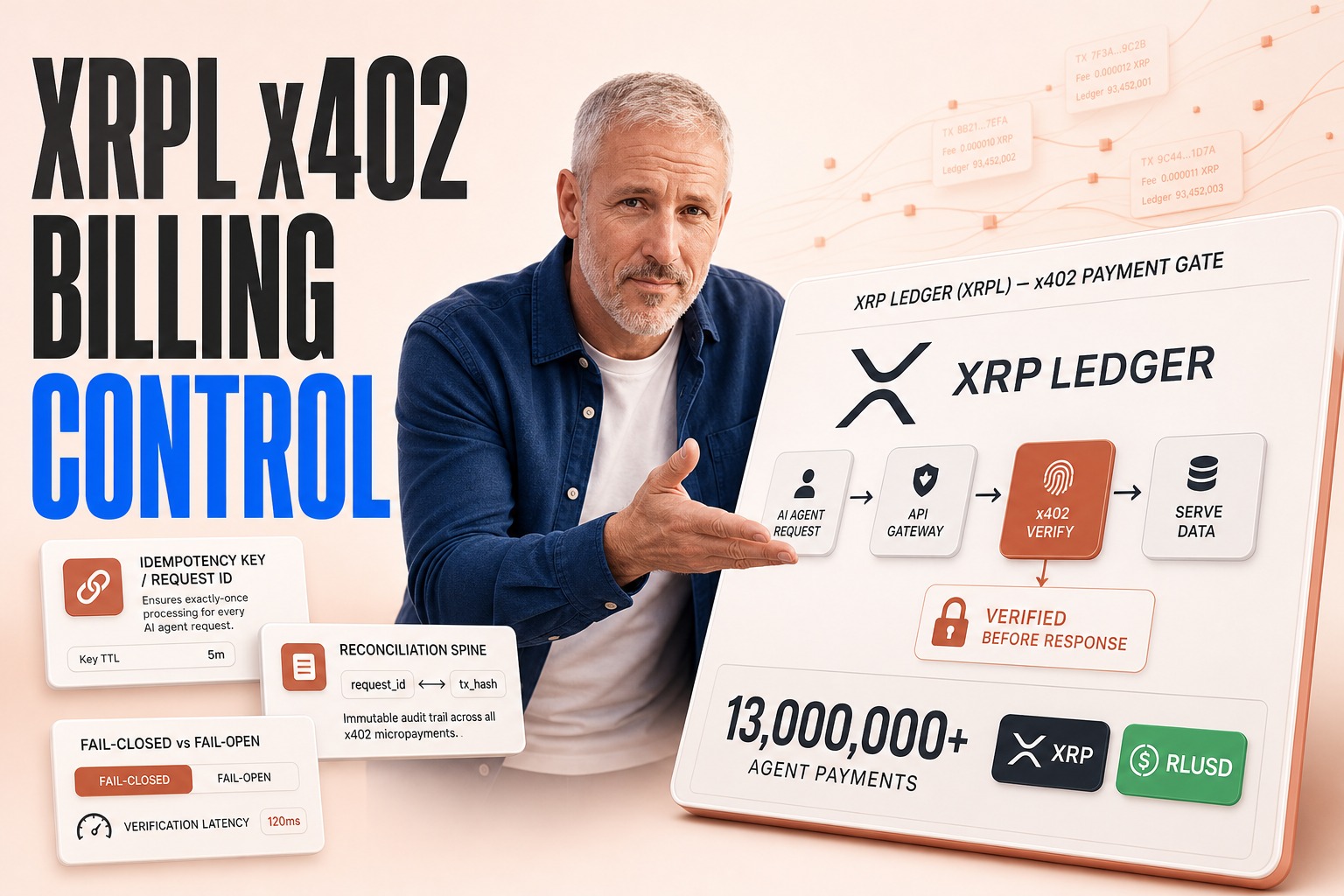
Are AI agents actually generating real payment traffic now, or is this still a lab demo? → On the XRP Ledger, developers are reporting a sharp rise in agent payments, and RippleX’s head of engineering said x402 processed more than 13 million agent payments, roughly 25% of ledger activity.
What’s the real engineering question we need to answer this quarter? → How do we design agent-to-agent payments so our API gateway, authorization, and reconciliation stay reliable when software pays per request without a human checkout flow.
What is the dominant signal behind the headlines? → x402 turns payment into a runtime primitive for software requests, and the network data suggests most of these transactions are tiny, per-request payments rather than large transfers.
Why do CTOs care if the total value transferred is small? → High transaction count with low value implies your bottlenecks move from invoicing to metering, fraud controls, and operational observability at very high request volume.
What’s Plavno’s stance in one line? → x402 is useful, but it will break teams that treat payments as a blockchain integration instead of a gateway-and-ledger system that needs strict authorization, funding strategy, and post-facto dispute handling.
The search question hiding inside x402: should we let agents pay per API call on XRPL?
The primary query we see from engineering leaders is practical: how to implement AI agent micropayments for paid data or services without forcing a user checkout each time, and without turning billing into a reliability incident.
The dominant news signal is the reported jump in AI-agent payments on the XRP Ledger via x402, with RippleX’s head of engineering stating the network processed more than 13 million agent payments through x402, about 25% of ledger activity.
Our central claim is that this shift breaks the common practice of treating billing as an offline system, and the right response is to move payment authorization, metering, and reconciliation into the request path alongside your API gateway.
Model the transaction as part of request authorization, not finance back-office: When software can authorize payment and obtain data once payment is verified, your ‘can this call proceed’ logic must include payment status, not just OAuth scopes or API keys.
Pick a settlement pattern up front: per-request or funded repeat requests: Ripple’s kit first supported per-request behavior (agents creating wallets, checking balances, paying for services in XRP or RLUSD), and later expanded in September to support a standard developed by Stripe and Tempo including a way to fund repeated requests with XRP instead of settling every request individually.
Assume transaction count will exceed value by design: XRPL AI Hub figures show millions of cumulative transactions across registered merchants, while cumulative payments recorded were approximately 6,991 XRP and 12,752 RLUSD, implying a large share of activity is tiny payments for individual requests.
Treat your gateway as the safety boundary: If you only integrate on the ledger side, you will miss the critical controls: rate limiting by funded balance, fail-closed behavior when verification is delayed, and preventing an agent from draining funds on accidental loops.
Build reconciliation and audit as a first-class data pipeline: The moment payments become ‘per request,’ you need a durable join between request IDs, merchant/service identifiers, and verified payments; otherwise you cannot explain revenue, refunds, or anomalies when usage spikes.
Quick Answer: how to adopt XRPL x402 for agent micropayments safely
If we’re implementing XRPL x402 for AI agent micropayments, we should treat payment verification as a request-gating step at the API edge, then pair it with a funding strategy that matches our traffic pattern.
For low-frequency, high-value calls, settling each request can work; for bursty traffic, the September expansion that supports funding repeated requests (using a Stripe-and-Tempo-developed standard) points to a more stable operational model.
Either way, the engineering success criteria are not ‘ledger integration completed,’ but gateway enforcement, idempotent request-to-payment mapping, and reconciliation that survives retries and partial failures.
- Boldly define what ‘verified’ means in your system: x402’s promise is that an agent can authorize payment and obtain data once that payment is verified, but you still have to decide where verification lives (gateway, middleware, or service), what timeouts do, and whether you fail open (risk) or fail closed (availability) when verification lags.
- Boldly restrict spending authority for agents by design: As transactions skew small and frequent, the main risk is not a single large fraudulent payment; it’s an agent that accidentally enters a loop, hits a retry storm, or is prompted into excessive calls, generating a long tail of micropayments.
- Boldly separate ‘wallet management’ from ‘service authorization’: Ripple’s developer tools let agents create wallets and check balances; that is necessary plumbing, but authorization belongs to your service boundary, where you can enforce policy tied to merchant IDs, products, and per-request cost semantics.
- Boldly insist on a single join key across payment and request telemetry: If you cannot connect a given API response to a specific payment verification event, you will lose the ability to troubleshoot revenue and customer experience when merchants and agents scale up.
If payments move into the request path, then availability and security are no longer separate concerns: every retry policy, timeout, and caching decision becomes a monetary policy decision.
The central shift: x402 makes billing a real-time API primitive, not an invoice
The non-obvious change is that agent payments are described as happening without a person opening a checkout page every time, with software paying for each request.
That single property changes where engineers must put rigor: historically, many teams let product and finance reconcile invoices after the fact; with per-request payments, your API platform becomes the billing engine.
The reported scale on XRPL underscores why: RippleX’s head of engineering stated more than 13 million agent payments via x402, and independent dashboard figures from XRPL AI Hub show more than 14.3 million cumulative transactions across 169 registered merchants.
In practice, this means your architecture has to handle a ‘paid request’ flow the same way it handles authentication and abuse prevention.
At Plavno, when we design agentic systems and automation, we treat the payment check as a gate similar to token validation and quota enforcement because it is a precondition to data release.
That design choice matters more than which ledger you use, because the failure modes will present as partial authorization, repeated charges, and mismatched state across gateway logs and ledger records.
What the XRPL numbers imply about workload shape
The XRPL AI Hub dashboard recorded approximately 6,991 XRP and 12,752 RLUSD in cumulative payments while transaction counts were in the millions, implying a workload dominated by small, frequent payments.
For engineers, this implies the ‘hot path’ is verification and idempotency, not treasury operations.
In a high-frequency micropayment pattern, the slowest component is often not the blockchain itself but your own request orchestration: retries, queue backpressure, and how you cache verification outcomes without accidentally authorizing unpaid calls.
Why the Stripe-and-Tempo standard matters operationally
Ripple expanded its kit in September to support a payment standard developed by Stripe and payments blockchain Tempo, including a way to fund repeated requests with XRP instead of settling each one separately.
Operationally, this is a recognition that per-call settlement can be brittle at scale: it pushes every transient network hiccup into the customer experience.
Funding repeated requests shifts the stability problem to balance management and periodic top-ups, which is typically easier to keep consistent than verifying a fresh payment event for every single call.
Where x402 projects fail: the orchestration boundary between gateway, verification, and service
Teams rarely fail because they cannot submit a payment transaction; they fail because they cannot keep request state, payment state, and service state consistent under retries.
x402’s value proposition is that an agent can receive a payment request, authorize payment, and obtain data once verified, but that implies multiple boundaries: the agent runtime, the merchant endpoint, and the verification step.
If the gateway forwards a request before verification is durable, or if the service produces a response but the payment record cannot be matched, you get the worst outcome: a system that is both untrustworthy and hard to debug.
- Boldly decide your fail mode when verification is delayed: A fail-open path improves availability but undermines monetization and invites abuse; a fail-closed path protects revenue but can turn minor verification delays into outages for paying customers. The right choice depends on whether your product tolerates delayed data delivery or must respond synchronously.
- Boldly treat idempotency as a revenue feature: When a single user action can trigger multiple agent retries, you need a stable mapping from ‘this intent’ to ‘this payment,’ otherwise you will double-charge or double-serve. Even without specifying a particular implementation, the architectural requirement is a durable request identity that both your gateway logs and your ledger verification pipeline can reference.
- Boldly avoid coupling payment verification to your core business service: If verification is embedded directly in the domain service, every outage in the verification dependency becomes a full outage of the business capability. A dedicated edge or middleware layer can isolate blast radius and provide consistent policy enforcement across services.
- Boldly instrument for dispute, not just success: In high-volume micropayments, the rare edge cases are guaranteed to happen daily. You need observability that can answer, for a specific transaction, what request was served, what verification event occurred, and what merchant product was involved.
‘Per request’ is a pricing model, but it behaves like distributed systems load testing
The XRPL AI Hub numbers show millions of transactions but comparatively small total amounts, consistent with software paying for individual requests.
That is not just a monetization tweak; it is a workload generator that will find weaknesses in your timeouts, caches, and concurrency limits.
When each request has a monetary side effect, the classic engineering shortcuts—silent retries, ambiguous timeouts, best-effort logging—become unacceptable because they produce ambiguous financial outcomes.
The architecture that survives scale: edge enforcement plus a reconciliation spine
At Plavno, we approach agent payments as a three-layer system: edge enforcement where requests are admitted or rejected, a verification layer that speaks in ledger-native facts, and a reconciliation spine that joins business events to payments for audit and customer support.
x402 pushes you toward this architecture because it explicitly talks about agents receiving a payment request and obtaining data once payment is verified. That implies verification is not a background job; it is a gate.
This is also where most teams underestimate complexity: they focus on the agent’s ability to create wallets, check balances, and pay using XRP or RLUSD (Ripple offered tools for that in June), but they do not build the data model that answers ‘what did we serve, and why are we sure we were paid.’
The reconciliation spine is what turns a ledger transaction into a business-grade receipt.
When we build such systems under cloud software development, we treat reconciliation as a streaming problem: it must work under partial failures, duplicates, and delayed confirmations, without blocking the entire product.
| Design choice you must make | What it optimizes for | What it risks |
|---|---|---|
| Settle each request individually | Maximum precision: each call has its own payment event | Operational brittleness: retries and verification delays become customer-facing incidents |
| Fund repeated requests (September kit expansion) | Stability under bursty traffic and fewer verification round-trips | Balance management complexity and the need for tighter spend controls |
| Gate at API edge vs inside the service | Consistent policy, smaller blast radius, easier observability | If done poorly, the edge becomes a single choke point |
| Treat ledger as source of truth vs treat internal ledger mirror as source | Strong auditability vs low-latency decisions | Either you accept higher latency, or you accept consistency engineering work |
Plavno’s position: x402 helps, but you still need an ‘agent spend firewall’
The temptation is to see x402 as an integration that magically turns API calls into paid calls. We disagree.
The reported volume—more than 13 million agent payments through x402 and millions more cumulative transactions across 169 merchants—suggests you will face automated behavior at automated scale.
In that environment, your main job is not enabling payment; it is constraining it.
We treat agent spend control as a security feature, not a finance feature, because it prevents self-inflicted losses from loops, mis-prompts, or runaway automation.
- Boldly separate agent identity from payment identity: Your agent runtime might create wallets and manage balances, but your platform should still bind spending to an application identity with enforceable policy, so a compromised agent cannot freely move between merchants and drain funds through tiny requests.
- Boldly cap the rate of paid actions, not just requests: Traditional rate limiting counts requests; agent commerce needs limits on paid actions per unit time, because an attacker or bug can generate many low-cost payments that still create high operational cost and customer support load.
- Boldly build merchant-side protections against ‘valid but abusive’ traffic: With micropayments, an adversary can pay legitimately and still abuse the service through volume. Your architecture needs throttles and circuit breakers that respect payment status but still preserve platform health.
- Boldly treat payment verification logs as security logs: You will investigate anomalies through payment traces as often as through application traces. Make those traces queryable and attributable to the agent or workflow that triggered them.
The business impact isn’t the XRP value moved; it’s unit economics per request
The XRPL AI Hub dashboard recorded approximately 6,991 XRP and 12,752 RLUSD in cumulative payments, which is ‘considerably smaller than the transaction count might suggest.’
That mismatch is the business story: agent commerce is about metering, not large transfers.
For a CTO, the unit economics move from subscription tiers to per-action gross margin, and your engineering team becomes accountable for leakage.
If a request is served without verified payment, that is not a bug in billing; it is margin erosion.
When micropayments are the product surface, the most expensive failures are silent: unpaid responses, double-served requests, and unverifiable receipts.
How we evaluate x402 readiness: treat it like launching a new critical dependency
We recommend evaluating x402 adoption the same way you would evaluate adding a new identity provider or message bus: by defining the failure modes you will tolerate and the ones you will not.
The input signal here is clear that activity is real and growing on XRPL, and that Ripple’s tooling covers wallet creation, balance checks, and payments in XRP or RLUSD, plus the newer funded-repeat-request pattern via a Stripe-and-Tempo-developed standard.
The open question is not capability; it is operational fit.
In practice, we ask engineering leaders to walk through one concrete scenario: an agent requests paid data, receives a payment request, authorizes payment, and expects data after verification.
Then we pressure-test what happens under retry storms, intermittent verification delays, and partial outages.
If your answer is ‘we’ll handle it later,’ you are not ready, because the entire point of per-request payments is that there is no later.
This is also why teams often engage us through AI consulting: they need architecture decisions anchored in operational reality, not a demo.
| Evaluation question | If your answer sounds like this | Expect this failure |
|---|---|---|
| Where does payment verification live? | ‘Inside the service, we’ll just check it there.’ | Payment dependency outages become full product outages |
| What happens on retries/timeouts? | ‘The client will retry until it works.’ | Duplicate charges or duplicate fulfillment with no clear audit trail |
| How do we support funded repeat requests? | ‘We’ll add it after launch.’ | You get locked into per-call verification costs and incident volume |
| Can support explain a disputed charge? | ‘We can query the ledger.’ | You lack a request-to-payment join and cannot reconstruct the user story |
Real deployments that make sense: paid data, paid automation, and merchant ecosystems
The clearest application described is an agent requesting paid data: it can receive a payment request, authorize payment, and obtain the data once verified.
In the market, this aligns with paid APIs, datasets, and automated service calls where you want to avoid a human checkout step.
The XRPL AI Hub data also points to a merchant ecosystem pattern, with 169 registered merchants, which implies multi-merchant routing and consistent enforcement are important even for ‘simple’ use cases.
- Boldly monetize a single high-value capability rather than an entire agent: If your differentiator is access to proprietary data or a specialized service call, per-request payment fits naturally. The engineering work is then focused on reliably gating that one capability and generating an auditable receipt for it.
- Boldly support merchant onboarding as a product, not an integration ticket: With many merchants, you will need repeatable configuration for pricing, verification policy, and dispute handling. Without that, every new merchant becomes a bespoke deployment that erodes the benefits of an ecosystem.
- Boldly pair micropayments with automation carefully: When you automate a workflow that triggers many calls, you amplify both revenue and risk. You need strong guardrails so a minor agent misbehavior does not become a cascade of paid requests.
- Boldly design for multi-asset payment semantics if you accept XRP and RLUSD: Ripple’s tools mention both XRP and RLUSD; operationally, that implies your accounting and reconciliation must understand which asset was used for which service event, even if the amounts are tiny.
Risks you cannot outsource to the ledger: tiny payments create big operational debt
It is easy to misread the XRPL transaction counts as a signal that the ledger solved the problem. The ledger processes transactions; your product ships outcomes.
When most transactions are small, you are operating a high-frequency payment system where edge cases are normal, and customer support needs answers fast.
The operational debt shows up as ambiguous state: was the payment verified, did we serve the data, did the agent retry, did we accidentally accept two payments for one intent.
- Boldly expect your incident class to change: You will see ‘billing incidents’ that look like API incidents: elevated error rates caused by verification latency, request spikes driven by agent loops, and mismatched counts between served responses and verified payments.
- Boldly plan for merchant-side abuse that is still paid: Micropayments do not prevent abusive behavior; they can finance it. A malicious actor can pay tiny amounts at high volume to stress your system while appearing legitimate, forcing you to enforce health-based throttles independent of payment status.
- Boldly confront the support burden of high-volume microcharges: Even when the total XRP or RLUSD moved is low, the number of line items can be massive. Disputes, refunds, and explanations become a workflow problem unless your reconciliation spine is built from day one.
- Boldly avoid coupling agent autonomy to unlimited spend: If your agent can autonomously authorize payments, you must bound it with policy. Otherwise, prompt errors become financial errors, and you will end up disabling autonomy to regain safety.
A practical decision path: when to choose per-request settlement vs funded repeat requests
Ripple’s timeline matters: tools for agents to create wallets, check balances, and pay for services in XRP or RLUSD arrived in June, and in September the kit expanded to support the Stripe-and-Tempo-developed standard including a way to fund repeated requests with XRP instead of settling each one separately.
That should guide your decision: if your business model naturally maps to occasional paid calls, per-request can be viable; if your product encourages repeated calls, funded repeat requests will likely produce fewer customer-visible failures.
The decision is less about preference and more about traffic shape and tolerance for synchronous verification.
If your system must respond in real time and cannot tolerate verification delays, funding repeated requests can reduce the number of times you block on payment.
If your system is extremely sensitive to spend control, per-request settlement offers tighter granularity but requires stronger idempotency and better retry design.
Either path still demands gateway enforcement and reconciliation, because both produce financial side effects.
What to build first so x402 doesn’t become your next reliability incident
If we had to prioritize the engineering work implied by this shift, we would start at the boundary where an agent request becomes a served response.
That boundary needs payment verification semantics, caching policy that does not leak unpaid access, and a durable audit story.
Only after that is stable should you invest in expanding merchant coverage and optimizing the agent’s wallet lifecycle, because the business risk lies in serving without a provable payment or charging without provable service.
At Plavno, teams that want to ship agent commerce fast often start with a narrowly scoped product surface: one paid endpoint, one verification policy, one reconciliation path.
From there, you can generalize to multiple merchants and additional paid actions.
If you want this built by an engineering team that has shipped production-grade agent systems, our AI agents development services focus on operational controls as much as model behavior, because x402-style commerce makes operations inseparable from product.
Author and freshness
Plavno team. Last updated: October 2026.
 Chat GPT
 Perplexity
 Claude
 Gemini

