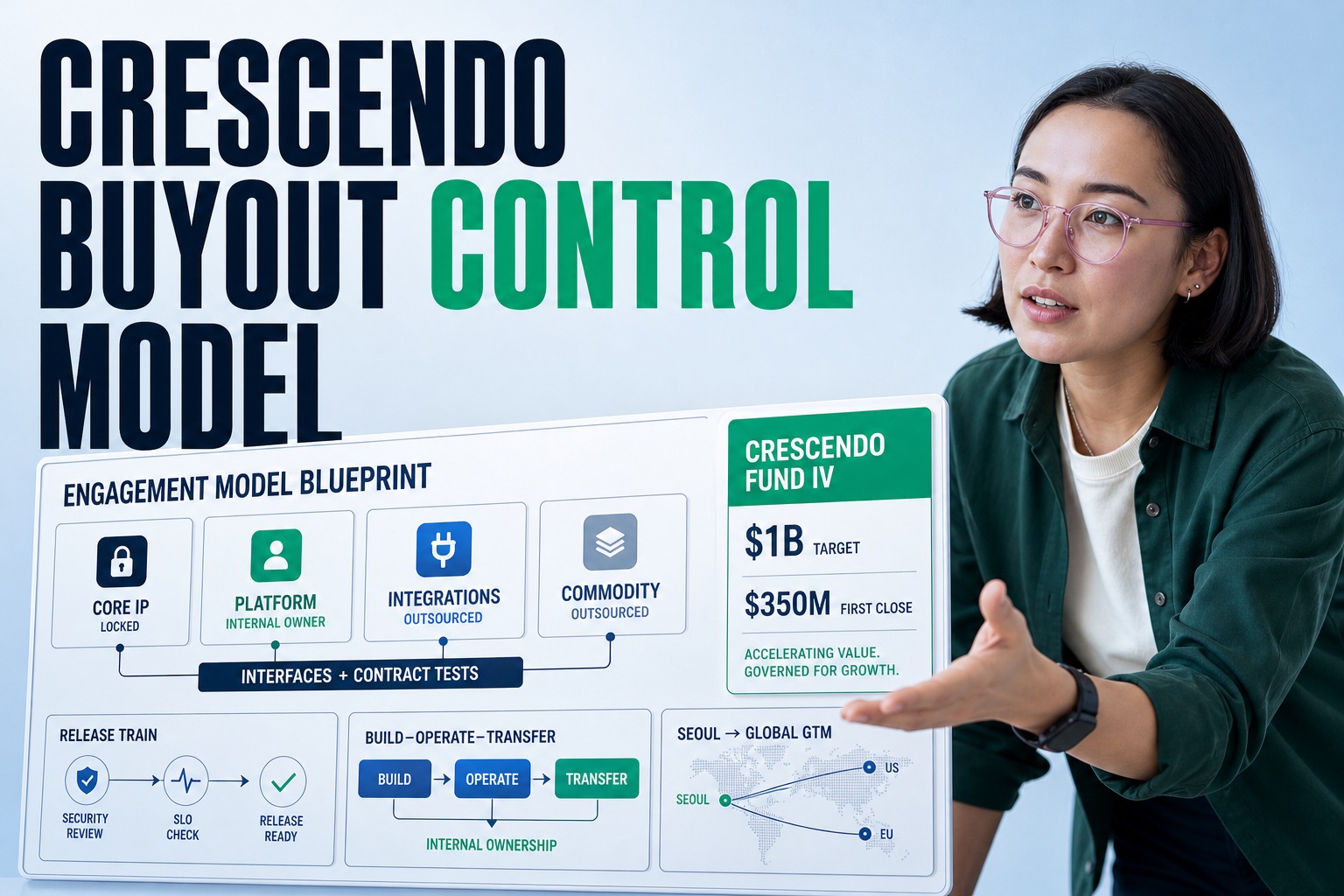
What changed with Crescendo Fund IV? → A PE firm focused on Korean tech raised over $350M offshore toward a $1B buyout fund.
Why should US CTOs care? → Buyouts accelerate global go-to-market, and engineering capacity becomes the first bottleneck.
Where does software development outsourcing fit? → It becomes an integration and scale tool, not just a cost lever.
What is the decision you must make early? → Pick engagement models that preserve architecture control while you expand.
What is the practical takeaway? → Treat vendors like product surfaces: govern interfaces, not people.
Quick Answer: Software Development Outsourcing Under Global PE Pressure
Software development outsourcing works best in PE-driven scale-ups when you buy outcomes through explicit interfaces: platform boundaries, release trains, and security gates. Crescendo is targeting controlling stakes in Korean tech firms and explicitly aims to help strong domestic winners expand globally; that kind of expansion creates uneven demand spikes across product, data, and infrastructure. The engagement model that wins is the one that can absorb spikes without rewriting your org chart.
If you cannot describe your engagement model as an architecture decision, you are about to lose technical control during growth.
The Signal Hidden In Crescendo Fund IV
Crescendo Equity Partners disclosed a first close of more than $350 million from overseas investors for its fourth buyout fund and is targeting $1 billion total. Analysis: the important part is not fundraising theater; it is the playbook implied by controlling stakes in small and midsized tech companies and then pushing them outward. If you are preparing for that push, align your delivery strategy early, including a single, governed lane for software development outsourcing.
Why Engagement Models Become A Board-Level Constraint
Crescendo’s stated specialty is finding Korean technology companies with strong domestic positions but limited global reach, then helping them scale overseas. In practice, this forces engineering to do three things at once: harden the platform, internationalize the product, and prove reliability to new enterprise buyers. Engagement models are the mechanism for deciding what stays core and what becomes a managed interface with external teams, without turning every backlog item into a headcount debate.
The fastest way to derail global expansion is to mix scaling work and core IP work in the same unmanaged vendor stream.
What The Fund Focus Tells You To Expect In Delivery
Crescendo Fund IV will focus on buyouts of Korean small and midsized technology companies valued at 50 billion won to 500 billion won, especially in semiconductors, electronics, B2B software, and cybersecurity. Analysis: those categories share one trait—tight coupling between product promises and operational truth. If your engagement model cannot guarantee repeatable build quality and operational handoffs, global customers will find the seams before sales hits escape velocity.
How Thiel-Style Networks Change The Engineering Risk Profile
Crescendo was established in 2012 through a partnership between Peter Thiel and CEO Lee Gi-doo, and executives from Thiel Capital participate directly in Crescendo’s investment committee. The firm also says Thiel’s global network supports portfolio companies’ international expansion. Analysis: network-driven expansion is opportunity and risk: you can suddenly face higher expectations for security posture, enterprise integrations, and compliance narratives.
Crescendo reports investing 1.52 trillion won across 29 companies without any losses of invested principal, and it has managed three blind funds and 10 project funds with cumulative AUM of about 1.8 trillion won. For CTOs, the operational lesson is simpler than the performance story: a repeatable playbook rewards repeatable engineering governance. Your engagement model should make repeatability cheaper, not harder.
- A first close and active due diligence implies near-term portfolio changes and integration work.
- B2B software and cybersecurity targets usually mean faster enterprise-grade process expectations.
- Global expansion support raises the bar for documentation, observability, and security evidence.
- Valuations in the 50–500 billion won range often correlate with lean internal engineering bandwidth.
Pick The Model Before You Pick The Vendor
When growth is externally accelerated, the selection mistake is to start with a vendor shortlist instead of an engagement model definition. Decide what you will measure: throughput, defect rate, time-to-recover, or domain knowledge transfer. If you expect elasticity, a structured team extension can work, but only when the internal platform team defines interfaces and owns the roadmap. For capacity that must flex, compare with outstaffing and keep management responsibility explicit.
Classify work into core IP, platform, integrations, and commodity engineering.
Assign a governance owner for each class: internal lead, vendor lead, or joint.
Define acceptance gates: security review, SLO checks, and release readiness.
Agree on escalation paths that bypass account management and reach technical owners.
Software Development Outsourcing Engagement Models That Survive Growth
The hardest phase is the first six months after a strategic shift, when priorities churn and leadership wants parallel execution. This is where outsourcing vs in-house development becomes a false binary. You can keep architecture, product direction, and security posture internal while externalizing well-bounded slices that ship independently. The key is to contract for deliverables that map to boundaries: services, modules, test suites, runbooks—not hours.
Use engagement models as levers: fixed-scope delivery for stable, testable components; team augmentation for domains where context matters; and operating support where the work is operationally defined. Crescendo’s prior funds reportedly produced strong returns, including a first blind fund gross IRR exceeding 30% and a later recovery of more than total invested capital via an iText sale. Analysis: investors like repeatable execution; your delivery model must be repeatable too.
| Engagement Model | Best Fit In A Scale-Up | CTO Guardrails |
|---|---|---|
| Project-Based Outsourcing | Integrations, migrations, discrete feature packages | Lock scope to interface contracts and test coverage, not UI mockups |
| Dedicated Product Squad | A product line with steady roadmap and stable domain language | Keep architecture owner internal; require design docs and ADR cadence |
| Managed Ops/Support | Monitoring, incident response support, reliability runbooks | Enforce SLOs, on-call boundaries, and access control audits |
| Build Operate Transfer | New capability that must become internal later | Define transfer milestones: code ownership, runbooks, and staffing plan |
When Build Operate Transfer Beats Pure Delivery
Build operate transfer is the cleanest option when you need a new capability quickly but cannot afford permanent dependency. The trick is to treat the operate phase as a reliability lab, not an afterthought. Require the vendor to mature observability, incident playbooks, and deployment automation while internal engineers shadow and then take over. This is also where outsourcing software tooling matters: shared issue tracking, CI visibility, and a single source of truth for releases.
Where Team Extension Fits In The Stack
Team extension works when you know what to build but lack sustained bandwidth, and when internal leads can do real technical management. Use it for workstreams that require ongoing collaboration: refactoring, data model evolution, or multi-quarter platform hardening. Do not use it to outsource ambiguity. If your requirements are still moving, you need a tighter discovery loop internally, otherwise you pay twice: once to build the wrong thing, and again to unwind it.
How Do AI Staffing Use Cases Influence Engagement Models?
AI staffing use cases are practical when they shrink coordination cost: triage, support automation, testing augmentation, and internal tooling that accelerates engineers. The engagement-model angle is that AI work tends to be cross-cutting; it touches data access, privacy, and runtime costs. If you cannot define the boundaries, keep it close to the platform team and buy narrow deliverables outside. When you do externalize it, anchor it to measurable outcomes and pair it with custom software development practices that enforce design review and model governance.
| AI Staffing Use Case | What You Can Externalize | What Must Stay Internal |
|---|---|---|
| Test Generation And QA Triage | Test harness expansion, regression automation, defect workflows | Release authority and risk acceptance |
| Customer Support Automation | Bot flows, retrieval tuning, integration plumbing | Data policy, brand voice, escalation rules |
| Security Signal Processing | Log parsing, alert enrichment, dashboarding | Detection strategy, incident command, access policy |
| Dev Tooling Assistants | IDE helpers, internal knowledge search, templates | Platform standards, source-of-truth documentation |
What Does A Devops Outsourcing Process Need To Cover?
A devops outsourcing process must start with access and end with evidence. Define identity boundaries, least privilege, and audit requirements before anyone touches your environments. Next, standardize delivery: branching, CI gates, artifact signing, and deployment approvals. Finally, operationalize feedback with SLOs and postmortems that include vendor participation. Analysis: in PE-backed expansion, you will be judged on reliability narratives by new enterprise buyers, so operational discipline is part of product.
- Pre-provisioned, time-boxed access with audit trails and quarterly recertification.
- CI/CD gates for security scans, dependency policy, and reproducible builds.
- Joint incident response: severity definitions, paging rules, and escalation ownership.
- Postmortems with action items tied to owners and deadlines, not generic learnings.
Governance Artifacts That Prevent Loss Of Control
You do not scale governance with meetings; you scale it with artifacts. Keep a living architecture map, interface contracts, and a release calendar that every party follows. Require ADRs for material decisions and define what counts as material. Treat documentation as a deliverable with acceptance criteria. When leadership pressure rises, these artifacts are what keep you shipping without slowly converting your platform into a patchwork.
Cybersecurity Targets Make Process Non-Negotiable
Crescendo Fund IV explicitly calls out cybersecurity alongside semiconductors, electronics, and B2B software. Analysis: this is a hint about buyer expectations—security will be part of the GTM story, not a back-office function. If you are engaging external teams, make security review a standard gate, not an exception. For organizations that need an independent check on vendor-delivered changes, align it with focused services like cybersecurity and penetration testing and feed the findings back into your delivery playbook.
Use The Investor Playbook, But Keep Engineering Autonomy
Crescendo says overseas commitments may exceed the original target as discussions continue, and it is also aiming to raise additional capital from Korean investors with due diligence underway. That dynamic matters because it suggests more activity and potentially more portfolio-level standardization. The opportunity is to borrow the discipline: standard KPIs, reusable patterns, and shared vendor governance. The risk is letting financial urgency override architectural sequencing. Autonomy comes from clarity: interfaces, ownership, and stop-criteria.
- Which domains are non-negotiable core IP, and who owns their architecture decisions?
- What is our minimum security posture for any external contributor, including tooling access?
- How will we measure vendor impact: cycle time, defect escape rate, uptime, or all three?
- What work must be paused if priorities change, without leaving the platform inconsistent?
A Practical Decision Rule For CTOs
If the work changes your platform’s long-term constraints, keep it internal; if it changes throughput, externalize it behind interfaces. That rule stays stable even when investors accelerate your roadmap. Crescendo’s model is to take controlling stakes and help companies expand beyond a strong domestic base; engineering leaders should mirror that logic by building a strong internal core and scaling the perimeter with partners. Done well, software development outsourcing becomes a controlled extension of your system design, not a loss of control. Author: Plavno team. Last updated: November 2026.
 Chat GPT
 Perplexity
 Claude
 Gemini

