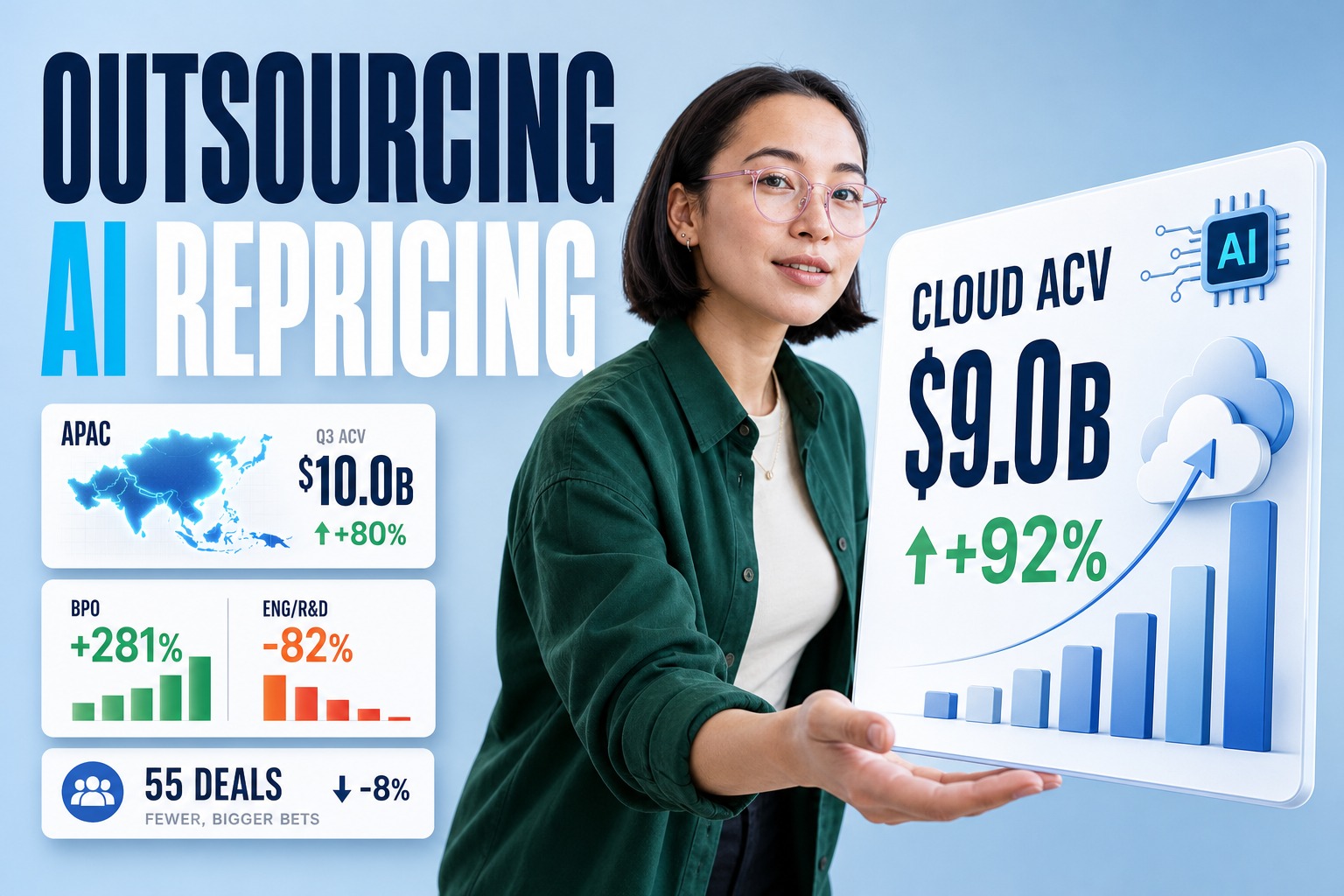
What changed in APAC sourcing this quarter? → software development outsourcing spend crossed a new threshold, led by cloud and AI-driven demand.
Why should US engineering leaders care? → The mix shift signals what vendors will prioritize globally: infrastructure-first AI roadmaps.
Which services surged and which collapsed? → BPO jumped sharply, while engineering/R&D services dropped as buyers rethink build-vs-buy.
Where did growth come from inside the region? → Smaller markets drove the expansion while Australia/New Zealand stayed flat and India declined.
What’s the decision takeaway? → Treat outsourcing as an AI capacity strategy, not just a rate-card exercise.
Quick Answer
software development outsourcing is being pulled into an AI-first spend cycle: Asia Pacific contract value hit a record $10.0B in Q3 as cloud ACV climbed to $9.0B, indicating buyers are funding AI-enabled platforms before expanding teams. Managed services still grew to just over $1.0B, but deal counts fell, signaling fewer ‘nice-to-have’ engagements. For CTOs, the practical move is to prioritize vendors that can integrate cloud, data, and delivery governance—not just provide engineers.
- Expect vendor roadmaps to center on cloud foundations for AI, not net-new headcount growth.
- Plan for procurement scrutiny: fewer discretionary deals means higher bars for measurable outcomes.
- Rebalance portfolios toward platform modernization plus selective app delivery, not blanket staff augmentation.
- Use BPO growth as a signal: AI adoption is shifting ‘process’ into ‘product’ requirements.
- Treat engineering/R&D softness as a warning: generic build capacity is being commoditized.
Software Development Outsourcing Is Being Repriced By AI Infrastructure
ISG’s Asia Pacific index shows combined ACV up 80% to a record $10.0B in Q3, and almost all of that lift came from cloud-based services rising 92% to $9.0B. That is the tell: budgets are flowing to infrastructure that can host, secure, and scale AI workloads. If you’re evaluating software development outsourcing, treat ‘cloud-first delivery’ as a contract constraint, not a preference—because the market’s pricing power is moving to cloud operators.
- Ask for a clear split between IaaS/SaaS work and application delivery; it reveals real AI readiness.
- Require an AI-era reference architecture: data boundaries, model endpoints, and observability baked in.
- Confirm how the provider manages cloud cost controls when AI workloads spike unpredictably.
- Demand integration ownership across infra and app layers to avoid vendor gaps during incidents.
- Make outcome metrics explicit: latency, error budgets, and release frequency, not just utilization.
Choosing Engagement Models When AI Workloads Are Driving The Backlog
A lot of board-level debate framed as outsourcing vs in-house development is actually about risk allocation under uncertainty: model performance, data quality, and cloud spend. In practice, the right answer often mixes engagement models: keep product direction and data governance internal, while using team extension to accelerate delivery of well-defined slices. If you need flexible capacity without surrendering control, outstaffing can work—provided you run it with the same SDLC rigor as employees.
| Segment (Asia Pacific, Q3) | ACV | YoY Change |
|---|---|---|
| Combined market (cloud + managed services) | $10.0B | +80% |
| Cloud-based services | $9.0B | +92% |
| Traditional managed services | Just over $1.0B | +16% |
| BPO / Engineering R&D | $209M / $52M | +281% / -82% |
Reading The ‘Fewer Deals, Bigger Bets’ Signal
Only 55 managed services contracts were awarded, down 8% from a year earlier, even as managed services ACV stayed above $1.0B for a second straight quarter. My interpretation (analysis) is that procurement is bundling: fewer, larger scopes tied to platform modernization and cost takeout, while small discretionary deals get cut. That matters operationally because bundling increases integration risk—your supplier must coordinate cloud, security, and app delivery as one motion.
AI demand is turning outsourcing into a capacity play for cloud-and-data execution, not a labor-arbitrage play for generic coding throughput.
AI Staffing Use Cases: Where Does Outsourcing Beat Hiring?
The ai talent shortage shows up first in roles that blend disciplines: platform engineers who understand cost controls, data engineers who can enforce governance, and delivery leads who can ship reliably across time zones. That’s why ai staffing use cases are shifting from ‘add developers’ to ‘add a delivery system.’ With tech hiring trends still volatile, using remote developers through a partner can de-risk speed—if the provider can standardize onboarding, security controls, and release management. Start by validating capability via an AI consulting spike.
Define one thin AI-enabled product slice with clear inputs/outputs; avoid ‘platform rewrites’ as the first outsourced step.
Lock data access early: least privilege, audit trails, and synthetic data paths for non-prod.
Run a two-track plan: cloud foundations in parallel with app work so teams don’t idle waiting on infra.
Measure developer productivity with ai by release frequency and defect escape rate, not story points.
Convert the pilot into a repeatable template: playbooks, CI/CD policies, and runbooks owned jointly.
The Operating Model That Keeps Remote Delivery Predictable
AI-heavy work amplifies coordination tax: model and data changes ripple into infra, apps, and compliance. The fix is not more meetings; it’s a tighter operating model (analysis): a single backlog with explicit ownership boundaries, a shared definition of done that includes observability, and mandatory incident-ready runbooks for every service. When the partner team ships, your internal SRE/Platform function should be able to operate it without heroics.
If you can’t transfer operational ownership cleanly, you don’t have an outsourcing model—you have a dependency.
Governance Patterns That Make Software Development Outsourcing Work With AI
Governance has to move earlier in the lifecycle because AI features fail differently: silent degradation, data drift, and cost blowups. In contracts, that means your acceptance criteria must include non-functional gates: logging, monitoring, and rollback plans. It also means your provider must be fluent in cloud primitives, because cloud ACV in the region climbed to $9.0B and IaaS alone rose 99% to $8.3B in Q3. If you’re modernizing foundations, align delivery with cloud software development practices.
DevOps Outsourcing Best Practices: What Must Stay Internal?
When people ask devops outsourcing best practices, the honest answer is that you can outsource execution, but you shouldn’t outsource accountability. Keep internal ownership of release policy, identity and access, and risk acceptance; outsource pipeline implementation, environment provisioning, and automation of compliance evidence. The Q3 data supports a ‘platform-first’ posture: buyers are investing in cloud services far faster than managed services, so your DevOps model should bias toward reusable platform capabilities—owned internally, implemented with partners.
AI is rocket fuel for the Asia Pacific market, says ISG Asia Pacific regional leader Michael Gale.BPO Surged Because AI Is Becoming A Product Requirement
BPO ACV skyrocketed 281% to $209M, driven by fivefold growth in industry-specific services, while IT outsourcing climbed 41% to $785M. Read that as a product signal: companies are operationalizing AI in the workflow layer, not just inside apps. Meanwhile, engineering, research and development services fell 82% to $52M—consistent with a market that is pausing generic engineering spend while it figures out which AI initiatives have durable ROI. The winning vendors will connect process redesign to deployable software.
- Outsource workflow discovery and redesign when you can clearly define outputs but lack domain ops bandwidth.
- Keep internal ownership of customer experience and product analytics; it’s where differentiation survives automation.
- Push providers to package repeatable components: connectors, document pipelines, and human-in-the-loop patterns.
- Require ‘run’ readiness from day one: monitoring, escalation paths, and cost guardrails for AI usage.
- Avoid outsourcing speculative R&D unless you can bound success criteria and exit cleanly.
Regional Signals: Flat ANZ, Down India, Up ‘Everyone Else’
Australia and New Zealand, the region’s largest market, was flat in Q3, while India declined 10%. Growth came from smaller markets: Southeast Asia rose 16% and Korea grew tenfold year over year. For US buyers, the lesson is not geography; it’s fragmentation risk. As providers chase growth pockets, you’ll see uneven maturity in delivery standards and toolchains. If you use software development outsourcing across regions, standardize your own governance artifacts—security baselines, SDLC controls, and KPI definitions—so switching costs stay low.
- Treat vendor selection as a systems integration decision, not a staffing decision; AI work spans layers.
- Expect more bundling of cloud plus delivery as providers respond to larger, fewer deals.
- Validate delivery maturity with evidence: incident metrics, postmortem culture, and change management discipline.
- Use regional competition to negotiate better terms, but don’t compromise on security and observability.
- Bake portability into contracts: documentation, environment-as-code, and clean IP handoff milestones.
What To Put In The Contract When AI Drives Scope Changes
AI scopes change because the model, data, and user workflow co-evolve. Contracts that assume stable requirements will create change-order friction and slow learning. A better pattern (analysis) is to fix the operating constraints—security, SLOs, release cadence, and cost ceilings—while leaving room to re-prioritize features inside a governed backlog. Tie payment to demonstrable increments: deployable services, validated workflows, and measurable reliability, not ‘percentage complete.’ That is how you keep speed without losing control.
When AI is the sponsor, the contract should optimize for learning speed under guardrails, not for feature certainty.The Practical Next Step For AI-Driven Outsourcing Demand
ISG also reported year-to-date combined ACV up 50% to $25.0B and raised its cloud forecast to 60% from 30%, while keeping its global managed services growth forecast for 2026 at 2.1%. That mix shift is the point: cloud and AI are where budgets are compounding. If you want software development outsourcing to pay off in this environment, start with a cloud-and-governance readiness check, then run a tightly scoped pilot that proves operability, security, and delivery cadence. Author: Plavno team. Last updated: October 2026.
 Chat GPT
 Perplexity
 Claude
 Gemini

