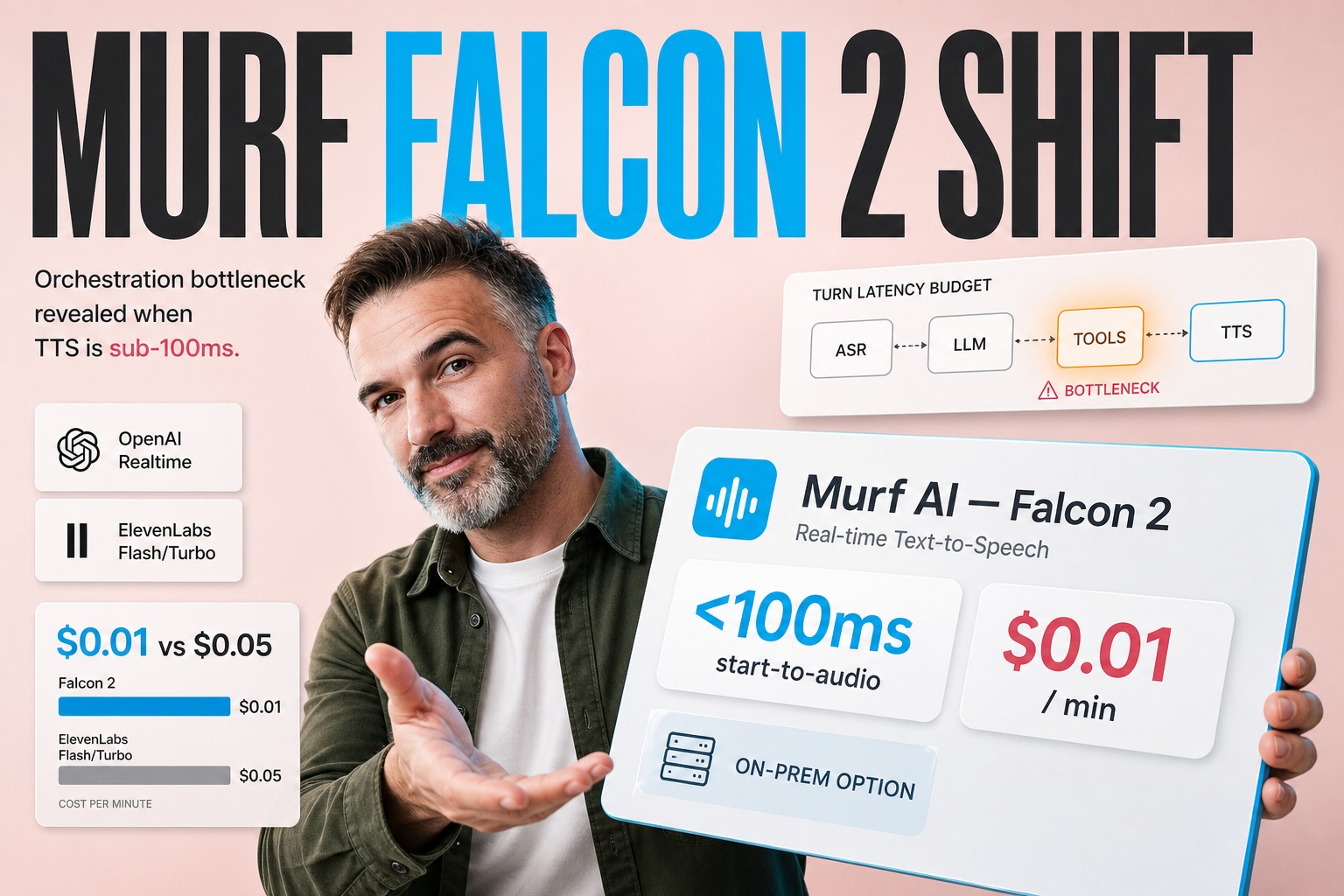
Is there a real shift in enterprise voice AI this week, or just another model launch? → The shift is unit economics plus latency: Murf AI is claiming under 100 ms to first audio and $0.01 per generated minute for Falcon 2, which changes what is rational to deploy at scale.
What is the primary question CTOs are actually trying to answer? → How do we choose a real-time text-to-speech model for production voice agents without betting the company on the wrong latency, cost, and data-control assumptions?
Why does this matter now rather than later? → When TTS becomes cheap and near-instant, the bottleneck moves to orchestration, tool latency, and compliance controls; teams that keep evaluating only the voice model will ship fragile systems.
What is the non-obvious decision hidden inside this news? → Whether your voice stack should be designed around cloud APIs, or around an on-prem option for regulated workloads that need data control and predictable infrastructure behavior.
What angle are we taking at Plavno? → We argue that sub-100 ms TTS shifts the engineering practice: you must optimize the turn-level pipeline and governance layer first, then select the model as a replaceable component.
Real-time TTS just got cheap enough to change the architecture
Murf AI’s Falcon 2 launch signals a practical inflection point for voice agents: the company claims audio generation can start in under 100 milliseconds and pricing is $0.01 per generated minute, while positioning itself against OpenAI Realtime and ElevenLabs Flash and Turbo. If those two claims hold in your workload, you no longer design the system around waiting for speech; you design it around streaming, turn-taking, and controlled tool execution.
Quick Answer: how to choose a real-time text-to-speech model for enterprise voice agents
Choose a real-time TTS model by optimizing for end-to-end conversational turns, not isolated voice quality. Falcon 2’s claimed under-100 ms start and $0.01 per generated minute matter most when your architecture already supports streaming audio, predictable tool-call latency, and a data-control posture (including on-prem options) that matches regulated use cases like BFSI and healthcare.
| Model mentioned in the report | Pricing per generated minute (as stated) | Latency / deployment notes (as stated) |
|---|---|---|
| Murf Falcon 2 | $0.01 | Starts generating audio in under 100 ms; on-premise deployment option mentioned |
| ElevenLabs Flash and Turbo | $0.05 | Latency not stated in the report |
| OpenAI Realtime | Not stated in the report | Latency not stated in the report |
| Murf Falcon 1 (previous) | Not stated in the report | Falcon 2 focuses on improved voice quality while retaining speed and cost profile |
Central claim: the bottleneck is now orchestration boundaries, not the voice model
At Plavno, our central claim is simple and arguable: Murf’s sub-100 ms, low-cost positioning doesn’t primarily change which TTS model you pick; it breaks the common engineering practice of treating speech synthesis as the pacing constraint. When speech arrives fast and cheap, the failure modes migrate to the boundaries between ASR, LLM reasoning, tool execution, and audio streaming.
In other words, you can win the naturalness benchmark and still lose the customer call because your agent hesitates after a database lookup, repeats itself after a CRM write, or speaks an unsafe answer before policy checks finish. The right response this quarter is to design a turn-level voice pipeline with explicit latency budgets, data-control options (including on-prem for regulated environments), and model interchangeability.
- Turn-level latency spikes: The user experiences the whole turn, including ASR decode time, LLM response formation, tool calls, and only then TTS; sub-100 ms TTS exposes every other delay.
- Tool-call uncertainty: When the agent must hit a scheduling system, payment processor, or internal policy engine, the system needs a plan for partial responses and safe stalling without sounding broken.
- Streaming synchronization: Real-time agents depend on continuous audio streaming and careful timing; even a great voice model will sound robotic if your streaming buffers and interruption handling are naive.
- Governance and compliance gates: Banking and healthcare use cases require controls that can add latency; if you do not place these gates correctly, you either ship slow voice or ship unsafe voice.
- Cost visibility in production: A cheap per-minute rate can still produce unpredictable spend if retries, re-prompts, or long-winded turns are not bounded by design.
What under-100 ms start-to-audio actually unlocks in a live conversation
A TTS engine that begins generating audio in under 100 milliseconds changes how we structure dialogue. Instead of waiting for full text, we can architect for incremental generation where the agent starts speaking while downstream components continue to compute, which is how humans talk during uncertain tasks. But this only works if your transport (for example, WebRTC or a telephony bridge) and your agent runtime can handle partial audio safely.
The trade-off is that streaming voice increases the number of edge cases: mid-sentence interruptions, barge-in, late-arriving tool results, and policy redactions after audio has already started. If the model is fast, the system needs stronger orchestration discipline: the agent must know when to commit to speech and when to hold for a decision.
| Voice-agent stage | What usually dominates engineering effort | What becomes visible when TTS is sub-100 ms |
|---|---|---|
| ASR (speech-to-text) | Accuracy and endpointing | Endpointing delays become the user’s perceived sluggishness |
| LLM reasoning | Prompting and context handling | Multi-turn state errors become obvious because the agent can speak quickly but incorrectly |
| Tool execution | API integrations and retries | Slow or flaky internal services become the conversation bottleneck |
| TTS (text-to-speech) | Naturalness and latency | TTS stops masking upstream delays; you hear orchestration problems |
Start with a turn budget and a failure budget, then map every component to it. We decide what the user should experience when the CRM is slow or the appointment system is down before we ever debate which voice model is more natural.
Validate streaming behavior in your actual transport. A model’s under-100 ms start is only valuable if your telephony or WebRTC layer can deliver partial audio smoothly and can interrupt cleanly.
Test naturalness using your ugliest enterprise text, not demo scripts. Real support transcripts contain product codes, names, addresses, and compliance language; pronunciation and emphasis handling matter more than a generic benchmark.
Evaluate data-control and deployment posture early. If you may need on-prem for BFSI or healthcare, your architecture should allow a local synthesized deployment without rewriting the agent runtime.
Only then compare pricing, because pricing is meaningful after you understand the minutes your system will generate under retries, fallbacks, and long turns.
Benchmark naturalness is a weak predictor of customer outcomes by itself
Murf says Falcon 2 ranks ahead of OpenAI Realtime and ElevenLabs Flash and Turbo for naturalness on the Artificial Analysis Speech Arena, and that is directionally useful. But in production voice agents, the dominant question is whether the voice stays coherent under your domain text, in your languages, under interruptions, and under policy constraints. A benchmark can tell us the model is promising; it cannot tell us that the end-to-end system will feel trustworthy.
| What to test in enterprise TTS | Why it matters for production voice agents |
|---|---|
| Pronunciation of domain tokens | Product SKUs, medication names, and legal terms can destroy credibility if spoken wrong |
| Pacing and emphasis stability | A model that sounds natural in one turn can sound rushed or flat when the LLM changes tone mid-flow |
| Contextual carryover | If the voice changes how it says a name or number across turns, users perceive the agent as unreliable |
| Multilingual consistency | Coverage across languages is not enough; the same workflow must sound consistent across markets |
Cost is now a design constraint you can actually exploit
Murf’s stated pricing is $0.01 per generated minute for Falcon 2, while the report cites ElevenLabs Flash and Turbo at $0.05 per generated minute. Murf also spells out the arithmetic: one million minutes of generated speech would cost $10,000 at $0.01, versus $50,000 at $0.05. That difference is not a rounding error in a scaled support organization; it changes whether voice is viable for every tier-1 issue or only for premium lanes.
However, we should treat low per-minute pricing as an invitation to redesign the product, not as a reason to let the agent talk more. If the agent becomes verbose, or if retries multiply due to upstream tool flakiness, spend can still explode. The architectural response is to enforce turn discipline, summarize before speaking, and treat voice minutes like an observable resource.
- Retry amplification: When tool calls fail, agents tend to re-ask and re-say content; this increases generated minutes even if per-minute pricing is low.
- Verbose safety patterns: Many teams overcompensate for risk by adding long disclaimers; that can become your largest minute driver.
- Silence filling: If you fill latency gaps with speech, you can double minutes while still delivering a worse experience.
- A/B experimentation overhead: Running two voices or two model variants in parallel can silently multiply minutes unless you cap experiments tightly.
- Monitoring gaps: Without per-session minute attribution, you cannot tie spend back to specific flows like appointment booking or password resets.
On-prem voice synthesis is returning for regulated workloads, but it is not plug-and-play
Murf offers on-premise deployment, described as running a synthesized version of the model on the customer’s own servers, and the company is exploring such deployments with BFSI customers in India and the US. That is the most operationally meaningful part of the signal for many enterprises: the voice layer is no longer forced to be an external API call if your compliance posture or customer contracts demand tighter control.
The trade-off is operational ownership. Once the voice model runs in your environment, you inherit release management, GPU capacity planning, and incident response. Murf’s CEO also notes continued use of smaller, commodity GPUs rather than leaning primarily on high-end hardware, which implies an efficiency-focused inference profile; but even with commodity hardware, on-prem means your SRE team needs a deployment, logging, and rollback story.
For organizations in banking, insurance, or healthcare, on-prem can simplify data-control narratives, but it complicates engineering. We typically recommend treating on-prem voice like a product surface with clear versioning and security review rather than treating it like a library you drop into an app. This is where a structured security program, including cybersecurity and penetration testing, becomes part of the voice roadmap rather than a late-stage checkbox.
| Deployment posture | What you gain | What you take on |
|---|---|---|
| Cloud TTS API | Fast iteration and vendor-managed scaling | Data boundary risk, dependency on external uptime, and harder-to-control latency under congestion |
| On-prem synthesized TTS | Stronger data-control posture and predictable network path | GPU operations, patching cadence, and stricter change management |
| Hybrid (policy-driven routing) | Flexibility by workload type and region | More complex observability and regression testing across two stacks |
| Multi-vendor abstraction | Swap models without rewriting the app | Requires disciplined interfaces and consistent audio streaming semantics |
Smaller, commodity GPUs change the SRE conversation more than the AI conversation
Murf highlights that it has continued using smaller, commodity GPUs to manage infrastructure utilization as demand changes. For enterprise teams, that points to a pragmatic operational win: if voice synthesis can run efficiently, we can scale capacity closer to normal microservice thinking rather than treating TTS like a rare, expensive accelerator workload.
But there is still a trade-off: efficient inference does not eliminate the need for careful real-time scheduling. Voice workloads are bursty, and real-time agents punish tail latency. If you colocate TTS with other GPU consumers, you can create noisy-neighbor effects that are invisible in offline testing. The architecture that works is the one that treats voice generation as latency-critical, with isolation and admission control, regardless of whether the GPUs are commodity.
- Capacity planning shifts from peak minutes to peak concurrent sessions: A million minutes can arrive smoothly or as spikes; real-time calls require concurrency-aware provisioning.
- Isolation becomes a first-class concept: Even on commodity GPUs, voice synthesis needs predictable scheduling; mixing batch jobs and real-time voice without controls is a common outage pattern.
- Rollback must be instant: A voice regression is customer-facing; your deployment process needs fast reversibility and canarying.
- Observability must include audio symptoms: Standard metrics are insufficient; you need signals like start-to-audio delays and interruption handling failures.
- Networking matters again: When TTS latency is tiny, jitter and packet loss in the audio path become the user’s complaint, not the model.
150 voices across 35+ languages sounds like coverage, but the integration burden is the real cost
Murf says Falcon 2 supports more than 150 voices across over 35 languages, including 12 Indian languages. In enterprise deployments, broad language coverage is only the start. The technical burden is making multilingual voice behavior predictable across the entire agent workflow: the same customer identity checks, the same appointment flow, the same escalation rules, and the same tone constraints.
The trade-off is between product velocity and consistency. If each new language forces new prompt tuning, new pronunciation dictionaries, and new QA scripts, you will slow down. The architecture we prefer separates language-specific resources (like pronunciation hints and locale formatting rules) from the agent logic and binds them at runtime, so adding a language is not a rewrite.
- Locale-aware content shaping: Dates, currencies, and addresses must be formatted correctly before they ever hit TTS, or naturalness cannot save you.
- Pronunciation governance: Names and regulated terms need consistent pronunciation across teams and releases, which means centralized control, not ad hoc fixes.
- Voice identity stability: When the same customer calls back, voice and tone should not drift; this requires deterministic voice selection policies.
- QA at the workflow level: You do not test voices in isolation; you test full flows like card replacement, claim filing, or appointment booking.
- Regional compliance overlays: Different markets may require different disclosures; the voice system must apply them without inflating talk time unnecessarily.
If vendors are building the full voice-agent stack, you should architect for modularity now
The report notes Murf is targeting enterprise voice agents and is building out a broader voice-agent stack, beyond text-to-speech. That direction is rational for vendors, but it is risky for buyers if it leads to end-to-end lock-in. Our recommendation is to assume the vendor will offer more of the stack over time and to design your own agent runtime so TTS remains a replaceable component.
- A transport layer: Telephony or WebRTC needs stable streaming semantics, interruption handling, and recording policies.
- An agent runtime: The LLM-driven planner, memory, and tool router must be independent from the voice vendor to avoid lock-in.
- A tool tier: CRM, scheduling, payments, and ticketing integrations should be encapsulated behind internal APIs to control latency and retries.
- A policy and safety tier: Regulated disclosures, PII handling, and escalation gates must run consistently regardless of which voice model speaks.
- An observability plane: Session-level tracing across ASR, LLM, tools, and TTS is required to debug real-time failures.
How we evaluate Falcon 2-like claims against OpenAI and ElevenLabs in procurement reality
Enterprises rarely choose a voice model in a vacuum; they choose a risk profile. Murf’s claims touch three axes that procurement actually cares about: perceived naturalness, real-time latency, and unit cost. They also add a fourth enterprise axis: on-prem deployment for data control. The engineering job is to translate those axes into measurable acceptance criteria in your own environment.
In practice, we run evaluations as production rehearsals. We route real workflow text through the candidate TTS, over our real audio transport, with our real tool calls in the loop. Then we decide whether the model is a primary choice, a fallback choice, or an experimentation choice. The procurement outcome becomes a technical architecture decision: are we buying a component, or are we buying a platform?
Latency: measure turn-level behavior, not start-to-audio in isolation
Murf’s under-100 ms start-to-audio claim is valuable, but the user does not experience start-to-audio; they experience whether the agent responds naturally after they finish speaking. If ASR endpointing is conservative, if the LLM waits for tool results, or if your policy layer blocks output, the conversation will still feel slow. The right metric is consistent turn responsiveness under the exact failure conditions your tools will generate.
If TTS is faster than your tool tier, the only honest optimization target is the tool tier; otherwise you are paying for speed that users never perceive.
Data control: on-prem is not only about privacy, it is about operational predictability
On-prem deployment is often framed as privacy, but for voice agents it is also about reducing external dependencies in a latency-sensitive loop. If your customer support workflow depends on sub-second turn-taking, external network variance can matter as much as policy. Still, on-prem means your team owns uptime, scaling, and patching cadence; you are trading vendor risk for internal operational risk.
Plavno’s position: build a two-tier voice architecture instead of a one-vendor bet
At Plavno, we recommend a two-tier approach: a stable production tier optimized for predictability, and a flexible experimentation tier that keeps you competitive as models shift. Murf’s Falcon 2 claims make it a credible candidate for the production tier when cost and latency are dominant constraints, but we still architect to swap the voice component without rewriting the agent. This is the mindset we bring to AI consulting engagements: decide your interfaces and budgets before you decide your vendor.
Tier 1: production voice optimized for predictable budgets and predictable failures
In the production tier, we care less about the best possible demo and more about stable behavior across a million messy interactions. The economics Murf highlights, including the $10,000 cost for one million generated minutes at $0.01 per minute, matter here because they let finance approve broader deployment. But engineering must enforce guardrails: maximum response length, safe stalling patterns during tool latency, and deterministic fallback to human escalation.
A production voice tier is not a model choice; it is a contract between SRE, security, and product about what the system is allowed to do when it is uncertain.
Tier 2: experimentation voice that keeps you from freezing your roadmap
In the experimentation tier, we intentionally accept more variance: new voices, new languages, and new naturalness improvements. Murf’s note that Falcon 2 follows Falcon 1, introduced in private beta six to seven months earlier, is a reminder that voice models iterate quickly. If you cannot trial changes safely, you will either stagnate or you will push risky changes directly to customers.
Where Falcon 2-like economics matter most: support, outbound sales, banking, healthcare
The report lists customer support, outbound sales, banking and financial services, healthcare, and appointment booking as target applications. In our experience, these are not just verticals; they are different latency and compliance regimes. Customer support often prioritizes fast resolution and smooth escalation, which rewards low-latency voice. Outbound sales often prioritizes tone and pacing, which rewards strong naturalness, but it also punishes long monologues.
Banking and healthcare add governance pressure. Even if on-prem deployment simplifies the data-control story, the agent still needs policy gates and auditing. The practical implication of cheaper voice is that more organizations will attempt higher-volume deployments; that is when failure modes show up, because edge cases scale faster than your QA capacity.
When pricing drops, the first thing that scales is not revenue; it is the number of edge cases you must operationally support.
Appointment booking is the workflow where naturalness and latency directly touch revenue
Appointment booking sounds simple, but it is the workflow where users are least forgiving of hesitation and repetition. The agent must confirm names, times, and locations, and then execute a scheduling tool call. If the tool is slow, a fast TTS model can help the agent acknowledge the request quickly, but only if you have a safe strategy for speaking while the booking is pending. Otherwise the agent either stalls awkwardly or over-promises.
The risks that appear when TTS becomes faster than your safety layer
As voice generation becomes near-instant, it becomes easier for an agent to speak before it should. In regulated contexts, the biggest risk is not a slightly unnatural voice; it is speaking the wrong thing with a natural voice. This is why we treat policy, PII handling, and escalation as first-class components of the voice pipeline, not as late-stage filters.
If you cannot prove where policy decisions happen in the turn timeline, you do not have a compliant voice agent, regardless of how natural it sounds.
What we would do next if we were piloting a voice agent this quarter
We would build a thin, instrumented end-to-end slice: one workflow, one audio transport, one tool integration, and one TTS option, then expand only after we can explain every delay and every failure. Murf’s Falcon 2 claims make it a compelling TTS candidate for such a slice, especially if you anticipate high volume or need an on-prem option. If you need help scoping and shipping that pilot without locking yourself into the wrong stack, we typically start with a single-workflow voice MVP through our AI voice assistant development practice.
The fastest way to evaluate a voice model is to put it behind real tool latency and see whether the conversation still feels human.
Closing insight: your durable advantage is the voice pipeline you can change safely
Falcon 2 is a strong market signal because it combines claimed naturalness, under-100 ms start-to-audio, low per-minute pricing, and an on-prem option in one narrative. But the competitive advantage for an enterprise is not owning the best voice model; it is owning an architecture where the voice model can be swapped, measured, governed, and rolled back without drama. Author: Plavno team. Last updated: August 2026.
 Chat GPT
  Perplexity
  Claude
  Gemini
