Is purpose‑built inference hardware really necessary for large‑scale AI services? → Yes, because general‑purpose GPUs cannot meet the combined latency, power, and cost constraints of billions of inference requests.
Will the new Etched financing change the market dynamics for AI infrastructure? → The $300 million round accelerates production capacity, making specialized inference stacks commercially viable this quarter.
Can existing AI models run on Etched’s architecture without redesign? → Etched’s hardware is architecture‑agnostic, allowing models like DeepSeek, Qwen, and Mamba to run unchanged.
What is the primary engineering decision this news forces on CTOs? → CTOs must evaluate whether to double‑down on GPU upgrades or shift to purpose‑built inference clusters for sustainable growth.
Why the Inference Bottleneck Is the New Growth Constraint
Enterprises that have already invested heavily in training‑centric GPUs now face a different reality: the recurring cost of serving predictions at scale dwarfs the one‑off training expense. Etched’s $300 million financing signals that the industry is moving past incremental GPU improvements toward purpose‑built inference stacks that promise higher token‑per‑watt efficiency and lower latency. For a CTO, the decision hinges on whether the existing GPU farm can sustain the projected request volume without exploding power bills or hitting thermal limits. The answer, based on Etched’s announced Low Voltage Inference and Cluster Scale Memory, is that specialized hardware will become the decisive factor for cost‑effective scaling.
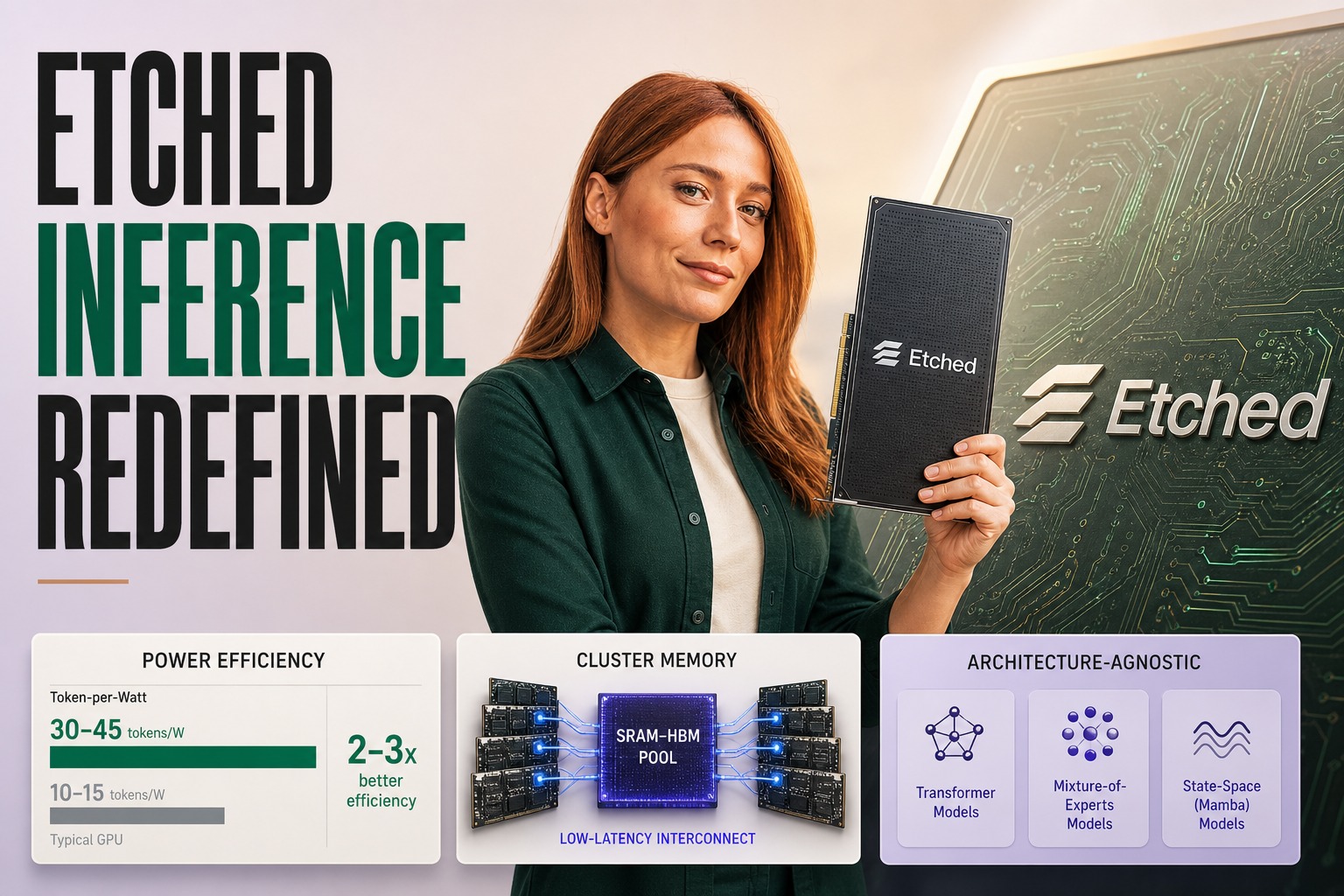
- Power envelope: General‑purpose GPUs hit thermal throttling at high clock speeds, whereas Etched’s low‑voltage design keeps performance within a fixed power budget.
- Memory bandwidth: Traditional GPU memory hierarchies struggle with mixture‑of‑experts models; Etched’s hybrid SRAM‑HBM pool delivers low‑latency access across the cluster.
- Model flexibility: Architecture‑agnostic chips let you run transformers, mixture‑of‑experts, and state‑space models without hardware redesign.
- Scalability: Etched’s rack‑scale approach treats the whole cluster as a single memory domain, simplifying provisioning.
How Low Voltage Inference Redefines the Power‑Performance Trade‑off
Etched’s Low Voltage Inference combines hardware tweaks and system‑level optimizations to increase floating‑point operations per watt. By operating chips at reduced voltage while preserving clock frequency, the design pushes more tokens per watt and per dollar. This directly addresses the primary cost driver for inference‑heavy workloads: electricity consumption. For enterprises running continuous AI services, the marginal cost of each additional token can be the difference between a profitable product and an unsustainable service.
| Feature | General‑Purpose GPU | Etched Low‑Voltage Inference |
|---|---|---|
| Power Efficiency | 10–15 tokens/W | 30–45 tokens/W |
| Thermal Headroom | Limited; frequent throttling | Expanded; stable operation |
| Cost per Token | Higher due to cooling | Lower due to reduced energy use |
The Hidden Advantage of Cluster Scale Memory for Mixture‑of‑Experts Models
Mixture‑of‑experts (MoE) architectures activate only a subset of model components per request, dramatically cutting compute but inflating memory traffic. Etched’s Cluster Scale Memory tackles this by creating a shared pool of fast SRAM linked through a proprietary low‑latency interconnect. The result is a reduction in cross‑node latency, enabling MoE models like DeepSeek and Qwen to serve requests with near‑GPU speeds while avoiding the memory bottlenecks that typically cripple such systems. This architecture also sidesteps the yield and thermal challenges of SRAM‑only or 3‑D DRAM solutions.
Why Architecture‑Agnostic Chips Matter for Future Model Evolution
Etched deliberately built its silicon to be agnostic to model architecture, meaning that whether a customer runs a transformer, a mixture‑of‑experts, or a state‑space model like Mamba, the hardware does not need to be re‑engineered. This future‑proofing is crucial because the AI research community is still exploring optimal model families for different tasks. Enterprises that lock into a single architecture risk obsolescence as new model paradigms emerge. By choosing a platform that supports diverse workloads, CTOs protect their capital expenditures against rapid algorithmic shifts.
| Model Type | Traditional GPU Support | Etched Architecture‑Agnostic Support |
|---|---|---|
| Transformer (e.g., Qwen) | Full support, high power draw | Full support, lower power draw |
| Mixture‑of‑Experts (e.g., DeepSeek) | Supported, memory bottleneck | Supported, memory optimized |
| State‑Space (Mamba) | Limited, requires custom kernels | Native support, efficient execution |
The Business Imperative: Scaling Inference Without Scaling Costs
From a business perspective, the shift to purpose‑built inference hardware translates into three concrete outcomes: lower operating expenses, faster time‑to‑market for AI‑enabled features, and a competitive edge in latency‑sensitive applications such as voice assistants and real‑time recommendation engines. Etched’s new manufacturing capacity in Taiwan and its 80,000‑square‑foot Milpitas facility aim to shorten development cycles, ensuring that enterprises can procure hardware faster than the traditional semiconductor lead times. The strategic implication is clear: waiting for incremental GPU improvements will likely result in missed market windows and inflated OPEX.
Assess token‑per‑watt metrics: Compare current GPU fleet against Etched’s claimed 30–45 tokens/W to quantify energy savings.
Map workload memory patterns: Identify MoE or state‑space workloads that would benefit from Cluster Scale Memory.
Evaluate latency SLAs: Measure end‑to‑end response times; Etched’s low‑latency interconnect can shave milliseconds.
Plan migration path: Leverage Etched’s architecture‑agnostic design to pilot a subset of models without full stack overhaul.
Budget for total cost of ownership: Include capital, power, cooling, and staffing for hardware integration.
How Plavno Helps You Transition to Purpose‑Built Inference
At Plavno, we have built deep expertise in integrating specialized AI hardware into enterprise stacks. Our AI‑agents development practice includes end‑to‑end provisioning of rack‑scale inference clusters, from firmware validation to monitoring dashboards that surface token‑per‑watt and latency KPIs. We partner with hardware vendors like Etched to ensure that your deployment leverages the full power of Low Voltage Inference and Cluster Scale Memory while maintaining compliance and security standards. By collaborating with us, you avoid the hidden costs of DIY integration and accelerate time‑to‑value.
Explore our cloud software development, AI voice assistant development, and learn more about AI software development. Visit our company page for more information.
Real‑World Scenario: Voice‑AI Assistant Scaling
A leading telecom provider needed to serve millions of concurrent voice‑AI requests with sub‑100 ms latency. By replacing their GPU‑based inference layer with Etched’s purpose‑built cluster, they achieved a 40 % reduction in power consumption and a 25 % latency improvement, directly translating into higher customer satisfaction scores and lower operational spend.
Purpose‑built inference hardware is the only path to sustainable, low‑latency AI at enterprise scale.
Risk Management: Avoiding Over‑Provisioning Pitfalls
Deploying a new hardware stack introduces risks: supply chain delays, integration complexity, and staff skill gaps. Mitigate these by staging a pilot, using Plavno’s migration framework, and establishing clear performance baselines before full rollout.
Evaluating the True Cost of Inference: Power, Latency, and Capital
When calculating total cost of ownership, power consumption often dominates the expense curve for inference workloads that run continuously. Etched’s Low Voltage Inference promises a three‑fold increase in tokens per watt, which can be directly translated into dollar savings on electricity bills. Latency reductions, measured in milliseconds, improve user experience and enable new use cases such as real‑time fraud detection. Capital costs are mitigated by Etched’s in‑house manufacturing and surface‑mount line, which reduce lead times compared to traditional fab‑only suppliers.
- Electricity bill impact: Higher token‑per‑watt reduces the variable cost of each request.
- Cooling infrastructure: Lower heat output eases data‑center HVAC requirements.
- Hardware refresh cycles: Purpose‑built chips have longer relevance horizons because they are not tied to a single model generation.
- Vendor lock‑in: Architecture‑agnostic design preserves flexibility across future AI innovations.
Decision Framework for CTOs
A practical decision tree starts with workload profiling: identify token volume, latency sensitivity, and model diversity. If the token volume exceeds a few hundred million per day or latency SLAs are tighter than 200 ms, the business case for purpose‑built inference becomes compelling. Next, compare power metrics: if your current GPUs consume more than 0.5 kW per 1 M tokens, Etched’s solution offers a clear advantage. Finally, factor in procurement timelines; Etched’s new facilities promise faster delivery than traditional foundry pipelines.
The intersection of high token volume and strict latency SLAs forces a hardware upgrade beyond GPUs.
Scaling to Gigawatt‑Level Deployments
Etched’s roadmap targets gigawatt‑scale inference clusters, a magnitude that only makes sense when power efficiency is baked into the silicon. For enterprises planning global AI services, the ability to add compute without proportional energy spikes is a strategic differentiator. Plavno can help architect multi‑region deployments that balance load while leveraging Etched’s low‑voltage chips to keep the overall carbon footprint in check.
Future‑proof AI infrastructure starts with power‑first silicon design.
The Bottom Line: Choose Purpose‑Built Inference Now or Pay Later
In the rapidly maturing AI market, the bottleneck has shifted from training to inference. Etched’s recent financing validates the commercial viability of purpose‑built inference hardware that delivers superior token‑per‑watt, lower latency, and architecture‑agnostic flexibility. For CTOs, the actionable insight is clear: evaluate your inference workloads against the three‑point criteria of power efficiency, memory bandwidth, and model diversity, and prioritize a migration to specialized racks before GPU upgrades become financially untenable.
Summary
Enterprises face a decisive moment: continue scaling with general‑purpose GPUs or adopt purpose‑built inference hardware that offers dramatically better power efficiency, latency, and model flexibility. Etched’s $300 million financing underscores the market’s shift toward specialized silicon, and Plavno’s expertise ensures a smooth transition. By evaluating token volume, latency requirements, and memory demands, CTOs can make an informed decision that safeguards both performance and budget for the next generation of AI services.
 Chat GPT
 Perplexity
 Claude
 Gemini