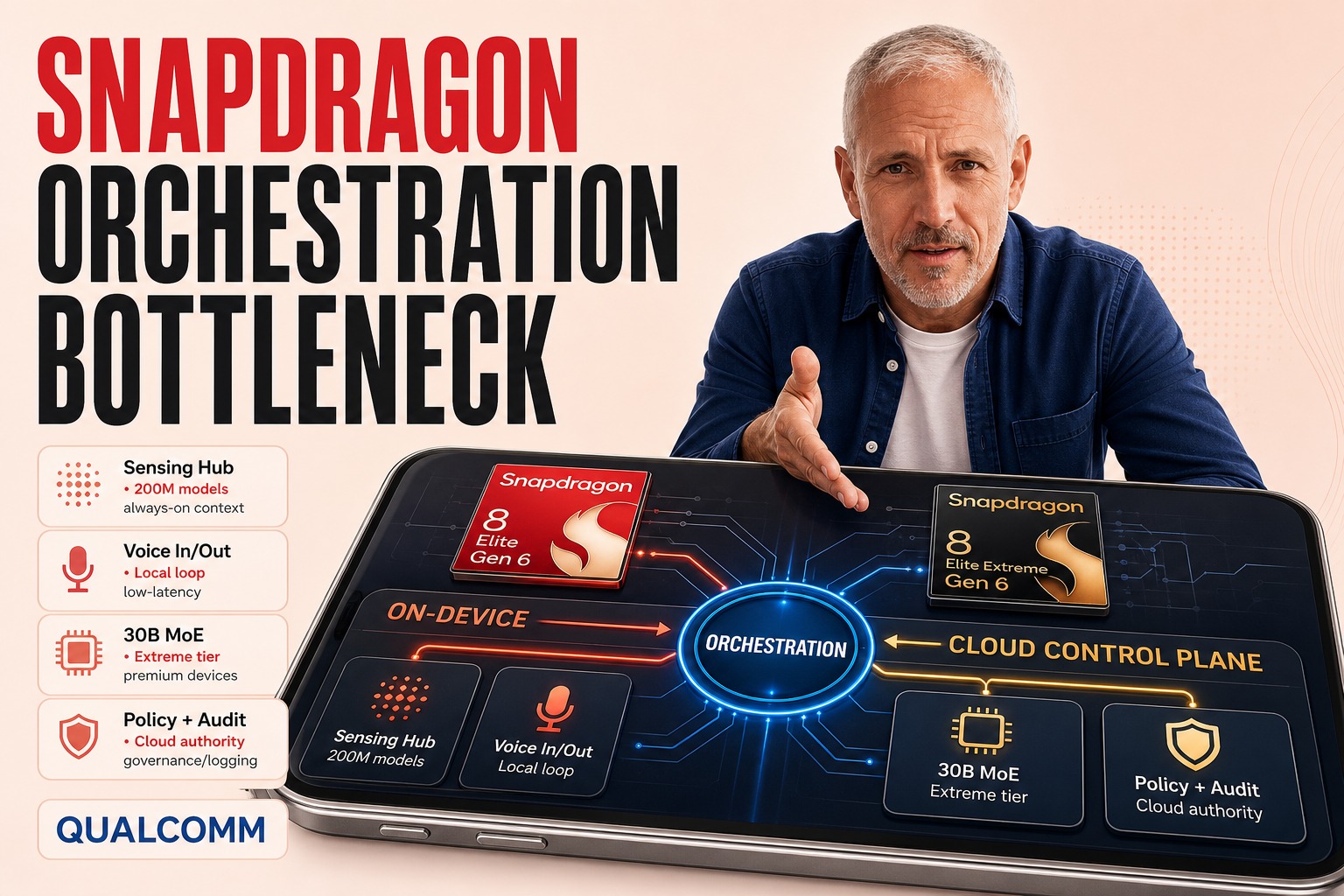
What changed this week that matters for mobile AI roadmaps? → Qualcomm’s Snapdragon 8 Elite Gen 6 and 8 Elite Extreme Gen 6 push more agent-grade AI onto the phone, including a complete voice-in/voice-out agent and larger local MoE models.
What’s the business/engineering question we have to answer now? → How do we design an on-device AI agent architecture that exploits these chips without shipping an unobservable, privacy-risky system?
Is this mainly about picking the best model? → No. These chips make model choice less decisive than orchestration, memory design, and fallback behavior across device tiers.
What’s the “new primitive” engineers can actually build around? → A sensing hub that can run small models up to 200 million parameters for continuous context, plus a high-end tier that can run a 30B parameter MoE locally.
What decision should a CTO make this quarter? → Commit to a hybrid agent stack where on-device handles sensing, personalization signals, and low-latency voice loops, while cloud remains the authority for heavy reasoning, compliance logging, and fleet-wide improvement.
Quick Answer: What should we run on-device vs in the cloud on Snapdragon 8 Elite Gen 6?
For an on-device AI agent architecture on Snapdragon 8 Elite Gen 6, we should treat the phone as the system that captures context, runs always-on lightweight models (up to 200M parameters on the sensing hub), and executes low-latency voice interactions locally, while keeping cloud services as the control plane for policy, long-horizon workflows, and auditing. The engineering bottleneck shifts from “can we run a model?” to “can we orchestrate safely across tiers and SKUs?”
If your agent’s reliability depends on a single model running everywhere, the Snapdragon split between “Elite” and “Extreme” will break your product; design for tiered capability and graceful degradation from day one.
The dominant signal: smartphones are becoming the default AI agent device, not a thin client
Qualcomm’s Snapdragon 8 Elite Gen 6 and Snapdragon 8 Elite Extreme Gen 6 are explicitly positioned around AI-focused features, including on-device personalization for AI agents and a complete voice-in/voice-out agent running through the chip. The practical implication is not just more local inference; it’s a new expectation that the phone is where the agent senses, decides, and responds under tight latency and privacy constraints.
At Plavno, we read this as a product-architecture shift: your agent is no longer a cloud chatbot with a mobile UI. It becomes a distributed system where the phone is a first-class runtime tier, with its own memory, sensing, and performance envelope. That changes what we optimize for, how we test, and what we promise customers when we sell “personalization.” For teams building AI agents development services, this is where roadmaps start to diverge between those who engineer for devices and those who just port prompts.
- Local context becomes a feature, not an optimization. The sensing hub running small models up to 200M parameters implies always-on signals can drive suggestions and task automation without roundtrips.
- Device-tier fragmentation becomes your architecture’s fault. Snapdragon 8 Elite vs Extreme means you cannot assume one local capability level across your user base.
- Voice loops move onto the phone. If a complete voice-in/voice-out agent runs locally, orchestration, interruption handling, and state become mobile runtime problems.
- Personal memory becomes a systems problem. Building memory from usage for better suggestions forces governance decisions about storage, lifecycle, and reset semantics.
- “Pro” media features now interact with agent features. Pixel-level camera control, stabilization, and pro codecs create new agent surfaces that must be isolated and permissioned.
Why “30B on-device” doesn’t mean “offline-first”: it means “boundary-first”
The Snapdragon 8 Elite Extreme Gen 6 can run a 30-billion-parameter mixture-of-experts model locally, but that capability should not automatically push teams into an offline-only posture. The hard failures in production won’t come from the model being too small; they’ll come from mismatched behavior across devices, unclear data boundaries for personalization, and missing operational control when an on-device agent behaves unexpectedly.
The sensing hub is a separate runtime tier, and it should own continuous context
Qualcomm describes new sensing hubs that can run small models up to 200 million parameters, enabling a local “personal scribe,” differentiating between speakers, and building memory based on usage for better automation suggestions. Architecturally, we should treat that hub like a dedicated “context plane” that generates structured signals, not like a place to run the whole assistant. The trade-off is clear: the hub can be always-on and private, but its outputs must be constrained to avoid silently shaping agent behavior without visibility.
- Speaker-aware capture as a bounded service. The hub can differentiate between speakers, but downstream agent logic should consume “who spoke” as a constrained attribute, not raw assumptions.
- Local scribe as an input stream, not a database. A personal scribe is valuable, but we should treat it as an ephemeral stream feeding explicit user-approved memory.
- Usage-based memory as a policy object. If the phone “builds memory,” the app must expose lifecycle controls: what is remembered, for how long, and how it is deleted.
- Automation suggestions as explainable triggers. Suggestions should be driven by explicit signals (recent actions, active app, speaker context), not opaque “agent vibes.”
Voice-in/voice-out on-device shifts the performance risk into orchestration, not inference
Qualcomm says it can run a complete voice-in and voice-out agent through the new chip, alongside AI features that boost vocals, reduce noise, and isolate user noise with voice bubble tech during calls. That bundle is telling: once the voice loop lives locally, the user judges the system on interruption handling, turn-taking, and consistency, not on benchmarked model quality. The trade-off is that local voice reduces dependency on network conditions, but increases the importance of deterministic state handling across audio processing and agent response.
Establish a single “conversation state” owner on device so audio enhancements (noise reduction, vocal boost) cannot desynchronize from the agent turn.
Separate “capture” from “interpretation” so speaker differentiation and transcription can be swapped without rewriting business logic.
Define explicit handoff rules for when the device escalates to cloud reasoning, including what context is allowed to leave the phone.
Implement a fallback response contract for partial failures so the system can degrade to simpler behavior without sounding broken.
Instrument the voice loop as a pipeline with traceable stages, because user-perceived latency often comes from stage boundaries, not raw inference.
| Runtime tier implied by the announcement | What it’s best used for | What can go wrong if you misuse it |
|---|---|---|
| Sensing hub (up to 200M parameter models) | Continuous context signals, speaker differentiation, local scribe inputs | Hidden “behavior shaping” with no observability; memory creep without user control |
| Flagship on-device agent (voice-in/voice-out) | Low-latency conversational loops, immediate actions, noise-robust calls | State desync across audio and agent turns; inconsistent behavior across SKUs |
| Extreme-tier local MoE (30B parameter MoE) | Higher-quality local reasoning on premium devices | Tier fragmentation, UX inconsistency, and policy drift across device populations |
| Cloud services (as the control plane) | Governance, auditing, fleet learning, heavy workflows | Privacy exposure if you exfiltrate context by default; over-reliance increases latency |
Personalization is now the hardest engineering problem, because “memory” has to be governed
Qualcomm’s framing is explicit: these chips enable improved personalization for AI agents, including building memory based on usage for better suggestions for automating tasks. That sounds like a product win, but for engineering leadership it is a governance commitment. The moment a device “remembers,” you have to define what memory is, where it lives, and how it is inspected, reset, and constrained.
In practice, many teams will try to solve this by expanding prompt context or by dumping interaction logs into a local store. That tends to break at the edges: cross-device upgrades, app reinstalls, multi-user households, and speaker differentiation errors all become “memory corruption” from the user’s perspective. We recommend treating on-device memory as a controlled product surface with explicit invariants and user affordances, not as an implementation detail hidden behind a smarter model. This is the core difference between shipping an assistant and shipping an agent product, and it’s why teams often come to AI assistant development asking how to make personalization predictable.
When capabilities expand, tighten interfaces; the system becomes safer by making fewer things implicit.Camera and call-time AI features turn “agent apps” into platform integrations
Qualcomm also highlights pixel-level camera control for more pro-level experiences, improved stabilization and motion understanding, plus Extreme-tier support for 8K 60fps and 4K240 recording and the Advanced Professional Video codec. Add call-time features like vocal boost, noise reduction, and voice bubble isolation, and you get a pattern: the agent is moving into system-level surfaces that are permissioned, performance-sensitive, and hard to test across devices.
The more surfaces your agent touches (voice, camera, calls), the more your architecture must look like a platform team’s: strict permissions, explicit state machines, and versioned contracts between subsystems.
The right response is a tiered agent stack: local context, local loops, cloud control
The Snapdragon announcement is an invitation to rebuild your agent stack around tiers: a low-power context plane (sensing hub), a local interaction plane (voice-in/voice-out), and a remote control plane (cloud) for governance and heavy workflows. If you approach this as “move everything on-device,” you will ship inconsistent behavior across Elite and Extreme devices and lose the operational leverage that businesses need. If you approach it as “keep everything in cloud,” you will miss the latency, privacy, and personalization advantages that Qualcomm is building toward.
At Plavno, we typically design this as an orchestration problem first and a model problem second. The “agent” is the runtime that decides where work executes and what data crosses boundaries, not a single monolithic LLM. That is also where automation value is captured: once your agent can safely decide to act locally or escalate remotely, you can expand the scope of task automation without expanding privacy risk. This is why the architecture conversation often overlaps with AI automation services rather than just model selection.
Device-tier fragmentation is guaranteed, so your UX must degrade gracefully by design
Qualcomm ships two flagships: Snapdragon 8 Elite Gen 6 and the higher-end Snapdragon 8 Elite Extreme Gen 6. Motorola already announced a Motorola Signature 27 powered by the Extreme version. That’s enough to predict a near-term reality: your “best” on-device behavior will only exist for part of your install base, even inside a single Android app. The trade-off is that tiering lets you exploit premium hardware, but only if you define consistent user promises that don’t collapse on non-Extreme devices.
- Capability discovery at runtime. The app should detect which tier it’s on and expose consistent feature semantics, even when the underlying model or pipeline differs.
- Stable contracts for actions. A “schedule,” “summarize,” or “suggest automation” action should mean the same thing, even if implementation changes across tiers.
- Predictable degradation for voice. If the full voice agent cannot run locally, the system should fall back to partial local processing plus cloud reasoning without changing the interaction style.
- Explicit user messaging for premium-only behavior. If Extreme devices can do higher-quality local reasoning, communicate it as an enhancement, not as the baseline.
Mixture-of-experts changes cost and scheduling assumptions, not just “model size”
Qualcomm states that the Extreme version can run a 30B parameter mixture-of-experts model locally, where only a certain number of parameters activate for a task. Apple, by comparison, released a 20B parameter mixture-of-experts model at WWDC. The engineering takeaway is not which number is bigger; it’s that MoE makes per-request compute variable. That variability pushes complexity into scheduling, memory pressure management, and worst-case latency handling on a device that also has to run camera pipelines and the UI.
Define which user journeys demand deterministic latency, then constrain local agent behavior inside those journeys.
Identify which tasks can tolerate variable compute, then allow higher-quality local reasoning only there.
Decide what “escalation” means when local compute is busy: queue, degrade, or offload to cloud.
Treat on-device inference as a shared resource with camera and audio pipelines, and design arbitration rules.
Measure success as consistency across devices, not peak capability on Extreme-tier hardware.
| Decision you must make | If you bias toward on-device | If you bias toward cloud |
|---|---|---|
| Personalization and memory | More privacy and immediacy, but harder resets and less central auditing | Easier auditing and fleet learning, but higher sensitivity and exfiltration risk |
| Voice interaction loop | Lower latency and robustness to network, but tougher observability | Better monitoring, but user experience tied to connectivity and roundtrips |
| Pro media surfaces (camera/video) | Tight integration and responsiveness, but more device-specific QA | Simpler backend, but limited real-time control and higher integration friction |
| Policy enforcement | Harder to guarantee uniform policy across SKUs | Easier central policy, but must limit what context you send |
How we evaluate this in practice: ship a tiered agent roadmap, not a single “LLM feature”
Teams are hearing the same market drumbeat Qualcomm referenced: there is still a belief that many people will use their phones for AI rather than dedicated devices, echoed by industry leaders. For engineering leadership, the actionable step is to stop planning AI features as isolated chat capabilities and start planning them as an agent roadmap that spans sensing, memory, voice, and pro device surfaces.
We recommend a quarter-level evaluation that starts from user promises and operational constraints. What is the strongest guarantee you can make about privacy, latency, and determinism when the agent is partially on-device? What is the minimum viable “memory” that actually improves suggestions without turning into a shadow profile? Which device surfaces are you willing to own end-to-end, including QA for speaker differentiation, local scribe behavior, and call-time audio effects? These questions are best handled as architecture, risk, and governance work, which is why we often begin engagements through AI consulting rather than jumping straight into model experiments.
The central claim we operate on is simple and arguable: Snapdragon-class on-device capability breaks the old practice of designing agents as cloud services with mobile front ends, and the correct response is to engineer orchestration boundaries and memory governance before you optimize model quality. A reasonable engineer could disagree and try an offline-first build, but in B2B settings the lack of auditing, tier fragmentation, and unclear reset semantics tend to dominate outcomes.
A production agent is a contract with operators, not a conversation with users.Where on-device agents win immediately: latency, privacy posture, and resilience
When a complete voice-in/voice-out agent can run locally and the sensing hub can run small models continuously, on-device execution becomes the fastest path to responsiveness and reduced dependency on network conditions. The trade-off is that you accept more complexity in mobile runtime state, QA, and observability, but you get resilience and a privacy posture that can be easier to explain to enterprise stakeholders than “we send everything to the cloud.”
- Call-time assistance that must feel instant. If voice bubble and noise reduction are in play, the user expects immediate, stable behavior with no network jitter.
- Speaker-aware meeting capture on the device. Differentiating speakers plus a local scribe can produce value even when connectivity is limited.
- Personal automation suggestions from usage patterns. When memory is built locally from usage, suggestions can be faster and less invasive than cloud profiling.
- Pro media workflows tied to device sensors. Pixel-level camera control and stabilization are inherently device-local surfaces where roundtrips are awkward.
- Enterprise environments with strict data boundaries. Keeping more context on the phone can simplify certain compliance narratives, if governance is explicit.
If you cannot explain, in plain language, what your on-device memory stores and how it is erased, you should not ship personalization—even if the hardware can do it.
The hidden risks: observability gaps, silent regressions, and policy drift across SKUs
On-device agents fail differently than cloud agents: you can’t rely on centralized logs, you can’t assume uniform compute, and you can’t hotfix behavior the same way when the logic lives on the phone. Snapdragon 8 Elite vs Extreme makes this sharper, because “the agent” is no longer a single runtime profile. The right mitigation is to design for traceability and policy consistency as first-order requirements, not as an afterthought once the model is “good enough.” Author: Plavno team. Last updated: September 2026.
Security and privacy boundaries shift when the phone becomes the agent runtime
Qualcomm’s emphasis on personalization and memory based on usage implies that sensitive context will live closer to the user. That can reduce cloud exposure, but it also raises the stakes of device compromise, unclear permission boundaries, and accidental cross-app inference. The trade-off is that keeping processing local can be a privacy win, but only if your architecture constrains what data flows into memory and what actions an agent can take without explicit confirmation.
Testing and QA must cover orchestration boundaries, not just prompts and responses
When the sensing hub generates signals, the voice pipeline shapes turns, and the agent reasons locally or remotely depending on tier, most failures emerge at handoffs: state mismatches, race conditions between UI and voice, and inconsistent behaviors after OS updates. The trade-off is that you can ship smarter experiences, but you must test the system as a pipeline across device classes. A “great prompt” cannot compensate for a brittle boundary between local memory and action execution.
- Silent behavior changes across devices. The same app can behave differently on Elite vs Extreme if local reasoning quality or pipeline capacity differs.
- Untraceable user complaints. Without careful instrumentation, “it suggested the wrong thing” becomes impossible to diagnose.
- Memory creep and unwanted personalization. Usage-based memory can accumulate and shape suggestions in ways users can’t predict or undo.
- Policy drift between local and cloud. If cloud policy evolves but local logic lags, the agent may violate new constraints.
- Surface-area explosions. Camera and call integrations expand the number of subsystems that can break the agent experience.
- Treat escalation as a product feature. Make “send to cloud” a governed, user-understandable transition, not an invisible implementation detail.
- Version contracts between subsystems. The sensing hub’s outputs, the voice loop state, and the action layer should be compatible across app versions.
- Design reset and recovery paths. Users and IT admins need clear ways to clear memory and restore safe defaults.
- Build tier-aware acceptance tests. Validate that promises hold across Elite and Extreme, even when the best model only runs on premium hardware.
- Operate with explicit boundaries. The most durable agent systems are the ones that define what is allowed to happen locally, and what must be mediated centrally.
 Chat GPT
  Perplexity
  Claude
  Gemini
