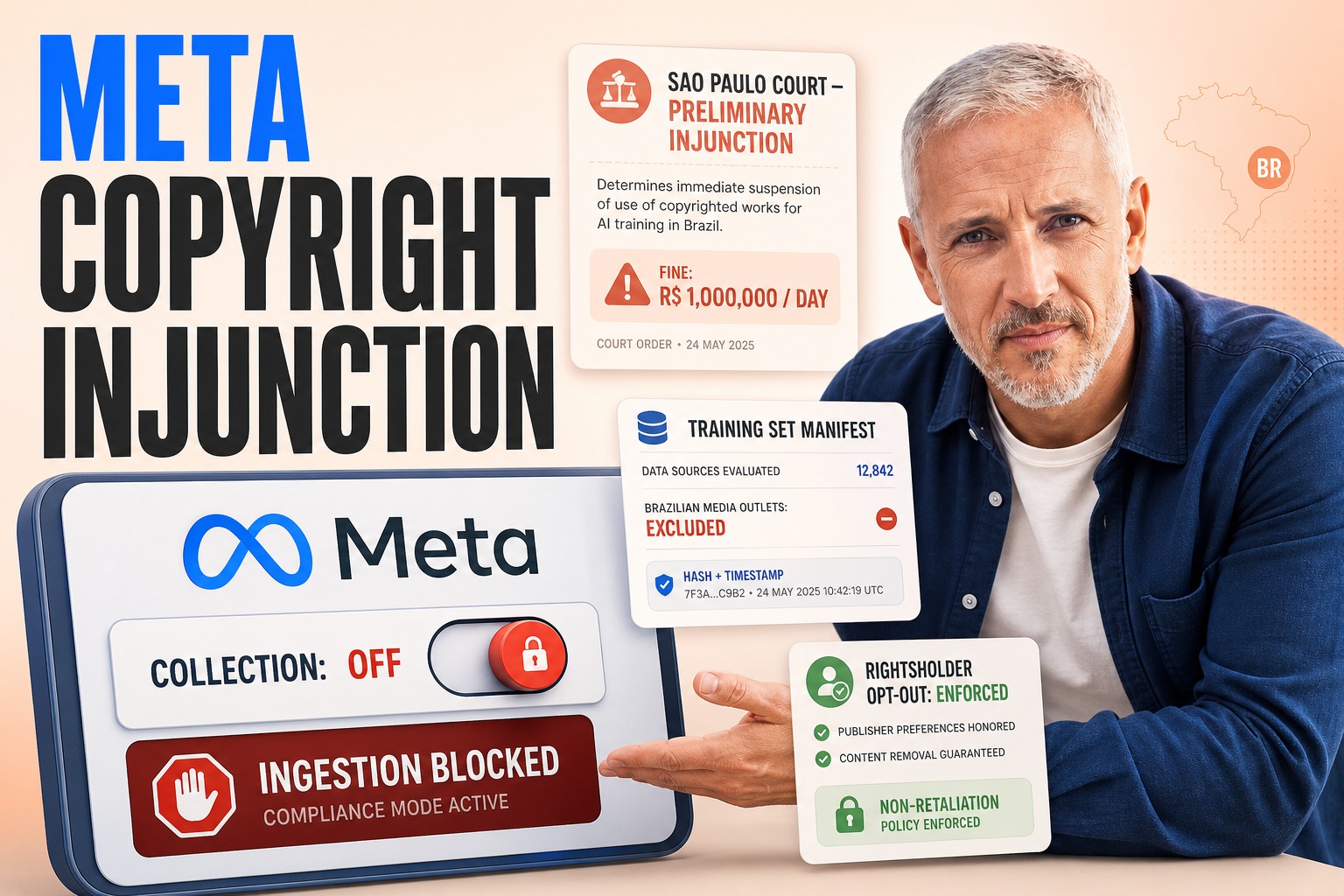
What just happened in Brazil? → A Sao Paulo state court ordered Meta to stop collecting Brazilian media content for AI training.
Why should a CTO care? → Because consent, provenance, and opt-out mechanics must be engineered, not promised.
What is the core technical risk? → Training an llm on disputed data creates “irreversible” exposure once weights embed it.
What changes immediately? → Treat terms-of-service changes like production dependencies with rollback plans.
What is the practical takeaway? → Build data and model controls that can prove exclusion and enforce licensing.
Quick Answer
An llm program fails compliance when it cannot stop ingesting, prove what was excluded, and demonstrate non-retaliation paths for rightsholders. In Sao Paulo, a judge issued a preliminary injunction ordering Meta to halt collecting Brazilian media content for AI training, with a daily fine of one million reais for non-compliance. The order also suspended a terms section and barred penalties against outlets that rejected it.
Copyright compliance is now a runtime requirement of your training pipeline, not a clause in your vendor contract.
The Meta Injunction Is A Systems Problem, Not A PR Problem
A Sao Paulo state court ordered Meta to stop collecting content from Brazilian media outlets, after three national press associations sued over new business terms. Those terms, set to take effect on November 20, allegedly tied continued platform use to free access to copyrighted works for AI training. If you ship llm based solutions, read this as an engineering pattern: courts can force abrupt data-source shutdowns, and you need graceful degradation.
- Injunction risk is operational: training jobs, dataset refreshes, and vendor connectors may need an immediate hard stop.
- Consent must be machine-readable: human PDFs do not translate into enforceable ingestion decisions.
- “No penalty for opting out” becomes a product constraint, not just a legal position.
- Auditability matters: you may need to show which sources were excluded and when.
- Timelines compress: the judge ruled without waiting for Meta’s response due to the short runway.
LLM Training Rights: What The Brazil Injunction Signals
The court set a daily fine of one million reais if Meta fails to comply, and gave the company five days after notification to present its defence. The judge also agreed harm would be irreversible once an AI model is trained on the outlets’ content, and called forced free surrender of copyrighted works an abuse of rights. For engineering leaders, the signal is blunt: training data rights will be tested under injunction timelines.
| What The Order Targets | What Breaks In A Typical Stack | What To Engineer For |
|---|---|---|
| Collecting media content for AI training | Automated scrapers, feed imports, backfills | Source-level kill switches and allow/deny lists |
| Terms tied to continued platform access | “Accept or lose distribution” dependencies | Alternate distribution and ingestion paths |
| Penalties against outlets that reject terms | Account restrictions, reduced reach, throttling | Non-retaliation controls and policy-as-code |
| Daily fine for non-compliance | Slow internal escalation loops | Real-time compliance toggles and incident playbooks |
Data Engineering Best Practices For Copyright-Safe Training?
Start by assuming that a court can invalidate a specific clause while keeping the rest of the relationship intact. That means your data engineering cannot treat “source = platform” as a single trust unit. Build your ai data pipeline with explicit content lineage: which outlet, which URL or handle, which ingestion mechanism, and which permission state. When permissions flip, ingestion must flip too, without manual reprocessing chaos.
Design For Injunction Latency, Not Quarterly Policy Reviews
Meta’s terms were scheduled to take effect on November 20, and the judge acted fast, issuing the ruling without waiting for the company’s response. That is the operational shape of modern AI governance: short windows, partial information, and immediate constraints. Your architecture should assume that a source can become prohibited mid-sprint and that you will still be expected to keep the product running.
A practical pattern is to separate ingestion, transformation, and training queues so you can pause one without collapsing the rest. Add a rights gate before any durable storage tier. Then ensure model serving can continue on existing artifacts while training is paused, with feature flags that disable retrieval or summarization over newly restricted corpora.
Prove What Was Not Used
The judge’s rationale hinges on irreversibility after training. From an engineering standpoint, that translates into evidentiary requirements: demonstrate exclusion, not just inclusion. Maintain immutable logs of ingestion decisions, retain hashes and timestamps for each document, and store permission snapshots that explain why a piece of content was eligible at that moment. This is not “nice to have”; it is your defense posture when policy shifts faster than release cycles.
Contract Language Won’t Save A Pipeline That Can’t Enforce It
The associations alleged Meta demanded free access to content in exchange for continued use of its platforms. Even if your org never writes terms like that, the caution is broader: contractual intent does not automatically map to technical enforcement. If your collectors, partner APIs, or downstream vendors cannot represent “reject” states, you may accidentally keep ingesting after an opt-out, and you will not be able to unwind it.
Source registry with ownership metadata and permission state per publisher, not per platform domain.
Rights-aware storage tiers: quarantine buckets for disputed content until clearance is explicit.
Training set manifests that can be regenerated to exclude specific outlets on demand.
Automated ai damage assessment: map which features and endpoints depend on a given corpus.
Release controls: block deployments when policy gates are failing or audit trails are incomplete.
How To Implement MLOps For Copyright Compliance?
If your team is asking how to implement mlops under fast-moving AI regulation, anchor the answer in controllability and traceability. Compliance should be a first-class pipeline stage: validate rights before ingestion, before embedding, and before training. Make “deny” a tested path, not an exception. Then connect that to incident response: a court order is effectively a P0, with rollback, comms, and verification.
An opt-out that cannot be enforced end-to-end is indistinguishable from no opt-out at all.
Where Compliance Actually Lives: Manifests, Gates, And Evidence
Treat training data like dependencies with explicit versioning. The key artifact is a manifest: a signed list of inputs that a training run is allowed to touch. When a publisher’s permission changes, you regenerate manifests and invalidate any scheduled jobs referencing the old ones. This also clarifies what you owe downstream: a service can continue operating on prior approved snapshots while you quarantine new inflow.
- Rights gate at ingestion that blocks writes when permission state is unknown or revoked.
- Content provenance tags propagated through embeddings, indexes, and feature stores.
- Dataset manifests stored immutably and referenced by every training run.
- “Stop collecting” switch wired to orchestration, not to a human runbook.
Build The Team Like It’s Product, Not Legal Support
The plaintiffs included the National Association of Newspapers (ANJ), whose executive president Marcelo Rech said the injunction was a positive sign that there are limits to abuse of economic power. That framing will show up elsewhere: rightsholders will organize, and regulators will act. Engineering cannot delegate this to counsel alone; you need a product owner for rights workflows and a platform owner for enforcement. This is where AI consulting can accelerate gap analysis.
LLM Governance Patterns CTOs Can Ship This Quarter
Start with two realities: (1) injunctions can land before you “finish the policy,” and (2) retraining is not a rewind button. Design governance controls that are cheap to execute under time pressure. That means precomputing dependency maps from sources to product features, and building a path to pause collection without pausing customer-facing endpoints. You are optimizing for containment speed and evidentiary clarity, not just accuracy.
RACI For Rights: Make Enforcement Someone’s Job
Assign a single owner for publisher permissions, another for pipeline enforcement, and a third for incident response verification. Then rehearse the play: “publisher rejects terms” and “court bans collection.” The Sao Paulo judge also prohibited Meta from penalising outlets that rejected the terms; translate that into product requirements so your systems do not automatically throttle, demote, or restrict accounts when permission toggles occur.
The Engineering Thesis: Compliance Must Be Reversible Even When Training Is Not
The judge accepted that damage would be irreversible once the AI is trained on the outlets’ content. That logic is not Brazil-specific; it is a systems constraint. You cannot promise to “remove it later” unless you designed for exclusion up front. The safest move is to reduce how often you need to make irreversible updates: use smaller, more frequent, well-scoped training runs with explicit manifests, and minimize silent background ingestion.
When you do need deeper model work, isolate it behind well-defined interfaces so policy changes don’t require full-stack rewrites. For teams doing heavy data work, invest in machine learning development practices that bake provenance into datasets, experiments, and deployments.
Closing Checklist For Copyright-First AI Programs
Assume your next AI initiative will be reviewed through the same lens as the Meta dispute: coercive terms, free content demands, and irreversible training effects. Keep your llm roadmap viable by making permission states executable, auditable, and fast to change. The organizations behind the lawsuit say the ruling is the first in any country favoring a coalition opposing the new terms; regardless, the engineering lesson is portable. Author: Plavno team. Last updated: November 2026.
 Chat GPT
 Perplexity
 Claude
 Gemini

