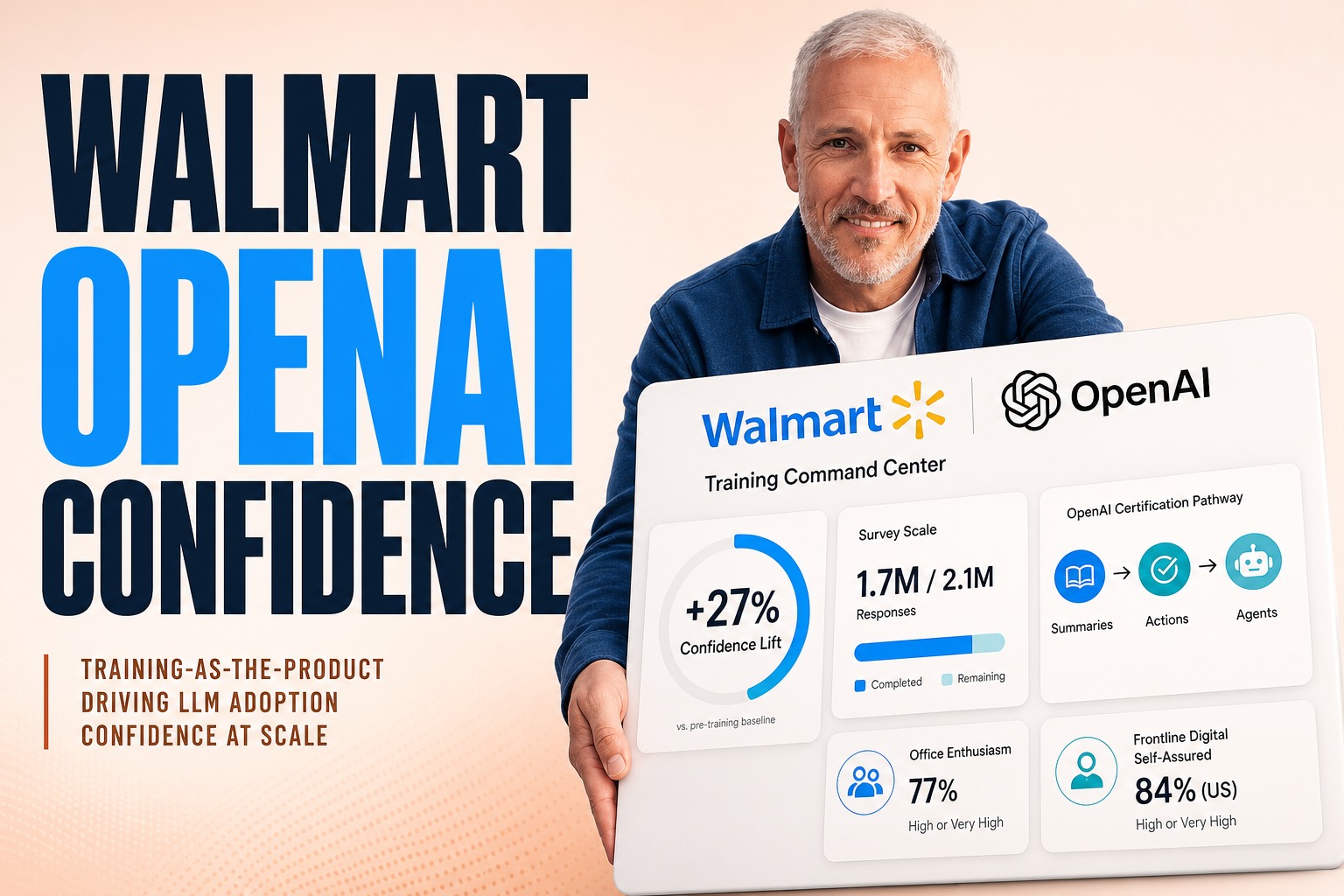
What changed when Walmart trained at scale on an llm? → Associates who completed OpenAI training reported a 27% confidence increase using AI.
How broad was the signal? → Walmart said its June 2026 survey drew 1.7 million responses out of 2.1 million associates.
What did office teams say? → Walmart said 77% of office-based associates feel enthusiastic about AI improving their jobs.
What did frontline teams say? → Walmart said 84% of U.S. frontline associates feel self-assured using digital tools.
What’s the adoption lesson for CTOs? → Treat training and certification as the product that unlocks daily AI usage.
Quick Answer
An llm rollout succeeds when you engineer confidence as deliberately as you engineer accuracy. Walmart’s internal June 2026 survey suggests that structured training (including OpenAI certification pathways) can move sentiment and day-to-day behavior, not just awareness. For CTOs, the replicable pattern is: standardize learning, connect it to practical workflows, and measure adoption with the same rigor you apply to reliability.
Adoption isn’t a side effect of model access—it’s a deliverable you build through training, tooling, and measurable work habits.
LLM Adoption Starts With Confidence, Not Curiosity
Walmart’s June 2026 internal survey is notable because it ties training to a concrete adoption outcome: associates who completed OpenAI training reported a 27% increase in confidence using AI. Walmart also said it gives more than 2 million associates access to no-cost AI learning and works with OpenAI and Google on certification pathways—an approach that looks less like ‘enablement content’ and more like an internal platform for behavior change. If you’re investing in llm based solutions, this is the reminder to budget for confidence-building, not just compute.
Certification pathways can act as a governance layer: they define who is ready to use which tools, where, and for what kinds of work.
How To Implement MLOps
If your adoption goal is ‘used daily by real operators,’ mlops has to cover more than training pipelines and model evaluation. It must also support controlled iteration of prompts, retrieval sources, and agent behaviors as people discover edge cases in normal work. That means versioning not just the model, but the workflow: inputs, guardrails, and output formatting that users learn to rely on.
The practical way to keep this sustainable is to treat the experience layer as a first-class artifact in the cloud: rollbacks, feature flags, and telemetry across roles. If your AI features are part of a broader modernization effort, align the release process with your existing delivery stack, such as cloud software development, so adoption fixes ship as routinely as product fixes.
| Adoption Signal | What To Measure | Why It Matters |
|---|---|---|
| Training-to-confidence lift | Pre/post self-reported confidence (as Walmart reported +27%) | Confidence predicts whether tools get tried without escalation |
| Role-based sentiment | Office enthusiasm (77%) vs frontline self-assurance with digital tools (84%) | Different roles need different UX and guardrails |
| Certification usage | Whether certificates map to daily workflows | Prevents ‘training theater’ and validates curriculum |
| User-built utilities | Count of practical internal tools built by associates | Indicates empowered problem-solving, not passive consumption |
Why Walmart’s Numbers Matter More Than Model Choice
Walmart said the June 2026 survey drew responses from 1.7 million associates out of 2.1 million. That scale matters because it reduces the risk you’re reading tea leaves from early adopters only. It also reframes enterprise generative ai as an org-wide capability: you can’t depend on a small ‘AI guild’ to carry adoption. You need measurable changes in confidence and routine usage across tenure levels and job families.
- Instrument confidence and frequency, not just ‘users activated’ or feature clicks.
- Design training around the workflows people already do, then remove friction from those steps.
- Make certifications operational: tie them to tool access, support tiers, and safe-use patterns.
- Encourage small internal utilities; they create pull for standards, not just top-down mandates.
Training As A Governance Primitive
Walmart said it works with OpenAI and Google on certification pathways, and that associates are using the certificates, training, and tools in daily work. That’s a governance strategy disguised as learning. When you standardize what ‘qualified usage’ looks like, you reduce security and compliance uncertainty without freezing adoption. This is especially relevant to teams planning chatgpt integration: the risk isn’t only data leakage, it’s inconsistent outputs becoming embedded in operational decisions.
Define role-based ‘allowed tasks’ and align each to a training module and assessment.
Create a certification ladder that matches tool power (summaries → actions → agents).
Require completion before expanding access to higher-impact capabilities.
Re-certify when workflows change, not only when the model changes.
How To Build An LLM
Building a working system is straightforward; building one people will use repeatedly is the hard part. Start by narrowing to two or three high-frequency tasks where output structure is obvious (summaries, checklists, exception triage). Then design for predictable interaction: the ‘right’ answer must look consistent enough that users can spot wrong answers quickly.
The second step is operational: choose review loops and ownership so the system improves from real usage. That includes quality triage, data sourcing rules, and change management across teams that will consume outputs. If you want a structured discovery and rollout plan, AI consulting can help translate adoption goals into a build backlog and governance checklist.
- Define acceptance criteria as a template: what fields must always be present in outputs.
- Prefer constrained generation and validation over open-ended responses for operational tasks.
- Build feedback capture into the workflow, not as a separate ‘report a problem’ form.
- Treat UX copy and training prompts as production assets with version control and reviews.
From Certificates To Citizen Builders
The document described associates building AI tools for their jobs, including a transportation associate in Canada who built an agent to help teams identify potential supply chain disruptions, and an Idaho store leader who built an app that turns handwritten notes into organized summaries and action items. That’s the adoption endgame: users who stop waiting for product teams. Support it with safe templates and lightweight deployment paths—especially for ai powered mobile apps used in the field.
Publish a ‘safe starter kit’ of approved patterns: summarization, classification, extraction, routing.
Offer a sandbox environment and explicit data handling rules for experiments.
Create a fast review lane for small tools so momentum isn’t killed by process.
Share internal examples and reuse components to avoid one-off, unmaintainable utilities.
Comparing Internal Sentiment To National Anxiety
Walmart compared its results with national sentiment: an August 2026 Pew Research Center poll found 52% of U.S. adults were more worried than enthusiastic about AI, while 9% leaned toward excitement over worry. Walmart said its associates described feeling more at ease with the technology and more eager about it. The point isn’t that retail workers are uniquely optimistic; it’s that structured exposure shifts perceived risk from abstract to manageable.
- Track ‘worry vs enthusiasm’ by role to spot where targeted training is needed.
- Separate fear of replacement from fear of errors; mitigate each with different messaging.
- Pair learning with tangible time savings in a real workflow to convert skepticism.
- Treat sentiment as a leading indicator for shadow AI usage and policy violations.
Adoption Architecture: Tools, Data, And Guardrails
Walmart’s leadership message implies a simple mechanism: provide tools, provide training, then measure the shift in confidence. Architecturally, you should assume the toolset expands from assistants to task-specific agents, and that different teams will want different levels of autonomy. A centralized platform that standardizes identity, policy, and observability makes that expansion survivable, especially if you plan broader AI agents development.
The adoption-centric design move is to make ‘doing the right thing’ easier than improvising. That includes approved knowledge sources, clear boundaries for automation, and escalation paths when outputs look wrong. If an llm is going to influence operational decisions, then auditability and explainability aren’t features—they’re prerequisites for trust at scale.
Tenure Neutrality Is The Hidden Win
Walmart said associates who have been with the company for one year and those who have been there for two decades report similar levels of AI excitement. That’s a strong adoption signal because it suggests the program reduced intimidation across experience bands. For engineering leaders, this is the argument for baseline enablement: if veterans and newcomers converge on similar enthusiasm, your organization can standardize workflows rather than fragmenting into ‘AI users’ and ‘everyone else.’
The Adoption Loop For Enterprise Generative AI
Walmart asked associates about AI for the first time in June, according to CNBC, and Walmart’s chief people officer for associate experience and digital, Maren Waggoner, told CNBC that associates are using the certificates, training, and tools in daily work. Notice the loop: ask, train, certify, observe usage, then ask again. Your adoption program needs that cadence so you’re not making roadmap decisions based on executive intuition.
In practice, enterprise generative ai becomes sustainable when HR enablement, security policy, and engineering delivery share one operating model. Don’t treat ‘governance’ as a document and ‘product’ as a separate stream; unify them in one backlog. And if your llm work includes chatgpt integration or internal copilots, make the user journey explicit: who is allowed to do what, with which data, and how mistakes are handled.
Metrics That Don’t Lie About Adoption
If you want a signal as clean as Walmart’s reported confidence lift, you need measurement designed for honesty. Track whether people return to the tool after the first week, whether outputs are being copied into real artifacts, and whether managers cite the tool in routine check-ins. Pair that with lightweight surveys so you can segment confidence by role. Most importantly, treat adoption gaps as engineering work: improve UX, tighten constraints, and clarify the ‘right way’ to use the system.
When user confidence rises, ‘AI policy’ shifts from policing behavior to enabling better behavior.
A Practical Next Step For Your Team
Start by choosing one workflow where errors are visible and recoverable, then couple access to training, not job titles. Run a short pilot, measure confidence shifts, and promote the people who build practical utilities into your internal champions. If you’re scaling an llm across functions, prioritize the adoption system—curriculum, certification, and observability—before you chase the next model upgrade.
Author: Plavno team. Last updated: October 2026.
 Chat GPT
 Perplexity
 Claude
 Gemini

