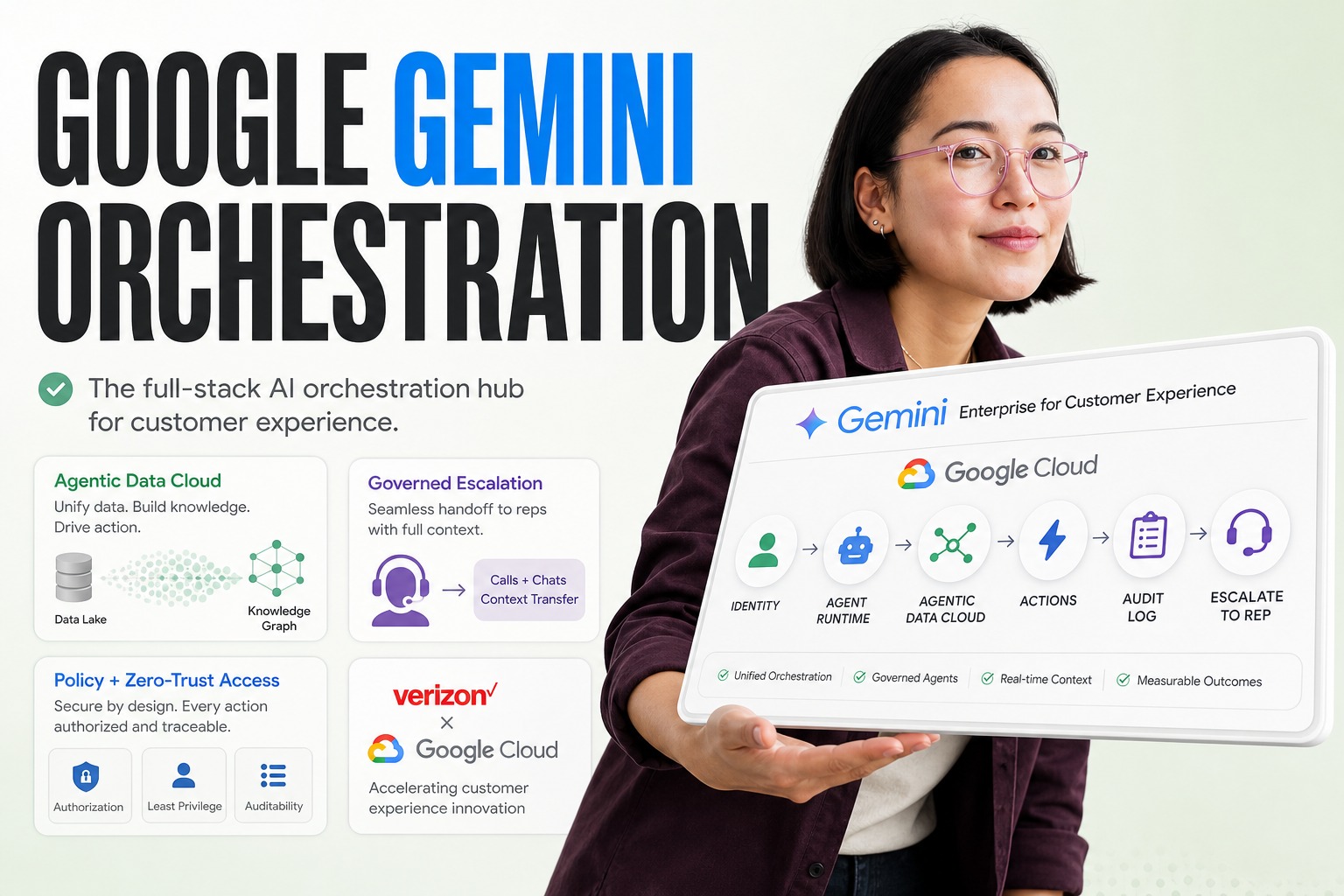
Is Gemini Enterprise for Customer Experience just a better chatbot for support? → No. The Verizon–Google Cloud partnership signals that the winning pattern is full-stack: the model, the data platform, and the operating model ship together.
What’s the real engineering question we need to answer this quarter? → Whether we should modernize customer experience with Gemini Enterprise now, and what foundations we must build first so it doesn’t stall after a pilot.
Why does Agentic Data Cloud matter in this story? → Because Google Cloud is positioning unified, agent-ready enterprise data as the prerequisite for reliable AI agents, not a later “phase two.”
Where do enterprise AI rollouts usually fail when leaders chase “AI-first”? → At orchestration boundaries: identity, data access, workflows, escalation, and governance—not at the raw model capability.
What’s the stance we’re taking at Plavno? → Treat Gemini Enterprise adoption as a data-and-operating-model migration with measurable CX outcomes, or you’ll build an impressive demo that cannot safely scale.
Verizon betting on Gemini Enterprise changes the “AI-first” playbook for CX teams
Verizon and Google Cloud are signaling a dominant shift: enterprise customer experience modernization is moving from isolated conversational AI deployments to a full-stack AI transformation anchored in Gemini Enterprise and a unified data foundation. Our central claim is that this breaks the common engineering practice of “deploy a bot, then connect data later.” The right response is to design for agent orchestration, data unification, and governance first—because reliability in production depends on the platform boundaries, not the model’s cleverness.
If you can’t describe how customer conversations, enterprise data, and agent actions are governed end-to-end, you’re not adopting Gemini Enterprise—you’re prototyping it.
Quick Answer: Should we adopt Gemini Enterprise for Customer Experience for our contact center and CX modernization?
Yes—if you are prepared to treat it as an enterprise modernization program that couples Gemini Enterprise for Customer Experience with a unified data foundation and clear agent orchestration boundaries. The Verizon partnership highlights that Google Cloud expects Gemini’s conversational, multimodal capabilities to sit on top of enterprise-wide data unification and security posture improvements. If your plan is only to add an LLM layer to existing silos, you should delay rollout until you can guarantee data access patterns, escalation paths, and governance.
- Adopt when CX is a platform problem, not a script problem. If your customer experience spans calls, chats, and digital touchpoints with inconsistent outcomes, Gemini Enterprise for Customer Experience only pays off when the underlying data and workflows are unified.
- Adopt when you can centralize enterprise truth. Verizon’s story explicitly ties acceleration to consolidating legacy data lakes into Google’s Agentic Data Cloud, which implies that “single source of truth” is a precondition for safe automation.
- Adopt when you need agents to execute, not only answer. Google Cloud frames Gemini Enterprise as enabling agents that perceive context and execute automated tasks; that changes your design from “responses” to “actions with auditability.”
- Adopt when security posture is part of the scope. The partnership emphasizes advanced threat detection and proactive risk governance; in practice this means your AI rollout must sit inside your security and compliance operating model.
The search question engineering leaders are actually asking
The practical query behind this news is: how do we implement Gemini Enterprise for Customer Experience without turning our contact center into a fragile orchestration layer that can’t scale? In our experience, the engineering risk is rarely that the model can’t converse; it is that identity, data access, and workflow execution are bolted on late, producing inconsistent agent behavior and forcing humans to clean up “automated” work.
Start from the action boundary, not the prompt. Define what the agent is allowed to do in customer journeys across calls and chats, then design the gating, auditing, and escalation path before you iterate on language.
Map data unification to CX outcomes. Verizon’s emphasis on consolidating data lakes into an Agentic Data Cloud implies that agent accuracy depends on unifying structured operational databases, unstructured documents, and knowledge graphs into a usable enterprise layer.
Treat agent orchestration as a production system. The partnership calls out agent orchestration and employee productivity; that implies a runtime with controls, not ad-hoc tool calls scattered across teams.
Align security posture with automation scope. If you plan to automate tasks, you must align with threat detection and risk governance requirements from day one, not after the first incident.
Design for enterprise rollout, not pilot optics. Verizon is scaling AI across the enterprise; evaluate whether your org can support cross-functional ownership across CX, data, security, and operations.
What Verizon’s “majority of inbound calls and chats” implies for reliability
When a platform handles the majority of inbound consumer calls and chats in a month, the system’s weakest point is not conversation quality—it is the operational failure mode when data is missing, confidence is low, or workflow execution is blocked. That scale forces disciplined fallback behavior: seamless handoff to customer care representatives for complex cases, consistent context transfer, and strict governance over what automation is permitted to do.
- A predictable escalation path beats a clever answer. At scale, the agent must reliably route complex, high-touch customer needs to representatives with full context, otherwise automation increases handle time and erodes trust.
- Unified enterprise data becomes a runtime dependency. If the agent depends on fragmented sources, different channels will produce different “truths,” which is operationally worse than a simple, consistent baseline.
- Agent action must be constrained. As agents move from answering to executing tasks, every action needs a policy boundary; otherwise a single misrouted workflow becomes a systemic incident.
- Observability becomes CX, not just SRE. Once AI touches core customer journeys, monitoring has to include customer outcomes and automation behavior, not only infrastructure uptime.
The dominant signal: full-stack AI is replacing “LLM-on-top” CX projects
Google Cloud is not positioning Gemini Enterprise as a standalone model choice; it is presenting a full-stack AI approach that includes high-performance infrastructure, advanced data infrastructure, and custom business agents. Verizon is adopting that full stack to modernize customer experiences, unify enterprise data, and scale AI across the enterprise. For engineers, this is the key shift: success criteria move from “does the bot answer well” to “does the platform safely orchestrate actions across business units.”
Gemini Enterprise for Customer Experience forces a hard choice about CX architecture
Verizon’s partnership frames Gemini Enterprise for Customer Experience as delivering measurable improvements in customer satisfaction and automated resolution rates across digital touchpoints, while freeing representatives to focus on complex needs. That’s the architectural tension: automation is now expected to handle the common path, which means your architecture must make the “simple path” genuinely simple—consistent customer identity, consistent data access, consistent policy checks—otherwise your team will spend the next year compensating for edge cases that should have been designed out.
- A conversational layer without unified data creates channel drift. Calls and chats become separate products with separate truths unless both draw from the same enterprise source of truth and governance model.
- Automation requires a stable operating model. If employees don’t trust agent outputs or can’t correct them with traceability, they will bypass the system and your automated resolution rates will stall.
- Customer-first “by name” implies identity discipline. Personalization at scale depends on consistent identity and consent handling; in practice, that is a systems problem, not a UX tweak.
- High-touch work becomes the exception path. Once the agent handles the majority path, you must engineer the exception path as a first-class flow with context transfer and clear accountability.
| CX modernization approach | What usually breaks in production | What Verizon’s signal suggests instead |
|---|---|---|
| Standalone bot for FAQs | Inconsistent answers across channels because enterprise data is fragmented | Gemini Enterprise sits inside a full-stack AI program with unified data |
| Point integration to a few systems | Workflow execution fails when edge cases hit permissions and missing fields | Agent orchestration is treated as an enterprise capability |
| Channel-by-channel automation | Support teams lose trust because behavior varies by touchpoint | A single, governed operating model across digital touchpoints |
| “Pilot first, platform later” | The pilot can’t scale because governance and security are retrofitted | Data and governance modernization are prerequisites |
Agentic Data Cloud is the real product decision hiding behind the model decision
Google Cloud explicitly positions Agentic Data Cloud as the engine for enterprise intelligence, natively managing and unifying all data types—from structured operational databases and unstructured documents to complex knowledge graphs. Verizon’s multi-year consolidation of legacy data lakes to this platform is presented as the groundwork for current AI acceleration, reducing silos and operational overhead while establishing a single source of truth. Our view: this is the real buy-in point—because a CX agent cannot be reliable if the enterprise cannot agree on its data.
Where AI agents actually fail: orchestration boundaries, not “hallucinations”
The press release language focuses on conversational, multimodal capability and high-precision outcomes, but the engineering failure mode we see in enterprise environments is orchestration: the point where an agent must pull context, apply policy, execute a task, and record what happened. Verizon is using Gemini Enterprise for agent orchestration and employee productivity across core functions, which implies that the agent layer is expected to touch workflows—not just respond. That is why we argue the architecture matters more than the model choice.
- Context boundaries create inconsistent agent behavior. When structured operational databases, unstructured documents, and knowledge graphs are not unified behind consistent access rules, the same question yields different outcomes depending on which context the agent can reach.
- Execution boundaries create silent failure. Agents can produce a confident narrative even when a downstream task fails; without explicit orchestration state and audit trails, teams misdiagnose the issue as “model quality.”
- Governance boundaries create rework and mistrust. If risk governance is unclear, teams will restrict automation reactively, turning agents into expensive chat interfaces that can’t safely do meaningful work.
- Escalation boundaries decide customer satisfaction. Verizon emphasizes freeing representatives for complex needs; that only works if escalation is engineered as a clean transfer of state, not a dead-end.
Security posture becomes part of CX when agents touch enterprise systems
Verizon’s partnership highlights strengthening cloud security posture with advanced threat detection and proactive risk governance while scaling AI across the enterprise. That matters because once AI agents are permitted to execute automated tasks, security is no longer an IT-only concern; it becomes part of customer experience reliability. If governance is unclear, teams will over-restrict what the agent can do; if controls are weak, the agent becomes a new pathway for misuse or unintended actions.
If an agent can act, then every action needs explicit authorization, traceability, and a defined owner—otherwise “automation” just moves risk into production.
Marketing automation is the canary for whether your “agentic” stack is real
Verizon is leveraging Google Cloud’s data and AI solutions to modernize marketing platforms, automating content creation and campaign orchestration to drive engagement, sales, and retention. Marketing is often the first domain where organizations try to operationalize automation because it spans data, workflows, and brand risk. If your stack cannot reliably orchestrate marketing tasks with unified data and governance, it will not reliably orchestrate higher-stakes customer care and network operations tasks either.
| Enterprise function | What the agent needs to be trustworthy | What the Verizon pattern implies |
|---|---|---|
| Customer experience (calls/chats) | Unified customer context, governed escalation, consistent digital touchpoints | Gemini Enterprise for Customer Experience plus enterprise data unification |
| Network operations | Ability to predict and resolve anomalies before customers are affected | An autonomous network intelligence framework on a data platform partner |
| Marketing | Campaign orchestration and content creation tied to accurate enterprise data | Automation is only as good as the single source of truth |
| Security | Threat detection paired with proactive risk governance | AI rollout is inseparable from security posture modernization |
Employee productivity is not a side benefit—it is the deployment mechanism
Beyond customer-facing use, Verizon will use Gemini Enterprise for agent orchestration and employee productivity to improve the operating model across core business functions. That’s the part many teams under-budget: employees become the control loop for automation quality. If the workforce cannot inspect, correct, and learn from agent behavior, you will not scale beyond pilots. At Plavno, we treat internal workflows as the proving ground for governed automation before expanding the blast radius to customer-facing journeys.
- Design humans as supervisors, not janitors. If employees only fix failures without visibility into why they happened, your system accumulates hidden debt and teams lose trust.
- Make productivity measurable in operational terms. If agent orchestration reduces friction in core functions, you should be able to trace improvements to specific workflows, not vague “time saved” stories.
- Treat knowledge capture as part of the workflow. Every escalation from agent to employee should improve the underlying enterprise knowledge base, or automated resolution rates will plateau.
- Align incentives across CX, data, and security. Scaling AI across the enterprise only works when teams share ownership of policies and outcomes, not just tooling.
How we evaluate Gemini Enterprise readiness in practice (without pretending we can predict everything)
We recommend evaluating readiness by walking one end-to-end customer journey and one end-to-end internal workflow, then stress-testing the orchestration boundaries. Start with a journey that crosses channels—calls and chats—and identify what data must be unified to keep the agent consistent across digital touchpoints. Then pick a workflow where the agent would execute tasks; define what the agent can do, what requires approval, and what must escalate. If you cannot articulate these boundaries, you are not ready to scale.
Plavno’s perspective: treat Gemini Enterprise adoption as a modernization program, not an AI project
At Plavno, we approach enterprise AI initiatives the way we approach any critical platform change: we anchor it to operating outcomes, and we design the data and orchestration layers to be maintainable under organizational reality. The Verizon–Google Cloud partnership emphasizes unifying enterprise data, scaling AI across the enterprise, and strengthening security posture; that combination is a blueprint for what “AI-first” means when you cannot tolerate brittle automation.
When we partner with teams on AI consulting, we typically frame the first phase around defining what “agentic” means in that organization: what tasks are automatable, what guardrails are required, and how enterprise data becomes a single source of truth that agents can rely on. The model is important, but the system is decisive.
Real-world application: a modern contact center that can actually scale beyond pilots
A practical scenario aligned to Verizon’s direction is a contact center modernization where Gemini Enterprise for Customer Experience handles the common inbound calls and chats while customer care representatives focus on complex cases. The architectural challenge is preserving context across channels and ensuring that automated resolution does not produce untraceable outcomes. In practice, that means the agent’s responses and actions must be grounded in unified enterprise data and governed escalation paths, so the “majority path” is stable and predictable.
Real-world application: autonomous network intelligence needs the same data discipline as CX
Verizon is building an autonomous network intelligence framework to predict and resolve network anomalies before they affect customers, using Google Cloud as a data platform partner. Even if you are not a telecom, the pattern generalizes: operational AI that affects customer experience must connect operational data, unstructured knowledge, and policy constraints into one governed system. This is where investing in cloud software development pays off, because your runtime and data foundation determine whether “autonomous” is safe or reckless.
Risks: a unified stack can simplify operations—or concentrate failure modes
A full-stack approach can reduce operational overhead by breaking down silos and establishing a single source of truth, but it also concentrates dependency on the platform boundaries. If enterprise data consolidation is incomplete, agents will be confident in the wrong context. If governance is ambiguous, teams will fight over what automation is allowed to do. And if security posture modernization lags behind agent rollout, the organization will be forced into reactive restrictions that stall adoption.
The trade-off leaders underestimate: consolidation speed versus organizational alignment
Verizon’s story includes a multi-year consolidation of legacy data lakes, which is a reminder that the hardest part is not deploying an agent—it is aligning organizations around shared data and shared ownership. Moving fast without alignment produces fragmented “AI-first” experiments that cannot share context or governance. Moving slowly without clear outcomes turns modernization into an endless platform program. The right balance is to modernize data and orchestration in lockstep with a small set of journeys that matter to customers and operations.
Build versus buy is the wrong question; “who runs the platform” is the right one
Gemini Enterprise and Agentic Data Cloud can accelerate delivery, but your organization still needs an engineering owner for the orchestration runtime, the data contracts, and the governance model. That owner can be internal, or it can be a partner, but it must be explicit. If you lack senior capacity this quarter, a targeted outstaffing model can help you stand up the platform team while your internal leaders retain architectural control and operational accountability.
What to measure when outcomes are described as “measurable,” not quantified
The partnership notes measurable improvements in customer satisfaction and automated resolution rates, but it does not publish numbers—and that’s typical in enterprise announcements. Engineering leaders still need measurement to decide whether the system is working. We recommend treating measurement as part of the architecture: define what constitutes automated resolution, how escalations are classified, and how consistency is verified across digital touchpoints. If you can’t measure it cleanly, you can’t improve it safely.
Closing insight: Gemini Enterprise is a forcing function for enterprise discipline
Verizon’s decision to make Gemini Enterprise a pillar of enterprise and customer experience modernization is a market signal that “agentic” AI is moving into core operations, not staying in innovation labs. Our claim stands: the winners won’t be the teams with the most impressive demos—they’ll be the teams who build unified data foundations, explicit orchestration boundaries, and governance that lets agents act without creating chaos. If you want AI that scales, treat it like a platform modernization and design for reliability from day one.
Author and freshness
Author: Plavno team
Last updated: August 2026
If you are planning a Gemini Enterprise for Customer Experience rollout and you can’t yet articulate your data unification plan, escalation model, and governance boundaries, we should treat that as the real blocker—not model selection. At Plavno, we help teams design the agent orchestration and data foundation so your CX modernization can scale from a pilot to an enterprise operating model via our AI agents development services.
 Chat GPT
  Perplexity
  Claude
  Gemini
