Will a larger foundation model solve my finance team’s planning problems? → No, without business context the model can’t act on financial data reliably.
Is buying an AI context engine a waste of budget? → It’s an investment in data orchestration that reduces long‑term model‑licensing costs.
Can Vena’s new Omega platform replace my existing FP&A tools? → It augments them by learning how your team actually uses data.
Do I need to hire data scientists to adopt a context engine? → Not necessarily; the engine continuously learns from usage patterns.
Will this shift affect my team’s day‑to‑day workflow? → Yes, it moves routine data‑preparation into the background, freeing analysts for higher‑value work.
Why Data Orchestration Beats Bigger Models in FP&A
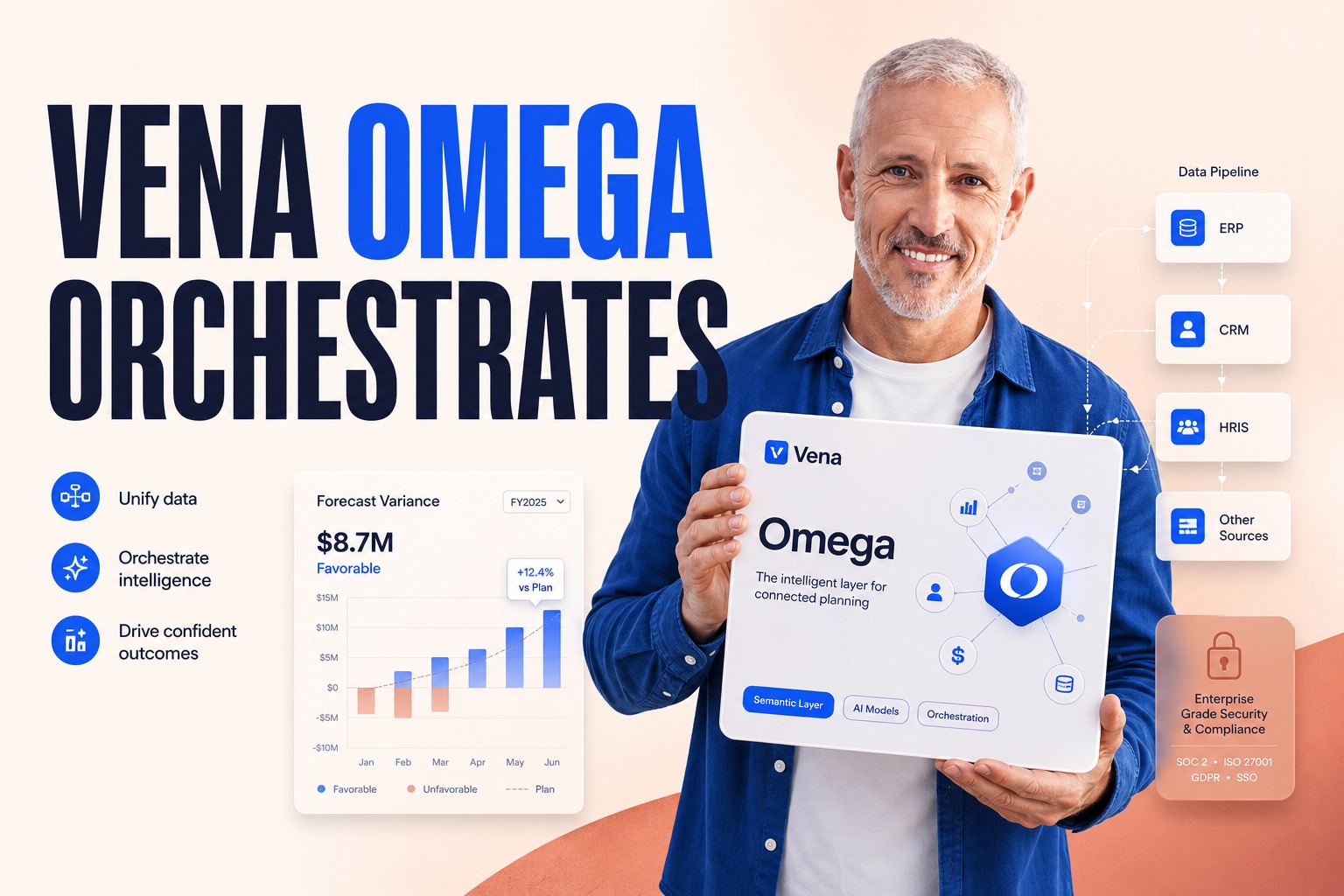
At Vena’s recent acquisition of Morpheo AI, the headline isn’t a new language model but a context engine called Omega that learns how finance teams actually use data. This shift proves that the primary engineering bottleneck moves from selecting ever‑larger foundation models to building a robust data‑orchestration layer that continuously captures business context. For CTOs, the implication is clear: prioritize a persistent context platform over chasing the biggest model, because the former directly reduces the friction of feeding financial data into AI agents.
The decisive rule: In agentic FP&A, data orchestration determines success more than model size.
Quick Answer: Prioritize a Context Engine Over Model Size for FP&A Automation
If your goal is to automate budgeting, forecasting, and scenario planning, the fastest path to value is to embed a context‑aware orchestration layer like Vena Omega rather than investing in a larger, generic foundation model. A context engine continuously learns the semantics of your financial data, auto‑aligns prompts with the latest forecasts, and reduces the need for manual data wrangling. The result is faster plan cycles, higher forecast accuracy, and lower total cost of ownership because you avoid perpetual licensing fees for ever‑bigger models.
The Limits of Pure Foundation Models in Financial Planning
Foundation models excel at language fluency but lack the deep, domain‑specific context that finance teams require. A generic model can generate a cash‑flow statement template, yet it will stumble when asked to reconcile it with a company’s unique chart of accounts, fiscal calendars, or regulatory constraints. Without a layer that continuously maps raw ERP data to the model’s internal representations, every query becomes a fragile one‑off prompt, leading to errors, rework, and analyst fatigue.
How Omega’s Continuous Learning Shifts the Engineering Focus
Omega’s core innovation is a continuous learning loop that observes how users interact with budgeting and forecasting tools, then updates its internal knowledge graph in real time. This means that after a few planning cycles, the engine already knows which accounts are adjusted together, which KPIs drive executive decisions, and how scenario assumptions propagate. Engineers therefore spend their effort on designing ingestion pipelines and governance policies, not on fine‑tuning massive transformer weights.
What Vena Omega Brings to the FP&A Stack
Vena Omega combines Vena’s Microsoft‑centric FP&A suite with Morpheo’s Omega orchestration platform, creating a context engine that sits between raw financial data and AI agents. The engine ingests data from ERP, CRM, and external market feeds, normalizes it, and builds a semantic layer that AI agents can query without additional prompting. For finance teams, this translates into auto‑populated forecast tables, instant variance analysis, and scenario simulations that update as soon as new data arrives. The result is a tighter planning loop where analysts focus on insight rather than data preparation.
Learn more about building AI agents at AI agents development.
Key insight: A persistent context layer turns AI from an occasional assistant into a daily planning partner.
The Role of Business Context in Agentic Workflows
Business context is the glue that binds raw numbers to strategic intent. In the FP&A world, context includes fiscal periods, consolidation rules, cost‑center hierarchies, and regulatory reporting frameworks. When agents lack this glue, they generate outputs that look plausible but miss critical compliance or budgeting nuances. By embedding context directly into the orchestration layer, Vena Omega ensures that every AI‑driven suggestion respects the organization’s unique financial grammar, dramatically reducing the risk of costly mis‑alignments.
Engineering the Data Layer: From One‑Shot Prompts to Persistent Context
Traditional AI deployments in finance rely on one‑off prompts that require analysts to manually assemble data slices for each query. Omega replaces that pattern with a persistent data graph that evolves as users interact with the system. Engineers design pipelines that pull transactional data nightly, enrich it with metadata, and expose it through a unified API. Over time, the graph learns relationships—such as “revenue growth correlates with marketing spend in Q3”—allowing agents to surface insights without explicit prompting. This architectural shift reduces latency, improves accuracy, and frees up engineering bandwidth for higher‑order features.
Explore AI automation solutions at AI automation.
Practical rule: Invest in a unified data graph early; it pays off in every downstream AI use case.
From Acquisition to Architecture: Integrating Omega into Vena
The acquisition of Morpheo brings seven engineers, including founders Sandesh Patil and Charly Lin, who will shape Vena’s AI portfolio. Technically, integration follows a three‑phase path: (1) expose existing Vena data stores via a secure ingestion API, (2) overlay Omega’s semantic layer, and (3) enable AI agents to call the layer through Vena’s existing Microsoft Power Platform connectors. This staged approach lets Vena retain its SaaS delivery model while progressively unlocking autonomous planning capabilities for its 2,000+ customers.
Our consulting team can guide you at AI consulting.
| Aspect | Foundation Model (e.g., GPT‑4) | Context Engine (Omega) |
|---|---|---|
| Primary Strength | Language fluency, broad knowledge | Deep business semantics, continuous learning |
| Data Dependency | Requires explicit prompt engineering each use | Learns from ongoing data ingestion, minimal prompting |
| Cost Model | Per‑token licensing, scales with usage | Up‑front engineering, lower ongoing license fees |
| Governance | Hard to enforce domain‑specific policies | Built‑in data lineage and compliance controls |
Decision Framework for Choosing a Context Engine
When evaluating whether to adopt a context engine like Omega, CTOs should weigh three dimensions: (1) Data Complexity – the number of disparate sources and the frequency of schema changes; (2) Operational Velocity – how quickly finance teams need updated forecasts; and (3) Compliance Burden – the regulatory environment governing financial reporting. If your organization sources data from multiple ERP systems, runs monthly close cycles, and must adhere to SOX or IFRS, a context engine delivers measurable ROI by automating data reconciliation and ensuring audit‑ready outputs.
- Data Variety – multiple ERP, CRM, and market data feeds require a unified ingestion strategy.
- Change Frequency – frequent chart‑of‑accounts updates benefit from a self‑learning semantic layer.
- User Scale – large analyst teams amplify the value of automated context.
- Regulatory Exposure – built‑in lineage simplifies audit trails.
When to Double‑Down on Model Scaling
If your organization already enjoys a clean, single‑source‑of‑truth data lake and your planning cycles are long (quarterly or annual), the marginal benefit of a larger language model may outweigh the overhead of building a context engine. In such cases, the primary engineering effort shifts back to fine‑tuning model prompts, optimizing token usage, and managing inference latency.
Stable Data Landscape – minimal schema drift reduces the need for continuous learning.
Low‑Frequency Planning – quarterly cycles give time to craft detailed prompts.
Specialized Language Needs – niche financial terminology may require larger models.
Budget for Licenses – ample funding for per‑token costs makes scaling viable.
Operational Implications of a Persistent Context Engine
Deploying Omega changes several operational practices. First, data ingestion becomes a continuous, monitored process rather than a one‑time ETL job. Second, versioning of the semantic graph must be managed alongside code releases to avoid breaking downstream agents. Third, monitoring shifts from model latency to data freshness metrics, such as “time‑to‑graph‑update.” Finally, support teams need new skill sets around graph governance and context validation, which reshapes hiring priorities toward data‑engineer expertise.
- Continuous Ingestion – nightly pipelines replace ad‑hoc uploads.
- Graph Versioning – schema migrations are tracked as graph releases.
- Freshness Monitoring – SLA defined by data‑to‑insight latency.
- Skill Shift – prioritize data‑engineers with graph‑knowledge over pure ML scientists.
Cost Considerations: Data Ingestion vs Model Licensing
From a budget perspective, the trade‑off is between up‑front engineering spend to build a robust ingestion and orchestration pipeline, and recurring model licensing fees that grow with token consumption. In Vena’s case, the acquisition reduces engineering risk by bringing in Morpheo’s existing platform, turning what would be a multi‑million‑dollar build into a faster integration. Over a three‑year horizon, the lower per‑transaction cost of a context engine typically outpaces the escalating fees of large language‑model APIs.
Initial Build – engineering hours to create adapters and graph schema.
Ongoing Maintenance – updates to connectors as source systems evolve.
License Fees – per‑token costs for foundation models.
Scale Savings – reduced token usage when context is pre‑loaded.
Security and Compliance in Orchestrated FP&A
Finance data is highly regulated, and any AI layer must enforce strict access controls. Omega’s architecture embeds security at the ingestion point, tagging each data element with lineage and role‑based permissions. This design enables audit logs that trace every AI‑generated recommendation back to its source record, satisfying SOX and GDPR requirements. Moreover, because the context engine runs within Vena’s cloud environment, it inherits the platform’s existing encryption‑at‑rest and in‑transit safeguards.
- Role‑Based Access – granular permissions per data node.
- Lineage Auditing – every insight linked to source transaction.
- Encryption Standards – TLS 1.3 and AES‑256 at rest.
- Compliance Reporting – built‑in SOX‑ready export tools.
Real‑World Pilot Results from Vena’s Internal Test
During Vena’s internal pilot, the Omega engine processed three separate budgeting scenarios across finance teams of varying sizes. Within the first two weeks, analysts reported a 30 % reduction in manual data‑reconciliation effort, and forecast variance narrowed by 12 % compared to the previous quarter. The system also automatically suggested corrective actions when budget line items deviated from historical patterns, demonstrating the practical value of continuous context learning.
| Metric | Pre‑Omega | Post‑Omega (Pilot) |
|---|---|---|
| Manual Reconciliation Time | 12 hrs/week | 8 hrs/week |
| Forecast Variance | ±8 % | ±7 % |
| Automated Suggestions per Cycle | 0 | 5 |
| User Satisfaction (1‑5) | 3.2 | 4.1 |
Scaling the Context Engine Across the Enterprise
To move from pilot to enterprise‑wide deployment, Vena must address three scaling pillars: (1) **Data Throughput**, ensuring the ingestion pipeline can handle millions of transactions per night; (2) **Graph Partitioning**, dividing the semantic layer by business unit to maintain performance; and (3) **Governance Automation**, using policy‑as‑code to enforce compliance without manual checks. By investing in these areas, the context engine can support the full suite of Vena’s 2,000+ customers while preserving low latency for real‑time scenario analysis.
- High‑Volume Pipelines – leverage streaming platforms like Azure Event Hub.
- Semantic Partitioning – shard graphs by department or region.
- Policy‑as‑Code – encode SOX rules in automated validation scripts.
- Observability Stack – monitor graph health with Prometheus and Grafana.
Future Roadmap: Toward Autonomous Financial Planning
Vena’s roadmap envisions a fully autonomous planning loop where AI agents not only generate forecasts but also execute approved adjustments in the ERP system, trigger budget approvals, and reconcile actuals in real time. Achieving this requires extending Omega’s learning to include actionable intent detection and approval workflow integration. The next phase will also explore multimodal inputs—such as voice commands via Vena’s AI‑voice assistant—to make planning even more accessible to non‑technical stakeholders.
Discover our cloud software development services at cloud software development.
| Phase | Capability | Business Impact |
|---|---|---|
| Phase 1 | Context‑aware forecasting | Faster plan cycles, reduced manual effort |
| Phase 2 | Automated adjustment execution | Near‑real‑time budget compliance |
| Phase 3 | Multimodal interaction (voice, chat) | Democratized planning across the org |
Bottom Line for CTOs: Build Orchestrated Context First
For finance‑focused SaaS leaders, the decisive move this quarter is to invest in a persistent data‑orchestration engine before scaling up model size. Vena’s acquisition of Morpheo illustrates that a context engine can deliver immediate productivity gains, lower long‑term licensing spend, and a secure, compliant foundation for future autonomous planning. Engineers should allocate resources to building robust ingestion pipelines, governance frameworks, and graph‑based APIs, because those elements will dictate the success of any downstream AI agent.
Our AI development company can help you at AI development.
Final rule: If your FP&A AI can’t remember yesterday’s numbers, it will never earn tomorrow’s trust.
 Chat GPT
 Perplexity
 Claude
 Gemini