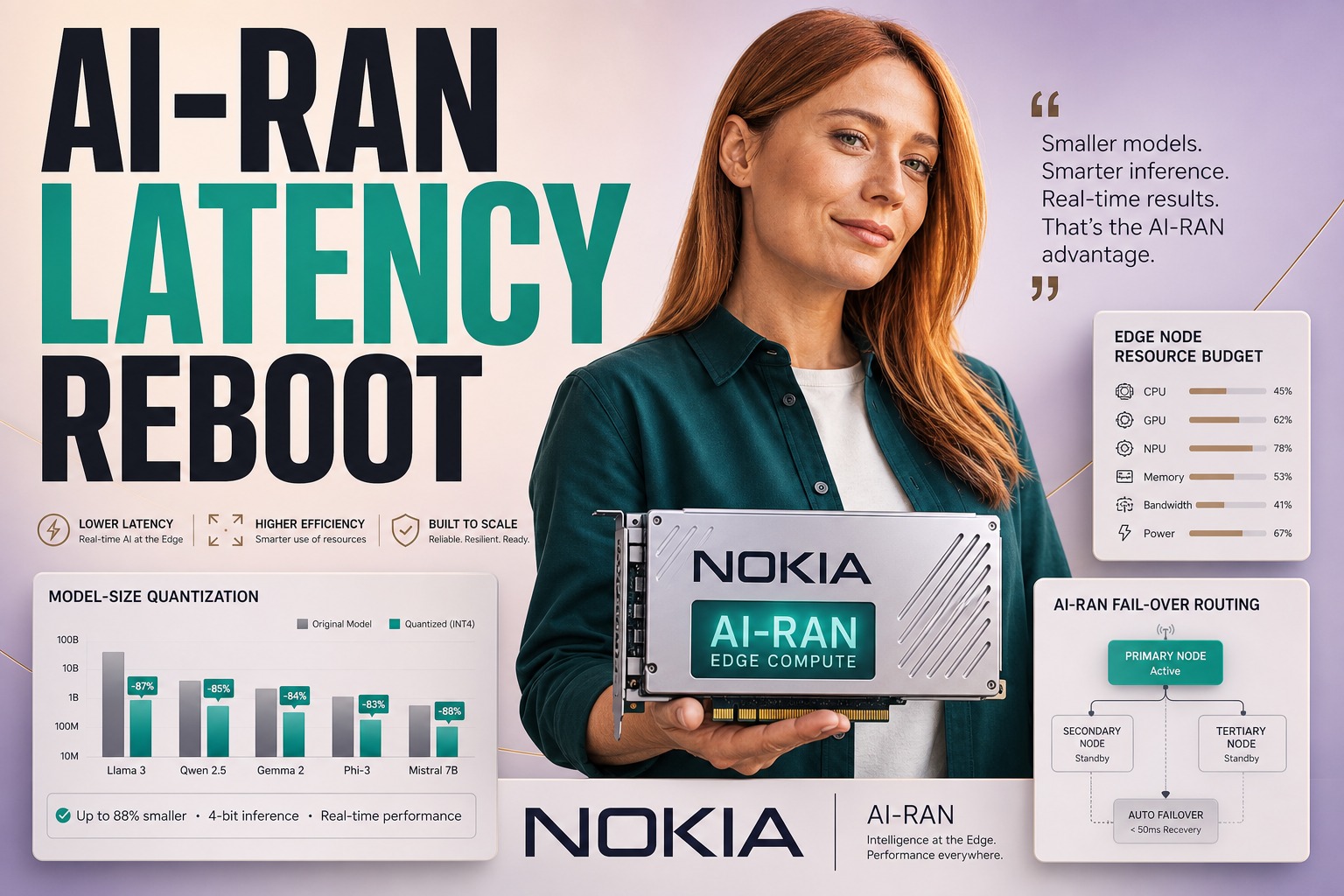
Can edge‑located AI inference really beat a central data‑center? → Yes, when latency dominates the service‑level agreement, placing inference at the radio access network cuts round‑trip time dramatically.
Is Nokia’s AI‑RAN just a marketing buzzword? → No, it is a concrete hardware‑software stack that turns existing cell towers into micro‑data centers capable of running AI models locally.
Do investors care about AI‑RAN, or is it only for telecom engineers? → Both; Wall Street is loading up on Nokia because AI‑RAN promises a $35 billion spend window, while engineers see a new latency‑breakthrough for real‑time AI.
Will AI‑RAN replace traditional AI cloud services? → Not replace, but it will offload latency‑critical inference, forcing architects to redesign the edge‑to‑cloud pipeline.
Quick Answer: AI‑RAN Shifts Real‑Time Inference from Data‑Center Bottlenecks to Edge Micro‑Data Centers
AI‑RAN transforms cellular base stations into compute nodes that host AI inference workloads, eliminating the network‑hop latency that plagues traditional cloud‑based inference. For engineers, this means the primary design decision moves from selecting the most powerful GPU model to orchestrating model placement, data freshness, and edge resource budgeting. The result is a latency‑first architecture where edge compute capacity, model quantization, and orchestration logic dominate performance and cost.
| Aspect | Traditional Cloud‑Centric Inference | AI‑RAN Edge Inference |
|---|---|---|
| Latency source | Network round‑trip to data centre | On‑site processing at the tower |
| Typical round‑trip | 30‑80 ms (varies by distance) | 5‑15 ms (local compute) |
| Capital expense | Large‑scale GPU farms | Upgraded base‑station hardware |
| Operating expense | High bandwidth & cooling costs | Distributed edge power & maintenance |
Why Latency Becomes the Deciding Factor for Real‑Time AI Services
Engineers have long optimized inference pipelines for throughput, assuming that the network delay is a minor constant. The surge in AI‑driven voice assistants, autonomous‑driving telemetry, and AR overlays makes sub‑20 ms response times a hard requirement. Nokia’s AI‑RAN technology, backed by Nvidia’s $1 billion investment, directly tackles this requirement by embedding GPUs and AI accelerators into the radio access network. The shift forces a re‑evaluation of where to host models: instead of a monolithic cloud, the optimal point moves to the nearest tower that can guarantee the latency budget.
- Latency‑first placement – Engineers must profile end‑to‑end latency and place the model at the edge if the network adds more than 10 ms.
- Model size constraints – Edge nodes have limited memory; models often need pruning or quantization to fit.
- Resource orchestration – A central controller must allocate compute slices across many towers, balancing load.
- Data freshness – Real‑time streams must be cached locally to avoid back‑haul delays.
- Fail‑over strategy – If an edge node fails, traffic must reroute to a neighboring tower without breaking the latency SLA.
How AI‑RAN Redefines the Edge‑to‑Cloud Boundary
In a classic architecture, the edge merely forwards raw sensor data to a cloud where a powerful GPU performs inference, then returns the result. AI‑RAN collapses this boundary by installing inference engines directly on the base station’s compute fabric. The practical effect is that the “edge” now hosts the entire model execution stack, while the cloud retains only model training, versioning, and analytics. This inversion means that the latency budget is no longer a function of network speed but of the compute latency inside the tower, which is typically an order of magnitude lower.
- Compute fabric upgrade – Nokia retrofits existing towers with AI‑accelerated ASICs, turning them into micro‑data centres.
- Software stack – A lightweight runtime manages model loading, inference, and telemetry on the tower.
- Network slicing – 5G‑Advanced slices guarantee deterministic bandwidth for AI traffic.
- Telemetry loop – Edge nodes report performance metrics back to a central orchestrator for dynamic scaling.
- Security enclave – Sensitive inference runs inside a hardware‑isolated enclave, reducing attack surface.
The Real Cost Curve: Capital vs. Operating Expenses in AI‑RAN Deployments
While AI‑RAN reduces latency, it introduces a distributed capital expense: each upgraded tower requires a GPU‑class accelerator, power upgrades, and cooling. However, the operating expense shifts from massive bandwidth bills to localized power consumption and periodic hardware refreshes. For a telecom operator, the net‑present value calculation now hinges on the trade‑off between saved latency‑induced churn (e.g., higher user satisfaction for voice assistants) and the incremental CapEx of edge compute. Nokia’s Q1 report shows a 49 % growth in its AI and cloud segment, indicating that the market is already pricing in this shift.
Assess latency budget – Quantify the maximum acceptable round‑trip time for your service.
Map tower coverage – Identify which cell sites can host the model within that budget.
Size the model – Prune or quantize to fit the edge node’s memory limits.
Allocate compute slices – Use a central orchestrator to reserve GPU time on each tower.
Implement fail‑over – Design a fallback path to neighboring towers or the cloud for resilience.
The Engineering Decision: Model Choice vs. Architecture Choice
When AI‑RAN entered the market, many teams assumed that the most powerful model would still win, simply because the hardware was now “close”. In practice, the architecture decision outweighs the model selection. A 175‑billion‑parameter model may deliver marginal accuracy gains, but its memory footprint and inference latency will exceed the capacity of a typical AI‑RAN node. Conversely, a well‑engineered 2‑billion‑parameter model, aggressively quantized, can meet sub‑15 ms latency on the same node, delivering comparable user experience. Therefore, engineers must prioritize architecture‑centric trade‑offs—edge placement, model compression, and orchestration—over raw model size.
| Decision factor | Cloud‑centric approach | AI‑RAN edge approach |
|---|---|---|
| Primary bottleneck | GPU throughput | Edge compute & memory |
| Model size limit | Tens of GB | Few hundred MB |
| Latency target | 30‑80 ms | 5‑15 ms |
| Scaling strategy | Horizontal GPU farms | Distributed tower upgrades |
Plavno’s Perspective on Building AI‑RAN‑Ready Solutions
At Plavno we have been advising enterprise AI teams on latency‑critical deployments for years. The emergence of AI‑RAN forces us to rethink our standard cloud‑first playbook. We now recommend a hybrid pattern: train centrally on Nvidia‑powered clusters, then export a distilled, quantized model to the edge runtime that runs on Nokia’s AI‑RAN nodes. Our experience shows that the most common pitfall is ignoring the edge’s limited storage, leading to model‑load failures during peak traffic. By integrating a model‑registry that tags each version with edge‑compatibility metadata, we avoid costly rollbacks. Learn more about our AI‑agents development service, explore cloud software development, see how we build AI voice assistants, get a software development consult, and read about the broader AI software development industry trends.
Key rule: In AI‑RAN deployments, latency‑budget compliance is the ultimate success metric, not raw model accuracy.
Operationalizing Model Updates Across Thousands of Towers
Deploying a new model version to a handful of data‑center GPUs is a simple CI/CD step. With AI‑RAN, the same operation must propagate to potentially thousands of distributed towers, each with its own firmware version and compute capacity. The solution is a staged rollout: first push to a pilot cluster of towers, monitor latency and error rates, then expand incrementally. This approach mirrors telecom‑grade software upgrades and requires robust telemetry pipelines that feed back into the central orchestrator.
- Telemetry ingestion – Real‑time metrics on inference latency, GPU utilization, and error counts.
- Canary release – Deploy to 1‑2 % of towers, validate, then scale.
- Version tagging – Each model carries a compatibility matrix for hardware revisions.
- Rollback automation – Immediate revert if latency spikes beyond threshold.
- Compliance audit – Log every tower’s firmware and model version for regulatory reporting.
When AI‑RAN Becomes a Competitive Differentiator for Enterprises
Enterprises that rely on ultra‑low‑latency AI—such as financial trading platforms, autonomous‑vehicle fleets, or immersive AR experiences—can gain a decisive edge by leveraging AI‑RAN. By processing inference at the tower, they reduce the round‑trip time that would otherwise expose them to market latency or user‑perceived lag. This advantage translates directly into higher conversion rates, lower churn, and in regulated industries, compliance with latency‑sensitive mandates.
Business Impact: From a $35 B Five‑Year Forecast to Real Revenue Streams
Dell’Oro Group projects cumulative AI‑RAN spending to reach $35 billion within five years. For Nokia, this translates into a potential margin lift, moving its historically sub‑3 % margin toward double‑digit profitability as AI‑RAN hardware sales accelerate. For telecom operators, the revenue model shifts from pure connectivity fees to value‑added AI services sold to enterprise customers. This creates a new revenue stream that justifies the upfront CapEx of upgrading towers, especially when combined with Nvidia’s $1 billion partnership that guarantees a supply of AI‑ready silicon.
| Stakeholder | Pre‑AI‑RAN Revenue Model | Post‑AI‑RAN Revenue Model |
|---|---|---|
| Nokia | Hardware sales + legacy networking | AI‑RAN hardware + AI‑software services |
| Telecom operators | Connectivity fees | AI‑as‑a‑service subscriptions |
| Enterprises | Cloud‑only AI costs | Edge‑AI subscription + lower latency fees |
Evaluating AI‑RAN for Your Quarter‑Planning Cycle
When a CTO sits down to allocate budget for the next quarter, the decision matrix now includes an “edge‑compute” line item. The first step is to quantify the latency gap between current cloud inference and the target SLA. If the gap exceeds 10 ms, AI‑RAN becomes a viable option. Next, calculate the number of towers needed to cover the user base, multiply by the per‑tower upgrade cost, and compare that to the projected revenue uplift from reduced churn or premium AI services. Finally, run a pilot on a limited geography to validate the model‑size limits and orchestration logic before committing to full rollout.
Real‑World Applications That Already Benefit from AI‑RAN
Several telecom giants have publicly committed to AI‑RAN trials, focusing on voice‑assistant latency, real‑time video analytics for public safety, and predictive maintenance of network equipment. In the voice‑assistant space, sub‑15 ms response times enable seamless conversational experiences on mobile devices without relying on distant cloud endpoints. For video analytics, processing frames at the tower reduces bandwidth consumption and allows instant alerts for anomalies, such as detecting a fire in a crowd‑dense area. Predictive maintenance leverages edge inference to detect hardware degradation patterns in real time, preventing costly outages.
Risks and Limitations of AI‑RAN Adoption
Despite its promise, AI‑RAN introduces new failure modes. Edge nodes are exposed to harsher environmental conditions, leading to higher hardware failure rates. The limited memory on towers forces aggressive model compression, which can degrade accuracy if not carefully calibrated. Moreover, orchestrating thousands of distributed inference instances creates a complex management plane prone to configuration drift. Finally, regulatory constraints in some regions may restrict on‑site AI processing of personal data, requiring additional privacy safeguards.
How to Build a Future‑Proof AI‑RAN Strategy
A future‑proof AI‑RAN strategy starts with modularity. Choose a model architecture that can be swapped out without re‑writing the edge runtime. Invest in a unified telemetry platform that aggregates per‑tower metrics into a single dashboard. Adopt a continuous‑delivery pipeline that supports staged rollouts and automated rollbacks. Finally, partner with hardware vendors—such as Nokia and Nvidia—who provide long‑term roadmaps for AI‑accelerated base stations, ensuring that your edge compute can evolve alongside model advances.
Modular model design – Use interchangeable layers that can be pruned or expanded.
Unified telemetry – Centralize latency, utilization, and error logs.
Staged CI/CD – Deploy canary releases across a small tower subset.
Automated rollback – Trigger instant revert on SLA breach.
Vendor roadmap alignment – Sync product cycles with Nokia/Nvidia releases.
The Bottom Line for Engineers and CTOs
AI‑RAN does not merely add another compute node; it reshapes the entire inference pipeline. Engineers must shift focus from chasing the biggest GPU to mastering edge placement, model compression, and distributed orchestration. CTOs should view AI‑RAN as a strategic investment that unlocks new revenue streams and satisfies latency‑critical SLAs, while also budgeting for the distributed capital costs and operational complexity. The decisive factor this quarter is whether your latency gap justifies the edge upgrade—if it does, AI‑RAN is the only viable path forward.
Takeaway: Treat AI‑RAN as a latency‑first platform; let that premise drive every architectural and budgeting decision.
Ready to future‑proof your AI infrastructure?
Our team can help you design, pilot, and scale AI‑RAN solutions that meet your latency goals while protecting your bottom line.
 Chat GPT
 Perplexity
 Claude
 Gemini