What does “agentic AI” mean for a warehouse management system? → It adds autonomous decision‑making agents that can trigger actions without human prompts.
Why is Kuehne+Nagel moving to a cloud‑native platform now? → To standardise processes across 100 countries and improve visibility during disruptions.
Which risk shifts when AI orchestration is added? → From data integration to the reliability of the AI coordination layer.
How should a logistics CTO evaluate this change this quarter? → By testing modular orchestration APIs before committing to full‑scale rollout.
Agentic AI Shifts WMS Priorities
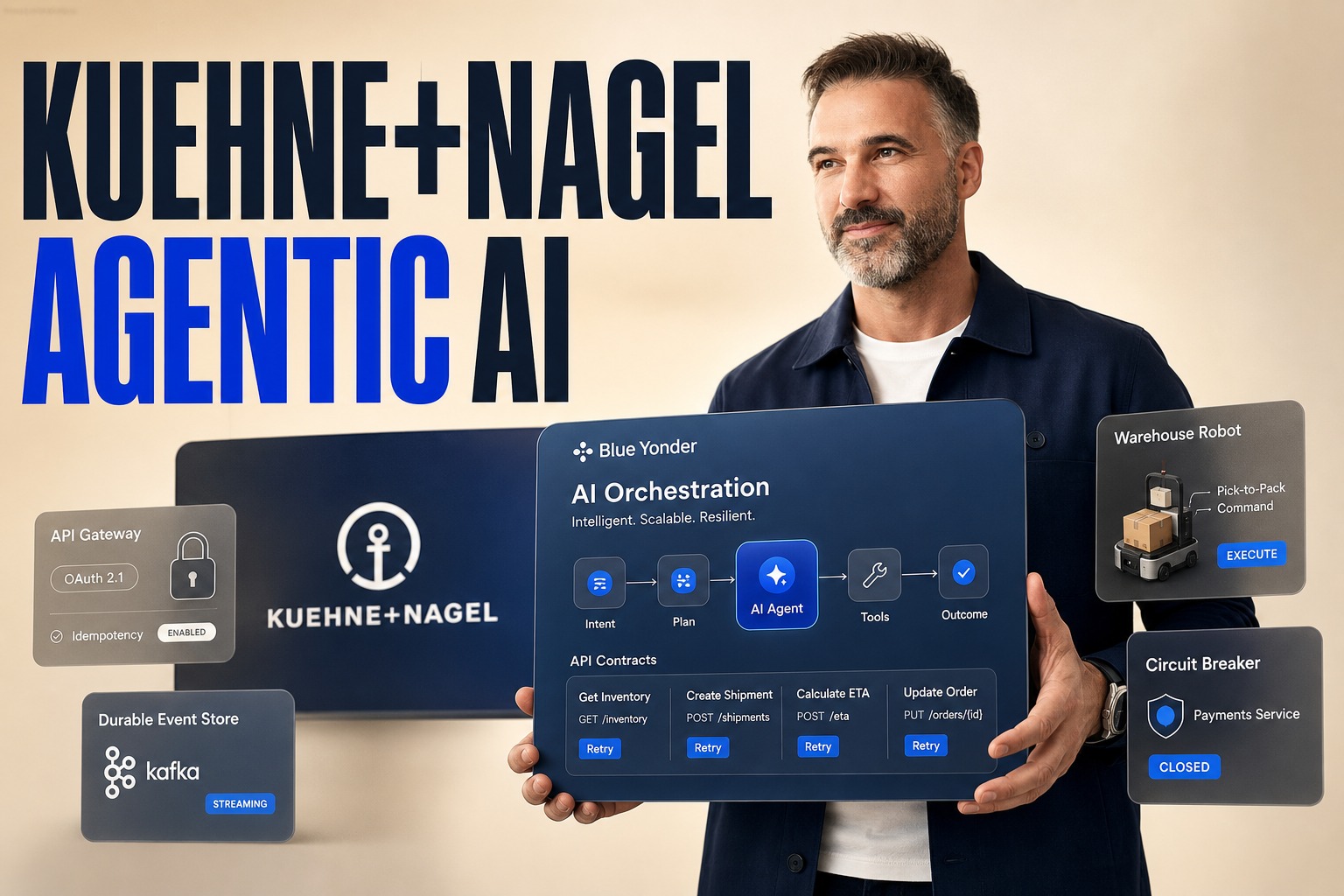
The rollout of Kuehne+Nagel’s cloud‑native platform, powered by Blue Yonder, replaces the legacy KN SwiftLOG system with “agentic AI capabilities”. This move is not a simple upgrade; it injects autonomous agents that can initiate planning, routing, and exception handling across the global network. For engineers, the headline implication is that the orchestration layer – the glue that connects agents to warehouse execution – becomes the new critical path. The classic focus on data pipelines recedes, and the reliability of the AI‑driven decision engine takes centre stage.
Key principle: In AI‑enabled WMS, orchestration reliability outweighs raw model accuracy.
Why Orchestration Becomes the Bottleneck
When a system can act on its own, every hand‑off between an AI agent and a downstream service introduces latency and failure modes. Kuehne+Nagel’s phased deployment across Asia highlights this: each phase must verify that agents can safely trigger pick‑to‑pack actions without breaking existing workflows. Engineers must therefore audit the APIs, idempotency guarantees, and retry semantics of every orchestration point before scaling.
Key principle: Treat every AI call as a distributed transaction.
Quick Answer
Agentic AI in a cloud‑native WMS forces logistics CTOs to prioritize modular orchestration layers over traditional WMS customisation. The immediate engineering response is to evaluate the vendor’s orchestration API, enforce strict contract testing, and stage AI agents behind feature flags during the first rollout.
Integration Risks vs Orchestration Risks
Legacy WMS upgrades traditionally worry about data schema mismatches. With agentic AI, the dominant risk moves to how agents coordinate actions. Kuehne+Nagel’s plan to keep the existing SwiftLOG core while adding AI agents illustrates this shift: the core still handles inventory, but agents decide when to move stock. Engineers must therefore build observability into the orchestration layer—tracing, metrics, and circuit‑breaker patterns—so that AI‑driven decisions can be rolled back if they jeopardise throughput.
Modular AI Orchestration Architecture
A practical architecture separates three concerns: (1) a stateless API gateway that validates agent requests, (2) a durable event store that records decisions, and (3) a pluggable executor that translates AI intents into warehouse commands. This pattern lets the logistics team replace or upgrade individual agents without touching the core WMS. Blue Yonder’s platform already exposes such APIs, but engineers must verify that they support versioned contracts and graceful degradation.
Evaluating Vendor APIs and Extensibility
When assessing a cloud‑native AI‑enabled WMS, the engineering checklist should include: supported authentication mechanisms, rate‑limit policies, event‑driven webhook reliability, and the ability to run agents in isolated containers. Kuehne+Nagel’s phased approach gives a natural testbed; each region can expose a sandbox API to validate these criteria before production traffic is switched.
- Authentication model – does the API use OAuth 2.0 or API keys?
- Idempotency guarantees – can repeated calls be safely retried?
- Versioning strategy – are breaking changes announced with deprecation windows?
- Observability hooks – does the platform emit OpenTelemetry traces?
- Fail‑over mechanisms – are there built‑in retries or circuit breakers?
Operational Scenarios Where Orchestration Fails
Even with robust APIs, real‑world disruptions expose hidden fragilities. Imagine a sudden surge in inbound freight; AI agents may flood the execution layer with pick orders, overwhelming the downstream conveyor control system. Without proper back‑pressure handling, the system stalls, and manual overrides become necessary. Engineers should simulate such spikes in a staging environment and validate that the orchestration layer throttles gracefully.
Cost Implications of Orchestration Layers
Adding an orchestration service incurs compute, storage, and network overhead. Kuehne+Nagel’s global rollout will multiply these costs across 100 sites. However, the payoff is faster disruption response and higher utilisation. A cost‑benefit model should compare the incremental cloud spend against the projected reduction in manual exception handling hours.
Baseline cloud spend – capture current VM and storage usage.
Orchestration overhead – add expected API gateway and event‑store consumption.
Efficiency gains – estimate hours saved from automated exception resolution.
ROI calculation – weigh added spend against saved labour.
Sensitivity analysis – vary AI request volume to see cost elasticity.
Roadmap for a Quarter‑Long Evaluation
A logistics CTO can structure the evaluation in four sprints: (1) sandbox integration, (2) contract testing, (3) load‑testing orchestration, and (4) phased pilot. Each sprint should produce a gate‑keeping metric—API latency under load, error‑rate thresholds, and rollback latency. By the end of the quarter, the team will have a quantified risk profile for scaling the AI agents globally.
| Metric | Target (Phase 1) | Target (Phase 2) |
|---|---|---|
| API latency | ≤ 100 ms | ≤ 80 ms |
| Error rate | ≤ 0.5 % | ≤ 0.2 % |
| Rollback time | ≤ 5 s | ≤ 2 s |
What the numbers mean for engineering
The latency targets force the orchestration layer to run in a low‑latency VPC, while the error‑rate ceiling pushes for exhaustive contract tests. Meeting these thresholds in Phase 1 validates that the AI agents can operate safely before expanding to additional regions.
Plavno’s Playbook for AI‑Enabled WMS
At Plavno we help logistics firms design the orchestration glue that connects AI agents to legacy execution systems. Our approach starts with a service‑mesh that enforces retries and circuit‑breakers, then layers event sourcing to guarantee auditability. By decoupling agents from the core WMS, we reduce the blast radius of any AI‑driven bug. We also provide cloud software development and AI consulting to tailor solutions, and our warehouse automation solutions accelerate deployment.
- Service mesh – Istio or Linkerd for traffic management.
- Event store – Kafka or Pulsar for durable decision logs.
- Feature flags – LaunchDarkly to toggle agents per site.
- Observability – Grafana dashboards for latency and error rates.
- Compliance – Ensure data residency per region.
Business Impact on Multinational Logistics
Standardising processes across Kuehne+Nagel’s 100‑plus sites promises tighter inventory visibility and faster response to supply‑chain shocks. The AI agents add a predictive layer that can re‑route shipments before a disruption hits. For a CTO, the business case hinges on quantifying the reduction in manual exception handling and the uplift in on‑time delivery metrics.
Visibility uplift – real‑time stock levels across borders.
Planning accuracy – AI‑driven demand forecasts.
Response speed – automated rerouting within minutes.
Cost reduction – fewer manual interventions.
Customer satisfaction – higher on‑time delivery rates.
Risks, Limitations, and Mitigations
Agentic AI introduces new failure modes: model drift, unintended command loops, and vendor lock‑in. Mitigation strategies include continuous model monitoring, sandbox‑only rollouts for new agents, and contractual API version guarantees from Blue Yonder. Engineers should also maintain a fallback path that can revert to the legacy SwiftLOG logic instantly.
Mitigation checklist for the quarter
- **Model drift alerts** – set thresholds on prediction confidence.
- **Rollback drills** – practice switching back to legacy workflows.
- **API contract audits** – verify version compatibility weekly.
- **Vendor SLA review** – ensure uptime guarantees cover orchestration services.
- **Data residency checks** – confirm cloud regions meet local regulations.
Closing Insight
The real takeaway for logistics engineers is that the success of a cloud‑native, AI‑augmented WMS now hinges on the robustness of its orchestration layer, not on the sophistication of the AI models themselves. By treating orchestration as a first‑class engineering concern—through contract testing, observability, and modular design—CTOs can unlock the promised agility while keeping risk in check.
Bottom line: Prioritise orchestration reliability today; the AI models will follow.
 Chat GPT
 Perplexity
 Claude
 Gemini