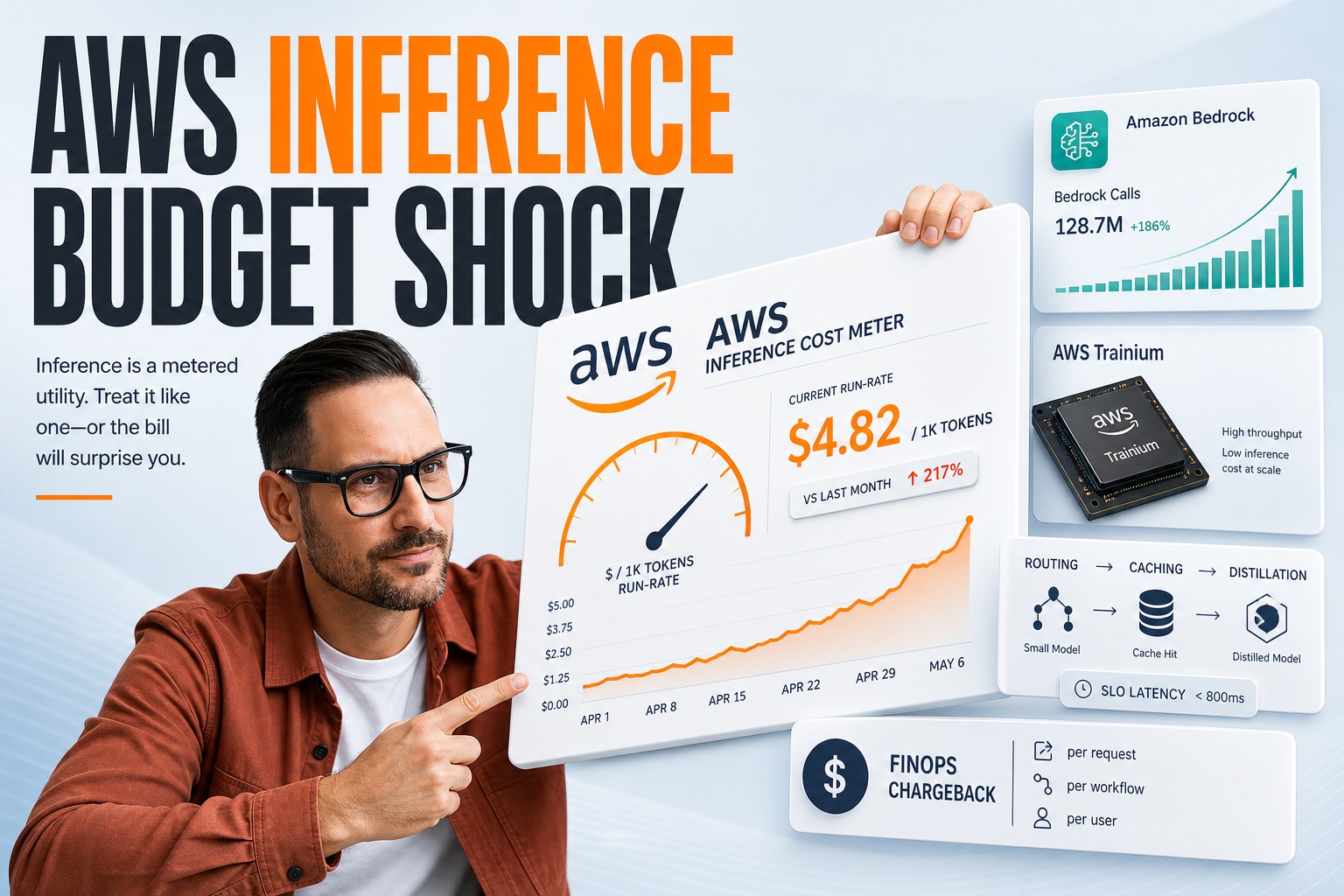
Is enterprise ai adoption slowing down or just getting more expensive? → More teams are shipping pilots, but inference turns every success into recurring spend.
Why does inference matter more than training for budget planning? → Training is periodic; inference happens every time the model is used at scale.
What is the most common budget surprise? → Usage grows faster than governance, so token volume becomes an unowned cost center.
What should engineering leaders do first? → Treat inference like a production platform with SLOs, not a one-off feature.
Where do skills constraints show up? → In operating and fine-tuning systems, not in writing prompts.
Quick Answer
enterprise ai adoption is increasingly constrained by inference economics, not model availability. Amazon CEO Andy Jassy called out the high cost of inference computing as a limiter for broader enterprise use, and he is right to frame it as a cost-per-unit problem: every additional workflow, user, and integration multiplies calls. When you budget AI like a project, you miss the ongoing bill.
Plan the ai budget around unit costs (per request, per workflow, per user) and force architecture decisions that reduce inference load: routing, caching, distillation, and right-sized infrastructure. If you are treating this as part of your digital transformation roadmap, bring finance in early with a metered model so success does not look like an overrun.
If your AI initiative cannot explain its inference unit economics, it is not production-ready, it is a demo with a future invoice.
Enterprise AI Adoption Is Now an Inference Budget Problem
On Amazon's third-quarter earnings call, Andy Jassy pointed to the high cost of AI models as a barrier to broader enterprise usage, with a specific emphasis on inference computing. He also highlighted a shortage of employees who can operate AI systems and fine-tune models. That pairing is the real story: even if you can pay, you still need the operating muscle to keep the bill stable as usage rises.
The spending mix is shifting toward inference. Gartner forecasts that inference will account for 55% of global AI-optimized infrastructure-as-a-service spending in 2026, reaching $23.3 billion, compared with $19 billion for training. This aligns with the mechanical reality: training is episodic; inference occurs each time a model is used. So the moment your product team finds real traction, your cost curve changes from capex-like bursts to an always-on opex line.
This is why enterprise ai adoption needs a budget narrative that is closer to cloud FinOps than to R&D. Jassy has argued inference will be the overwhelming majority of future AI costs, and he called chips the biggest culprit. He also pointed to model distillation, prompt caching, computing infrastructure, and model architectures as levers to improve efficiency. As engineering leaders, we should translate that into an operating principle: design for fewer, cheaper calls, not just better answers.
How Does Digital Transformation Cost Change With AI Inference?
Digital programs used to be costed around build and integration. With AI, the digital transformation cost becomes dominated by variable usage: every inference is a micro-transaction against your platform budget. In practice, this means the KPI that matters is not model quality in isolation, but cost per successful outcome under production load. That is also why leadership teams get surprised: adoption metrics look great right up until the invoice arrives.
Jassy's comments point to the right response: keep working on taking inference costs down. That is not a single tactic. It is an engineering portfolio: distill models where acceptable, cache prompts where deterministic, and redesign workflows so the model is not invoked for steps that a rules engine or retrieval layer can handle. In other words, you build a hierarchy of cheaper decisions around the expensive one.
There is also an infrastructure angle. Jassy cited AWS custom silicon, including Trainium AI chips, as a path to lower the expense of running models. Whether you are on AWS or elsewhere, the takeaway is the same: your ai budget should include an explicit line item for inference efficiency work, because the ROI is compounding. Without that, every new AI feature has an unbounded marginal cost.
| Budget Question | What Changes With Inference | What To Measure |
|---|---|---|
| What is the recurring run rate? | Costs scale with usage, not releases | Cost per request and cost per resolved task |
| Where are we wasting calls? | LLM invoked for low-value steps | Cache hit rate, routing accuracy |
| Who owns reliability? | AI becomes a production dependency | Error rate, latency SLOs, fallback success |
| Are we paying for the right compute? | Chips and infrastructure drive unit cost | $ per token-equivalent and utilization |
Designing An AI Operating Model For Inference Economics
The fastest way to lose control of spend is to let every team call the model directly. Enterprise ai adoption needs an ai operating model that defines who can ship AI changes, how they are gated, and how usage is accounted for. If inference is already well over half of AWS' AI revenue, as Jassy said, then you should assume your own program will naturally drift there too once adoption starts.
Treat this like a product platform with chargeback or showback. The core capabilities are boring but decisive: centralized telemetry, usage quotas, approval paths for new high-volume flows, and a performance budget per workflow. If you do not have the staff to do this, the constraint Jassy named becomes your constraint: operational expertise is scarce. This is where targeted AI consulting can be rational, but only if it builds internal capability rather than creating a permanent dependency.
Finally, do not underestimate ai change management. The moment you make teams accountable for unit costs, they will try to route around controls, especially under delivery pressure. Make it easy to do the right thing: provide shared libraries, approved patterns, and pre-built evaluation harnesses. You are not just enforcing governance; you are engineering the incentives that keep inference from eating the rest of the roadmap.
- Define a per-workflow inference budget and fail builds that exceed it without explicit approval.
- Route requests: small model first, escalate only when confidence drops.
- Cache deterministic prompts and standard summaries; measure cache hit rate weekly.
- Use fallbacks: retrieval answers, templates, or human handoff when latency spikes.
- Meter by tenant and by feature so product owners see the bill their roadmap creates.
What Drives Business Analysis Cost In Enterprise AI Programs?
Business analysis cost rises in AI programs because requirements are no longer just functional. You are specifying uncertainty: acceptable hallucination risk, response latency, escalation behavior, and what happens when the model refuses or fails. Add the need for evaluation datasets and policy constraints, and BA becomes an ongoing product discipline, not a phase gate.
Jassy explicitly called out a shortage of employees with expertise to operate AI systems and fine-tune models. That shortage shows up as analysis churn: teams keep re-scoping because they cannot predict behavior under real data and real users. One pragmatic fix is to staff the missing roles quickly with temporary capacity, then backfill internally. For some organizations, outstaffing can bridge MLOps, data engineering, and evaluation skills without pausing delivery.
Also, do not misread training vs inference. Many stakeholders still focus on training because it feels like the expensive moment. But as Amazon has explained, inference is repeated computing, and in large-scale applications it becomes the ongoing cost. Your BA artifacts should therefore include volume assumptions, call graphs, and fallback paths, because those determine the run-rate more than the initial model selection.
Start with a call graph: list every planned inference trigger, its volume driver, and its fallback.
Define acceptance by outcome, not by model: accuracy, latency, and escalation rules per workflow.
Add an evaluation loop: datasets, regressions, and release gates tied to unit cost.
Document ownership: who can increase volume limits and who signs off on spend impact.
A Practical AI Maturity Model For Budget Owners
An ai maturity model that ignores inference economics is incomplete. Early maturity is about shipping something that works; later maturity is about making it cheaper, safer, and more repeatable. The practical signal is whether you can forecast spend from product usage with reasonable confidence, then hold teams accountable to improve that forecast.
Use maturity levels that finance and engineering both understand: metering in place, unit cost targets set, routing and caching patterns standardized, and a repeatable evaluation process for releases. The goal is not perfection; it is to prevent the common pattern where the first successful workflow consumes the budget meant for the next five.
Where To Spend Next Quarter’s AI Budget
First, fund observability and metering. If you cannot tie token volume (or equivalent request volume) to a feature, you cannot govern it. Second, fund inference efficiency work explicitly: caching, routing, distillation experiments, and load testing. These are not polish items; they are what turns usage growth into margin, not pain.
Third, invest in reusable agent patterns rather than one-off chat UIs. Many enterprises are moving from single prompts to multi-step orchestration, and that makes call graphs even more important. If you need help building those patterns into products, ai agents development should be scoped around measurable unit-cost reductions and operational readiness, not just feature velocity.
What This Means For Enterprise AI Adoption In 2026
Gartner's forecast that inference will reach $23.3 billion and 55% of AI-optimized IaaS spending in 2026 is a budget warning: the default trajectory is more usage, more inference, more cost. Jassy said inference already accounts for well over half of AWS' AI revenue, and that is consistent with where most enterprise programs will land once real users arrive.
Closing: Make The AI Budget Survive Success
The healthiest enterprise ai adoption programs treat inference as a production utility: metered, optimized, and owned. Amazon reported AWS revenue growth of 39.3% to $46 billion in the quarter, and Bedrock usage indicators surged; the market is clearly pushing toward more inference, not less. Your job is to ensure your organization can afford its own growth curve by turning unit economics into an engineering requirement.
Author: Plavno team. Last updated: October 2026.
 Chat GPT
 Perplexity
 Claude
 Gemini

