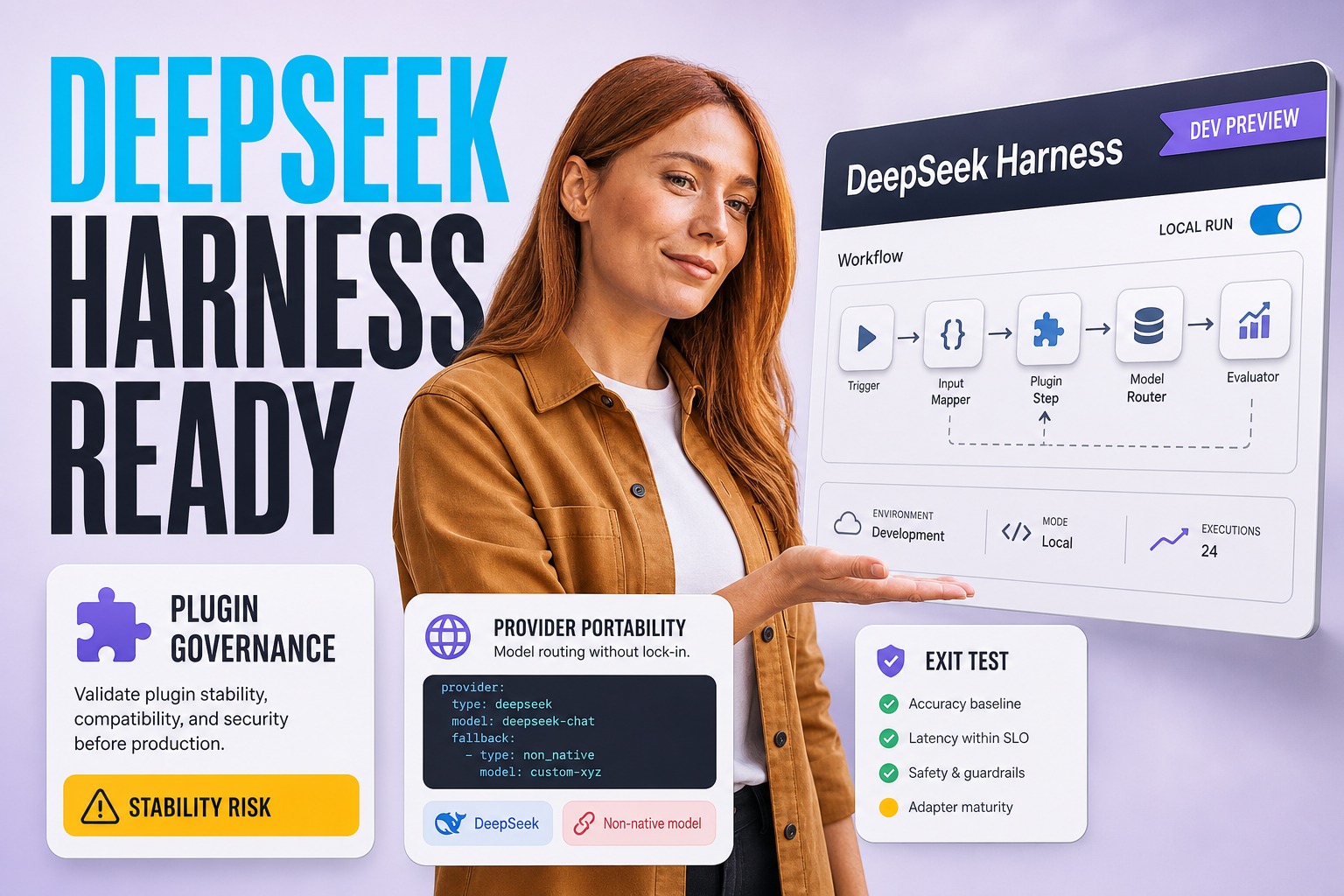
Is DeepSeek Harness the real shift this week, or just another AI repo spike? → The shift is architectural: an open source, locally-run workflow harness with a GUI is challenging the default assumption that AI orchestration must live in a cloud ecosystem.
What is the primary question engineering leaders should ask right now? → Whether a local, plugin-driven harness can meet production requirements for reliability, governance, and provider portability without becoming a new form of lock-in.
Why does this matter this quarter for a CTO? → Because local-first orchestration changes procurement, compliance posture, and operating model, and the wrong decision creates hidden maintenance debt around plugins and model compatibility.
What is the non-obvious risk that will decide success or failure? → The failure mode is not model quality; it is integration fragility at plugin and provider boundaries, especially when you need non-native models.
What will we recommend at Plavno? → Treat DeepSeek Harness as a control-plane experiment: pilot it for local workflow governance and privacy-sensitive workloads, but do not commit production-critical orchestration until you prove compatibility and contribution constraints in your environment.
Quick Answer: should we adopt DeepSeek Harness as a local AI workflow tool for production?
DeepSeek Harness is best evaluated as a local-first workflow orchestrator you can pilot now, not a production default yet. It is open source, runs entirely on local machines with a graphical web interface, and supports modular plugins plus multiple AI providers via configuration files, but it is also labeled a developer preview and shows real friction with non-DeepSeek models, plugin stability, and restricted external contributions.
Central claim: DeepSeek Harness signals that AI workflow reliability will be decided more by local orchestration and plugin governance than by the model itself, so the right response is to architect for strict integration boundaries and portability tests before you bet production on any single harness.
The dominant signal: local-first orchestration is moving from niche to default candidate
DeepSeek Harness is not being noticed because it is another interface for prompting; it is being noticed because it runs entirely on local machines and still gives developers a web-based graphical control surface for workflows. That combination is a direct challenge to cloud-first AI tooling, where orchestration, logs, and execution are implicitly tied to a hosted service and its billing and data boundaries.
Market pull is visible in the adoption pattern: the repository reached 135,000 GitHub stars and 8,800 forks within four days. That speed is not proof of production readiness, but it is a strong indicator of demand for open source, subscription-free AI workflow control that emphasizes privacy, control, and cost-efficiency rather than a cloud contract.
- Local execution as a first-class design: Workflows run on local systems, which changes security assumptions and eliminates an external control plane dependency.
- A GUI for operators, not just developers: A graphical web interface shifts the day-to-day workflow management discussion from scripts to operational control.
- Provider switching via configuration: Multi-provider support through configuration files suggests a path away from being trapped in one hosted AI ecosystem.
- Plugins as the customization mechanism: A modular, plugin-based architecture makes extensibility easy, but also creates a new reliability and governance surface.
Why local-first orchestration changes the engineering operating model
When orchestration is local, we stop outsourcing reliability to a vendor control plane and start owning it: host health, storage, secrets handling, and execution constraints become our problem again. In practice, this is attractive when privacy and cost predictability matter, but it also means your AI workflows inherit the same SRE expectations as any internal service, including change control and incident response.
| Decision axis | Local harness (DeepSeek Harness style) | Cloud-first AI workflow ecosystem |
|---|---|---|
| Control plane and data boundary | Runs locally, emphasizing privacy and direct control | Typically externalized to vendor cloud services |
| Extensibility model | Plugins and modular customization | Often integrations tied to the vendor platform |
| Portability across providers | Config-driven switching is the goal, but compatibility may vary | Switching providers can be constrained by platform assumptions |
| Operational responsibility | Your team owns runtime stability and upgrades | Vendor owns core service stability, you own integration |
The plugin architecture is the power, and also the production fault line
DeepSeek Harness emphasizes modular customization through plugins and supports multiple AI providers through configuration. In production, that means most outages and regressions will come from mismatched plugin expectations, provider-specific behavior, and the absence of universal compatibility standards when you bring non-native models. The input signal is explicit: integrating with non-DeepSeek models has proven difficult, and third-party add-ons can introduce crashes or instability.
Start by defining the workflow boundary: Decide what must stay local (data, prompts, logs) versus what can call out to a model provider, because local orchestration does not automatically mean local inference.
Map provider dependencies early: If you need non-DeepSeek AI models, treat compatibility as a gating requirement and assume friction until proven otherwise.
Treat plugins as third-party software: Plan a review and release process for plugins, since instability has been observed with add-ons.
Decide how you will handle a restricted upstream: If external contributions are limited, you must plan for internal ownership or forking when gaps appear.
What DeepSeek Harness really replaces is not an LLM, but your workflow control plane
In most enterprises, the real cost and risk of AI is not generating text; it is connecting generation to action across local systems. DeepSeek Harness positions itself in that gap by pairing a local runtime with a graphical interface that controls workflows end to end. That is why engineers should evaluate it like a control plane: the question is whether you can standardize execution and governance across teams without inheriting a fragile plugin dependency chain.
If your workflow can break when a plugin crashes or a provider adapter changes behavior, your reliability work belongs in orchestration governance, not in prompt iteration.
Local operation improves privacy, but it also makes you the vendor
Running entirely on local machines is the headline feature because it changes the default privacy posture: the harness does not rely on cloud services to operate, and that reduces exposure to subscription-based ecosystems. For regulated teams, it also reduces the number of external systems that must be justified during security review, because the control interface and workflow execution remain internal.
The trade-off is operational ownership. Local-first means your team must manage upgrades, configuration drift, runtime failures, and the discipline of how workflows and plugins are deployed. At Plavno, when clients ask whether local-first reduces cost, we answer that it shifts cost categories: you may reduce vendor spend, but you increase internal responsibility for engineering standards, especially if you want repeatable environments. This is where AI consulting becomes less about model selection and more about operating model design.
Provider portability is only real if non-native models behave predictably
DeepSeek Harness supports switching between AI providers via configuration files, which is a compelling promise for teams tired of vendor lock-in. But the input constraints matter: compatibility with non-DeepSeek AI models has been difficult, and the harness performs optimally with DeepSeek proprietary models. That means portability has to be tested as behavior, not assumed from configuration capability.
- Behavioral differences between model providers: Even with a shared workflow, model outputs and tool invocation patterns can diverge enough to break downstream steps.
- Adapter maturity becomes the bottleneck: If non-native model integration is inconsistent, the adapter layer defines your production ceiling.
- Configuration simplicity can hide deep coupling: A clean config file does not guarantee that plugins and workflows are provider-agnostic.
- Optimal performance with native models is a signal: If the system works best with one vendor, your portability story must include exit testing.
Restricted community contributions change how you plan for maintenance
Open source licensing suggests you can modify and redistribute, but restricted external contributions can still constrain the rate at which issues are fixed upstream. In practice, that means a CTO must decide whether the team is willing to become a long-term maintainer for critical gaps, especially when compatibility and plugin stability are known challenges. Without that plan, local-first can quietly become team-specific infrastructure that only one engineer understands.
Choose your ownership posture up front: Decide whether you will consume upstream as-is, maintain an internal fork, or treat the harness as a disposable pilot tool.
Define a plugin intake policy: Require explicit review for third-party add-ons, because add-ons have been associated with crashes and instability.
Create an exit test for provider changes: Validate that a non-DeepSeek provider can run your critical workflows before declaring portability.
Set upgrade guardrails: If the harness is a developer preview, upgrades should be staged and reversible rather than automatic.
The integration hurdle is not the UI, it is fitting a harness into your existing AI stack
A locally-run harness with a graphical interface is easy to demo, but enterprises rarely adopt demos; they adopt what fits their environment. The input signal already points to the hard part: integrating with non-native models and third-party plugins is inconsistent. In real systems, that inconsistency shows up at the seams where you connect workflow steps to identity, storage, and internal task execution.
When we evaluate tools like this, we treat them as a coordination layer that must coexist with existing services rather than replace them. Even if the harness runs locally, you still need an integration story for whatever sits around it: CI/CD, artifact distribution, runtime isolation, and the ability to run in standardized environments. That is where teams often lean on cloud software development patterns even for local-first tools, because the discipline of repeatable deployment matters more than where the bits execute.
Plugin instability is not a nuisance, it is a governance failure mode
The harness is modular by design, and that makes plugins the primary unit of customization. The input risk is direct: third-party add-ons have occasionally caused crashes or instability. In production, we treat that as a supply-chain and runtime governance issue, because a single plugin can destabilize a workflow that looks fine in development.
- Version drift across plugins: Without strict compatibility control, a plugin update can change behavior in ways your workflow tests do not catch.
- Unreviewed third-party code paths: Plugins expand the executable surface area, which complicates security and stability assurance.
- Hidden coupling to a specific provider: A plugin can quietly assume DeepSeek-native behavior, undermining provider switching.
- Operational ambiguity during incidents: When a workflow fails, teams can waste time arguing whether the model, the plugin, or the harness is at fault.
Non-DeepSeek model compatibility is the first production gate, not a nice-to-have
The input notes that integrating with non-DeepSeek AI models has been difficult due to the absence of universal compatibility standards. That means an enterprise that already uses multiple model providers should assume integration work, not hope to avoid it. The most practical interpretation is that the harness may define a preferred path that aligns with DeepSeek models, even if configuration suggests broader provider support.
Pilot with the workflows you cannot compromise on: Use the harness on a workflow that touches real internal tasks, because that is where compatibility and plugin behavior surface.
Test a non-native model early: If your roadmap requires a non-DeepSeek model, validate it during the pilot rather than after rollout.
Decide what production means for you: If the tool is a developer preview, your criteria should include rollback and incident handling, not just functionality.
Only then evaluate expansion: Scale adoption after you understand which parts are stable and which are vendor-aligned.
The business case is strongest where subscriptions and compliance reviews are blocking AI adoption
DeepSeek Harness is positioned as an alternative to subscription-based AI tools because it runs locally and is open source. For some organizations, that alone changes the buying conversation: instead of negotiating a cloud platform agreement for workflow orchestration, teams can start building internal capability and decide later which external services are truly needed.
There is also a strategic timing signal: its release coincides with a new, higher-priced AI model from DeepSeek, and the harness performs optimally with DeepSeek proprietary models. For a CTO, that combination means the business case has two layers: immediate value from local control, and long-term risk of ecosystem gravity. If your organization is pursuing broader digital transformation services, it is worth treating the harness as a lever that can accelerate internal AI workflow maturity, while keeping procurement and vendor strategy deliberately separate from tooling enthusiasm.
A free, local harness can reduce external dependencies today while quietly increasing internal dependency on a single model ecosystem tomorrow, unless you enforce portability tests.
Plavno’s stance: treat DeepSeek Harness as a control-plane component, not a developer toy
At Plavno, we like the direction: local operation, open source licensing, and plugin-based extensibility are aligned with enterprise needs for control. But we also see the production boundary clearly: a developer preview plus known integration friction means the correct adoption posture is staged, with explicit success criteria tied to stability, provider compatibility, and maintainability. This is exactly the kind of decision we support through AI agents development, where orchestration design is the core engineering challenge.
| Adoption posture | When it fits | What to watch |
|---|---|---|
| Sandbox evaluation | You want local-first experimentation without commitments | Plugin crashes, non-native model integration friction |
| Controlled pilot | You have a privacy-sensitive workflow with clear rollback | Provider portability, upgrade discipline, ownership model |
| Production expansion | You can support internal maintenance and governance | Restricted contributions, ecosystem coupling to native models |
Where this works in the real world: local workflows that connect generation to internal action
The harness is explicitly meant to bridge AI-driven text generation and task execution on local systems, which is exactly where many enterprises stall when cloud reliance is a blocker. A local GUI-driven workflow tool can help teams operationalize internal automations without shipping control and workflow metadata to an external orchestration service, as long as they accept that local operation also means internal operational accountability.
We see the strongest early fit in teams that need controlled environments: internal knowledge workflows, operations runbooks, and assistant-style interfaces that trigger local actions. The key is to scope the workflow so it benefits from the harness running locally, and then prove that the chosen model provider and plugins behave consistently across environments. If you are building assistant experiences around internal tasks, our AI assistant development work typically starts with this same question: where should orchestration live so governance is enforceable?
- On-device or on-prem workflow governance: Teams that need local execution for privacy and direct control over data flows.
- Internal task automation with human review: Workflows where the GUI helps operators inspect and approve actions.
- Provider-flexible experimentation: Engineering groups comparing model providers via configuration, while validating behavior differences.
- Cost-sensitive prototyping: Organizations exploring AI workflows without committing to subscription platforms.
If you cannot run the same workflow with at least one non-native model during a pilot, you have not validated independence, you have validated alignment.
The closing decision: adopt the local harness, but only with an exit plan and a stability bar
DeepSeek Harness is a credible signal that local-first, open source workflow orchestration has moved into mainstream engineering attention. The adoption spike and the emphasis on privacy and control show that teams want alternatives to cloud-tethered orchestration. The developer preview label, plugin instability, and non-DeepSeek compatibility friction show equally clearly that production confidence will not come from popularity, but from hard validation in your own environment.
Our central recommendation is to evaluate it as infrastructure, not as an app. That means you define what production means, you test portability as behavior, and you treat plugins as governed dependencies. If the harness remains most reliable with DeepSeek proprietary models, you decide whether that is acceptable vendor alignment or unacceptable vendor gravity, and you codify that choice into your architecture.
Author: Plavno team. Last updated: August 2026. If your team is considering local-first AI orchestration but wants to avoid a brittle plugin ecosystem or unintended model lock-in, we can run a short architecture evaluation and pilot design focused on portability and operational readiness, then help you turn the result into a production adoption plan.
 Chat GPT
  Perplexity
  Claude
  Gemini
