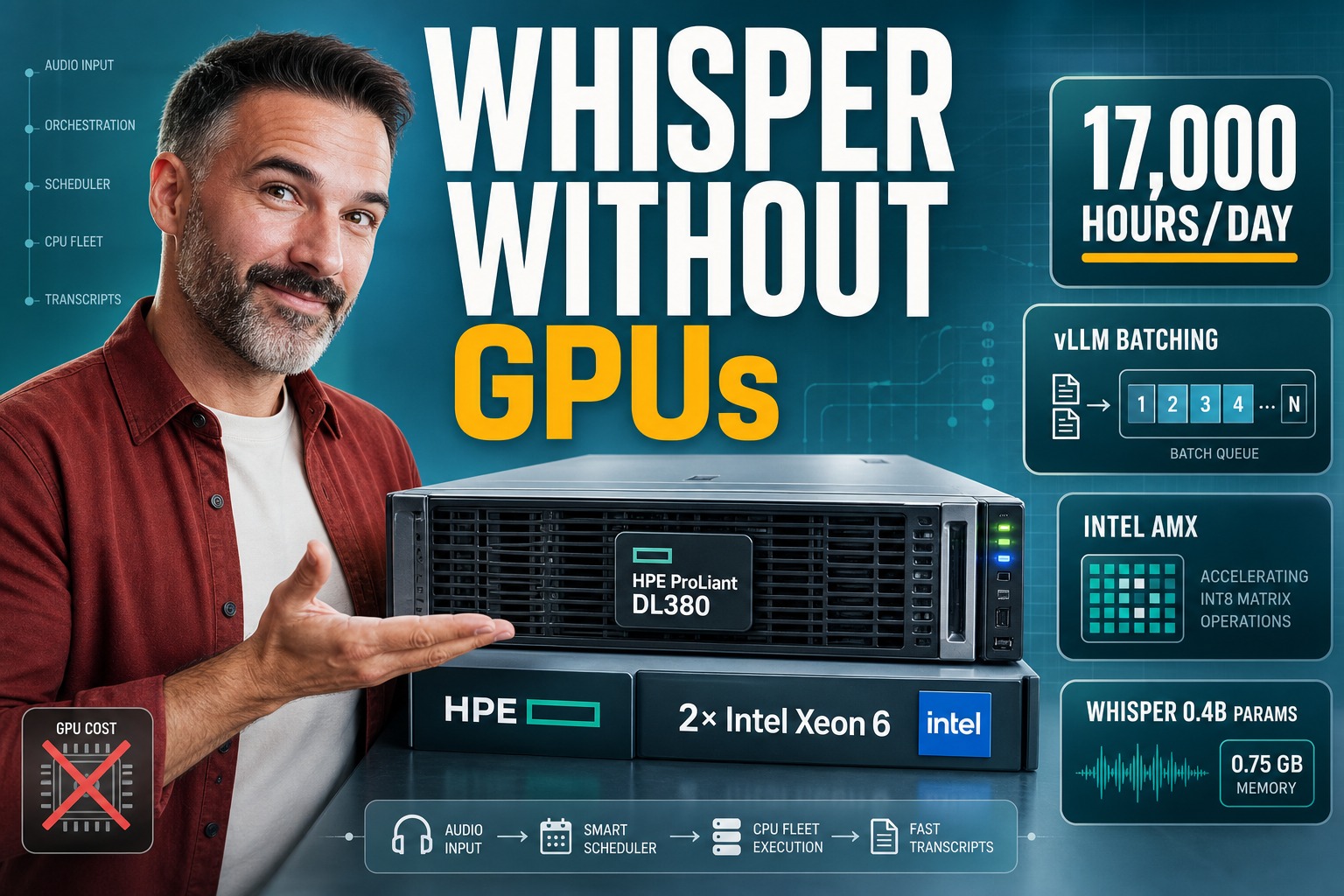
Can we run high-volume speech-to-text on CPUs only, without GPUs? → Yes, if we treat model optimization plus the serving stack as a single system, not as a ‘model choice’ problem.
What’s the dominant signal this week for enterprise AI infrastructure? → A single HPE ProLiant DL380 with two Intel Xeon 6 CPUs ran an optimized Whisper model and reportedly transcribed about 17,000 hours of audio per day using CPUs alone.
What’s the business/technical decision this forces this quarter? → Whether to keep funding GPU capacity or cloud transcription bills, or shift transcription to existing CPU server fleets for cost control and data sovereignty.
What’s the real question engineers will Google? → How to deploy Whisper speech-to-text on CPUs for production workloads without losing accuracy or blowing up latency and operations.
What’s the non-obvious angle we’re taking at Plavno? → CPU-only speech-to-text succeeds or fails at orchestration boundaries (batching, queuing, SLAs, governance), so the ‘right’ design response is platform engineering, not shopping for accelerators.
Quick Answer: should we deploy Whisper on CPUs for enterprise transcription?
Yes—CPU-only Whisper is now a credible production option when you can run an optimized model (Multiverse Computing reports Whisper reduced to 0.4B parameters) through a high-efficiency serving layer (vLLM) on modern CPUs (Intel Xeon 6 using Intel Advanced Matrix Extensions). The engineering response isn’t ‘swap GPUs for CPUs’; it’s to redesign transcription as an internal service with explicit latency and throughput controls, because your bottlenecks move from hardware to orchestration.
The news signal is not Whisper—it’s the end of ‘transcription needs accelerators’
Multiverse Computing, working with HPE and Intel, claims a single enterprise server can do CPU-only transcription at a scale that used to be treated as GPU territory. Specifically, they report about 17,000 hours of audio per day on one HPE ProLiant DL380 with two Intel Xeon 6 processors, by running a 0.4B-parameter Whisper variant with vLLM and Intel Advanced Matrix Extensions. For CTOs, this reframes transcription from a specialized hardware purchase into a capacity-planning problem on infrastructure you already own.
If you adopt CPU-only speech-to-text, the hardest part stops being ‘can the model run’ and becomes ‘can we operate the workload predictably when every upstream system discovers transcription is suddenly cheap.’
Central claim: CPU-only transcription changes architecture more than it changes models
The dominant shift here is that model compression plus a modern serving stack can move speech-to-text from GPU dependence to standard servers. Multiverse Computing’s reported results tie together three facts: Whisper reduced from 0.8B parameters to 0.4B, memory footprint reduced from 1.5 GB to 0.75 GB, and inference served via vLLM on Intel Xeon 6 CPUs using Intel Advanced Matrix Extensions.
Our position at Plavno is that this breaks a common engineering practice: treating transcription as a ‘black box API call’ or a ‘GPU job.’ Once transcription can run economically on CPUs, the workload becomes ubiquitous inside the enterprise—and failures show up at batching, queuing, multi-tenant isolation, and governance layers. The right response is to build a transcription platform with explicit service contracts, not to debate which Whisper checkpoint is ‘best.’
- Your throughput ceiling moves from silicon to scheduling. With CPU-only serving, the question becomes how vLLM batching interacts with your traffic shape (bursty uploads, long recordings, concurrent short calls) and whether your service degrades gracefully when demand spikes.
- Your biggest risk becomes ‘success.’ When a team learns transcription no longer requires dedicated accelerators, new consumers appear fast: compliance, QA, analytics, search, and downstream LLM teams all start sending audio.
- Your data boundary becomes simpler, but your audit surface grows. Keeping audio and transcripts on-prem can improve data sovereignty, yet now you must log access, retention, and redaction across more internal users.
- Your SLO work shifts toward tail latency and queue time. The input reports time-to-first-token improving from 2.11 seconds to 1.11 seconds; that’s valuable, but in production the longer tail often comes from queueing and retries, not just model compute.
- Your model lifecycle becomes an infrastructure problem. If accuracy remains comparable (the input reports 2.75% word error rate on LibriSpeech for English and Spanish for the optimized model), you still need controlled rollouts, regression evaluation, and rollback mechanics.
17,000 hours per day on one server forces a new kind of capacity math
A claim like ‘~17,000 hours of audio daily on a single server’ is not just a performance headline—it’s an operations prompt. In a GPU-first world, teams limited transcription because it was expensive; in a CPU-first world, teams limit transcription only when the platform collapses under demand, compliance requirements, or downstream indexing pipelines. The moment the cost barrier drops, the right engineering question becomes: what are we promising, to whom, and under what backlog conditions?
Tokens per second isn’t enterprise throughput until you translate it into product load
The input cites 1,413 tokens per second for the optimized model via vLLM on the DL380. That’s a meaningful serving metric, but product systems experience load as ‘hours of audio arriving per hour,’ ‘calls concurrently in progress,’ or ‘backlog to clear overnight.’ In practice, the risky gap is assuming a lab throughput number guarantees your end-to-end service rate when audio lengths vary and when your pipeline includes decoding, chunking, storage, and post-processing.
Why CPU-only works here: smaller Whisper, Intel AMX, and vLLM as a single system
The reported performance is not attributed to a single trick. It’s the combination of a smaller Whisper model (0.4B parameters rather than 0.8B), a lower memory footprint (0.75 GB rather than 1.5 GB), and CPU-side acceleration via Intel Advanced Matrix Extensions on Intel Xeon 6, served through vLLM. Engineers should read this as a system-level result: the model shape, CPU instructions, and serving framework together define viability.
| Deployment approach | What you mostly optimize for | What tends to break first |
|---|---|---|
| GPU-based on-prem transcription | Maximum raw model throughput | GPU availability, cost allocation, and ‘who gets the GPUs’ politics |
| Cloud transcription API | Fast time-to-market | Data sovereignty constraints and escalating usage-driven bills |
| CPU-only on enterprise servers (as reported) | Using existing fleet and keeping data on-prem | Orchestration: batching, queueing, and multi-tenant fairness |
| Hybrid (CPU baseline + GPUs for peaks) | Risk control and gradual migration | Complex routing logic and inconsistent latency across tiers |
If you don’t measure time-to-first-token and backlog wait time separately, you’ll blame the model for what is actually queueing and traffic shaping.
Data sovereignty stops being aspirational when the workload fits inside a DL380
One of the most practical implications of CPU-only transcription is that it makes data sovereignty achievable without shrinking your ambitions. If transcription can run on standard servers, sensitive audio from finance, healthcare, or internal HR no longer has to cross a cloud boundary just to become searchable text. But sovereignty is not just ‘on-prem equals safe’; it’s also about access control, retention, and proving to auditors that only authorized systems touched the raw recordings and derived transcripts.
To make that real, we typically pair on-prem inference with security review, threat modeling, and hardening of the service perimeter—work that fits naturally alongside cybersecurity and penetration testing when the transcription endpoint becomes a high-value internal dependency.
- ‘Who can transcribe what’ must be enforced at the service layer. When many internal systems gain access, the transcription service needs authenticated identities and auditable authorization decisions, not just a network allowlist.
- Retention rules apply to audio and text differently. In regulated environments, the transcript may be retained longer than audio (or vice versa), and the platform must implement those decisions as policy, not tribal knowledge.
- Derived data multiplies compliance scope. Search indexes, analytics stores, and downstream LLM/RAG corpora become additional regulated assets once transcription is widespread.
- Segmentation beats ‘one big bucket.’ Even on-prem, mixing departments and sensitivity levels into a single transcript store tends to fail audits because access becomes hard to reason about.
- Incident response becomes more important, not less. Keeping data on-prem reduces vendor exposure but increases the need for internal detection and response when credential misuse occurs.
Building a transcription service is platform engineering, not a model deployment
If we take the reported CPU-only capability seriously, the correct organizational move is to treat speech-to-text like a shared internal platform. That means a service interface, predictable SLAs, and strong integration patterns for ingestion and delivery rather than ad hoc scripts. In practice, teams often run this as a stateless serving tier with a durable job queue, writing transcripts to controlled storage, and emitting events to downstream indexing or analytics pipelines.
This is also where many enterprises discover the hidden work: networking, observability, autoscaling policy, and failure handling are what determine whether transcription is a reliable primitive for the business. The build-out frequently overlaps with broader cloud software development efforts, even when the runtime is on-prem, because the same patterns—service discovery, CI/CD, and telemetry—are what keep the system stable.
Where production failures show up first: batching behavior and backpressure
Serving frameworks like vLLM can increase utilization via batching, but enterprise traffic is messy: long recordings, short utterances, and sudden surges coexist. In production, the failure mode we see most is not ‘the model is wrong,’ but ‘the system stalls,’ because queues grow, batch sizes become pathological, or downstream storage/indexing can’t keep up. CPU-only inference makes it easier to scale out, but it also makes it easier to overload the platform silently.
The cost story: the million-dollar bill is usually an architecture problem
The input frames a clear business pain: a contact center processing 20 million calls annually can generate about 2 million hours of audio and may exceed one million dollars in transcription costs using traditional GPU-based approaches. When you can move that workload onto existing servers, cost control becomes realistic—but only if you avoid rebuilding the same cost drivers internally through inefficient pipelines, duplicated processing, or uncontrolled demand.
This is why we push clients to treat transcription as part of an automation roadmap, not a one-off experiment. When teams connect speech-to-text directly to workflow actions and searchable archives, the ROI story becomes clearer—and it aligns well with enterprise AI automation services that turn transcripts into operational signals rather than just stored text.
Start with the ‘audio inventory,’ not the model. Quantify where audio is generated (calls, meetings, media libraries) and who consumes the transcript, because consumption is what explodes once the marginal cost drops.
Define two separate SLAs: interactive and batch. The input reports time-to-first-token improving from 2.11 seconds to 1.11 seconds, which matters for interactive experiences, but batch processing is usually governed by backlog clearance time and predictable completion.
Decide your sovereignty boundary explicitly. If audio must remain fully on-prem, commit to on-prem ingestion and storage as first-class components; don’t treat them as ‘temporary staging.’
Model your scaling unit around standard servers. The reported results used one DL380 with two Intel Xeon 6 CPUs; the practical question becomes how many similar nodes you can allocate and how you distribute jobs across them without hotspots.
Institutionalize accuracy and regression gates. The optimized model reportedly achieved 2.75% word error rate on LibriSpeech (English and Spanish) versus 2.14% for the original; regardless of the delta, you need a repeatable evaluation pipeline before rolling changes into compliance-sensitive workflows.
The biggest ROI move is rarely ‘replace GPUs’; it’s ‘transcribe everything you were afraid to transcribe before,’ and then control the blast radius with platform-level quotas.
Plavno’s perspective: CPU transcription is the ingestion layer for every downstream AI system
At Plavno we treat speech-to-text as a front door into enterprise knowledge, not as an isolated ML feature. Once transcription is affordable and runs on hardware you already operate, transcripts become a dependable substrate for search, analytics, and internal assistants. That’s also why we care about operational design: downstream systems will assume the transcript stream is complete, timely, and consistent, even when the audio supply is chaotic.
When clients want to turn transcripts into interactive internal experiences—agent assist, knowledge lookup, meeting summarization—the work usually converges with AI assistant development because transcription quality, latency, and governance become product requirements, not infrastructure details.
- Compliance-grade searchable archives. If cost barriers fall, enterprises can index far more recorded calls and meetings, making internal discovery and audit response materially faster.
- Quality assurance at full coverage. Instead of sampling a small portion of calls, teams can evaluate a much larger share, but only if the pipeline is stable and the access controls are strict.
- Richer downstream analytics. Once audio becomes text, it can feed classification, trend detection, and routing systems; the value comes from consistent metadata and timing, not from a fancier model.
- Captioning and accessibility at scale. Media libraries can be captioned more broadly when inference is not gated by accelerator scarcity.
- Cleaner training corpora for internal AI. Transcripts become high-volume labeled material for other systems, which increases the need for provenance tracking and retention discipline.
Real-world deployments diverge by workflow: contact centers, finance, and healthcare aren’t the same
The input highlights three archetypes that care deeply about volume and sensitivity: contact centers, financial institutions, and healthcare providers. We’ve found the technical differences are less about the model and more about the workflow constraints. Contact centers emphasize near-real-time usefulness and operational feedback loops; finance emphasizes auditability and strict data boundaries; healthcare emphasizes privacy controls and minimizing exposure of sensitive content.
CPU-only feasibility doesn’t erase those differences—it removes one blocker (accelerator dependency) so the real constraints surface. That’s good news for engineering leaders because it shifts the conversation from procurement to design: where does audio enter, who can request transcription, where are transcripts stored, and how do they flow into other systems?
Accuracy parity is a governance requirement, not a feel-good metric
Multiverse Computing reports that the optimized 0.4B Whisper model maintains comparable quality, citing 2.75% word error rate on LibriSpeech for English and Spanish, compared to 2.14% for the original, and notes both are below a 3% threshold. In regulated environments, that kind of claim is only useful if you can reproduce it on your own representative data and then lock it into change control. Governance demands you know when quality changes, why it changed, and what downstream processes must be revalidated.
CPU-only doesn’t remove risk—it shifts it to SLAs, multilingual scope, and operational surprises
Even if the reported performance holds for your workload, CPU-only transcription introduces its own operational risks. First, you still own the consequences of recognition errors, especially when transcripts feed compliance workflows. Second, multilingual or domain-specific audio may behave differently than benchmark datasets like LibriSpeech. Third, once transcription becomes internally ‘cheap,’ teams will push it into interactive products, where jitter and tail latency matter as much as average throughput.
The upside is that these are solvable engineering problems, but only if they’re acknowledged early. The most expensive CPU-only deployments we see are the ones that treated the infrastructure win as the finish line, and then had to retrofit quotas, tenancy isolation, and lifecycle management after the transcript firehose already became business-critical.
Design for overload from day one. Assume demand will grow rapidly once costs drop; implement admission control and queue-based backpressure so you fail predictably instead of timing out randomly.
Separate storage and compute concerns. Keep the inference tier stateless and treat transcript persistence as a governed system of record, so you can scale serving independently and audit data access.
Establish a regression protocol before the first rollout. Even with reported comparable quality, you need internal evaluation sets and release gates to prevent unnoticed accuracy drift in production.
Make latency visible end-to-end. The input reports time-to-first-token dropping from 2.11 seconds to 1.11 seconds; maintain that observability internally by tracking queue time, processing time, and downstream write/index time as distinct signals.
Control tenancy explicitly. If multiple business units share the service, enforce quotas and isolation so one team’s surge doesn’t violate another team’s SLA or compliance posture.
The decision we recommend: adopt CPU-first for baseline, reserve GPUs for exceptions
We would not frame this as ‘CPUs versus GPUs’ ideologically. The actionable decision is whether your baseline transcription volume can be served on standard enterprise servers with acceptable latency and governance, using the kind of optimization described here (0.4B Whisper, vLLM serving, Intel Xeon 6 with Intel Advanced Matrix Extensions). For many enterprises, that’s enough to eliminate the default assumption that every transcription workload needs dedicated accelerators.
Where we still budget for GPUs is when the business requires specific latency characteristics under highly variable traffic, or when workloads expand beyond transcription into heavier multimodal or generative tasks. If you want a CPU-first transcription platform that is designed for scale, sovereignty, and downstream AI reuse, we can scope it end-to-end—from architecture and SLOs to integration with your internal consumers—through targeted AI consulting.
Author: Plavno team. Last updated: September 2026.
 Chat GPT
  Perplexity
  Claude
  Gemini
