Is conversational ai finally useful in ops? → It is, when it is orchestrated to surface issues before humans know what to ask.
What changed with Extreme Agent ONE Coworker? → It pushes proactive nudges inside existing workflows instead of waiting for prompts.
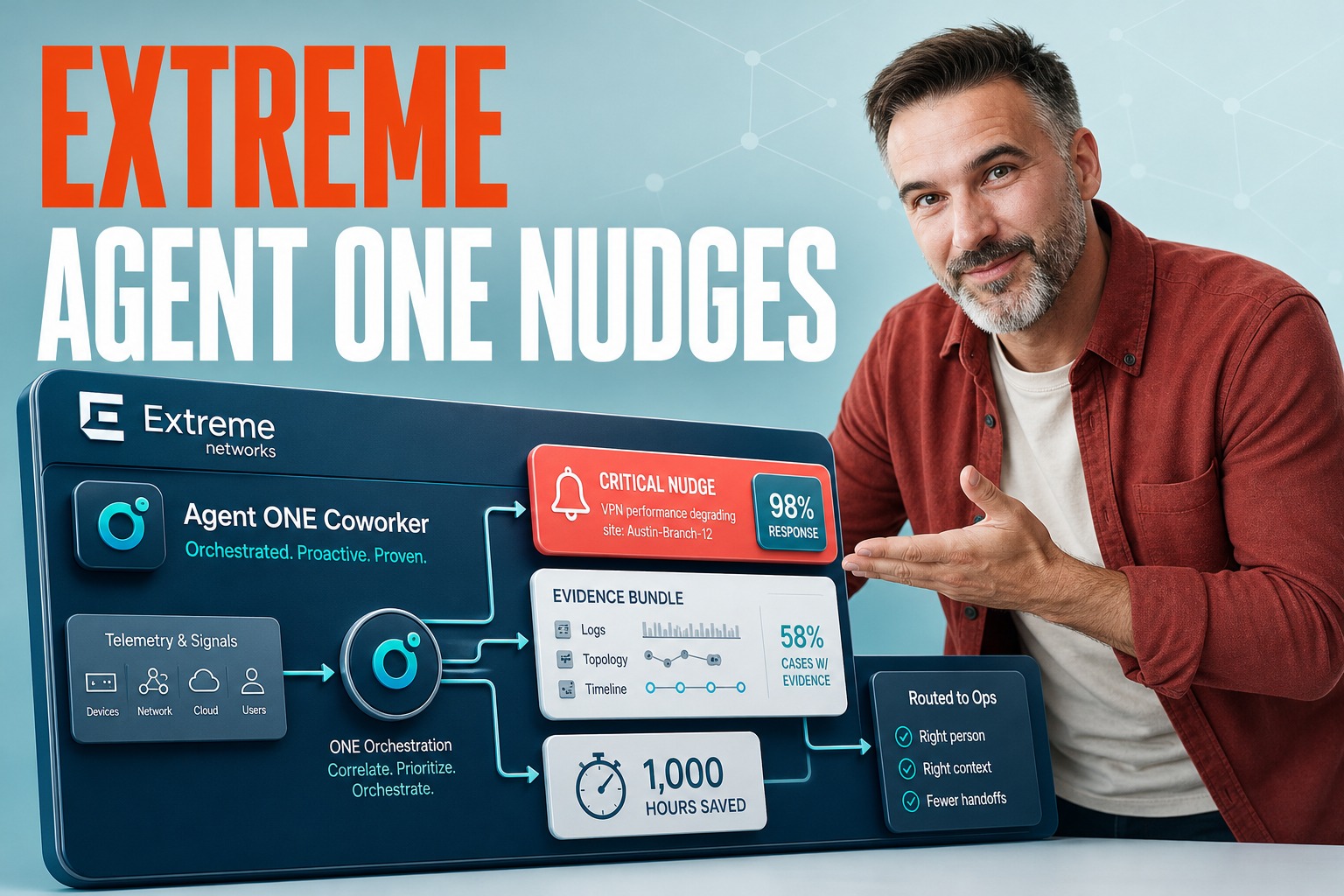
What did customers get in month one? → Extreme reports 1,000 hours saved and 98% response to critical nudges.
Why should CTOs care? → The win is fewer handoffs: evidence is bundled and routed, not just described.
What is the real lesson? → Treat ‘agent’ as orchestration across signals, actions, and governance.
Quick Answer
Conversational ai is trending back toward value because vendors are embedding it into orchestration loops, not chat windows. Extreme Networks says customers using Agent ONE Coworker saved an estimated 1,000 troubleshooting hours in its first month, and users responded to 98% of critical nudges. Extreme also reports 41% of Platform ONE customers used the tool for daily tasks, and 58% of support cases opened through it included the evidence support teams needed to start work.
The breakthrough is not the model; it is orchestration that turns live telemetry into governed nudges with attached evidence.
Conversational AI Moves From Chat To Orchestration
Extreme is positioning Agent ONE Coworker around a proactive operating model: the system flags likely network issues without waiting for a technician to type the first prompt. In its first public adoption data, Extreme says early engagement was about 10 times higher than with its earlier conversational agent. That is a product signal: users do not want another place to ask questions; they want fewer questions to ask.
The reported outcomes also map to the orchestration lens. Extreme says customers resolved some issues in minutes versus an industry average of two days, and that 58% of cases created via the agent contained the evidence support needed to begin. That ‘evidence-first’ pattern is what makes automation durable, and it is the same pattern teams pursue when they invest in AI automation to reduce toil rather than add dashboards.
Why Nudges Beat Prompts In Incident Triage
Prompt-driven systems assume the operator knows the failure mode and the right entry point. In real incidents, you start with symptoms, partial context, and competing alerts. A nudge model flips the default: continuously scan for conditions worth interrupting a human about, then provide the shortest path to validation and action. The orchestration work is deciding what deserves a nudge, where it appears, and what evidence must travel with it.
Orchestration Starts With Shared Context, Not Another Console
Extreme’s framing matters: Agent ONE Coworker is built into Extreme Platform ONE and is meant to operate ‘in the flow’ rather than as a separate chatbot. That is the architectural constraint CTOs should adopt: an agent is only as useful as its ability to share context across network, security, and operations tools without forcing swivel-chair debugging.
If you are applying the same idea to voice channels, the hardest part is usually voice ai integration across identity, CRM, ticketing, and policy. That is where engineering help tends to pay back fastest, whether you are buying a platform capability or building through ai voice agent development services that focus on routing, controls, and lifecycle management.
- Normalize signals first: topology, configs, logs, and user impact in one consistent context layer.
- Decide interruption budgets: which conditions generate nudges and which remain silent annotations.
- Attach machine-collected evidence to every recommendation, not just a natural-language summary.
- Route actions through governance: approvals, scopes, and auditability in the same workflow.
- Close the loop: capture what humans accepted, ignored, or corrected to tune orchestration.
What Extreme’s Early Metrics Suggest For CTOs
Three reported numbers tell the story. First, 41% of Extreme Platform ONE customers used Agent ONE for daily tasks in the first month. That implies the ‘unit of adoption’ is not a new UI, but repeated micro-actions that save minutes each time. Second, users responded to 98% of the system’s critical nudges, suggesting the notifications were specific enough to be trusted.
Third, Extreme says 58% of support cases opened through the agent included the evidence support teams needed to begin working. For orchestration, that is the key KPI: time-to-evidence, not time-to-answer. If your agent cannot reliably package proof (what changed, what broke, where to look), it will create more back-and-forth. This is also why many teams start with scoped AI consulting to define evidence contracts before they scale automation.
If the agent cannot package evidence and route it, it is not reducing toil—it is just generating text.
Evidence Bundles Are The New Ticket Template
Extreme says more than half of agent-opened support cases arrived with evidence sufficient to start work. Read that as an interface contract: the ‘case’ is no longer a human narrative, it is a bundle of telemetry and context that can be replayed. For CTOs, the design task is to standardize those bundles per incident class: Wi‑Fi degradation, firmware drift, suspicious east-west traffic, and so on.
Governance Is A Product Feature, Not A Policy Doc
Extreme’s CTO framed the tool as acting ‘under governance our customers control.’ That matters because proactive agents will inevitably cross from ‘recommend’ to ‘change.’ Orchestration needs explicit boundaries: which actions are read-only, which can be proposed, which can be executed, and what approvals are required. If governance is bolted on later, teams will either disable autonomy or accept unacceptable risk.
From Network Ops To Voice Ops: Same Pattern
The network story is a proxy for where enterprise agents are going in general. In voice, the equivalent of a nudge is a suggested disposition, an escalation recommendation, or a compliance warning delivered mid-call. An ai voice assistant becomes strategic when it can route decisions through the same evidence and governance layer as the rest of operations.
This is also how you should evaluate an ai phone agent: not by how fluent it sounds, but by whether it can move context across systems, create a defensible record, and trigger the right downstream workflow. Fluency is table stakes; orchestration is differentiation.
| Dimension | Chat-First Assistant | Orchestrated Nudge Model |
|---|---|---|
| Initiation | Human asks a question | System detects conditions and interrupts selectively |
| Output | Explanations and suggestions | Actions plus linked evidence, ready for execution |
| Workflow Fit | Separate interface and context switching | Embedded in existing tools and ticket flows |
| Failure Mode | ‘Looks right’ but hard to validate | Requires explicit governance and good signals |
Conversational AI In Operations: Where Orchestration Pays Off
Conversational AI still has a place, but mostly as an access layer to the orchestration engine. Technicians will ask for clarifications, drill-down, or ‘why’ explanations, and Touro University’s feedback emphasized transparency into the data and reasoning behind responses. That is a reminder: trust is built when the agent can show its work, not when it sounds confident.
Where orchestration pays off is in compressing the loop from detection to verified action. That means investing in the unglamorous pieces: context graphs, evidence schemas, policy checks, and rollout controls. If you do not have bandwidth to build that platform plumbing internally, targeted capacity via outstaffing can be a pragmatic way to deliver the integration and guardrails while your core team owns the operating model.
Inventory signals and owners: what is ‘source of truth’ for topology, identity, and change history.
Define nudge classes with thresholds, severities, and destinations inside existing workflows.
Standardize evidence bundles per class: what must be attached for validation and escalation.
Add policy gates: approvals, blast-radius limits, and audit trails before any write action.
Run a feedback loop: track ignored nudges, false positives, and human corrections to tune rules.
How To Implement AI Conversational Without Breaking Change Control?
Teams searching for how to implement ai conversational should start by separating ‘reasoning’ from ‘execution.’ Let the agent propose and explain, but route execution through the same change controls you already trust. In practice, that means: read-only nudges first, then suggested actions with evidence, then tightly scoped auto-remediation for a small set of reversible tasks. Orchestration maturity is earned in stages.
Treat nudges as deployable artifacts: versioned rules, tested scopes, and explicit rollback.
Case Notes: What Early Users Actually Valued
The user stories Extreme shared are telling because they are not about clever answers; they are about reducing navigation and narrowing the search space. Fastcom, a New Zealand IT and telecommunications business and Extreme partner, emphasized scaling sites and services without configuration sprawl, and the practical relief of not flicking between consoles to chase a single issue. That is orchestration value: fewer hops between tools, fewer partial truths.
Hill College in Texas described the agent pinpointing where to look when HR lost wireless, including identifying an access point needing attention and others due for firmware upgrades, resolving the issue in about 20 minutes. The same customer also cited using the tool to trace a device on a guest network running crypto mining software through access points to narrow its location. Separate from networking, these are the same dynamics you want in real-time voice ai: fast localization, minimal context loss, and a clear next action.
AI Conversational Use Cases: What Should Be Ambient?
When people ask about ai conversational use cases, many jump straight to chatbots. The stronger pattern is ‘ambient plus explainable’: the agent monitors, nudges, and only becomes a dialogue when a human needs to confirm, override, or learn. Extreme’s first-month data suggests that proactive nudges can drive engagement precisely because they remove the burden of framing the first question.
| Ambient Use Case | Signal To Watch | Orchestrated Outcome |
|---|---|---|
| Wireless outage isolation | AP health and client impact | Nudge with exact device scope and suggested fix path |
| Firmware drift | Version gaps across devices | Scheduled recommendation with upgrade grouping evidence |
| Suspicious guest activity | Anomalous traffic patterns | Trace path across access points and narrow physical location |
| Case creation | Repeated failures and errors | Open ticket pre-filled with telemetry and timelines |
Orchestration Architecture: A Practical Reference Model
A pragmatic architecture has five layers: signal ingestion, context resolution, reasoning, policy, and action routing. Even if you keep a conversational ai entry point for exploration, the system should not depend on it; nudges should be generated from live context and pushed where teams already work. The point is to turn ‘I think something is wrong’ into ‘here is the scoped issue, proof, and next step’ with minimal human formatting.
For voice workloads, the same model applies to ai call answering and post-call workflows. Ingestion is telephony plus transcripts; context is identity, account history, and entitlements; policy is compliance and escalation rules; routing is CRM updates, ticket creation, and handoff to humans when needed. Orchestration is what prevents the voice layer from becoming an isolated demo.
What To Measure In Month One
Extreme’s own first-month reporting is a useful template for instrumentation. Track nudge response rates (Extreme cited 98% for critical nudges) to validate interruption quality. Track evidence completeness (Extreme cited 58% of agent-opened cases including needed evidence) to quantify how much back-and-forth you removed. And measure time-to-isolation and time-to-resolution, because Extreme claims some issues went from days to minutes and that customers saved an estimated 1,000 hours of troubleshooting.
Decision Checklist For CTOs Evaluating Proactive Agents
First, decide what you are buying: a model, a UI, or an orchestration system. Extreme’s message is that proactive agents win when they are embedded into the platform and can reason over live network intelligence plus operational data. For CTOs, the evaluation should focus on context coverage (what signals are truly live), transparency (can the system show underlying data and reasoning), and whether nudges land inside the tools your teams actually use.
Second, define where autonomy is acceptable. Most teams should start with read-only detection and guided remediation, then graduate to constrained auto-actions for reversible changes. Governance needs to be explicit and testable, because ambient agents will generate a higher volume of ‘should we do something?’ moments. Your risk profile is dominated by false positives that trigger disruptive actions, not by the occasional wrong explanation.
Third, look for evidence portability. Can the system open a case already populated with what a human would have to collect anyway? Can it trace and scope impact in a way that survives escalation across teams? The goal is not a better chat; it is a faster, more reliable operating loop. That same checklist applies when you evaluate an ai voice assistant for customer ops: if it cannot route context and decisions, it will raise handle time instead of lowering it.
- Require a written evidence contract per nudge type: what must be attached before humans are paged.
- Enforce least-privilege for write actions and keep auto-remediation narrowly reversible.
- Measure interruption quality: critical nudges should be rare, specific, and consistently acted on.
- Make transparency mandatory: show data lineage and reasoning paths to avoid ‘black box’ operations.
- Plan rollback: orchestration changes should ship like software, with versioning and monitoring.
Closing Takeaway
The lesson in Extreme’s early Agent ONE Coworker numbers is not that conversational ai suddenly got smarter; it is that orchestration finally got productized. Proactive nudges, evidence-rich case creation, and customer-controlled governance are what drive adoption and real time savings. If you take one action from this, make your agents responsible for moving context and proof across workflows—not just answering questions. Author: Plavno team. Last updated: October 2026.
 Chat GPT
 Perplexity
 Claude
 Gemini

