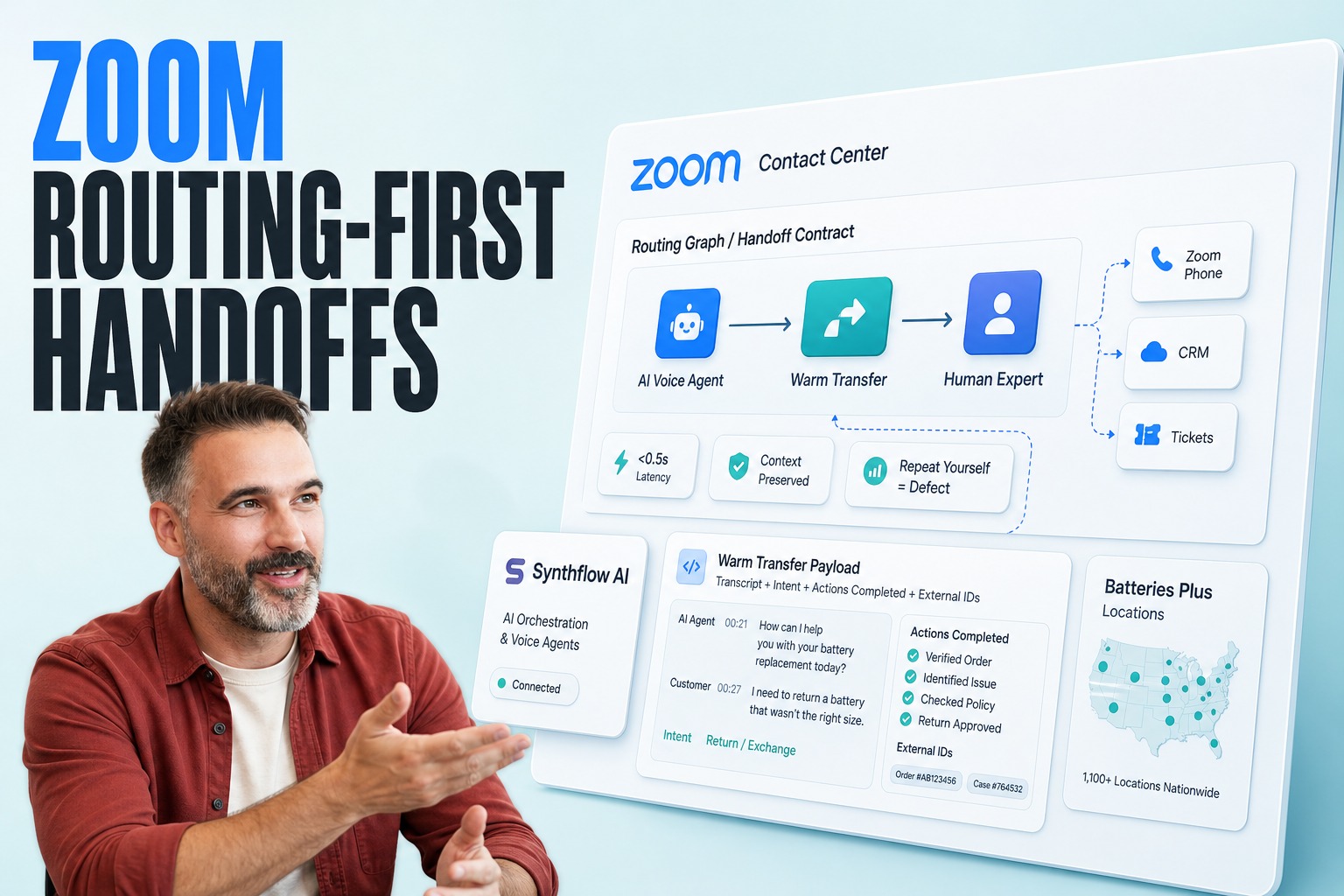
What did Batteries Plus actually change? → They put automated and human phone handling into one routed workflow on Zoom.
Why does this matter to engineering leaders? → Routing and state handoff, not speech quality, determines whether calls finish or churn.
Where does an ai voice agent fit? → As the first routed ‘queue consumer’ that can close routine intents or escalate with context.
What’s the core risk? → Losing transcript, intent, and actions during transfers creates repeat-the-problem loops.
What’s the CTO takeaway? → Treat call routing as an API contract across contact center, telephony, CRM, and tickets.
Quick Answer: Routing Principles For An AI Voice Agent
An ai voice agent succeeds when routing is designed as the product: capture intent fast, execute the simple path end to end, and escalate with full state. Batteries Plus’ deployment with Synthflow AI on Zoom shows why: sub–half-second responsiveness helps keep turn-taking natural, while warm transfers with transcripts and completed actions prevent the ‘start over’ experience. Build routing rules around outcomes and ownership, not menus.
If you want automation at scale, stop optimizing prompts and start optimizing routing state that survives every handoff.
The Batteries Plus Deployment, Interpreted As A Routing Story
Batteries Plus deployed Synthflow AI’s agentic voice AI agent via the Zoom App Marketplace for both Zoom Contact Center and Zoom Phone. The key engineering detail isn’t the marketplace listing; it’s that enterprises can run AI voice agents and human teams in a single workflow, with context carried across handoffs. Synthflow AI reports its agents respond in under half a second, resolve routine requests end to end, and then complete a warm transfer to a human expert when needed—passing the full transcript plus actions already taken.
Zoom’s open, API-first architecture is what makes the routing credible at enterprise scale: Synthflow AI can pass conversation state, intent, and customer history into Zoom, and read back from CRM and ticketing systems. For teams evaluating an ai voice agent, this is the difference between a demo and an operating model. If you’re shaping requirements, start with the transfer contract and systems-of-record integration; that’s also where ai voice agent development services typically begin.
- Route to an outcome owner, not a department label, so the first handler can actually finish the job.
- Carry state across layers: telephony session, conversation transcript, extracted intent, and actions executed.
- Treat warm transfer as the default, and define what ‘warm’ means in data terms.
- Fail closed on risky intents by routing to humans early, before partial actions create cleanup work.
- Make ‘repeat yourself’ a measurable routing defect, not a customer-service problem.
Routing Patterns That Make An AI Voice Agent Work With Humans
Batteries Plus is effectively collapsing two historically separate queues—IVR automation and human associates—into one routed path. Because Synthflow AI runs inside Zoom Contact Center and Zoom Phone, the agent and people can participate in the same operational workflow, instead of being stitched together with brittle forwarding rules. Architecturally, that enables a cleaner ownership model: the system handles routine intents; humans handle exceptions; and routing decides when to switch.
The most under-discussed pattern here is action-aware escalation. Synthflow AI says that when a caller needs a human, the system passes the full transcript and any actions already taken. That shifts routing from ‘handoff’ to ‘handoff with work product.’ For a CTO, the implication is that your routing engine must understand what has already been attempted (and with what result) so the human doesn’t repeat steps or undo them.
For distributed operations—Batteries Plus has more than 700 locations referenced in the deployment and a nationwide network of more than 800 locations open and in development—routing also becomes a locality problem. Even with a strong ai phone agent at the front door, you still need deterministic rules for which store or specialist should receive the warm transfer, and those rules must be explainable to the business when exceptions happen.
Latency Is A Routing Signal, Not Just A UX Metric
Synthflow AI says its agents respond in under half a second. In practice, real-time voice ai isn’t only about sounding natural; it also determines how aggressively you can route mid-call. If the system can’t keep up, callers talk over prompts, intent extraction degrades, and routing decisions get noisy. Managing voice ai latency therefore becomes part of your escalation strategy: when confidence drops or timing slips, route to a human sooner, with the partial transcript preserved.
| Routing Decision Point | Minimum State To Preserve | What Breaks If You Don’t |
|---|---|---|
| Start-of-call triage | Caller identifier, entry channel, prior history pointer | Personalization fails; you route blind and increase transfers. |
| Intent classification | Transcript snippet, intent label, confidence, disambiguation questions asked | Humans re-ask basics; automation loops on the same question. |
| Action execution | Actions attempted, external system IDs (CRM/ticket), success/failure | You create duplicate tickets or promise work that never happened. |
| Warm transfer | Full transcript, extracted entities, next-best handler target | ‘Repeat yourself’ experience; wrong specialist picks up without context. |
- Intent confidence over time: route when confidence falls, not only when an intent is ‘unknown.’
- Business hours and staffing: route based on who can act now, not who owns the function.
- Store/location affinity: route using the caller’s nearest or previously served location when applicable.
- System health signals: route around CRM or ticketing outages to prevent half-finished actions.
- Customer friction signals: repeated questions, interruptions, or long silences should trigger escalation.
The win isn’t that the agent answers faster—it’s that routing moves the customer to ‘done’ with fewer context resets.
Voice AI Agent Platform Use Cases: What Should Routing Decide?
Batteries Plus is explicit that the phone call is where customer experience is won or lost, and their integration emphasizes speed to outcome. That maps directly to the best use cases for an automated front line: the ones where routing can reliably detect intent, complete a bounded workflow, and only escalate when the edge cases appear. In other words, pick use cases where routing logic is stable and the action surface is well-defined.
A practical way to scope is to separate ai call answering from issue resolution. Call answering is just ‘first response’; resolution requires routing to the right capability (automation path, store associate, or specialist) and preserving context so the next handler can finish. If your organization lacks clarity on those boundaries, start with discovery and operating model work before building; teams often pair that with AI consulting to map intents to owners and systems-of-record.
Order/status-style questions → Route to automation first; escalate only when data is missing or conflicting.
Store-service requests → Route by location and skill, then pass transcript so associates start at the decision point.
Appointment or follow-up calls → Route using prior interaction context and preserve identifiers across transfers.
Policy or exception handling → Route early to humans; automation should only collect structured details.
Complaint scenarios → Route fast to a human expert, with a clean summary to avoid re-triggering frustration.
How To Build A Voice AI Agent Platform Without Breaking Handoffs?
Start by treating the agent as one participant in a routed graph, not as a separate ‘bot channel.’ In the Batteries Plus case, Synthflow AI runs inside Zoom workflows, which is exactly the direction you want: one interaction model, one place to orchestrate handoffs, and consistent observability. This is also where teams get value from Zoom’s open, API-first architecture, because you can pass conversation state, intent, and customer history into the platform and read back from CRM and ticketing systems.
Next, design the voice ai agent platform around actionability. The news claims the agent resolves routine requests end to end, and when it can’t, it hands off with transcript and actions already taken. That implies an internal action layer with idempotency and a clear notion of ‘attempted vs completed.’ For many enterprises, implementing that action layer is essentially workflow automation; it often pairs well with AI automation so the voice layer is not directly entangled with every back-office integration.
Finally, operationalize routing with a deployment cadence that matches business change. Batteries Plus’ CIO said the roll-out from kick-off to pilot was five weeks, which is a hint about keeping scope tight: a small set of high-volume intents, a deterministic routing plan, and a transfer contract that is easy to validate. Once that’s stable, you expand routing coverage—not by adding more phrases, but by adding more outcome paths and better escalation rules. This is also where an ai voice agent must be continuously tuned for handoff quality, not just containment.
Make The Transfer Contract Explicit And Testable
Warm transfer sounds like a feature, but it’s really a contract: what must be handed to the human so they can proceed without re-triage. Batteries Plus’ implementation highlights the essentials—full transcript and actions already taken—so build automated checks around them. If a transfer occurs without those fields, treat it as an incident. Routing quality becomes measurable when the handoff payload is versioned, validated, and observable.
- Define a handoff schema: transcript, intent, entities, actions, external IDs, and a ‘next step’ recommendation.
- Require idempotent actions so retries don’t create duplicate CRM records or ticket spam.
- Instrument ‘context loss’ as a top-line metric: any human re-asking previously answered questions.
- Create routing fallbacks for outages: if CRM read fails, route to humans with a visible warning.
- Review escalations weekly: update routing rules based on why humans took over, not on raw call volume.
If your handoff payload is solid, you can iterate routing fast; if it’s not, every new intent increases chaos.
Closing: Routing Metrics That Prove The Investment
The Batteries Plus story is a reminder that automation ROI comes from fewer misroutes and fewer context resets, not simply fewer seconds to answer. Track warm-transfer completeness, repeat-question rates, and ‘action already taken’ reuse by humans. Then iterate routing rules like product features, with clear ownership and release notes.
If you’re evaluating an ai voice agent, design the routing graph and transfer contract first, and make integration state a non-negotiable acceptance criterion. To pressure-test your architecture and implementation plan with Plavno, reach out via our contact page.
Author: Plavno team. Last updated: October 2026.
 Chat GPT
 Perplexity
 Claude
 Gemini

