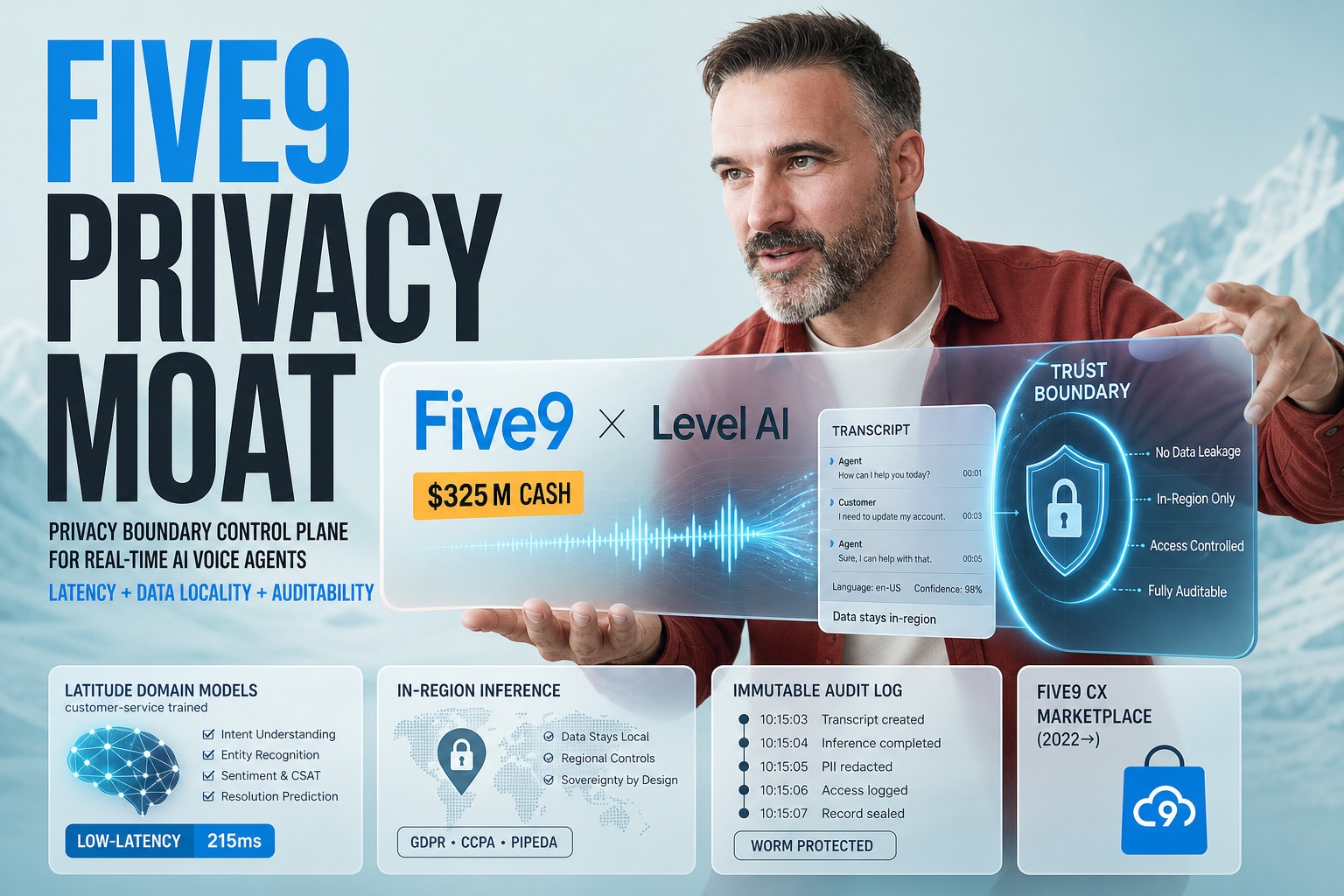
Why did Five9 pay $325M cash for Level AI? → Because domain models plus deployment control create a defensible privacy posture.
What does this mean for an ai voice agent roadmap? → Specialization is winning where latency and transcript sensitivity are non-negotiable.
What did Five9 actually buy? → Latitude, a model family trained on customer-service conversations, already running in-market.
Why does privacy matter more than model size here? → Contact-center data is regulated, litigated, and routinely audited.
What should engineering leaders do next? → Treat voice AI as infrastructure: inference location, logs, retention, and access paths.
Quick Answer
An ai voice agent strategy is getting re-priced around privacy and deployment control, not raw model scale. Five9 agreeing on November 5 to acquire Level AI for $325 million in cash signals that a narrower, contact-center-trained model family can be worth more than a generic frontier API when transcripts are sensitive and latency is unforgiving. The engineering takeaway: if you cannot run the core intelligence inside your trust boundary, you do not control risk.
- Five9 is buying latency, privacy control, and proven production fit, not a thin wrapper around a frontier model.
- Level AI’s Latitude models are trained specifically on customer service conversations, which improves cost and predictability.
- Four years of marketplace exposure since 2022 reduced integration uncertainty and made the purchase less speculative.
- The valuation gap versus $72.4M lifetime funding is a proxy for strategic risk: competitors could have bought it.
- CTOs should treat voice inference placement as a compliance architecture decision, not just a vendor selection.
The Deal Is A Privacy Architecture Signal, Not Just M&A
Five9’s November 5 announcement to acquire Level AI (Ujwal, Inc.) for $325 million in cash, expected to close by the end of its fiscal year per its 8-K, is a reminder that privacy is an engineering primitive. Level AI raised $72.4 million across four rounds, including a $39.4 million Series C in July 2024 led by Adams Street Partners, yet Five9 paid more than four times lifetime funding. That premium is about controlling where conversations live.
If your voice intelligence cannot run inside your trust boundary, every customer call becomes an outbound data-transfer event.
AI Voice Agent Economics: Why Five9 Paid For Narrow Models
Level AI built Latitude, a family of models trained on customer service conversations rather than general-purpose text, and that choice is the economic lever. In contact centers, inference cost multiplies by minutes, not tokens, and privacy multiplies by retention, not prompts. This is why specialized models can beat giants: they deliver predictable behavior under strict constraints while staying cheaper to run and easier to isolate.
- Domain-tuned models reduce incidental memorization risk by narrowing what the system ever needs to represent.
- Smaller inference footprints make it practical to keep transcripts in-region or on dedicated infrastructure.
- Fine-grained redaction and logging become feasible when the pipeline is purpose-built for conversations.
- Vendor lock-in shifts from prompts to governance: who can access raw audio, text, and derived insights.
Why Contact Centers Make Privacy A Performance Requirement
A contact center is one of the few enterprise environments where privacy and speed collide continuously. The moment you route audio or transcripts outside your control plane, your incident surface expands: more systems, more identities, more logs, more places to leak. At the same time, voice ai latency is user-visible in a way most copilots never are; callers will not tolerate long pauses. The engineering implication is uncomfortable but clear: you need a design that is both low-latency and locally governable.
| Architecture Choice | Privacy Upside | Operational Trade-Off |
|---|---|---|
| Frontier API for transcription + LLM | Fast to start, fewer components to own | Highest third-party data exposure and hardest audit story |
| Domain model family on dedicated infra | Strong control of transcript access paths | More MLOps ownership and model lifecycle work |
| Hybrid: local transcription, remote reasoning | Limits audio exposure, partial control | Complex threat model and split logging/retention |
| Fully local pipeline end-to-end | Best containment and clear compliance boundary | Highest engineering effort, careful capacity planning |
What Five9 Bought: A Proven Stack Inside Its Own Ecosystem
This was not a cold acquisition. Level AI had been operating in Five9’s ecosystem since 2022 through the Five9 CX Marketplace, which means the buyer saw real production behavior across voice and digital channels before writing a check. From an engineering perspective, that production exposure is more valuable than a benchmark: you learn failure modes, data-handling patterns, and where integration friction actually sits. Five9 is effectively buying certainty, plus the Latitude models and the team.
Privacy Is The Moat When Everyone Has Access To Similar Models
The AI industry spent much of 2026 staring at frontier labs and enormous compute bets, but the Five9-Level AI deal highlights a different moat: operational privacy. For enterprise buyers, voice ai compliance is rarely solved by a vendor slide; it is solved by showing exactly where audio, transcripts, embeddings, and QA artifacts are stored and who can retrieve them. Narrow models do not magically make you compliant, but they make containment practical enough to enforce.
Map data classes: raw audio, transcript text, PII fields, and derived analytics must have separate retention rules.
Constrain access: reduce who can view full transcripts versus redacted snippets used for coaching and QA.
Design for audit: logs should prove where the data went, not merely claim it stayed private.
Prefer deployability: choose systems you can run in a controlled environment without new third-party hops.
The Strategic Premium: Buy It Before A Rival Does
The gap between Level AI’s $72.4 million funding history and a $325 million cash purchase price is the strategic premium for scarcity. Once multiple buyers recognize that a working, integrated model family exists, the asset becomes expensive fast. The news explicitly frames this as infrastructure Five9 could not afford to rent indefinitely or let a competitor acquire. Genesys, NICE, and Salesforce are all racing to attach proprietary or tuned models to their CX stacks, and that pressure inflates defensible components.
Why Latency, Data Locality, And Ownership Converge
Five9 has also been repositioning itself this year: Amit Mathradas took over as CEO in February 2026, succeeding Mike Burkland, and the company has repeatedly emphasized it is an AI company now. The acquisition is the most credible form of that statement because it commits balance-sheet cash to owning the core. Technically, ownership matters because latency optimizations are inseparable from data locality decisions: caching, streaming transcription, and real-time scoring all touch sensitive content.
Put the privacy boundary first: decide where audio and transcripts are allowed to exist, then pick components.
Build streaming paths: voice systems must handle partial utterances without storing more than necessary.
Treat QA outputs as regulated data: scores, tags, and summaries can still reveal personal information.
Make failure safe: when models degrade, default to minimal retention and tighter access, not broader logging.
Voice AI Agent Platform Use Cases: Which Survive Privacy Constraints?
Most teams start with automation fantasies and end with governance reality. A voice AI platform that cannot prove containment will be restricted to low-risk queues, regardless of how good it sounds. The better approach is to select voice ai agent platform use cases that benefit from narrow, controllable data flows: tasks with short retention windows, clear user consent moments, and deterministic handoff rules. This is where specialized models and tightly scoped pipelines out-execute general assistants.
- Agent performance scoring where transcripts are redacted and only metrics persist beyond short retention windows.
- Quality assurance sampling with strict role-based access and immutable audit logs for retrieval events.
- Conversation-to-insight automation that stores structured outcomes, not full transcripts, when possible.
- Assistive routing that uses on-the-fly features and deletes raw text after the decision is made.
The Competitive Context: Voice Agents Are Becoming Labor Substitutes
The same week-level signal appears elsewhere: ElevenLabs has expanded from synthetic voice generation into AI voice agents targeting the roughly $40 billion U.S. call center and BPO market, repositioning from API provider into an operational labor alternative. That shift changes what enterprises ask for. They do not just want a demo; they want enforceable controls and predictable behavior at scale. If your system is an ai phone agent, it inherits the privacy obligations of a human agent.
How To Build A Voice AI Agent Platform That Keeps Data Local?
If you are deciding how to build a voice ai agent platform, treat it as a privacy-preserving streaming system with ML inside, not an ML project with telephony glued on. Start by minimizing transcript exposure: stream audio to transcription, extract only necessary entities, and apply redaction before anything hits long-term storage. Then control where inference runs so your organization, not a third party, defines retention and access. This is where AI consulting can help align architecture with governance.
| Control | What It Prevents | Where To Implement |
|---|---|---|
| Redaction before storage | PII leaking into data lakes and analytics | Transcript pipeline and QA tooling |
| Tenant-isolated keys | Cross-customer access through shared secrets | KMS, secrets manager, and app layer |
| Immutable audit logging | Untraceable transcript viewing and export | Data access gateway and admin console |
| Retention automation | Accidental long-lived sensitive datasets | Storage lifecycle policies and backups |
Building Blocks That Matter More Than Model Choice
Enterprises often over-rotate on model selection and under-invest in the privacy envelope. The practical differentiator is how you handle recordings, transcripts, and derived artifacts under real operational pressure. For example, ai call answering is not just speech recognition plus a response; it is identity checks, consent capture, escalation paths, and safe termination when uncertainty rises. The model is one piece. The system is the product.
In contact centers, privacy and latency are features you ship, not constraints you negotiate away.
Where Specialized Models Actually Reduce Risk
A narrow model family like Latitude changes risk in two ways: it reduces the temptation to over-share data with third parties, and it reduces the chance of unpredictable generalization in sensitive contexts. That is analysis, not a reported claim, but it matches why buyers pay for specialization. When models are trained around the exact conversation types you handle, you can design policy-aware behaviors and tighter evaluation suites. That containment story is often more persuasive than a marginal accuracy win.
Implementation Checklist For Privacy-First Voice Systems
If you want to operationalize real-time voice ai without turning your contact center into a data-leak factory, you need a checklist that engineering and compliance can both live with. Start with threat modeling: insider access, vendor access, and accidental persistence through logs and backups are usually the real failures. Then build the controls into your delivery pipeline so they do not depend on operator discipline. If you need independent validation, cybersecurity and penetration testing can surface weak points early.
What To Watch After The Deal Closes
Five9 has not said what happens to Level AI branding or whether existing CX Marketplace customers will see pricing changes once the transaction closes. For engineering leaders, the more important watch item is technical: will Five9 fold the Latitude models into a unified data plane with clearer retention controls, or keep multiple paths that complicate audits? Acquisitions can improve privacy if they reduce vendors; they can also worsen it if they multiply internal systems.
Making Voice AI Integration An Audit-Friendly Decision
The safest deployments treat voice ai integration as an identity and data-governance project first. Decide how transcripts flow between telephony, CRM, QA, and analytics; then require explicit contracts for redaction, retention, and export. If you are buying, insist on the ability to explain the full data path to your compliance team without hand-waving. If you are building, keep the audit narrative simple enough to survive personnel turnover and tool changes.
Where Plavno Fits In A Privacy-Driven Roadmap
Teams that succeed here build a platform, not a feature: streaming pipelines, access control, retention automation, and evaluation harnesses that reflect what your auditors will ask. If you need to move fast without losing control of sensitive call data, start with a bounded pilot, define the privacy boundary, and scale only after your operational evidence is solid. For teams that require local deployment, strict retention, and end-to-end ownership, Plavno can support implementation through ai voice agent development services. For scoping and budgeting, request a project estimate before committing to a full rollout.
Closing Thought: Buy Or Build, Own The Trust Boundary
Five9’s $325 million cash bet on Level AI is best read as an engineering thesis: vertical models plus deployability create a privacy story enterprises can defend. Whether you adopt a vendor stack or build in-house, your differentiator will be control of the full conversation lifecycle, from audio ingress to transcript deletion. A mature ai voice agent program is not judged by demos; it is judged by audits, incidents avoided, and latency your customers never notice.
Author: Plavno team. Last updated: November 2026.
 Chat GPT
 Perplexity
 Claude
 Gemini

