What changed in voice automation? → Retell launched Tell-1, a model tuned for live contact-center conversations where timing and action matter.
Why should CTOs care? → Sub-second decisions determine whether an ai voice agent feels natural or unusable.
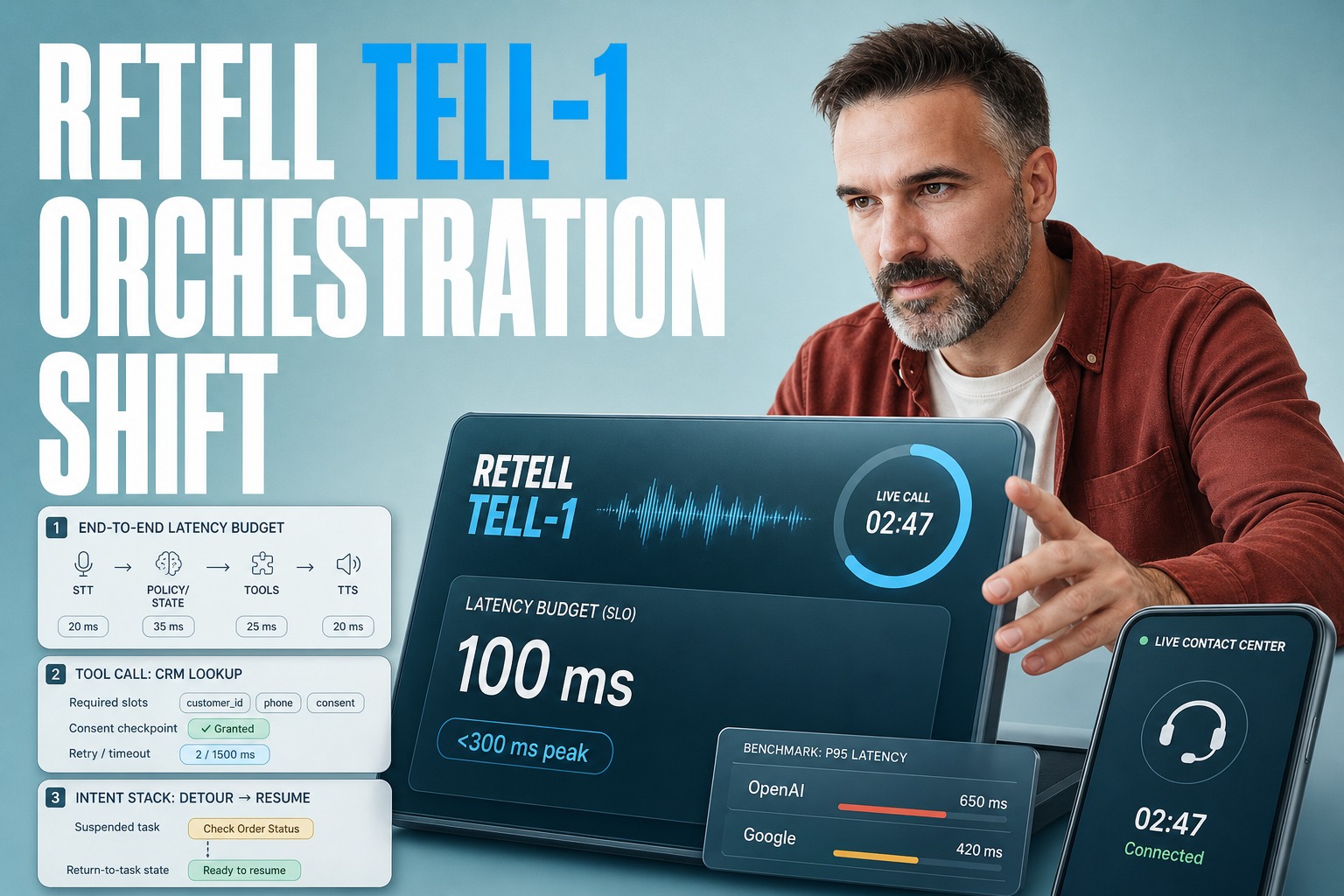
What’s the headline metric? → Retell reports under 100 ms responses on its live benchmark, designed to stay under 300 ms at peak.
What’s the deeper story? → Specialized models make orchestration (rules, tools, state) the primary engineering bottleneck.
What should you do next? → Re-budget your stack around end-to-end latency, not just model “intelligence.”
Quick Answer
An ai voice agent succeeds in production when orchestration, not just model quality, is engineered as the product. Retell’s Tell-1 is positioned around that reality: it’s trained for live calls, optimized for low cost and low latency, and built to follow complex business rules while taking tool-driven actions in real time. For engineering leaders, the lesson is to treat latency budgets, tool timing, and policy state as first-class design constraints.
- General-purpose models optimize for breadth; live calls punish that with higher latency and cost.
- Under 300 ms at peak should be a platform SLO, not a best-effort aspiration.
- The hard part is state: rules, exceptions, missing fields, and safe tool calls mid-dialog.
- Benchmarks matter only if they’re live-call realistic: grounding, tools, colloquial handling, latency.
- Build orchestration so the agent can recover from partial answers and topic detours without resetting.
AI Voice Agent Latency Is An Orchestration Problem
Retell’s announcement is a reminder that voice is an unforgiving interface: a small pause reads as incompetence. The interesting claim isn’t simply that Tell-1 can respond quickly; it’s that the model is designed to decide whether to ask, answer, or act while someone is waiting. For a CTO, that reframes voice AI latency from a model benchmark into an end-to-end orchestration budget spanning speech, policy, tools, and turn-taking.
- Assign a single latency budget across the whole turn: speech-to-text, reasoning, tool calls, text-to-speech.
- Represent business rules as versioned artifacts the agent can reference, not prose hidden in prompts.
- Treat ask vs act as a policy decision with guardrails and observability.
- Cache or prefetch likely lookups so tools don’t dominate the conversational timeline.
- Engineer recovery paths for interruptions, missing fields, and mid-task topic changes.
Why Tell-1’s Design Matters More Than Its Leaderboard Position
Retell describes Tell-1 as trained on hundreds of millions of calls and aimed at the failure modes where voice agents break: partial answers, subject changes, and needing to look something up and act while the caller waits. From an orchestration lens, this is less about smarter text and more about a model that stays coherent across a live workflow.
If you’re building similar capabilities, the fastest path to production isn’t swapping APIs weekly—it’s investing in the platform layer: state management, tool contracts, and safety constraints. That’s where ai voice agent development services can accelerate delivery, because the differentiator is often orchestration reliability, not a single prompt.
Interleaved Reasoning Changes How You Schedule Work
Retell says Tell-1 uses an interleaved reasoning architecture to think while speaking, reasoning through which rules apply, what’s missing, and whether to ask, respond, or act. Engineering-wise, the implication is that your runtime can no longer treat each turn as a clean request/response. You need orchestration that supports incremental commitments: acknowledging the user, collecting missing data, and firing tools only when preconditions are satisfied.
| Contact-Center Moment | What Usually Breaks | Orchestration Fix |
|---|---|---|
| Caller gives half an answer | Agent guesses or restarts | Slot tracking + targeted follow-ups |
| Caller changes the subject | Conversation resets | Intent stack + return to task state |
| Lookup required mid-call | Long silence | Async tool call + filler acknowledgement |
| Peak traffic hits | Latency spikes | Queueing + degraded modes + SLOs |
Read The Benchmark Like A Platform Engineer
Retell reports Tell-1 leads its live benchmark across instruction following, grounding, tool calling, colloquial quality, and latency, ahead of the latest models from OpenAI, Google, and Anthropic. The key is that those categories map directly to orchestration responsibilities. In particular, voice ai latency is rarely about raw tokens-per-second; it’s about when you trigger tools, how you handle partial inputs, and how your system avoids dead air while waiting on dependencies.
- Instruction following: enforce policy hierarchy (global rules, campaign rules, per-queue exceptions).
- Grounding: bind every claim to a source (CRM record, knowledge base article, tool output).
- Tool calling: validate arguments, run safety checks, and handle tool errors conversationally.
- Colloquial quality: support interruptions, repairs, and yeah… actually mid-sentence pivots.
- Latency: keep speech, reasoning, and tools within a single measurable SLO.
Tool Calling Is Where Voice AI Integration Succeeds Or Fails
Tool calling reads like a model feature, but the platform owns the hard parts: authentication, rate limits, retries, and consistency. Voice ai integration needs deterministic contracts: when the agent is allowed to hit an availability API, what happens if it times out, and what data must be confirmed before any write. Tell-1’s framing—act at the right time—matches what experienced teams learn: premature tools create wrong actions; delayed tools create dead air.
Define tool eligibility rules: required slots, confidence thresholds, and consent checkpoints.
Normalize tool I/O: strict schemas, enum constraints, and human-readable error payloads.
Instrument every tool call: start/end timestamps, retries, and caller waited duration.
Add conversational fallbacks: acknowledge delays and pivot to collecting more details.
Version everything: tool schemas, policy bundles, and routing logic tied to releases.
Voice AI Agent Platform Use Cases: What Should You Orchestrate First?
Most teams start with answering questions, then discover the real production wins come from workflow completion. The voice ai agent platform use cases that benefit first from orchestration are the ones with clear preconditions and bounded actions: identity checks, appointment scheduling, account lookup, and status updates. Retell’s examples—handling detours, partial answers, and calling lookups once enough info exists—are exactly the cases where state and timing outperform raw eloquence.
| Use Case | Required State | Safe Action Boundary |
|---|---|---|
| Account lookup | Caller identifiers + consent | Read-only queries until verified |
| Scheduling | Service type + timeframe | Reserve slot only after confirmation |
| Policy explanation | Policy version + context | No action; just grounded guidance |
| Case update | Case ID + status source | Write only with explicit confirmation |
Don’t Let Speech Recognition Drive Your Architecture
In voice stacks, speech recognition errors aren’t edge cases; they’re routine inputs your orchestration must absorb. When a caller provides only a first name, the right response is to ask for the missing detail, not to fill in with a guess or restart the form—Retell explicitly calls this out as a key failure mode. The platform should treat ASR output as probabilistic, preserve alternatives when available, and keep a repair loop that doesn’t blow the latency budget.
- Track slot confidence and ask targeted clarifying questions when confidence drops.
- Allow caller self-correction without resetting the workflow state.
- Keep a short-term memory of candidate entities (names, addresses) for repair turns.
- Use explicit confirmations before irreversible actions (cancellations, payments, reschedules).
- Log repair loops as a quality metric, not just conversation length.
Cost And Latency Must Be Governed Together
Retell notes that general-purpose models can be more expensive, and that an extra $0.05 to $0.10 per call compounds quickly at scale. The platform takeaway is that cost control is an orchestration discipline: constrain tool usage, avoid unnecessary long responses, and short-circuit dead-end paths. If you already have automation investments, connect them into the voice runtime intentionally—don’t bolt them on ad hoc. A good starting point is aligning your voice flows with broader automation standards via /services/ai-solutions/ai-automation.
In live calls, model intelligence is table stakes; orchestration that prevents silence, wrong actions, and rule drift is the competitive moat.
Design For Detours Without Losing The Transaction
Retell highlights a scenario every contact-center engineer recognizes: the caller asks an off-topic question mid-task, and naïve agents either ignore it or restart the workflow. The orchestration pattern that works is an intent stack: temporarily service the detour, then explicitly resume the suspended task with preserved state. This is also where you decide how much autonomy to grant—what can be answered from grounded sources, and what must be routed to a human when the policy tree gets ambiguous.
Treat Act At The Right Time As A Formal Contract
Tell-1 is positioned around taking the right action in real time, including calling tools such as availability or account lookup once it has enough information. Translate that into engineering: every action has prerequisites, every prerequisite has a measurement, and every measurement must be observable. If enough information is fuzzy, you’ll see production incidents as either premature writes or endless clarification loops.
Orchestration Requires Product-Grade Policy Engineering
Retell emphasizes following long, complex instructions with goals, policies, and exceptions kept in view from the first minute of a call to the last. Don’t implement that as a single mega-prompt. Build it like policy engineering: modular rules, scoped overrides, and an audit trail. When policies change weekly, the platform must support safe rollout, quick rollback, and consistent behavior across queues.
If you can’t explain why the agent took an action, you don’t have orchestration—you have a liability.
How To Build a Voice AI Agent Platform For An AI Voice Agent
How to build a voice ai agent platform starts with separating concerns: conversation state, policy state, and tool state should not be conflated. Retell’s framing—reasoning across the conversation, applying rules, and acting when ready—maps to a runtime that can pause, resume, and verify at each boundary. Architecturally, treat tools as deterministic services and the model as a controller that must justify transitions.
For most teams, the fastest path is to prototype flows end-to-end with observability, then harden policy and tool boundaries. If you need a neutral partner to pressure-test that design, /services/ai-solutions/ai-consulting can help you define the orchestration primitives before you scale call volume.
The CTO Checklist For Evaluating Tell-1-Style Voice Models
Treat Retell’s reported numbers—under 100 milliseconds on its live benchmark, designed to stay under 300 milliseconds at peak—as constraints to validate in your environment, not as marketing trophies. Your differentiator is whether the system keeps task continuity through partial answers, detours, and tool latency without violating policy. If a model helps, great; but orchestration is where you win.
When you’re ready to test, do it like a platform rollout: a narrow queue, strict action limits, and measurement of caller wait time versus tool time. If you want a concrete plan and effort estimate, start with a scoped discovery and timeline at /projectEstimate. Plavno teams typically focus on the orchestration layer first, because that’s what makes an ai voice agent trustworthy at scale.

 Chat GPT
 Perplexity
 Claude
 Gemini

