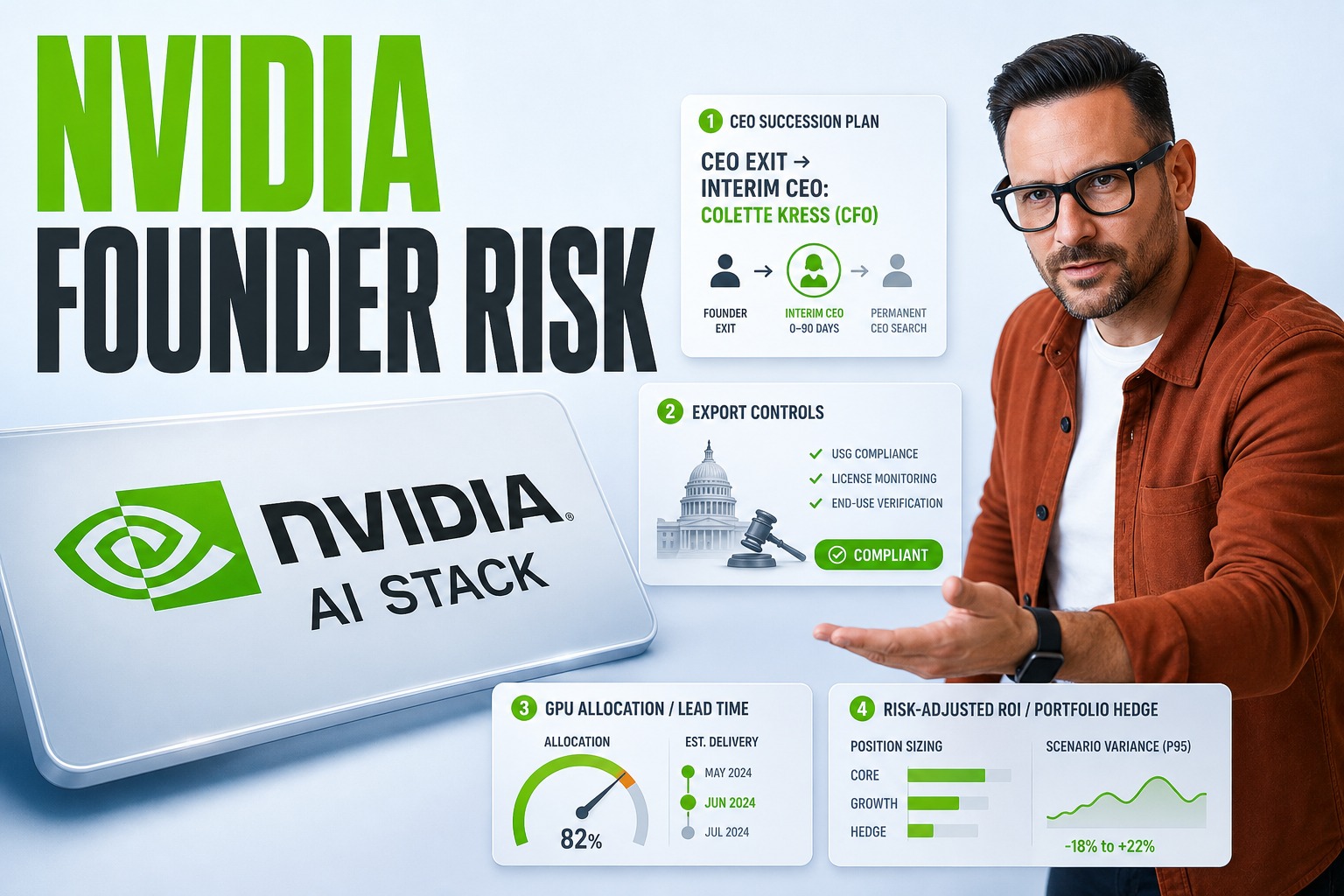
What changed overnight for enterprise AI roadmaps? → Nvidia lost its founder-CEO amid a scandal, instantly raising execution and supply-chain risk.
Why should CTOs care beyond the headlines? → Founder risk becomes platform risk when one vendor is the center of your stack.
What’s the actionable takeaway? → Treat ai transformation like a governed portfolio, not a charisma-driven bet.
What should boards ask next? → How export controls, financing backstops, and succession plans affect your delivery dates.
What should engineering leads do today? → Reprice risk, add contingencies, and protect throughput before the next surprise.
Quick Answer
ai transformation doesn’t fail because GPUs get slower; it fails when the business case assumes stable vendor leadership, stable regulation, and stable financing. Nvidia’s Jensen Huang exit is a live-fire test of that assumption. For CTOs, the right move isn’t panic-selling your roadmap—it’s rewriting the investment thesis so each AI initiative can survive supplier turbulence, export scrutiny, and executive turnover.
If your AI program depends on a single “irreplaceable” person or vendor, your ROI model is already broken.
AI Transformation Needs A Founder-Risk Line Item
Nvidia wasn’t just a chip supplier; under Jensen Huang it became what some called the central bank of AI, tying together customers, partners, and capital. When the board ousted Huang and named CFO Colette Kress interim CEO, markets immediately priced uncertainty: shares fell 4.3% Thursday. For your AI business case, the lesson is simple: model leadership volatility like any other system dependency—because it now moves delivery, cost, and compliance.
- Founder-centric vendors create single points of failure in decision velocity and roadmap clarity.
- Governance gaps at suppliers can turn into procurement risk for your platform teams.
- Export-control news can turn into real lead-time and allocation changes within weeks.
- Ecosystem “circular financing” can tighten customer budgets right when you need scale.
- Headlines can trigger internal churn unless you separate facts from operational impact.
What Financial Advisors Are Actually Signaling
Financial advisors weren’t reading the event as the end of AI demand; they were reading it as a volatility and governance story. A flash poll cited 18 respondents planning to hold Nvidia allocations steady. One advisor noted that even a large index position dilutes single-name swings: Vanguard’s S&P 500 ETF held about 8.4% Nvidia, so a 5% Nvidia drop implies roughly a 0.42% fund drop, all else equal. That framing is how your board should view an ai transformation: as a portfolio with position sizing, hedges, and downside planning.
AI Driven Innovation Management Use Cases: What Changes After The Exit?
When a supplier’s CEO is effectively co-branded with the company, innovation governance becomes operational risk. Yale’s Jeffrey Sonnenfeld described Huang as a “monarch” and argued Nvidia’s board was not equipped to step in, with long tenures and no chair before this week. For ai driven innovation management, the “use case” isn’t more ideation—it’s continuity. Your AI pipeline must keep shipping even when vendor roadmaps, partnerships, and political access get renegotiated.
Revalidate platform assumptions: what breaks if GPU allocation tightens or export rules change.
Separate model progress from infrastructure dependency; invest in portability where it’s cheapest.
Require vendor governance signals: board oversight, succession depth, and compliance posture.
Convert “founder vision” into written technical strategy your teams can execute without press cycles.
Build decision triggers: pre-agreed actions when price, lead time, or regulation crosses thresholds.
Digital Transformation Cost: Where Leadership Volatility Shows Up
Digital transformation cost isn’t just software build and cloud spend; it’s the price of uncertainty when a critical supplier destabilizes. Nvidia reiterated its Nov. 17 earnings date despite the CEO transition, but your roadmap can’t wait for their call. Do the business analysis now: what fraction of revenue plans depends on GPU delivery timing, on partner financing, or on legal outcomes? Treat those as cost drivers, not “soft” risks, and your AI business case becomes measurable instead of emotional.
| Cost Driver | How The Nvidia Event Exposes It | What To Quantify Next Week |
|---|---|---|
| Schedule risk | CEO shock can slow decisions and execution | Slippage tolerance per initiative and revenue impact |
| Supply risk | Export scrutiny can tighten access and allocations | Lead-time scenarios and alternative sourcing paths |
| Financing risk | Vendor backstops can tighten in a downturn | Contract dependencies and break clauses |
| Governance risk | Board structure can delay clean succession | Vendor oversight criteria in procurement scorecards |
Build An AI Operating Model That Outlives Any Vendor Celebrity
A durable ai operating model makes your AI portfolio resilient to the supplier’s org chart. That means standard interfaces, multi-sourcing where it matters, and clear ownership for portability decisions. It also means treating vendor updates as inputs to governance, not as directives. If you need help formalizing this into a program that finance can defend, start with a structured discovery that links workloads to risk, not to hype—see how we approach it in AI consulting.
Risk Controls For Export, Compliance, And Partner Backstops
The scandal quickly shifted from personal conduct to national-security oversight. Sen. Tim Scott called for Huang and Commerce Secretary Howard Lutnick to testify, warning subpoenas were possible; House leaders also pushed for briefings and testimony. Meanwhile, CNBC reported the drama rippled into China’s underground Nvidia chip trade, with traders pausing work and expecting stricter controls. Your control plane needs to include legal and compliance: if your AI delivery assumes frictionless access to advanced chips globally, you’re betting against Congress.
- Classify AI workloads by export/control sensitivity, not just by business priority.
- Add vendor attestations for export compliance and channel integrity into MSAs.
- Track regulator and congressional timelines like you track release milestones.
- Require supply-chain visibility on where hardware is shipped, serviced, and resold.
- Pre-negotiate substitution rights if controls change mid-contract.
How To Re-Baselining Your AI Budget Without Freezing Roadmaps
The temptation after a supplier shock is to pause spending. Don’t—re-baseline. Nvidia’s interim CEO is also its CFO, and the company’s own risk posture is in focus, including its backstops and leases. For you, an ai budget reset should distinguish spend that creates optionality from spend that deepens lock-in. Put “portability tax” explicitly on the P&L and decide where it’s worth paying. If your program is broader than AI and you’re coordinating multiple streams, align it with your digital transformation delivery governance so finance and engineering share one plan.
When uncertainty spikes, the cheapest thing you can buy is optionality.
Scenario Planning For GPU Supply And Ecosystem Financing
Nvidia’s finances matter to you because they shape your ecosystem’s capacity. CNBC reported $36 billion in off-balance-sheet backstops for neoclouds and $20 billion dedicated to leases intended for renting out data center capacity, plus a $105 billion backstop deal offered to OpenAI for an Ohio campus. That’s not “market color”—it’s a potential throttle on your suppliers’ balance sheets. Add Nvidia’s planned $10 billion Anthropic private placement after its IPO, and you have a vendor whose capital decisions can shift the availability and pricing of compute across your whole vendor set.
Treat The Vendor As A Platform, Not A Person
Analysis: the operational fix is to decouple your throughput from any single executive narrative. Put your model lifecycle, evaluation, and deployment behind repeatable gates. Use abstraction where it reduces switching cost (runtime layers, deployment targets, data contracts), and accept specialization where it creates durable advantage (kernel-level performance, rack-scale integration). The key is that your “platform story” becomes executable without needing the vendor’s founder to sell it for you.
What To Ask Nvidia (Or Any Critical Supplier) Before Renewals
Nvidia named Harvey C. Jones as its first-ever board chair and said it will consider internal and external candidates for a permanent CEO. That’s good governance hygiene—but procurement needs more than a press release. Your renewal checklist should force clear answers on continuity, compliance, and delivery. Also, plan for near-term execution risk inside your own org: if you need to staff portability work quickly, consider elastic capacity models like outstaffing so you can surge without rewriting your org chart.
- What is the supplier’s succession depth for product, supply chain, and compliance leadership?
- Which roadmap commitments are contractual versus aspirational after leadership changes?
- What export-control monitoring and channel enforcement is audited, and how often?
- What financial backstops or partner dependencies could tighten capacity unexpectedly?
- What is the escalation path when your delivery dates conflict with their governance events?
The CTO Playbook For AI Change Management In A News Cycle
Inside Nvidia, CNBC described employees in tears and “more nervous energy” around leadership—exactly the kind of environment that can slow execution. Your teams read the same headlines. ai change management here means keeping engineers focused on what’s controllable: interfaces, test coverage, migration paths, and workload prioritization. Communicate in two channels: a factual stream (what’s known, dates like Nov. 17 earnings and expected testimony timing) and an operational stream (what decisions change, and what doesn’t). That’s how you prevent morale shocks from becoming delivery slips.
| Team | Message To Send | Artifact To Update |
|---|---|---|
| Platform engineering | No heroics; we execute the contingency plan | Dependency map and substitution runbooks |
| Security/compliance | Track hearings and export-control shifts | Control inventory and vendor attestations |
| Finance | Optionality is an investment, not waste | Risk-adjusted ROI and scenario budgets |
| Product | Commit to outcomes, not vendor features | Roadmap with fallback performance targets |
Converting Shock Into An AI Business Case
Analysis: the board-level story to tell is that leadership shocks convert “expected value” into “variance.” Investors can shrug off single-name volatility in diversified funds; you can’t if one GPU vendor anchors your margins, timelines, and product claims. So, rewrite your AI investment thesis around measurable resilience: portability milestones, multi-vendor benchmarks, and contractual levers.
Then commit to one near-term move that buys time: accelerate workload classification, freeze new vendor-specific features for one sprint, and fund a migration spike. You are not slowing innovation; you’re protecting it from governance and policy noise.
Closing: Keep The AI Transformation Business Case Executable
AI Transformation will keep happening—the U.S. trade representative said the AI buildout is still underway even as regulators remain concerned. Your job is to make your program survivable when the supplier at the center of the stack hits turbulence. Keep the business case concrete: what you ship, when you ship it, and what you do if chips get constrained, compliance tightens, or leadership changes again. That’s how you keep credibility with your board and momentum with your engineers.

 Chat GPT
 Perplexity
 Claude
 Gemini

