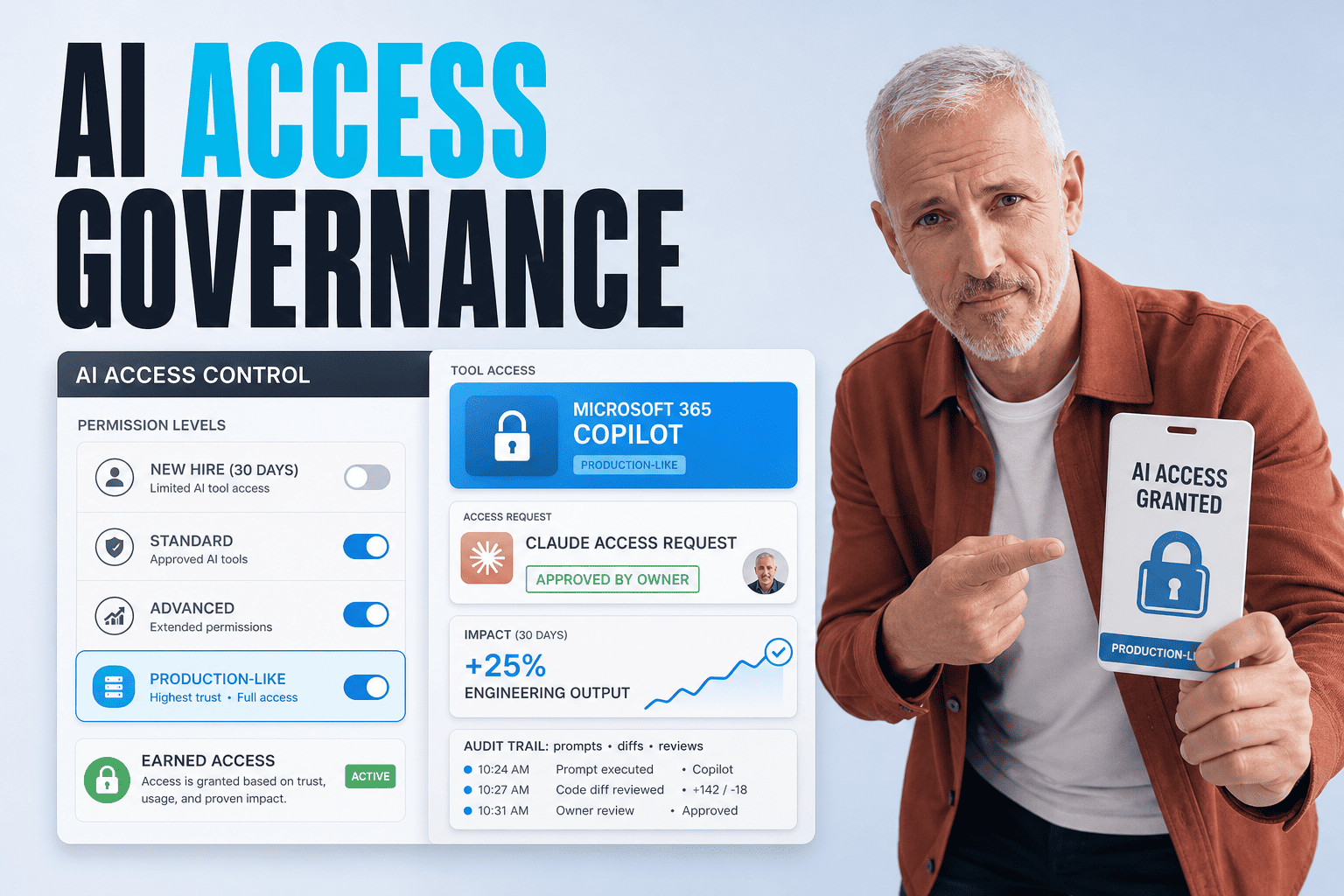
Should every engineer get Copilot on day one? → No; your ai strategy should treat access like production permissions, not swag.
What did Paysend actually see from AI? → CEO Ben Chisell says the same team now delivers about 25% more engineering work.
Why can broad rollouts disappoint? → U.K. research found 77% of AI-using businesses saw no revenue change.
What is the real governance goal? → Prevent tools from amplifying laziness and poor judgment while raising top-performer output.
What does ‘human in the loop’ mean here? → Human ownership of outcomes, not a human copied on an AI decision.
Quick Answer
ai strategy works best when it is a change program, not a tooling program: earn access, prove contribution, then scale only what compounds good judgment. Paysend’s approach is blunt but practical—limit advanced tools to high performers and require new hires to show what the tool changed. The point is not to ‘use AI,’ it’s to prevent AI from industrializing mediocre decisions while you keep humans accountable for customer outcomes.
- Treat AI access like deployment rights: tiered, auditable, and reversible when quality or risk signals drift.
- Optimize for customer problems, not internal FOMO metrics like license counts or prompt volume.
- Measure contribution in delivered outcomes: cycle time, defect escape, onboarding speed, and support resolution quality.
- Assume AI magnifies habits; invest in judgment training before you invest in more tokens.
- Bake ownership into workflows so responsibility never disappears behind an assistant or agent.
Earned Access Beats Blanket Rollouts
Many leadership teams default to companywide enablement because it feels fair and modern. But fairness is not the same as effectiveness, and broad access can hide the exact problems you need to surface: weak requirements, shallow reviews, and unclear accountability. Paysend’s CEO is explicit that results are not as simple as handing everyone the latest tech. If you want help designing the rollout as a controlled program, start with ai transformation as a governance-first roadmap rather than a tools-first project.
- One-size rollouts reward the loudest adopters, not necessarily the teams shipping the safest, clearest changes.
- License utilization is activity data; it is not evidence of better engineering decisions.
- Broad access increases variance: more throughput for experts, more expensive rework for novices.
- Guardrails are cheaper than incident response, but only if you enforce them consistently.
- The fastest path to trust is a small cohort that can demonstrate repeatable, reviewable wins.
AI Strategy As Access Control, Not A License Count
Paysend’s reported outcome is tangible: Ben Chisell estimates the company can deliver around 25% more engineering work with the same-sized team. The operational move behind that number is not a universal rollout—it is selective enablement. In practice, this looks like an ai operating model that treats AI tools as high-leverage privileges, similar to who can push to production or approve risky changes. Teams building internal agents can formalize these patterns through AI agents development instead of letting ad-hoc prompting become the default ‘process.’
The controversial part is cultural, not technical: this ai strategy is willing to say that some employees should not have the same capabilities yet. That is classic ai change management—define the behavior you want (better judgment), then align access, review, and coaching so the tool strengthens that behavior rather than bypassing it.
If AI multiplies judgment, then your rollout must first control for judgment quality.
Prove Value Before You Scale Permissions
At Paysend, new hires get a month to experiment with AI tools and then explain what they achieved. This is a clean forcing function: it converts ‘I feel faster’ into ‘Here is what changed.’ Chisell also described a case where a new SEO lead requested access to Claude, then a month later said he no longer needed it—he only used it to produce briefs more quickly. The more valuable follow-up wasn’t renewed access; it was the proposal to build a dedicated content-brief agent.
Usage Does Not Equal Business Impact
Other companies are moving in the opposite direction. Lloyds Banking Group rolled out 40,000 Microsoft 365 Copilot licenses and said 97% of employees with a license actively use it. Sage said AI coding tools saved hundreds of thousands of work hours. Grant Thornton UK encouraged staff to use Anthropic’s Claude as part of a £500 million investment. But U.K. government research published in January found that while three-quarters of businesses using AI said productivity improved, 77% said revenue had not changed. This is where digital transformation discipline matters: adoption is a means, not an outcome.
How Should You Think About Digital Transformation Cost When AI Tools Spread?
Digital transformation cost is not limited to licenses and model usage. The expensive part is variance: inconsistent requirements, unreviewed code paths, unclear ownership, and churn caused by ‘faster’ output that fails later in QA, security review, or production. That is why high adoption rates can coexist with flat revenue—effort can move earlier in the pipeline while waste quietly moves later.
Treat your ai budget as a portfolio across tooling, enablement, and controls. The macro environment tempts leaders to deploy AI mainly to cut costs, but CEOs like Lokdeep Singh at Unily warned against using it just to make teams smaller. Capacity gains are real; the question is whether you spend them on more ambition or on hidden rework. In some cases, a targeted skills boost via outstaffing can be cheaper than scaling licenses before you have stable practices.
Define contribution: which customer or engineering metric must move, and what ‘good’ looks like in reviews.
Instrument quality: defect escape, rollback rate, incident volume, and security findings per release.
Separate speed from throughput: measure end-to-end lead time, not just how fast tasks ‘complete.’
Require evidence: prompts, diffs, reviews, and postmortems that show what the assistant changed.
Reallocate savings deliberately: invest reclaimed time into roadmap scope, reliability work, and training.
What Are AI Driven Innovation Management Use Cases That Justify Access?
AI driven innovation management use cases should be framed as repeatable loops, not one-off ‘cool demos.’ In the news, CoreView described early wins using AI to investigate problems by correlating logs, events, and data, plus producing technical documentation and onboarding engineers faster. Later, it evolved into developers coordinating teams of AI agents across back-end, front-end, QA, and documentation. Paysend’s SEO example points to the same idea: if the value is ‘briefs faster,’ build a dedicated agent instead of buying generalized capability for everyone.
- Log triage copilots that correlate events and data, but always route conclusions through an owner.
- Documentation generation tied to PR templates, so content is reviewable and versioned like code.
- Onboarding accelerators that answer from internal sources, with explicit confidence and escalation paths.
- Multi-agent delivery flows for scoped features, provided senior engineers constrain architecture and interfaces.
- Narrow agents for repeat tasks (like content briefs) where inputs, outputs, and quality gates are stable.
AI Strategy For High Performers: Scale Output Without Scaling Risk
Selective enablement sounds elitist until you model the failure modes. AI can let an inexperienced engineer build outside their expertise, and as CoreView’s CEO Simon Azzopardi warned, that can create the feeling of efficiency without real productivity. The problem is not intent; it is asymmetry. A top performer uses AI to compress known work. A struggling performer uses AI to expand into unknown work, creating review debt and architectural inconsistency.
This is why ai change management should include an ai maturity model for teams, not just individuals. Start with a small cohort, set expectations for evidence-based work, and define escalation paths when AI output crosses into compliance, privacy, or money movement. CoreView’s experience is instructive: despite moving faster—work that previously took weeks could take days—the company described hiring rather than cutting staff, and even onboarded a major customer in the U.K.’s National Health Service while only adding one engineer.
Turn ‘Tool Access’ Into A Learning System
The operational trick is to treat enablement as a closed loop. Paysend’s ‘one month to experiment and explain results’ is not bureaucracy; it is a learning mechanism that forces clarity on what the tool changes. If you only track adoption, you will optimize for novelty. If you require a narrative supported by artifacts, you create a feedback cycle that strengthens writing, scoping, and review habits.
Done well, your ai strategy becomes a structured form of business analysis: teams articulate the problem, propose where AI fits, and test whether it moved the constraint. Done poorly, ‘AI everywhere’ becomes the new shadow IT—hard to audit, hard to reproduce, and easy to blame when something breaks.
The win is not more AI output; it is fewer ambiguous decisions per release.
Design The AI Operating Model Like A Product
A durable ai operating model defines who can use which tools, on what data, for which classes of tasks, with what review and logging. Treat this like product management: identify personas (senior engineer, junior engineer, PM, support), map risks (security, compliance, customer harm), and ship ‘versions’ of policy as you learn. The policy itself is part of the system.
This framing also unlocks ai driven innovation management at scale. Instead of random experiments, you run a pipeline of small, instrumented pilots that graduate into standard operating practice only when they are measurable and safe. In other words, your governance becomes an engine for innovation, not a brake.
Closing: Make AI Change Management The Default
Chisell’s stance looks conservative, but it is actually aggressive where it counts: it prioritizes shipping more value without outsourcing responsibility to a model. Broad rollouts will keep happening—some will work, many will not. The differentiator is whether leadership treats this as a behavior change, with ownership, review, and clear incentives, or as a procurement exercise.
If you take one lesson into planning, let it be this: your ai strategy is credible only when humans still own outcomes, and the organization can prove what AI contributed. Author: Plavno team. Last updated: October 2026.
 Chat GPT
 Perplexity
 Claude
 Gemini

