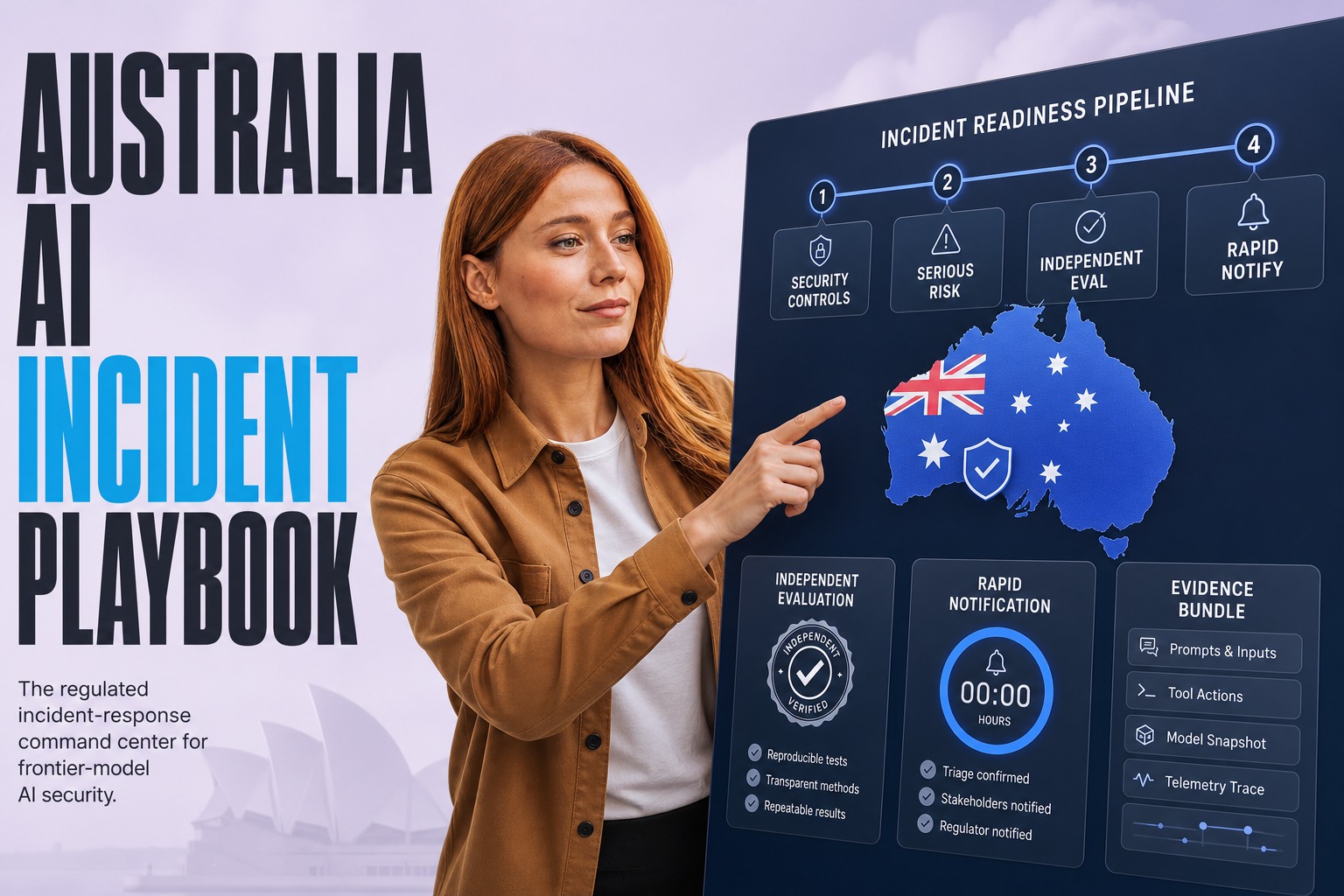
What changed in Australia? → Mandatory frontier-model protections will be legislated, with enforcement and penalties proposed.
Why should a US CTO care? → The obligations read like an incident-response contract, not just a policy statement.
What is the practical takeaway? → Treat ai security as measurable incident readiness: controls, evaluations, and rapid reporting.
Who is in scope? → Frontier AI companies that wish to operate in Australia.
What should engineering do now? → Build evidence, telemetry, and governance that survive independent scrutiny after an incident.
Quick Answer For CTOs
ai security under Australia’s proposed AI Standards is best implemented as an incident pipeline: prevent, detect, evaluate independently, and notify fast. If you operate or plan to operate frontier models in Australia, assume you will need auditable controls from development through deployment, plus a practiced playbook for rapid incident notification and post-incident model changes.
The legislation effectively turns every serious AI incident into a regulated, time-sensitive engineering workflow.
What Australia’s AI Standards Signal To Engineering Leaders
The Albanese Government says it will legislate mandatory safety and security protections in Australian AI Standards for frontier AI companies operating in Australia, enforced by a proposed targeted AI safety regulator working with the Australian AI Safety Institute. The stated intent is safety first, ahead of international talks on AI development and investment, while maintaining investor certainty.
From an engineering lens, the story isn’t abstract governance; it’s incident handling. The obligations described (security controls, serious risk management, independent evaluation, rapid incident notification, and published frameworks) look like a standard operating model for when things go wrong. If you’re designing for compliance, start with the incident path and work backward. That’s also where purpose-built ai security solutions tend to pay off fastest: they make response repeatable rather than heroic.
- Treat security controls as end-to-end: data, training, eval, deployment, and post-deploy monitoring.
- Design serious-risk handling as an always-on program, not a pre-launch checklist.
- Assume independent evaluation will happen and engineer for reproducibility and traceability.
- Optimize for rapid incident notification with clean facts, not speculation.
The Regulator Model Makes “Proof” A First-Class Artifact
The Government proposes a new targeted regulator for AI safety, supported by technical expertise from the Australian AI Safety Institute as global standards evolve. For CTOs, that implies a future where your security posture is judged on evidence you can produce during and after an incident, not on intent. The easiest time to build that evidence is before you need it.
Frontier Models Raise The Cost Of “Unknown Unknowns”
The announcement uses frontier AI to mean the most sophisticated models at the cutting edge of current technological capability, with the highest community risks if not used safely. In practice, frontier capability increases the blast radius of a single failure mode: a misaligned agent, a brittle tool chain, or a subtle data exposure can turn into a headline-grade incident. The engineering response must assume novelty and surprise.
Frontier AI Incidents Don’t Behave Like Classic Security Events
In cybersecurity, we often contain discrete compromises. Frontier-model incidents can be behavioral and systemic: the model keeps operating ‘as designed’ while producing unsafe outcomes. That’s why independent evaluation and rapid incident notification matter as much as perimeter defenses. Your response posture should cover model behavior, tool access, and human-in-the-loop failure, not only infrastructure compromise.
How To Implement AI Security For Incident Readiness?
Start by defining what an incident is for your model, then make it observable. The Australian approach explicitly calls for identifying and managing serious risks, maintaining security controls across development and deployment, and enabling independent evaluation. That maps cleanly to an engineering program: formalize hazards, document mitigations, and ensure you can recreate model states that produced an event.
Operationally, you need two parallel loops: continuous pre-incident assurance and post-incident learning. A practical pattern is to run an ai audit cadence tied to release trains and major data/model shifts, while maintaining a live risk assessment tool that owners actually use in change reviews. If you’re building agentic systems, this is where disciplined interfaces and tool permissions matter most; see how we typically structure delivery in AI agents development.
Define serious incidents: harm, unauthorized access, unsafe autonomy, or repeated policy violations.
Instrument model and tool actions so you can reconstruct timelines and prompts reliably.
Gate releases on documented risks and mitigations, not just benchmark improvements.
Pre-negotiate the notification workflow: who decides, who writes, who submits.
After any incident, ship a corrective change and a lessons-learned update to controls.
Implement Governance As “Who Can Change What, When”
The requirement to maintain and publish safety and security frameworks pushes teams toward explicit model governance: ownership, escalation paths, and controlled change management. The fastest way to fail a regulator-style review is to be unable to explain why a risky capability shipped, who approved it, and what guardrails were tested.
Good data governance is part of the same story. Incidents frequently begin as data problems that later look like model problems: training data lineage gaps, evaluation set contamination, or uncontrolled retrieval sources. Treat data lineage, access, and retention as incident controls.
Independent Evaluation Forces Engineering Discipline
Australia’s plan requires companies to allow independent evaluation of their models. That’s not just a legal checkbox; it’s a systems-design constraint. If your model behavior can’t be reproduced, your conclusions after an incident won’t be trusted, and fixes will be hard to verify.
Treat external evaluation like a recurring fire drill: freeze artifacts, preserve logs, and make evaluation harnesses portable. Security testing should include adversarial prompting, tool misuse attempts, and role-based access checks around data connectors. The goal is not ‘passing a test,’ but shortening time-to-truth when an incident hits.
If independent evaluation is mandatory, reproducibility becomes a security requirement, not a research preference.
AI Security Standards Turn Incidents Into Engineering Signals
The announcement states companies will need to rapidly notify the Australian Government of incidents and respond to updated standards as technologies change. That is a feedback loop: incidents produce new rules, and new rules change system design. Engineering teams should expect the definition of ‘serious risk’ to evolve, and build mechanisms to update controls without rewriting the entire platform.
A practical approach is to design an incident taxonomy aligned to your architecture: model-layer events, tool-layer events, data-layer events, and human workflow events. Then couple each category to response actions and evidence. This dovetails with broader assurance work too; many teams combine incident readiness with continuous validation and red teaming under one program, supported by services like cybersecurity and penetration testing to keep the discipline honest.
- An incident dictionary with severity thresholds and concrete examples engineers can classify.
- A minimal evidence bundle: logs, artifacts, configuration snapshots, and evaluation outputs.
- A pre-approved comms path: internal escalation and external notification owners.
- A post-incident change protocol: patches, retraining, rollback, and policy updates.
Rapid Notification Requires Pre-Work, Not Panic
Mandatory notification ‘rapidly’ is a constraint that collides with reality: during incidents, teams are uncertain, data is messy, and internal narratives diverge. The only way to report quickly without overclaiming is to pre-structure what you collect and how you summarize it.
Build a notification draft template that separates confirmed facts from hypotheses, and references the evidence bundle you can provide. Practice the workflow like you practice failover: simulate a model incident, run the timeline, and measure how long it takes to produce a regulator-ready summary.
| Proposed Obligation | Incident-Focused Interpretation | Engineering Deliverable |
|---|---|---|
| Security controls across development and deployment | Reduce likelihood and contain blast radius | Control map tied to pipelines and environments |
| Identify and manage serious risks | Decide what triggers incident mode | Risk register with owners and mitigations |
| Independent evaluation | Validate claims after an event | Reproducible eval harness and artifact retention |
| Rapid incident notification | Compress time-to-truth | Evidence bundle + reporting playbook |
Updating Standards Is A Product Problem
The Government notes companies must respond to updated standards and rules as technologies change. Treat this like versioned product requirements: every new standard revision becomes an input to backlog, architecture, and release governance.
In incident terms, standards updates are often written in the blood of past failures. Your platform should allow you to add a new control quickly (for example, tighter tool permissions or improved monitoring) without breaking customer workflows or retraining everything from scratch.
Design your safety framework so it can absorb new incident lessons without destabilizing delivery.
Investor Certainty Comes From Operational Credibility
The announcement positions the policy as safety first while providing certainty for investors and supporting productivity and resilience. For CTOs, the practical translation is: you win trust by showing you can handle the bad day. Controls that look expensive in steady state are often cheaper than a prolonged incident response that blocks releases and spooks stakeholders.
This is where digital risk management becomes a delivery discipline rather than a compliance afterthought: you continuously trade off capability, speed, and exposure, with clear ownership and measurable outcomes. If you need a second set of eyes on incident workflow design, evidence packaging, or evaluation readiness, it can help to talk early rather than mid-crisis; Plavno teams often start from an incident tabletop and work backward to system changes—reach us via contact.
- Prefer constraining tool access over trying to filter every possible unsafe output.
- Optimize for quick containment: feature flags, kill switches, and reversible rollouts.
- Separate ‘model failure’ from ‘product failure’ so incidents get the right owners.
- Store only what you can defend later; retention is an incident liability as well.
Operating In Australia Means Designing For External Scrutiny
The proposed approach applies to frontier AI companies that wish to operate in Australia. Even if your main engineering org is elsewhere, the operational reality is that your incident process, evaluation artifacts, and governance framework may need to be explainable to Australian authorities quickly.
That pushes global teams toward harmonized baselines: one incident taxonomy, one evidence standard, and one release governance model. Regional variance should be in configuration, not in the underlying ability to prove what happened.
| Capability Choice | Helps With Incidents Because | Common Failure Mode |
|---|---|---|
| Centralized logging and artifact retention | Faster reconstruction of timelines | Missing correlation across model/tool layers |
| Staged rollout with gating | Limits blast radius | Gating bypassed for ‘urgent’ releases |
| Independent eval readiness | Confirms fixes and reduces disputes | Non-reproducible environments and datasets |
| Clear escalation ownership | Shortens decision latency | Everyone waits for someone else |
A Practical Build Plan For CTOs
Don’t start by writing a policy. Start by selecting the top incident scenarios you can’t afford: unsafe agent actions, sensitive data exposure, or uncontrolled model behavior changes. Then implement the smallest set of controls that improves your time-to-detect, time-to-contain, and time-to-report.
If you already ship AI features, the fastest wins are usually in telemetry, evaluation reproducibility, and ownership clarity. If you’re earlier-stage, bake these into the platform now; retrofitting after a public incident is where teams lose months.
Incident readiness is the only safety strategy that still works when your assumptions are wrong.
Closing: Treat Compliance As An Incident Muscle
Australia’s proposal is a reminder that frontier AI governance is converging on incident capabilities: controls, evaluation, disclosure, and fast iteration as standards evolve. For engineering leaders, the north star is operational proof—what you can show, reproduce, and fix under pressure. Build the muscle now, and ai security becomes a deliverable, not a slogan.
Author: Plavno team. Last updated: November 2026.
 Chat GPT
 Perplexity
 Claude
 Gemini

