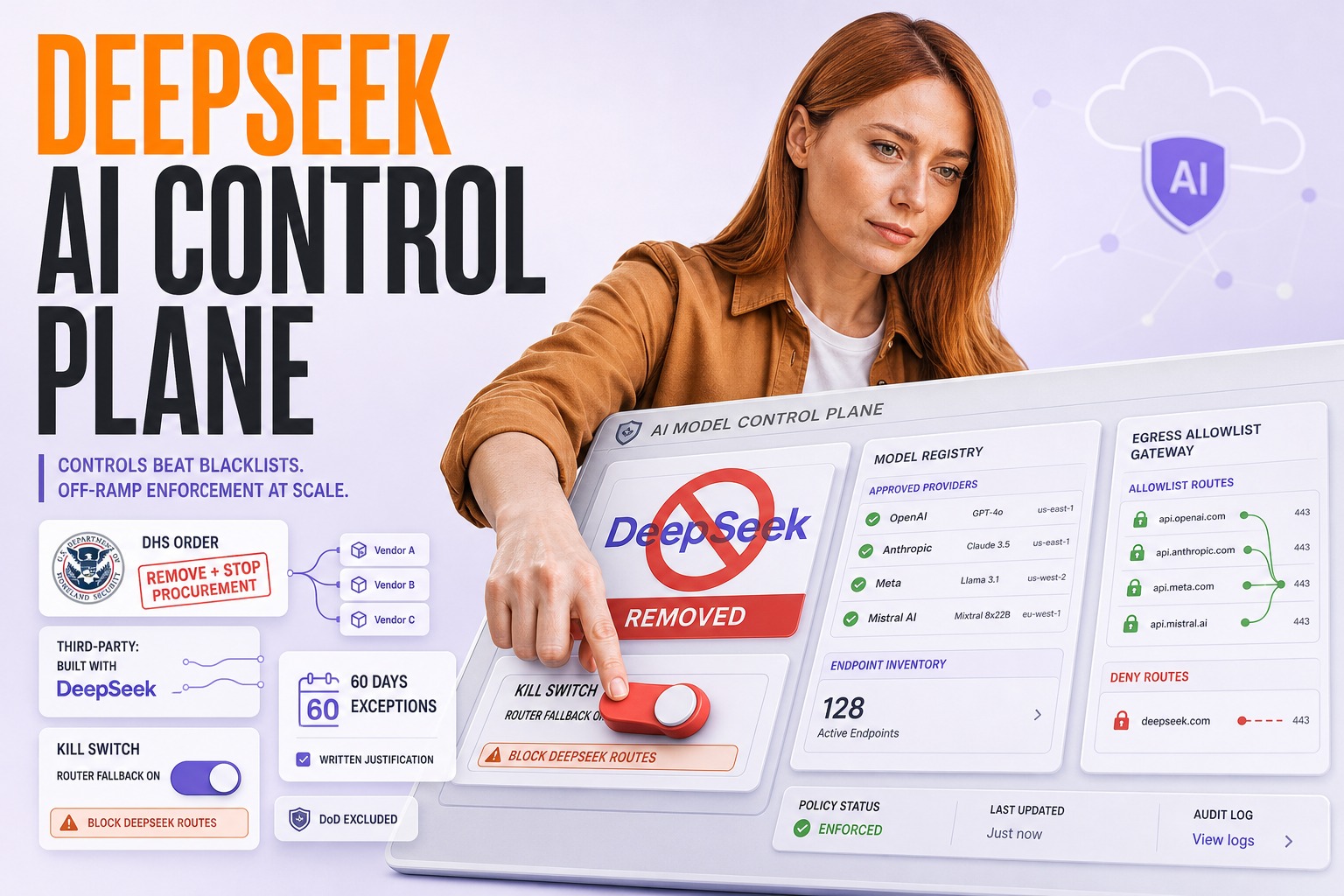
What changed with DeepSeek? → A DHS order requires federal civilian agencies to remove DeepSeek tech and stop buying it, reframing ai security as enforceable controls.
Who is affected? → Federal civilian agencies (Treasury, State, Justice cited), plus third-party products built using the company’s technology.
What’s the real engineering takeaway? → You need an inventory and control plane for models, not a vendor list.
Is the Department of Defense included? → No, the order excludes DoD, but related restrictions have already appeared elsewhere.
Can agencies delay compliance? → Yes, exceptions (including delays) are possible with written justification within 60 days.
Quick Answer: What The DeepSeek Ban Means For Controls
ai security is shifting from ‘pick safe vendors’ to ‘prove enforceable controls across your AI supply chain.’ DHS ordered federal civilian agencies to remove DeepSeek-related technology from IT systems and barred procurement of DeepSeek products and services, including third-party offerings built with DeepSeek tech. For CTOs, the immediate pattern is clear: you’ll be asked to demonstrate model provenance, data handling, and off-ramps—fast.
If you can’t prove where prompts, weights, and logs go, you don’t have controls—you have hope.
How To Implement AI Security
Start by treating ‘model use’ as a governed dependency, not a developer preference. Build a single inventory of where models are used (directly and via vendors), then enforce data and network controls at the integration points: gateways, SDK allowlists, and egress policies. If you need a reference architecture for these guardrails, Plavno’s ai security solutions focus on control enforcement rather than one-off reviews.
- Freeze new procurement of affected model services while you map usage and third-party propagation paths.
- Identify every application route that can send prompts, files, or logs to external endpoints.
- Create a kill-switch plan: feature flags, model routing fallback, and credential revocation.
- Add ‘model source of truth’ to CI/CD: approvals for SDKs, endpoints, and dependencies.
- Require evidence artifacts: data flow diagrams, egress rules, and vendor attestations.
What DHS Actually Ordered (And What It Didn’t)
On Monday, the Department of Homeland Security made public an order (originally issued July 24) requiring federal civilian agencies to remove DeepSeek-related technology from their IT systems and stop procuring DeepSeek products and services. The order applies to federal civilian agency IT systems and extends to third-party products and services developed using DeepSeek technology. It excludes the Department of Defense.
| Topic | What The Order Covers | CTO Interpretation (Analysis) |
|---|---|---|
| Systems in scope | Federal civilian agency IT systems | Inventory must include shared services and managed platforms. |
| Procurement | No procuring DeepSeek products/services | Add vendor onboarding gates that flag model-origin dependencies. |
| Third parties | Products/services built using DeepSeek tech | Ask ‘built with’ questions, not just ‘hosted by’ questions. |
| Exceptions | Written justification within 60 days | Formalize an exception workflow with compensating controls. |
Third-Party Exposure: The Hidden Part Of The Ban
The hardest part isn’t uninstalling an app; it’s discovering where DeepSeek sits inside other products you already use. DHS explicitly extended the ban to third-party products and services developed using the company’s technology. That’s a supply-chain statement: if your vendor routes data into someone else’s model, the compliance and risk posture follows the data. Your control objective is traceability from user input to model execution.
- Update vendor questionnaires to include ‘model provider,’ ‘fine-tuning source,’ and ‘inference routing’ disclosure.
- Require SBOM-like documentation for AI dependencies: SDKs, endpoints, model hosts, and plugins.
- Add contract clauses for prompt/log retention, data residency, and incident notification.
- Gate third-party integrations behind an outbound proxy with allowlisted destinations and audit logs.
Threat Vectors Cited In The Order
DHS stated DeepSeek’s AI models ‘present multiple threat vectors,’ including concerns that Chinese authorities could access sensitive data and that the models may introduce cybersecurity vulnerabilities. The agency also warned that use could transfer sensitive U.S. government data to China, potentially providing intelligence on American citizens and government programs. For enterprise teams, this maps cleanly to data privacy in ai: the question is what data leaves your boundary, where it’s stored, and who can compel access.
Controls Beat Blacklists In Model Procurement
Bans are blunt instruments, but they reveal what auditors and security leaders will ask next: can you show that your model choices are governed and your data flows are constrained? That’s a model governance problem, not a press-release problem. If your approval process lives in docs and meetings, you’ll be slow and inconsistent under time pressure.
Treat every model integration like a high-privilege dependency: isolate it, monitor it, and be able to swap it. Your evidence should be automation-first: a lightweight ai audit trail (who approved which model, for which use case, with which data classes) and policy checks in delivery pipelines. For teams that need help operationalizing these gates across products, AI consulting is most valuable when it results in repeatable controls, not slide decks.
- Maintain a ‘model registry’ with owners, endpoints, data classes, and approved use cases.
- Enforce egress controls so only sanctioned model endpoints can be reached from production.
- Classify prompts, uploads, and outputs; block or redact restricted fields automatically.
- Require vendor transparency on retention, training use, and sub-processor relationships.
How To Implement Cybersecurity AI Security
How to implement cybersecurity ai security comes down to merging two programs: classic cybersecurity controls plus AI-specific attack surfaces. Put security testing on the integration layer (SDKs, apps, gateways) and run cloud security baselines on the infrastructure that brokers model calls. Then add AI-focused checks: prompt and file handling policies, output filtering, and strict logging minimization. The goal is to make ‘unsafe by default’ impossible in production.
Your fastest compliance win is an automated model off-ramp: routing, egress, and credentials you can revoke in minutes.
Building A DeepSeek-Style Off-Ramp Without Freezing Delivery
The DHS order allows executive agencies to request exceptions, including delays, via written justification within 60 days of issuance. Even if you’re not a federal shop, that pattern is useful: create a formal exception process that buys time while you implement compensating controls. Crucially, keep engineering moving by separating ‘model swap’ from ‘product rewrite’ through routing and abstraction.
When the pressure spikes, you’ll also be asked to validate the obvious weak points quickly—apps, mobile clients, and integrations. DHS referenced open-source research that identified multiple critical vulnerabilities in DeepSeek’s iOS app; your takeaway is to test the whole delivery surface, not just the model endpoint. For acceleration, teams often pair internal work with cybersecurity and penetration testing to get independent evidence fast.
- Add a model router layer so each feature can fall back to an approved provider.
- Rotate and compartmentalize API keys by environment, service, and feature boundary.
- Centralize outbound calls through a proxy that logs destinations and blocks unknown domains.
- Pre-stage a ‘remove vendor’ playbook: dependencies, config changes, and rollback steps.
Red Teaming Your AI Supply Chain, Not Just Prompts
Most teams hear ‘AI red teaming’ and think only about prompt injection. That’s necessary, but the DeepSeek story is equally about supply chain: apps, SDKs, mobile clients, and third-party services embedding model capabilities. Red team the full path from user input to model invocation to downstream storage. The output you want is not a scary report; it’s a prioritized list of control gaps you can fix with routing, isolation, and data minimization.
Why Federal Moves Matter To Enterprises Anyway
This order applies to federal civilian agencies and excludes DoD, but it lands in a broader timeline of restrictions since DeepSeek surged in early 2025. Reports cited Congress restricting DeepSeek use in intelligence community systems in December 2025, U.S. Commerce Department bureaus telling staff in March 2025 it was banned on government devices, and the Defense Information Systems Agency moving to block access to DeepSeek models in January 2025.
Even if you never sell to government, large customers take cues from these moves. They’ll ask you to certify model origins, show data-flow constraints, and prove you can remove a dependency without downtime. If you already have those controls, a geopolitical shock becomes a vendor migration—not an existential scramble.
Identify every product feature that calls external models, directly or via vendors and embedded components.
Categorize data sent to models, including user content, attachments, logs, and system prompts.
Implement egress allowlists and routing so you can block a provider without code surgery.
Establish approval and review gates with owners, evidence, and expiry dates.
Run adversarial tests on the integration surface, then fix controls before debating model quality.
Exception Handling Is A Control, Too
DHS gave agencies a way to request exceptions, including delays, by submitting written justification within 60 days of issuance. That detail is the real operational lesson: exceptions will happen, so design them. Put a time limit on every exception, require compensating controls, and track who owns the remediation. Your objective isn’t zero risk; it’s bounded, monitored risk with an end date and a rollback path.
A Practical Control Map For Regulated Teams
Think in layers. Layer one is inventory: what models, what vendors, what endpoints, what environments. Layer two is data controls: classification, redaction, retention limits, and strict minimization of prompts and logs. Layer three is enforcement: routing gateways, outbound allowlists, and credential compartmentalization. Layer four is proof: evidence artifacts that survive executive scrutiny.
Then make it operable. Put control checks where engineers live: CI gates, infrastructure policies, and runtime monitors that alert on policy drift. If model calls traverse shared infrastructure, prioritize hardening that shared path first; it buys coverage quickly. Teams modernizing these foundations often start with a clean, well-governed platform for routing and observability, supported by cloud software development to bake controls into the platform rather than chasing them feature by feature.
| Control Objective | Concrete Control | Evidence You Can Show |
|---|---|---|
| Know what’s in use | Model registry and dependency discovery | Owner, endpoint list, environments, approved use cases. |
| Limit data exposure | Data classification and redaction before model calls | DLP/redaction policy, test cases, blocked-field logs. |
| Prevent silent routing | Egress allowlists and centralized model gateway | Firewall/proxy rules, gateway logs, alerting on new destinations. |
| Enable fast removal | Provider-agnostic routing and key rotation | Documented off-ramp runbook, change records, successful drills. |
Closing: Turn The Ban Into Repeatable AI Security Controls
The DeepSeek ban is a reminder that your risk surface isn’t limited to what you intentionally adopted; it includes what’s embedded in third-party services and apps ‘built using’ someone else’s technology. DHS framed the issue as access to sensitive data and potential vulnerabilities, and that framing will echo in enterprise security reviews. Treat this as a forcing function to formalize the control plane around model usage.
The goal of ai security isn’t predicting the next banned vendor. It’s building controls that make vendor swaps routine: inventory, egress enforcement, data minimization, evidence, and rehearsed off-ramps. If you can demonstrate those controls on demand, geopolitical volatility becomes a procurement event—not a production incident.
Author: Plavno team. Last updated: October 2026.
 Chat GPT
 Perplexity
 Claude
 Gemini

