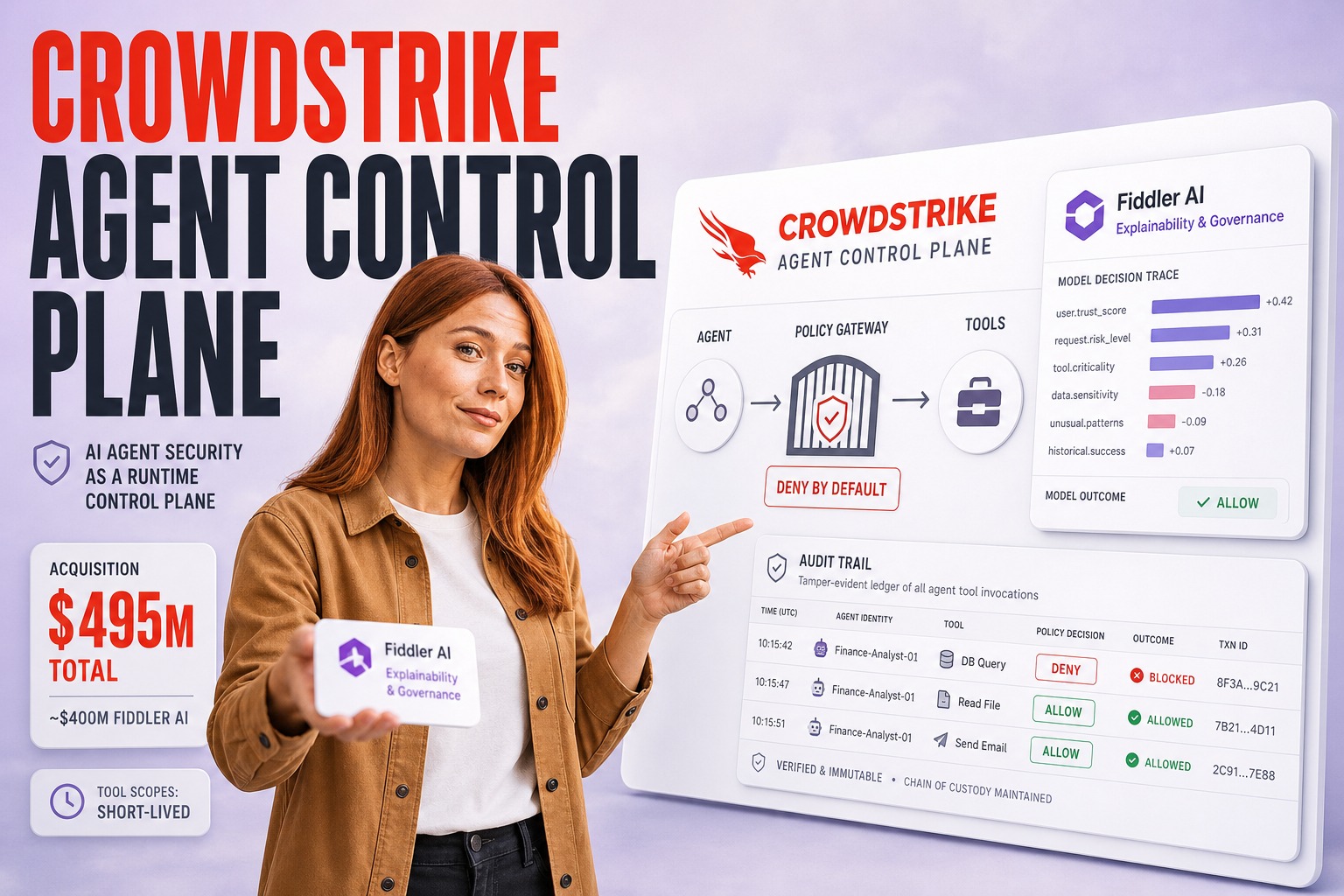
Why is CrowdStrike buying AI security startups now? → Enterprises are deploying AI agents fast, and controls are lagging behind.
What did CrowdStrike announce? → It will acquire two AI security startups for a combined $495 million.
What matters most in the deal? → Roughly $400 million is for Fiddler AI, signaling value in explainability and governance.
What should engineering leaders take from it? → Treat agent deployments as control-plane engineering, not just model hosting.
What’s the immediate next step? → Inventory agent actions and add enforceable policies before scaling.
Quick Answer
AI security is shifting from a set of point defenses to a control plane that constrains what AI agents can do, prove, and change. CrowdStrike’s acquisition news is a marker: buyers are paying for safety, governance, and explainability because those map directly to enforceable controls. If you’re rolling out agents, prioritize policy enforcement, auditability, and isolation boundaries before you optimize prompts or latency.
AI Security Is Becoming A Control Plane, Not A Feature
CrowdStrike will acquire two AI security startups for a combined $495 million, including roughly $400 million for Fiddler AI. The reporting frames the why clearly: enterprises are ramping up AI agent deployments and asking for more safety, governance, and explainability.
Here’s the engineering read: the market is pricing the control surface, not the model. If your agents can take actions, call tools, and touch production data, then your weakest link is rarely ‘the model output.’ It’s missing controls: who can run what action, under which conditions, with what evidence trail, and with what rollback path. That’s where budgets are moving.
- Agent deployments widen blast radius; controls must narrow it back down.
- Explainability is valuable because it supports approvals, audits, and incident response.
- Governance becomes real only when policies are enforced at runtime, not in a wiki.
- Acquisition signals buyers want integrated guardrails, not another dashboard.
The Hidden Driver: Controls That Survive Scale
Startups often demo safety with a single agent and a single happy path. Enterprises don’t operate that way. You have multiple teams, multiple toolchains, and multiple ‘almost production’ environments. Controls must survive scale, org boundaries, and fast iteration.
If you want a practical starting point, align your roadmap to a capabilities list, not a vendor list. Define the minimum control plane for agents, then decide whether you build, buy, or blend. When teams ask where to begin, I point them to a control-centric backlog like ai security solutions rather than isolated ‘model fixes.’
If you can’t enforce and prove controls at runtime, you don’t have governance—you have wishful thinking.
Where Agent Controls Break First In Real Organizations
The first failures are boring. They’re not sci-fi jailbreaks; they’re integration leaks and policy gaps. Agents get broader tokens ‘temporarily,’ tools get whitelisted ‘just for the pilot,’ and the line between staging and prod gets fuzzy. Once the agent is useful, nobody wants to slow it down, so the shortcuts harden.
Treat agent programs like distributed systems with privileged APIs. Design a policy perimeter around tools, data sources, and side effects. Then attach enforcement points to the request path, not the documentation path. If you’re building or hardening agent infrastructure, it often helps to separate delivery velocity from safety velocity—different pipelines, different gates. Teams implementing agent stacks via AI agents development typically move faster once those control seams are explicit.
Control Categories To Fund Before You Add More Agents
Budget discussions go sideways when ‘safety’ is treated as a non-functional nice-to-have. Make it concrete: invest in control categories that reduce blast radius and improve decision quality during incidents.
Start with model governance, but don’t let it become a paperwork exercise. Governance that matters is measurable: what was deployed, what changed, who approved it, what evidence supported the decision, and what the system did in production. If you can’t answer those questions quickly, you’ll end up freezing deployments after the first near-miss.
Zero-Trust Thinking For Agent Actions
Apply zero trust for AI agents the same way you apply it to services: assume every call can be wrong, malicious, or simply mis-scoped. The goal isn’t paranoia; it’s compartmentalization.
Build controls that force agents to earn privileges per action. Short-lived credentials, tool-specific scopes, environment-level isolation, and explicit ‘side-effect’ classification (read vs write vs irreversible) turn agent autonomy into bounded autonomy. You’re not trying to stop work—you’re making sure mistakes don’t become incidents.
- Classify tools by side effects and require stronger approvals for irreversible actions.
- Use least-privilege scopes per tool, not one shared token for the whole agent.
- Gate high-risk calls with policy checks, not prompt text.
- Log every tool invocation with inputs, outputs, and the policy decision taken.
Auditability Is A Design Constraint, Not A Report
An AI audit is easiest when you design for it upfront. If you bolt it on later, you’ll discover your logs don’t connect decisions to outcomes, and your evidence doesn’t survive across environments.
Architect the evidence chain: what the agent saw, what it decided, what tool it called, and what changed. Keep it tamper-evident, queryable, and tied to identity. Your future incident commander will thank you when a ‘harmless’ automation starts doing expensive things at 2 a.m.
How To Implement AI Security Without Slowing Agents Down
Implementation is mostly about placement: where controls sit in the request path. Put enforcement where it’s hardest to bypass—between the agent and tools, and between tools and sensitive systems. Then make the secure path the easy path: sane defaults, reusable policies, and friction that matches risk.
You’ll still need security testing, but focus it on the full action loop, not just model prompts. Test policy bypass, tool misuse, over-broad scopes, and failure modes under degraded dependencies. When leaders ask why this matters, the answer is simple: agents are operational automation. Operational automation needs guardrails that are as real as your IAM and network controls.
Ship Controls Like Product: Pipelines, Not Committees
Committees don’t scale. Pipelines do. If you want controls to keep up with agent iteration, treat them as versioned artifacts: policies, tests, attestations, and exceptions.
This is where DevSecOps earns its keep. Fold policy checks into CI, enforce them in CD, and create break-glass paths that are logged and reviewed. Your goal is not ‘no exceptions.’ Your goal is ‘exceptions are rare, explicit, time-bound, and observable.’ That is how control planes stay credible under delivery pressure.
The winning teams will make agent controls deployable, testable, and reviewable like code.
How To Implement AI Governance So It Actually Enforces Policy
Governance fails when it’s separated from runtime. Boards and risk teams want safety, governance, and explainability; engineering needs mechanisms. Bridge that gap with a control map: each policy statement must point to an enforcement point, telemetry, and an owner.
Don’t confuse governance with visibility. Visibility is necessary, but enforcement is the difference between ‘we noticed’ and ‘we prevented.’ Tie policies to identities, environments, and tool permissions, and predefine escalation paths for policy violations. If you need help validating those enforcement points under real adversarial thinking, pair governance work with cybersecurity and penetration testing so controls are exercised, not assumed.
What To Ask Vendors After This Acquisition Signal
Acquisitions like this are a hint about where platforms are heading: integrated safety plus explainability, sold as enterprise readiness. That’s fine—if it matches your control model.
Your vendor questions should be control questions. Where do you enforce policy? What happens when the model is wrong but confident? How do you scope tools per action? How do you export evidence? And how do you isolate tenants, teams, and environments? ‘Cybersecurity AI’ features that only surface alerts won’t be enough if your agent can already act.
A CTO’s Control Checklist For The Next 90 Days
If you’re already running agents in pilots, assume success will force scale. Prepare for that moment now, while you still have leverage to standardize.
Do a control-oriented gap analysis, then timebox remediation work alongside feature work. This avoids the trap where product wins early, and security gets asked to ‘add guardrails’ after adoption. If you want a fast way to scope effort and sequencing, run it like an engineering estimate: inputs, enforcement points, evidence, and rollout plan. If you need a baseline, start with a structured project estimate to make trade-offs explicit.
Inventory agent tools and side effects; label every call as read, write, or irreversible.
Define policy enforcement points between agent and tools; implement deny-by-default for high-risk actions.
Add evidence logging that ties identity, context, decision, and outcome into one trace.
Create an exception process with expiry, owner, and automated review reminders.
What This News Means For Your Architecture
CrowdStrike’s announcement doesn’t change your backlog by itself. But it validates a direction: buyers are paying for safety, governance, and explainability because those translate into controls you can defend in audits and incidents.
Architecturally, that means you should stop treating agents as ‘apps with prompts.’ Treat them as privileged automation endpoints. Put a control plane in front of actions, design for evidence, and keep privileges narrow. When you do that, you can scale agents without making every deployment a risk negotiation.
The Practical Bottom Line
Your competitors will ship agents fast. You don’t win by matching their recklessness; you win by shipping autonomy with boundaries. The simplest north star is control integrity: can you enforce, observe, and explain what the system did.
If you’re unsure where to start, start where incidents start: tool permissions, environment separation, and evidence trails. Do those three well, and the rest becomes iteration. That’s the path to AI security that survives real scale, real teams, and real production pressure.
Author: Plavno team. Last updated: November 2026.
 Chat GPT
 Perplexity
 Claude
 Gemini

