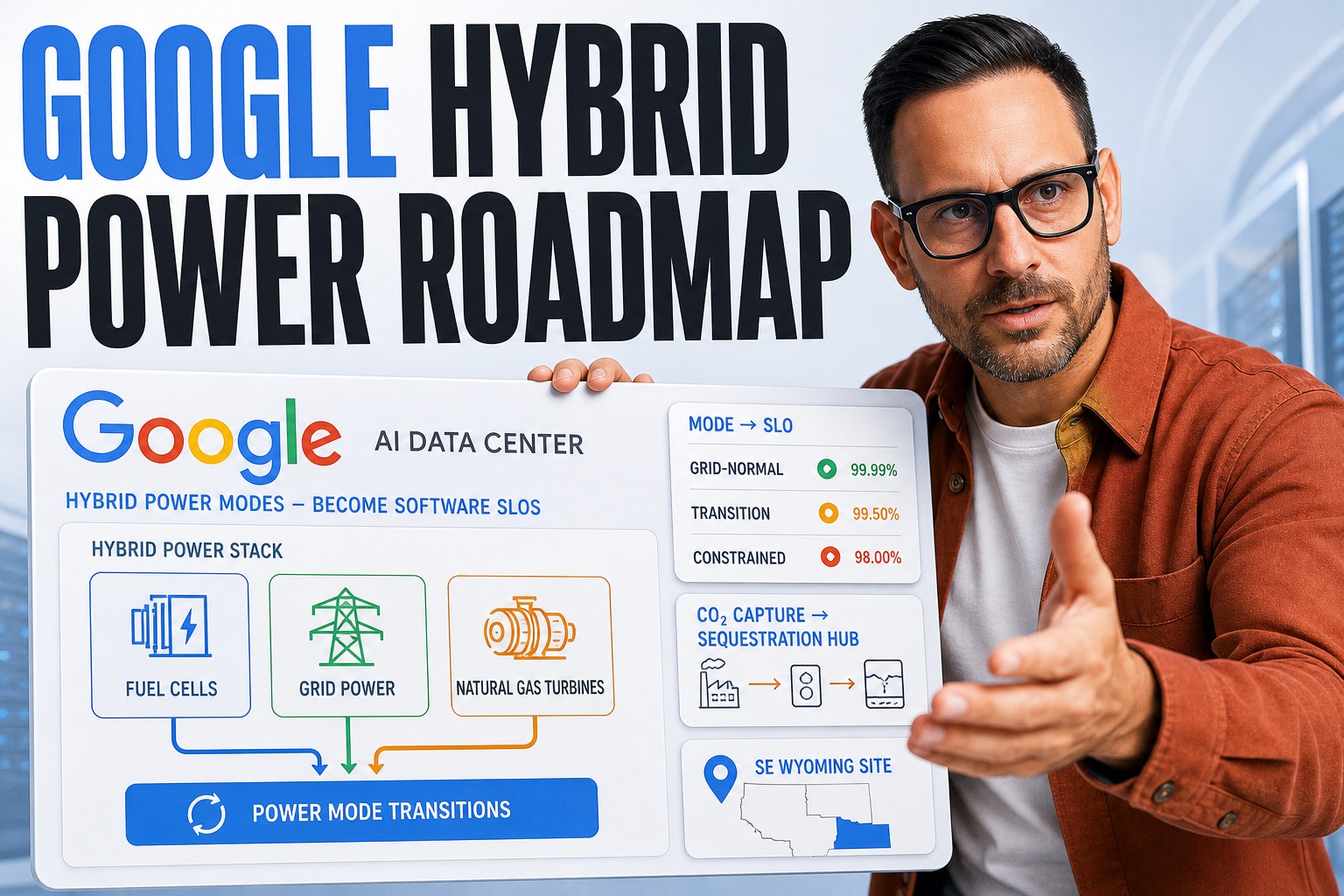
What happened in Wyoming? → Google acquired Crusoe’s southeast Wyoming site after Crusoe finished pre-development for the project.
Why does this matter to engineering leaders? → It validates that energy, permits, and site risk are now first-class parts of platform delivery.
Where does an ai implementation roadmap really start? → With a power strategy that you can translate into availability, cost, and rollout constraints.
What was technically distinctive? → A hybrid power strategy combining fuel cells, grid power, and natural gas turbines, plus a carbon-capture roadmap.
What should you do next? → Tie power modes to SLOs and capacity plans before you commit to model, cluster, and product scope.
Quick Answer
ai implementation roadmap decisions for data-center-backed AI should begin with hybrid power assumptions, not GPU selection. Crusoe’s Wyoming work shows the ‘real’ critical path is origination, entitlement, and de-risking: once you define how fuel cells, grid, and gas turbines will behave, you can design uptime tiers, job scheduling, and feature rollouts around those constraints. Treat energy variability as an input to architecture and operating cadence.
What Is The Digital Transformation Cost For Hybrid-Powered AI Data Centers?
The digital transformation cost that surprises teams is rarely software effort alone; it is the organizational overhead of coordinating power strategy, approvals, and compute delivery as one program. If your AI initiative depends on new capacity, your platform plan must include ‘energy-to-SLO’ translation, not just cloud architecture. This is where a practical digital transformation program earns its keep: aligning engineering, facilities, finance, and security around a single delivery rhythm.
If you cannot model watts like you model latency, your AI program will fail at scale.
AI Implementation Roadmap Starts With A Hybrid Power Strategy
Crusoe announced on November 6, 2026 that Google acquired its site in southeast Wyoming, completing Crusoe’s engagement for pre-development work such as site selection, governmental approvals, and power strategy. Read that as an execution pattern: hyperscalers want projects that are already ‘construction-ready,’ because the riskiest engineering decisions happen before the first rack arrives.
Crusoe and Tallgrass Energy initiated the campus by developing power and data center infrastructure in parallel, coordinating energy systems design, data center engineering, site development, and hyperscaler engagement at the same time. Their hybrid power strategy (fuel cells, grid power, and natural gas turbines) is the key technical lens: it forces an engineering leader to design for multiple power regimes and a long-term transition path.
- Site de-risking is a deliverable: origination, entitlement, and approvals shorten the time from plan to powered shell.
- Hybrid power changes reliability math: you architect for power-mode transitions, not just steady-state capacity.
- Energy partners become part of your release train: coordination spans utilities, on-site generation, and hyperscaler requirements.
- Acquisition signals maturity: ‘ready-to-build’ AI infrastructure can transfer owners once the hard work is done.
Why Hybrid Power Becomes A Software Requirement
Hybrid power is not just a facilities choice; it is a workload scheduling and product availability constraint. If your campus can operate on grid, fuel cells, or natural gas turbines depending on conditions, your cluster controller and service owners must agree on what degrades first: training, batch inference, retrieval indexing, or user-facing latency. The earlier you encode these priorities, the fewer ‘emergency architecture’ decisions you make during commissioning.
Translate Power Modes Into SLOs
CTOs should treat each power source and transition as a distinct operational mode with explicit service-level objectives. A ‘grid-normal’ mode can target peak throughput, while ‘on-site constrained’ mode may prioritize safety, essential inference, and data integrity. This is engineering analysis, not marketing: when power is a variable, you need a written contract between platform, product, and facilities on what stays up and what sheds load.
- Define tiered availability: which APIs remain hard-required when the site shifts power sources.
- Precompute shed lists: workloads to pause first, second, and last as capacity tightens.
- Bind telemetry: power signals should be visible next to latency, error rate, and saturation dashboards.
- Exercise transitions: run controlled power-mode drills like you run incident game days.
Which AI Driven Innovation Management Use Cases Survive Power Constraints?
The most valuable ai driven innovation management use cases are the ones that tolerate variability: internal copilots, asynchronous analytics, and batch-oriented automation often degrade gracefully, while hard real-time features may not. The lesson from a hybrid-powered campus is to sequence innovation by ‘power elasticity.’ Start with products that can absorb planned throttling, then graduate to always-on experiences after your power regime is stable and your operations muscle is proven.
Designing The AI Operating Model Around Power Variability
A workable ai operating model treats the energy strategy as a governance input: who can approve load shedding, who owns the ‘essential services’ list, and how capacity is reserved across teams. Hybrid power makes this unavoidable because the platform will periodically operate under different cost and availability envelopes. If you do not pre-assign decision rights, every transition becomes a war room.
This is also where the ai implementation roadmap should be explicit about interfaces: facilities provides mode and capacity forecasts; platform engineering provides automated policy enforcement; product provides ranked user journeys. Teams that need help structuring that interface often start with scoped discovery through ai consulting to formalize the decisions before code and contracts harden.
| Decision Surface | Hybrid-Power Signal | Engineering Action |
|---|---|---|
| Workload priority | Available MW changes by mode | Re-rank queues; pause nonessential jobs |
| Reliability posture | Transition window announced | Tighten SLOs; enable safe-degrade features |
| Capacity planning | Fuel and grid constraints | Adjust headroom; revise rollout gates |
| Incident response | Power anomaly telemetry | Trigger runbooks; escalate to joint on-call |
Business Analysis Before You Pick GPUs
Do the business analysis while power options are still malleable. The ‘right’ accelerator mix depends on whether your dominant constraint is steady throughput, ramp speed, or resilience during transitions. Document the business-facing acceptance criteria first: which services must be uninterrupted, what degradation is acceptable, and what must be postponed when capacity is tight. Then map those criteria to compute, storage, and networking decisions that can survive commissioning surprises.
Classify workloads by interruption tolerance and restart cost before you size clusters.
Define power-mode gates that block launches when the campus is not in a stable operating regime.
Build a joint runbook with facilities for planned transitions and unplanned anomalies.
Implement policy-based scheduling so shedding load is automatic, consistent, and auditable.
AI Implementation Roadmap: From Entitlement To Commissioning
A credible AI Implementation Roadmap spans more than software milestones; it tracks entitlement, interconnect, and power commissioning as dependencies for product delivery. Crusoe’s role in site selection, approvals, and power strategy is a reminder that the earliest ‘engineering’ artifacts may be permits, design packages, and operating assumptions. Tie your ai budget to those gates: fund the platform build when power mode definitions and reliability targets are contractually real, not aspirational.
What Google Buying The Site Signals To Builders
Google acquiring the Wyoming site after pre-development is a signal that the buyer values reduced uncertainty as much as megawatts. For CTOs, the takeaway is practical: if you are partnering with a developer, ensure deliverables include power-mode definitions, telemetry handoffs, and commissioning test plans that engineering can consume. Crusoe also recently announced it is the developer of Google’s data center campus under construction in Armstrong County outside Amarillo, reinforcing the same pattern.
- Ask for ‘mode taxonomy’ early: grid-normal, on-site-only, transition, and constrained modes with measurable triggers.
- Require integration points: power telemetry into observability, plus automated policy hooks into schedulers.
- Treat commissioning as validation: formal tests for failover, load shedding, and recovery timelines.
- Align contracts to software reality: define which degradations are acceptable in each operating regime.
Hybrid Power And AI Native Product Engineering Must Co-Evolve
Hybrid power changes how you ship AI features because infrastructure can be ‘right’ yet still variable. In ai native product engineering, that means building user experiences that can downshift: cached answers, queue-backed requests, or lower-cost models during constrained modes. It also means engineering discipline around progressive delivery, so you can roll out model changes without piling uncertainty on top of commissioning uncertainty.
To execute that cleanly, treat the campus as a multi-environment system: construction, burn-in, stable operations, and expansion. If you are building supporting services and data pipelines, you may want a dedicated cloud foundation team or a partner for cloud software development so your platform standards keep pace with physical build-out.
| Power Source | Strength In A Hybrid Stack | What Engineering Should Monitor |
|---|---|---|
| Fuel cells | Predictable on-site supply for baseline loads | Output stability, maintenance windows, integration alarms |
| Grid power | Scalable capacity when available | Interconnect constraints, curtailment risk, pricing signals |
| Natural gas turbines | Fast ramp and backup flexibility | Ramp behavior, fuel availability assumptions, transition timing |
Carbon Capture Roadmaps Are Scheduling Inputs, Not PR
Crusoe’s hybrid strategy includes a long-term roadmap for carbon capture via Tallgrass’s regional CO2 sequestration hub. Engineering should treat that as a planning timeline, not a branding line: if the operating regime will evolve, your capacity plan and workload placement policies should evolve with it. Over time, you may re-balance which workloads run on which modes, and which products you commit to always-on behavior.
Closing: Operationalize The AI Implementation Roadmap
The practical move after this news is to turn power strategy into engineering artifacts: mode definitions, SLO matrices, and automated scheduling policies. When you write your next ai implementation roadmap, make ‘energy-to-software translation’ a deliverable as concrete as an API spec. If you want an outside perspective on sequencing, governance, and execution risks, Plavno can help you scope the program and estimate effort in a way leadership can act on via a focused plan at projectEstimate.
Author: Plavno team. Last updated: November 2026.
 Chat GPT
 Perplexity
 Claude
 Gemini

