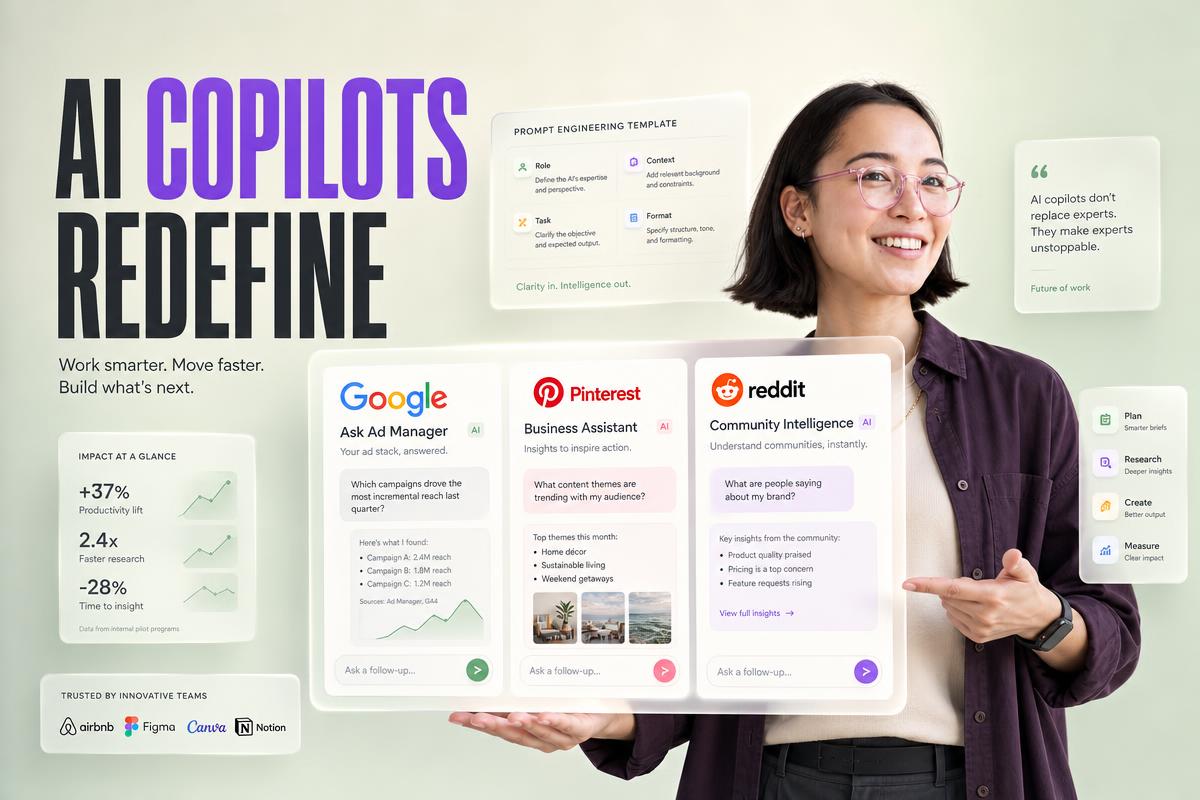
What exactly are AI copilots inside ad managers? → They are Gemini‑powered or community‑intelligence assistants that sit inside Google Ads, Pinterest Ads Manager, and Reddit’s ad suite, answering campaign questions, generating reports, and suggesting creative.
Why does their arrival matter now? → The tools launch this week, turning months‑long data‑digging into a few prompts, which reshapes how agencies allocate time.
Which engineering decision does this force? → Teams must decide whether to invest in prompt‑engineering pipelines and integration layers instead of only sharpening bidding strategies.
Can existing reporting stacks still be used? → Yes, but they become secondary; the AI copilots become the primary source of on‑demand insights.
What is the core question this article answers? → How should agencies restructure their paid‑media workflow to get the most out of embedded AI copilots?
AI Copilots Redefine the Paid‑Media Bottleneck
The instant‑answer capability of Google’s Ask Ad Manager, Pinterest’s Business Assistant, and Reddit’s community‑driven generators compresses what used to be a multi‑hour diagnostic ritual into a handful of conversational turns. This shift means the traditional bottleneck—manual data extraction and report assembly—has moved downstream to prompt formulation, model selection, and result validation. Agencies that continue to prioritize only bid‑adjustment expertise will find their competitive edge eroding as the AI layer dictates the speed of insight delivery.
Explore our services: AI agents development, digital transformation, AI consulting, cloud software development, AI‑voice assistant solutions.
- Prompt hygiene matters – vague queries produce vague answers, so disciplined phrasing is essential.
- Integration latency – pulling data from the platform into external tools adds measurable delay.
- Governance overhead – keeping prompts aligned with brand policy requires new review cycles.
- Skill set shift – engineers now need prompt‑engineering fluency alongside classic analytics.
Quick Answer: Prioritize Prompt Engineering Over Traditional Campaign Tweaks
When AI copilots sit inside your ad platform, the fastest path to performance gains is to build a robust prompt‑engineering framework, embed the copilot output into your existing automation pipelines, and treat the AI’s suggestions as a hypothesis rather than a final decision. In practice, that means creating reusable prompt templates, establishing validation checkpoints, and integrating the copilot’s API responses with your reporting dashboards.
The Real Shift Is From Data Mining To Prompt Crafting
The Gemini‑powered Ask Ad Manager pulls directly from your Google Ads account, meaning the raw data is already available. The real work now is asking the right question in the right format. A well‑structured prompt can surface a custom report that would otherwise require a manual filter cascade, while a poorly phrased one may return generic guidance that adds no value.
| Platform | Copilot Name | Core Capability |
|---|---|---|
| Google Ads | Ask Ad Manager | Campaign diagnostics and custom reports |
| Business Assistant | Data‑backed suggestions and dynamic creative selection | |
| Community Intelligence AI | Conversation‑driven ad generation and creative tailoring |
Why Prompt Engineering Beats Traditional Optimization
Traditional optimization focuses on adjusting bids, budgets, and targeting after the data is collected. Prompt engineering, by contrast, lets you retrieve the exact insight you need before you even touch the UI. This pre‑emptive approach reduces iteration cycles, shortens time‑to‑insight, and aligns the AI’s output with your strategic goals.
Define the business intent – start each prompt with a clear objective (e.g., increase ROAS for a specific product line).
Structure the query – include account identifiers, date ranges, and metric filters.
Validate the response – cross‑check AI‑generated numbers against known benchmarks before acting.
Iterate quickly – adjust wording based on the first answer to refine relevance.
Document templates – store successful prompts for reuse across campaigns.
Building a Prompt‑Engineering Pipeline
The first paragraph explains the need for a dedicated pipeline that captures prompts, routes them to the platform’s AI endpoint, and stores responses for downstream analysis.
The second paragraph describes how this pipeline can be layered on top of existing cloud‑based data warehouses, using services like Google Cloud Functions or AWS Lambda to orchestrate calls, and how it integrates with your BI tools for automated dashboards.
| Component | Typical Tool | Role in Pipeline |
|---|---|---|
| Orchestration | Cloud Functions / Lambda | Triggers AI calls based on schedule or event |
| Storage | BigQuery / Snowflake | Persists AI responses for audit and analysis |
| Visualization | Looker / Power BI | Turns AI insights into actionable dashboards |
- Security first – encrypt API keys and restrict access to the copilot endpoint.
- Version control – keep prompt templates in Git to track changes.
- Monitoring – log latency and error rates for each AI call.
- Feedback loop – feed performance outcomes back into prompt refinement.
- Scalability – design the pipeline to handle multiple campaigns concurrently.
Plavno’s Approach to AI‑Driven Media Ops
Our team treats the AI copilot as a micro‑service that sits beside your existing ad stack. We help you design prompt libraries, embed validation layers, and connect the copilot output to your KPI dashboards. By doing so, we turn the copilot from a novelty into a repeatable performance engine.
How Prompt Hygiene Drives Consistent ROI
When prompts are consistent, the AI’s answers become predictable, allowing you to set automated thresholds for actions like bid adjustments or creative swaps. This predictability reduces the need for manual oversight and frees senior analysts to focus on strategic planning.
Integrating Copilot Output With Existing Automation
The copilot’s JSON response can be parsed and fed directly into your rule‑engine. For example, a recommendation to increase budget on a high‑performing ad set can be turned into an API call that updates the campaign in seconds, closing the loop between insight and action.
- Parse the JSON – extract key metrics like CTR, conversion rate, and spend.
- Map to actions – translate recommendations into API calls (e.g., increase bid by 10%).
- Schedule updates – use cron or event‑driven triggers to apply changes.
- Audit changes – log every automated adjustment for compliance.
- Review outcomes – compare post‑change performance against baseline.
Business Impact of Prompt‑Centric Workflows
The first paragraph quantifies the time saved: agencies can cut report‑generation from hours to minutes, reallocating resources to creative strategy.
The second paragraph outlines revenue impact, noting that early adopters of Pinterest’s New Customer Acquisition tool reported a 64% lift in new‑customer conversions, illustrating how AI‑driven prospecting can outpace traditional retargeting.
Prompt engineering, not model selection, is the new competitive moat for agencies using AI copilots.
Evaluating AI Copilots in Practice
When assessing whether to double‑down on a copilot, start with a controlled experiment on a well‑understood campaign. Measure latency, answer relevance, and the downstream effect on KPIs. Compare the AI‑generated report against your manual analysis to gauge accuracy.
A disciplined experiment reveals whether the copilot adds real value or merely repackages existing data.
Decision Logic for Quarterly Investment
The decision tree begins with a feasibility check (API access, data permissions), moves to a pilot phase (single campaign), and ends with a ROI calculation that weighs time saved against any subscription costs. This logic helps CTOs justify budget allocations for prompt‑engineering resources.
Risks and Limitations of Embedded AI
While the copilots excel at surface‑level insights, they can hallucinate or misinterpret nuanced account settings. Over‑reliance without validation may lead to budget misallocation. Additionally, platform‑specific rate limits can throttle high‑frequency use.
Real‑World Applications Across Industries
The first paragraph describes how e‑commerce brands can use Pinterest’s one‑click Shopify integration to launch product‑focused pins, while the second paragraph shows how financial services can leverage Reddit’s community‑driven ad generator to craft compliant messaging that resonates with niche forums.
Embedding the copilot into sector‑specific workflows unlocks use‑cases that generic dashboards cannot deliver.
Closing Insight: Prompt Engineering Is the New Optimization Lever
As AI copilots become standard inside ad platforms, the decisive factor for agency success will be how well they can translate conversational output into automated, auditable actions. The era of manual report digging is ending; the era of disciplined prompt design is beginning.
 Chat GPT
 Perplexity
 Claude
 Gemini