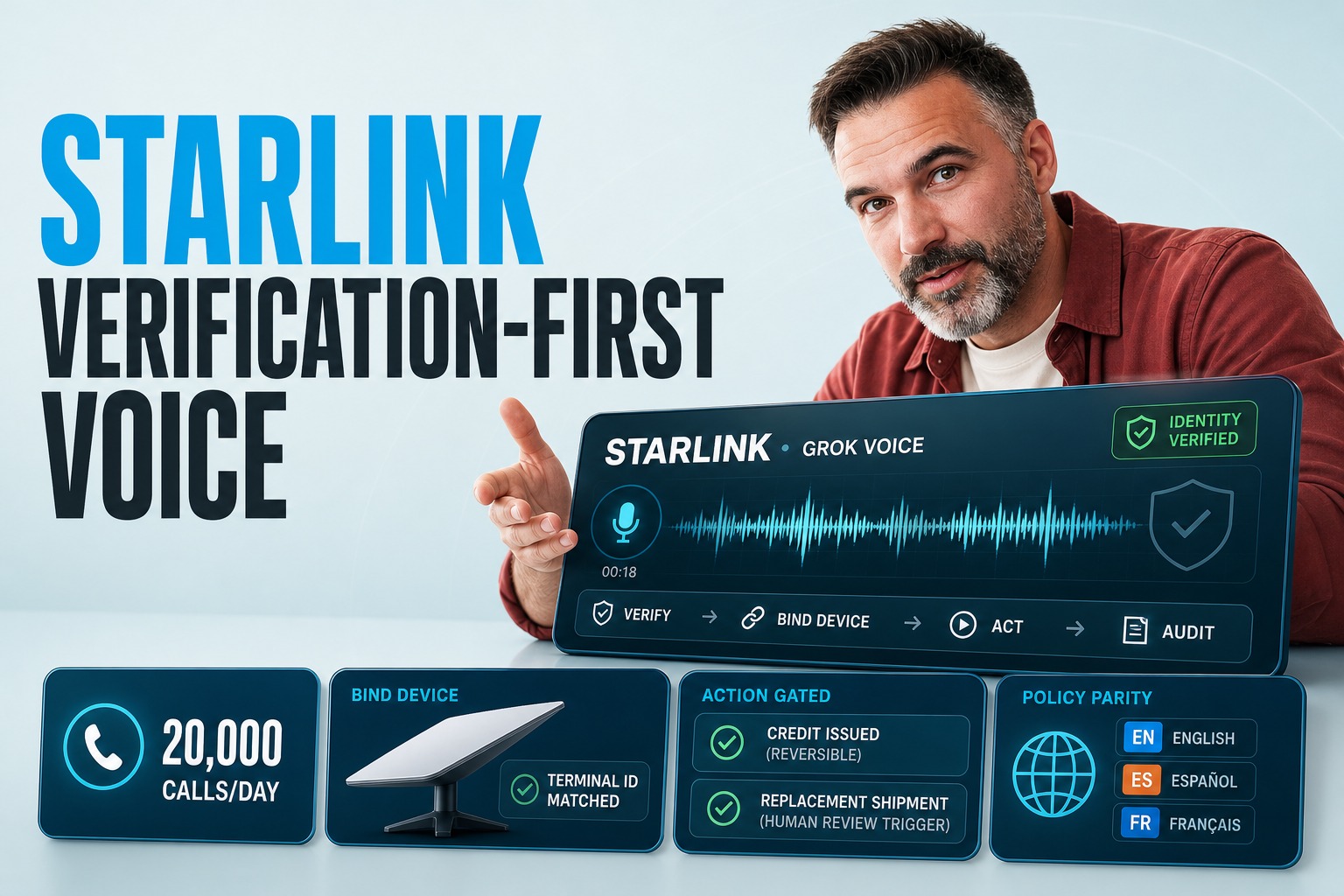
Is SpaceX really running voice AI in production? → Yes: Starlink says Grok Voice handles 20,000 customer calls per day.
What’s the business point of an ai call center here? → Scale support globally without building equally massive, multilingual human call centers.
What work is the AI doing on calls? → Starlink says it verifies customers, troubleshoots hardware, issues credits, and ships replacements.
Why should CTOs care beyond the hype? → Because verification becomes the engineering bottleneck that decides automation ROI.
What’s the key design question? → How you prove identity and intent, not how ‘human’ the voice sounds.
Quick Answer
An ai call center works when you treat every conversation as a verification workflow with measurable proofs and safe fallbacks. Starlink’s Grok Voice is a concrete example: it is already verifying customers, troubleshooting Starlink hardware, issuing credits, and shipping replacement equipment, in multiple languages. For most enterprises, the winning architecture is not ‘chat first’ but ‘verify, then act,’ with tight escalation rules.
In voice support, verification is the real product; natural conversation is just the interface.
Verification-First AI Call Center Architecture
SpaceX says Starlink call centers are already using Grok Voice agents to verify customers and complete operational tasks like credits and replacement shipments. That matters because those are not ‘small talk’ outcomes; they are actions that require the system to be confident about identity, authorization, and the customer’s exact asset (the right terminal, the right account, the right address).
If you’re planning the same shift, start from the verification chain: what the agent must prove before it can touch money, account state, or logistics. That design lens maps cleanly to build vs. buy decisions and to implementation scope for ai voice agent development services.
- Confirm caller identity before any account disclosure, not after troubleshooting begins.
- Bind the conversation to the correct Starlink device context (model, status, eligibility) before actions.
- Verify authorization for credits and replacements with policy-driven thresholds.
- Validate shipping details as structured data, not free-form voice alone.
- Log each verification checkpoint so escalations are explainable to humans.
Why Voice Changes The Verification Threat Model
Voice adds urgency, emotion, and social engineering pressure to every support flow. A bot that can talk smoothly is also a bot that can be talked into doing the wrong thing unless verification gates are explicit. For leadership, the main risk isn’t transcription errors; it’s unauthorized state changes, from credits to shipments, driven by persuasive callers. Treat verification as a first-class control plane.
| Verification Moment | What Must Be Proven | Failure Handling |
|---|---|---|
| Account access | Caller is the rightful customer | Provide generic guidance; no account-specific data |
| Credit request | Eligibility and intent match policy | Offer to escalate with context snapshot |
| Replacement shipment | Identity plus correct delivery details | Route to human verification queue |
| Device troubleshooting | Caller owns or is authorized for that terminal | Continue with non-sensitive diagnostics only |
Designing Prompts And Policies Around Proof, Not Small Talk
A production voice agent should prompt for evidence the same way a good support rep does, but more consistently. The point of the dialog is to collect minimum necessary signals, then stop. When teams over-optimize for ‘human-like’ banter, they lengthen the time-to-verification and expand attack surface. Design conversations to converge: confirm, check, act, summarize, and exit.
If you can’t define what ‘verified’ means at each step, you can’t safely automate the step.
What Grok Voice Signals For Enterprise Support
Starlink says Grok Voice is already answering 20,000 customer calls a day, and roughly 70% are resolved without humans. That’s the important signal for operators: a modern ai call center can be measured on end-to-end resolution, not on demo-quality speech. Starlink also says the agents can work in multiple languages, which is exactly where verification discipline prevents uneven policies across regions.
- Likely human-only: disputes where the caller contests policy outcomes and demands exceptions (analysis).
- Likely human-only: edge cases involving ambiguous ownership or third-party authorization (analysis).
- Likely human-only: situations where safety, harassment, or abuse policies must be applied (analysis).
- Likely human-only: novel failures not covered by known troubleshooting scripts (analysis).
What Are Voice AI Agent Platform Use Cases For Verification?
The most valuable voice ai agent platform use cases are the ones where speech is just the input channel to a structured decision. In practice, that means a real-time voice ai layer that captures intent while the orchestration layer validates identity, device context, and policy constraints. For global products, that verification layer matters more than language fluency, because multilingual operations tend to fragment rules unless they’re centralized.
A useful starting scope is an ai phone agent that can complete a narrow set of ‘verify-and-do’ actions: confirm a customer, run diagnostics, then either resolve or escalate with a clean audit trail. Teams often pair this with AI automation so approvals, ticket updates, credits, and shipping events are triggered only after explicit verification checkpoints.
Verification Flows That Actually Close The Loop
Starlink’s description of Grok Voice implies a closed-loop design: verify the customer, troubleshoot hardware, and then take consequential actions like credits or replacement shipments. For most companies, the key is to turn ai call answering into a sequence of reversible decisions. The agent should summarize what it verified and what it is about to do, then obtain an explicit confirmation before state changes.
Establish identity and authorization before showing any account-specific information.
Bind the call to the right asset (device, contract, address) and restate it for confirmation.
Troubleshoot using non-sensitive steps first; only unlock privileged actions after re-checking.
Execute a single action (credit or shipment) and immediately read back the outcome.
Write a structured call summary that a human can audit in seconds.
Escalation Criteria: When The Model Should Stop Talking
Escalation is not a failure; it’s a safety feature that keeps verification credible. A good rule is to escalate when identity signals are weak, when the caller requests an exception, or when the action is high-impact. Also escalate when the model’s confidence is low or the caller’s instructions conflict over time. The best handoff includes what was verified, what was attempted, and what remains unknown.
Operational Metrics For An AI Call Center Without Surprises
In an AI Call Center rollout, your first dashboards should be verification dashboards. Starlink reports scale (20,000 calls/day) and human deflection (about 70% resolved without humans), but the deeper operator question is why the other share needed people. Treat that delta as signal: verification gaps, policy exceptions, missing device telemetry, or integration constraints.
From an engineering standpoint, model quality is only one input; the system’s reliability comes from deterministic gates around identity and authorization. If you want help defining those gates and the surrounding controls, a short engagement via AI consulting can validate what should be automated now versus deferred until your data and policies are ready.
- Verification pass rate by call intent, not just overall resolution rate.
- Human handoff reasons, normalized into a small taxonomy you can actually fix.
- Action success rate for credits and shipments, with post-action reversal tracking.
- Multilingual parity: compare verification outcomes across languages and regions.
- Average time-to-verification, because long flows correlate with fraud and churn.
Voice AI Integration With Legacy IVR And CRM
Most enterprises won’t replace the phone stack overnight, so voice ai integration has to respect existing IVR constraints, ticketing workflows, and regulatory logging. The practical approach is ivr modernization by insertion: route a subset of intents to the agent, keep sensitive intents on legacy paths until verification is proven, and progressively expand. The verification model should be identical across channels, even if the UX differs.
Which AI Conversational Use Cases Still Need Human Agents?
Not all ai conversational use cases belong in full automation, even if the voice model sounds great. A useful heuristic is: if a call can’t be resolved without exceptions, it will eventually collide with verification or policy. In a mature ai call center, the agent still adds value by doing pre-work: verifying what it can, collecting context, and producing a structured handoff.
Humans remain essential when empathy, negotiation, or unusual judgment is the product, and when the caller’s request is adversarial to policy. Also, consider outbound ai calls carefully: when the system initiates contact, it must prove its own legitimacy to the customer and avoid training users to trust any convincing voice. Verification has to run both directions.
| Call Type | Verification Difficulty | Recommended Handling |
|---|---|---|
| Simple troubleshooting | Medium (asset binding) | Automate with strict device-context checks |
| Credits and refunds | High (authorization) | Automate only with strong identity gates |
| Replacement shipping | High (address + ownership) | Automate with confirmation and human review triggers |
| Policy disputes | Variable | Human-led, AI-prepared summary and evidence pack |
Security, Compliance, And Auditability For Voice
Voice creates a compliance challenge because the output can directly change financial and operational state. Whether you store audio, transcripts, or both, treat verification events as auditable records: what was asked, what signal was accepted, and which policy allowed the action. Starlink has not disclosed which languages Grok supports or which calls still require a person, so you should assume your own risk profile will vary by region and intent.
The safest voice agent is the one that can explain, step by step, what it verified before it acted.
Implementation Path: Start With Verification, Then Expand
A pragmatic rollout starts with the calls where you can standardize verification quickly and where actions are bounded: identify the customer, bind to the correct asset, and complete one reversible operation. Once that works, you can broaden intents, add languages, and raise autonomy. This sequencing turns ‘voice AI’ into a platform decision rather than a one-off chatbot project.
For teams that need a plan and a timeline, treat the first milestone as a verified-action pilot, not a general assistant. If you want an outside estimate for scope, integration effort, and risk controls, use Project Estimate to pressure-test your assumptions before you scale an ai call center across regions.
- Define verification tiers for actions: read-only, reversible, and irreversible.
- Centralize policy rules so multilingual experiences don’t diverge.
- Instrument every handoff reason; don’t accept ‘model uncertainty’ as an answer.
- Add customer-facing proof when you call them, not only when they call you.
- Run red-team scenarios focused on persuasion, not just prompt injection.
Bottom Line
Starlink’s Grok Voice story is interesting because it treats voice as operations: verify customers, troubleshoot hardware, issue credits, and ship replacements at scale. The takeaway isn’t that every company should copy Starlink; it’s that verification is the design center that makes autonomy safe. If your verification chain is explicit, an ai call center can scale without turning into an uncontrolled credits-and-shipments machine.
Author: Plavno team. Last updated: October 2026.
 Chat GPT
 Perplexity
 Claude
 Gemini

