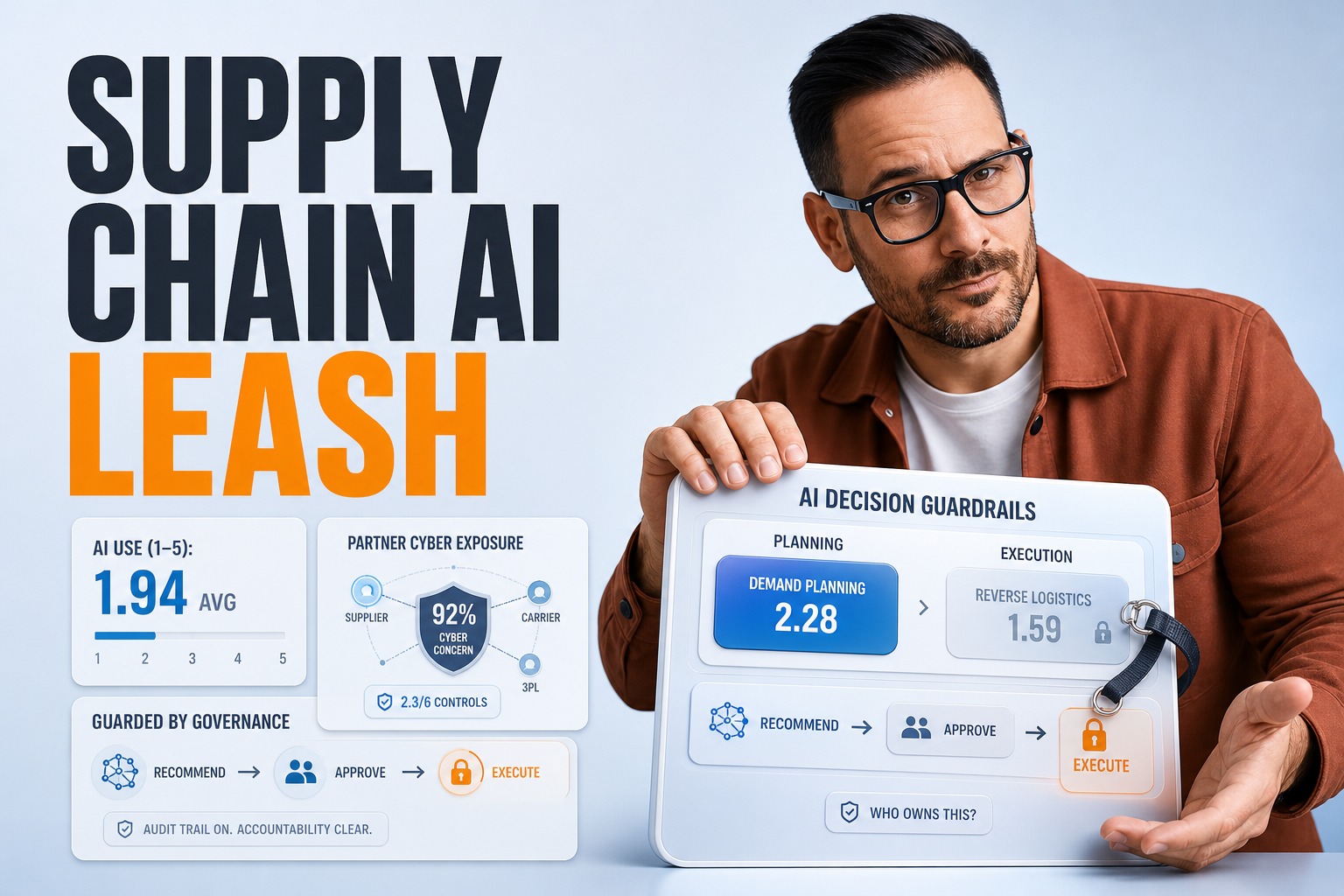
Why is the ai business case stalling in supply chain execution? → Because most teams only trust AI for planning outputs, not transactional decisions.
What did the survey actually measure? → AI use across 13 supply chain functions on a 1–5 scale, averaging 1.94.
What’s the hidden blocker beyond data? → ai change management: decision rights, ownership, and training below the C-suite.
Where is AI strongest today? → Planning, with demand planning scoring 2.28 and supply/inventory planning 2.12.
What risk is under-addressed? → AI-linked partner connectivity is widening cybersecurity exposure faster than safeguards.
Quick Answer
The ai business case is failing less on model capability and more on organizational trust: teams won’t grant AI authority to execute. The ASCM and DSCI survey shows AI concentrated in planning (scores just above 2), while execution-heavy work lags (returns/reverse logistics at 1.59). For CTOs, the move forward is explicit guardrails, measurable outcomes, and a decision-ownership model that reaches directors and frontline operators.
If AI can’t own a bounded decision, it’s not 'adoption' — it’s analytics with a new UI.
Why Supply Chains Keep AI In Planning Mode
The survey’s average AI score of 1.94 (on a 1–5 scale) is a signal that most organizations are still experimenting, not executing. Planning functions lead, execution trails, and companies describe AI as being kept on a 'short leash.' That is not a technology limitation as much as a governance and operating reality.
If you’re trying to scale beyond pilots, treat this as a change program first. Many teams benefit from external facilitation to define scope, owners, controls, and measurement; that’s where ai consulting can accelerate alignment without turning everything into a platform rewrite.
- Planning is easier to sandbox: outputs can be reviewed before anything touches customers or inventory.
- Execution needs clear decision rights: who owns the outcome when the system acts?
- Weak data and weaker process hygiene get amplified when AI is asked to transact.
AI Business Case: Why Planning Gets AI First
Demand planning (2.28) and supply/inventory planning (2.12) scored highest because they fit the classic 'recommend, then approve' workflow. You can overlay AI on top of spreadsheets and BI, keep humans in the loop, and still claim progress.
Execution functions are different. The moment AI is allowed to route freight, commit to customers, or adjust sourcing, it becomes part of the control plane. That forces uncomfortable work: defining risk thresholds, escalation rules, auditability, and the 'stop the line' mechanism when the system is wrong.
| What The Survey Scored | Example Function | AI Score (1–5) |
|---|---|---|
| Overall average across 13 functions | All core supply chain functions | 1.94 |
| Highest-scoring planning area | Demand planning | 2.28 |
| Next-highest planning area | Supply and inventory planning | 2.12 |
| Lowest-scoring area | Returns and reverse logistics | 1.59 |
Treat Adoption As An AI Maturity Model, Not A Feature List
A useful way to read the 1–5 scoring is as an ai maturity model: 1 is 'no use,' 2 is 'assist,' 3 is 'recommend with oversight,' and 5 is 'autonomous execution without review.' The cluster around ~2 suggests many orgs are stuck in a comfortable middle: AI produces forecasts or exceptions, people still transact.
Here’s the CTO trap: vendors are selling 'autonomous' systems, while your organization is operating a cautious, human-first control environment. That mismatch becomes an ai operating model problem. You don’t need a stronger model as much as you need a policy for when the system is allowed to act, how it is supervised, and how you prove it behaved inside bounds.
The Real KPI Is Response Time, Not Headcount
One executive in the report argues that measuring AI by headcount reduction is too simplistic. The better measure is response time: how quickly the organization detects a disruption, evaluates options, and acts. That is exactly where AI should help — but only if the organization will let it.
From an engineering lens, 'response time' is a full-stack metric. It includes data latency, model inference time, workflow handoffs, approval queues, and the operational muscle to execute. If you only automate the analysis step, you haven’t moved the needle; you just made the spreadsheet prettier.
Why 'Glorified Spreadsheet' Is A Governance Smell
Calling AI a 'glorified spreadsheet' isn’t an insult to the model; it’s a warning about decision design. Spreadsheets are acceptable when the consequence of being wrong is low. The moment the consequence is customer commitments, sourcing, or disruption handling, organizations demand traceability and ownership. If your system can’t answer 'who approved this and why,' you’ll keep AI stuck in planning.
Define which decisions are low-risk, high-frequency, and parameterizable for AI execution.
Document escalation triggers (threshold breaches, novel events, low confidence) that force human review.
Build an audit trail that ties inputs, options considered, and final action to an accountable owner.
Start with one route, one supplier, or one key customer process and measure before/after outcomes.
Why C-Suite Sponsorship Doesn’t Equal Adoption
The survey shows 82% of C-suite respondents lead, implement, or scale AI initiatives, while awareness drops sharply below leadership: many directors are only aware, and that 'aware-only' share rises further among managers and staff. Even if the job-level results are directional (the report notes small samples), the pattern matches what most CTOs see: strategy is centralized, behavior change is not.
Skills, ROI, And Data: The Three-Way Deadlock
Two barriers tied for the top spot at 33% each: lack of workforce skills/resources and an unclear business case or ROI. Poor data quality followed at 25%. Notice what’s missing: executive skepticism isn’t listed as a main hurdle. People want AI — they just don’t know how to operate it safely.
This is where ai change management becomes the core program. If you automate foundational work (reports, spreadsheets, exception-spotting), you also remove the training ground where professionals learned judgment. The report warns that moving people into higher-value decision roles without understanding fundamentals creates risk: powerful technology plus uncritical operators is a dangerous combination.
An ai business case that ignores training and decision ownership is just a funding request, not a plan.
What Is The Digital Transformation Cost When AI Stays In Planning?
The digital transformation cost isn’t limited to software spend; it’s the opportunity cost of slow decisions. If disruptions are recognized late, options are evaluated slowly, and execution is gated by manual handoffs, you pay in service, inventory, and expediting. AI that only improves planning artifacts doesn’t fix that.
Treat 'staying in planning' as a symptom of unresolved operating friction: unclear decision rights, inconsistent processes, and brittle data pipelines. If your goal is to shorten disruption response time, you’ll eventually have to let systems transact within limits. That means your transformation roadmap must include governance, workflow redesign, and production-grade reliability, not just model selection.
- Quantify response-time bottlenecks: detection latency, analysis time, approval queues, and execution lead time.
- Map the value stream before building: fix broken steps and missing data, then automate.
- Align the ai budget to outcomes and controls, not to 'number of use cases shipped.'
Cyber Risk Is Scaling Faster Than Controls
The survey reports 92% of respondents are significantly concerned about cybersecurity exposure through AI-enabled suppliers and trade partners. At the same time, the average organization had adopted 2.3 of six standard cybersecurity practices. That delta matters because post-pandemic visibility initiatives connected more suppliers, carriers, and brokers on shared platforms.
A conference example in the report describes a compromised carrier email leading to a fraudulent pickup of a cold-storage load. That’s not an 'AI bug'; it’s an ecosystem access problem. When your extended network includes tier-three and tier-four vendors with limited security resources, your integration layer becomes your attack surface.
For CTOs, this is a forcing function: before you expand autonomous actions, harden identity, access, and monitoring across partner flows. If you need an independent view of exposure, cybersecurity and penetration testing is often the fastest way to validate assumptions.
Start With One Process, Then Earn Authority
The report’s first recommendation is pragmatic: pick one high-value process (a key customer process, supplier, or route), involve the people who run it, and establish measurable outcomes. That’s how you replace AI hype with operational proof.
From an engineering perspective, 'one process' is also the smallest unit where you can validate the full loop: data quality, model performance, workflow design, monitoring, and human escalation. It’s the difference between a demo and an owned service.
- Choose a process with clear owners and pain: not a shared inbox, not a committee decision.
- Lock the boundaries: what the system can do, what it can recommend, and what it must never do.
- Instrument everything: confidence, overrides, exception types, and time-to-decision end to end.
What Drives Business Analysis Cost In AI Programs?
Business analysis cost rises when teams try to automate 'the supply chain' instead of a decision slice. Every ambiguous rule, undocumented exception, and tribal workflow becomes a requirements debate. Multiply that across functions and you get analysis paralysis.
A tighter approach is to model decisions, not departments. Define inputs, constraints, decision parameters, and acceptable outcomes. Then attach owners and escalation policies. This is also where AI and ERP history rhymes: the report highlights that technology can’t fix bad process or bad data. Your analysts should be mapping value streams and isolating root causes before you scale automation.
| Barrier Or Risk From The Survey | Share Reported | What CTOs Should Do Next |
|---|---|---|
| Lack of workforce skills/resources | 33% | Build training paths; pair domain experts with engineers on one process. |
| Unclear business case or ROI | 33% | Tie ROI to response time and error cost, not labor reduction. |
| Poor data quality | 25% | Fix upstream definitions, lineage, and exception handling before 'autonomy.' |
| Cybersecurity exposure via partners | 92% concerned | Raise baseline controls and monitoring across shared platforms. |
Designing Guardrails That Actually Scale
Guardrails fail when they are vague. 'Human in the loop' is not a control unless you specify who, when, and what happens on disagreement. Start by turning risk into explicit thresholds: dollar impact, service impact, customer tier, disruption category, confidence bands. Then wire those thresholds into workflow routing.
Also plan for the talent shift the report flags. If AI takes over foundational analysis, you must replace that learning path with deliberate practice: scenario reviews, post-incident analysis, and decision simulations. Otherwise you end up with junior staff asked to approve or override outputs they can’t validate.
When you’re ready to operationalize, push beyond prototypes into managed automation: observability, rollback, and safe deployment patterns. If you want to industrialize those workflows, digital transformation is the umbrella program — but it only works when decision authority is designed, not implied.
AI Business Case: Expanding Authority Without Losing Control
The next phase is not 'let the model run wild.' It’s controlled expansion: AI handles routine transactional decisions within parameters, people keep high-risk calls on customer commitments, sourcing, and major disruptions. That framing matches the report’s recommendation to expand AI authority only when confidence is earned.
An ai business case that wins in the boardroom is one that names the control model: what decisions are automated, what evidence proves safety, and who owns outcomes. If nobody can 'own the decision for the organization,' AI will remain a recommendation engine. Make ownership explicit, measure response time, and scale from one process to the adjacent one.
Closing Checklist For CTOs
If you want autonomy in execution, treat it like production software with clear owners, not like a research project. Lock the operating boundaries, build the audit trail, and invest in training so humans can critically evaluate what the system produces.
If your team needs help turning pilots into an execution-grade program, Plavno can support architecture, governance, and delivery through AI automation. The fastest wins usually come from one well-chosen process, measured tightly, then scaled with confidence.
Final Take
The ai business case will stay stuck at 'planning scorecards' until organizations redesign how decisions are owned, supervised, and audited in day-to-day operations. Start small, measure response time, harden partner security exposure, and use ai change management to bring directors and frontline teams into the operating model. Author: Plavno team. Last updated: October 2026.
 Chat GPT
 Perplexity
 Claude
 Gemini

