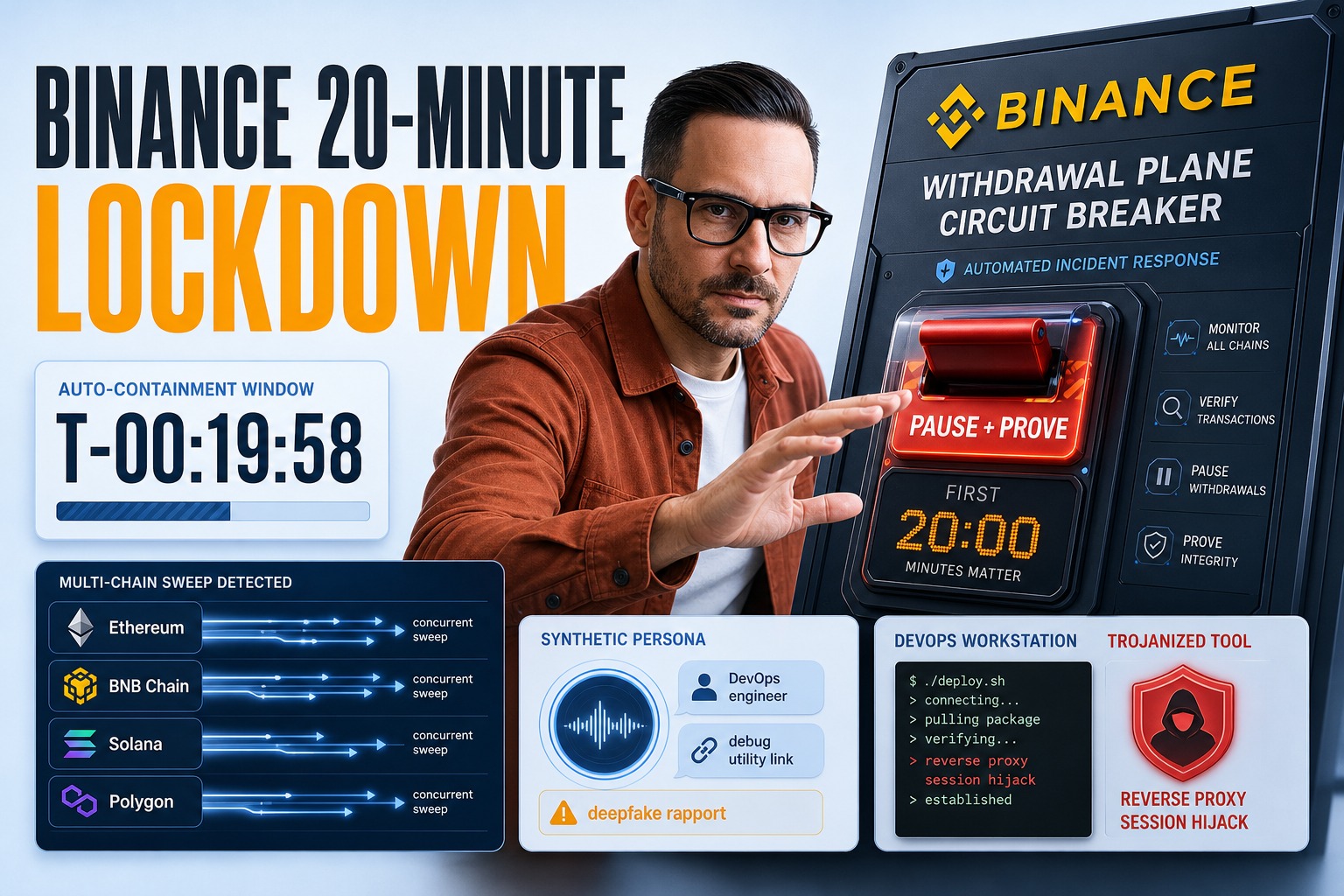
What failed in the Binance incident? → Human-paced response couldn’t compete with a sub-20-minute, multi-chain drain.
Why does this matter to non-crypto CTOs? → It’s a preview of agentic, machine-speed intrusions against any automated money-moving workflow.
Where did the breach start? → A senior DevOps engineer’s workstation, via AI-generated personas and a trojanized utility.
What is the new defensive baseline? → Automated incident response with enforced circuit breakers and pre-approved containment.
What role does ai automation play here? → It’s now both the attacker’s accelerant and the defender’s only viable equalizer.
Quick Answer
ai automation is now required for the first 20 minutes of an incident, because attackers can execute reconnaissance, privilege use, and multi-system exfiltration faster than a human can triage. In the October 29, 2026 Binance event, state-linked operators paired synthetic personas with autonomous scripts to drain hot wallets across ten blockchains in under twenty minutes. The engineering takeaway: build automated circuit breakers that trigger before loss, not alerts that fire after.
| Attack Stage (Reported) | What Made It Fast | Defensive Control To Automate |
|---|---|---|
| Engineer compromise via deepfake personas | Weeks of rapport, then one ‘debug tool’ run | Vendor/package allowlists, isolated dev sandboxes |
| In-memory container traversal | Parsing K8s, CI/CD, APIs without noisy scans | Privileged access segmentation, config exfil detection |
| Concurrent multi-chain sweep | Pre-compiled sweepers, parallel transactions | Withdrawal-plane rate limits and kill switches |
| Algorithmic laundering | Micro-splitting, bridge routing, AMM swaps | Automated freezes, interdiction playbooks, issuer coordination |
Why Speed Turned A Breach Into A Liquidity Crisis
The Binance autopsies read like a warning label for any platform that settles value automatically: the critical path isn’t the exploit, it’s the elapsed time between first misuse and enforced containment. When the operational phase is shorter than your on-call paging loop, ‘respond faster’ is not a strategy. If you’re modernizing incident response, treat it as product engineering, not a runbook refresh, and fund it like a core reliability program via ai automation services.
- Machine reconnaissance replaced noisy port scans by reading manifests, pipelines, and internal docs in memory.
- Approval latency was bypassed by abusing legitimate settlement channels meant for high-frequency rebalancing.
- Concurrency across ten chains eliminated the defender’s biggest advantage: time to correlate anomalies.
- Laundering became adaptive routing, with volumes tuned beneath heuristic thresholds.
- Countermeasure success depended on pre-existing emergency levers, like stablecoin blacklist functions.
Synthetic Personas Were The New Initial Access
This intrusion didn’t begin with a novel exploit against the exchange core. It began with identity. Investigations described Lazarus-linked operators cultivating developer credibility for weeks on Telegram and LinkedIn, using generative language and cloned voice to present as real engineers. The ‘ordinary’ open-source debugging utility delivered to the DevOps workstation hid an obfuscated staging loader; when executed locally, it established an out-of-band reverse proxy tunnel that effectively stole an authenticated session.
Build trust with a synthetic developer persona using domain-accurate dialogue and cloned voice cues.
Deliver a plausible dev utility that fits the engineer’s current problem space.
Establish remote access via a reverse proxy, piggybacking on legitimate session state.
Autonomously enumerate Kubernetes, CI/CD, and internal APIs within existing access boundaries.
Execute concurrent hot-wallet sweeps and rapid laundering before humans can coordinate a response.
What Are AI Automation Use Cases For Automated Incident Response?
For CTOs, the core shift is that containment must be computed, not convened. Practical ai automation use cases here include: automated privilege downgrades when a developer workstation touches production withdrawal paths; real-time transaction intent classification that distinguishes market-making rebalancing from anomalous drains; and automatic isolation of CI/CD identities when pipeline behavior deviates from baseline. These are not ‘alerts.’ They are actions with bounded blast radius.
This is where ai process automation and hyperautomation stop being buzzwords and start being architecture: you are orchestrating identity, policy, network controls, and financial rails as one system. The Binance case shows why: attackers used agentic scripts to map pipelines and parameters quickly, then exploited legitimate channels at scale. Matching that speed requires pre-approved, testable decision logic that can execute safely without waiting for a bridge call, and many teams formalize that capability through AI agents development aligned to security guardrails.
If your incident response is human-paced, an attacker’s agent will always win the first 20 minutes.
AI Automation For Recon, Not Just Remediation
Most teams automate the last mile: ticketing, notification, and evidence collection. The Binance reporting implies the decisive advantage came earlier, during silent discovery: parsing Kubernetes manifests, tracing CI/CD flows, and reading internal gateway docs without triggering volumetric alarms. Defensive automation has to operate in that same layer, watching for ‘impossible’ traversal patterns like a dev session enumerating withdrawal-worker parameters, velocity limits, and batch-signing routines.
Circuit Breakers That Agents Can’t Outrun
Binance stated cold storage master keys were not touched; the path was operational. That’s the uncomfortable part: your strongest cryptography can be bypassed by abusing authorized workflows if the workflow is fast and loosely bounded. Engineer your circuit breakers like you would design a hard real-time safety system: explicit thresholds, deterministic triggers, and a default-safe state. If a withdrawal-plane service role starts behaving like an adversarial sweeper, it should lose capabilities automatically, not after an incident bridge forms.
In practice, this means separating human approval from machine execution. Put withdrawal workers behind enforced policy gates with immutable limits, require independent risk scoring for cross-domain actions, and implement automatic ‘pause and prove’ modes when activity spans multiple networks simultaneously. Validate these controls with adversarial simulations and red-team exercises; if you need help pressure-testing the whole stack, start with cybersecurity and penetration testing focused on workflow abuse, not only vulnerabilities.
Treat withdrawal workers like production payment rails: policy-enforced, rate-limited, and kill-switchable by design.
Which RPA Use Cases Still Matter When You Deploy Agents?
The debate isn’t RPA versus ‘AI everywhere,’ it’s rpa vs ai agents at the control boundary. Classic rpa use cases still fit where the task is deterministic and low-risk: copying evidence into a case system, opening tickets, rotating non-privileged credentials on schedule, or enforcing checklist hygiene. The moment interpretation is required (is this transaction a rebalance or a drain?), you need an agentic layer that reasons over context, and you must constrain it with policy.
Building A Withdrawal-Plane Zero Trust Model
The Binance details point to a common engineering smell: an unintended operational pathway between developer environments and automated withdrawal workers. Zero trust for the withdrawal plane means every hop is explicit: which identities can request withdrawals, which services can batch-sign, and which network paths can reach signing and broadcasting infrastructure. One practical use of ai automation here is continuously re-evaluating those entitlements as the environment changes, and automatically reducing scope when a session begins to enumerate sensitive parameters at machine cadence.
Also plan for adversarial concurrency. Forensics described pre-compiled sweepers and delegation-style authorization logic similar to EIP-7702 patterns, plus dynamic fee tuning and jitter across distributed endpoints to mimic natural congestion. Your response must include pre-negotiated external levers too; in this event, stablecoin issuers used blacklist functions to freeze roughly $3.0 billion worth of USDT and USDC, while federal action (OFAC, CISA, FBI) moved to coordinate sanctions and advisories. Productize those integrations as part of your AI security solutions roadmap, not as an emergency scramble.
- Segment dev workstations from any path that can influence withdrawal workers, even indirectly via CI/CD.
- Force high-risk withdrawals through a separate, slow lane with non-bypassable delay windows.
- Bind ‘rebalancing’ privileges to narrow intents, not broad settlement APIs usable for drains.
- Add automated multi-chain correlation so simultaneous outflows trigger immediate containment.
- Pre-stage issuer and law-enforcement escalation workflows for assets with freeze capabilities.
Operational Telemetry For AI In Anomaly Detection
The hardest part is not generating alerts; it is making them reliable enough to trigger safe actions. ai in anomaly detection should focus on invariants that attackers struggle to mimic across layers: cross-environment traversal sequences, unusual access to K8s manifests and pipeline metadata, and the combination of fee-optimization behavior with new destination patterns. The goal is actionability: when confidence is high, the system should isolate identities, pause settlement lanes, and preserve evidence automatically.
- Baseline normal withdrawal-worker call graphs, then alert on new edges, not only on volume spikes.
- Correlate developer-session activity with production settlement events to catch ‘impossible’ causal chains.
- Track mempool-fee and nonce patterns for synthetic jitter consistent with bot-driven execution.
- Require multi-signal confirmation before auto-pausing, but keep the confirmation window under minutes.
- Log immutable decision trails so containment actions are auditable and reversible when false positives occur.
Readiness At Scale Through Automated Software Training
Automated defense fails if operators don’t trust it under pressure. Build automated software training that repeatedly drills your teams on what the system will do, what it will not do, and how to override safely. Incorporate deepfake-aware social engineering scenarios, because the initial access in this case was human engineering amplified by generative models. If you’ve already standardized automated invoice processing in finance, reuse the same change-management discipline: clear exception paths, rehearsed rollbacks, and measurable error budgets for automation.
| Pattern | Where It Fits | Where It Breaks In Machine-Speed Attacks |
|---|---|---|
| Rules + RPA | Evidence handling, ticket routing, routine rotations | Cannot interpret intent or adapt to attacker ‘jitter’ |
| Agentic response | Triage, context joining, containment decisioning | Must be bounded by policy to avoid unsafe actions |
| Hybrid playbooks | Most SOCs: agents propose, controls enforce | Requires strong testing and audit trails |
| Financial ops automation | automated invoice processing and approvals | Over-optimized speed can become an attacker’s runway |
The CTO Playbook: Automate The First 20 Minutes
The Binance event is a milestone because it demonstrated state-grade agentic operations: synthetic personas to gain access, autonomous discovery to avoid detection, and concurrent execution to outrun humans. For your org, the message is simple: invest in automated containment where the system can pause, degrade, and prove legitimacy before value moves. Done well, ai automation becomes a safety mechanism, not just an efficiency lever, and it turns ‘we noticed’ into ‘we stopped it.’
Author: Plavno team. Last updated: November 2026.
 Chat GPT
 Perplexity
 Claude
 Gemini

