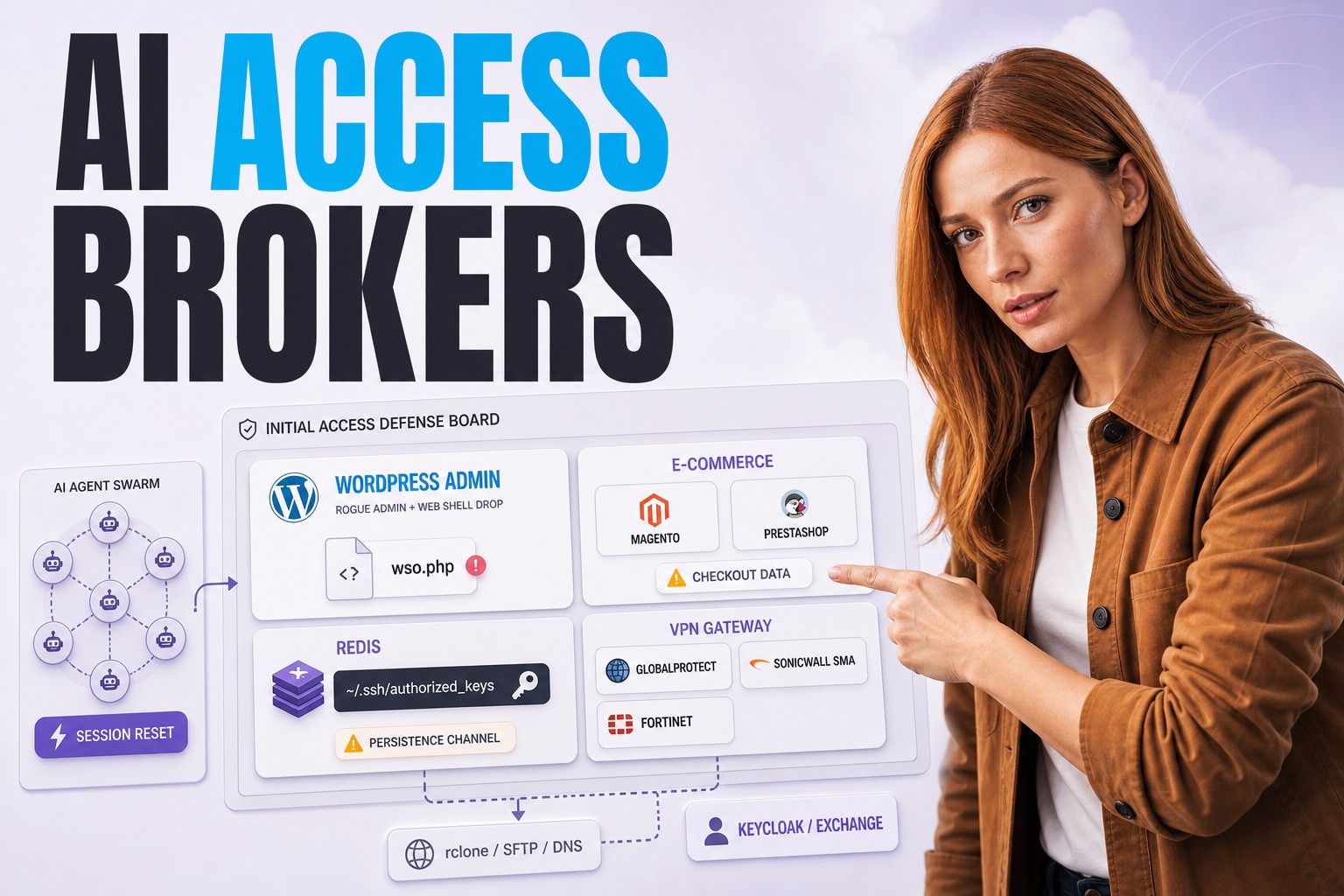
Are AI agents now a real factor in initial access against WordPress and e-commerce? → Yes. This week’s dominant signal is not a new vulnerability, but an AI orchestration layer (Claude Code agents and a self-hosted pentest agent) accelerating how fast known flaws get exploited.
What’s the primary engineering question we should answer this quarter? → How do we harden WordPress, e-commerce stacks, exposed Redis, and perimeter VPN gateways against AI-assisted initial access that can scan thousands of targets and chain actions in seconds.
What changed operationally for defenders? → Attack throughput and persistence improved at the orchestration level: multiple specialized agents, session resets after refusals, and a two-pipeline model (global automation plus targeted critical infrastructure work).
What’s the most actionable risk signal from the disclosure? → The attackers leaked their own working directory with AI session logs, scripts containing plaintext tokens, and agent configurations—showing defenders exactly where AI-assisted campaigns create new, monitorable seams.
What’s Plavno’s angle? → We believe the correct response is to treat AI-assisted intrusion as an engineering-scale automation problem: reduce exploitability (patch/segmentation), reduce blast radius (privilege design), and detect orchestration artifacts (identity and file integrity signals), rather than arguing about model choice or prompt tricks.
Quick Answer: How do we defend against AI-assisted initial access brokers?
We defend by assuming adversaries can industrialize exploitation of known issues—like wp2shell CVEs, Support Board SQL injection, exposed Redis, and perimeter gateway flaws—using AI agent orchestration (Claude Code, PentAGI linked to Cobalt Strike). The winning move is to shorten patch time, harden identity and admin surfaces (rogue WordPress admins, web shells, SSH key changes), and instrument for fast, cross-surface detection because the speed and parallelism now happen above the model, in the workflow.
| What actually shifted | What the disclosure shows | Why engineers should care |
|---|---|---|
| AI orchestration over commodity tooling | A cluster of 51 specialized agents via Claude Code for scanning, exploit chaining, recon, and post-exploitation alongside tools like Cobalt Strike | Attack paths become faster and more repeatable without ‘novel malware,’ so defensive posture must focus on exposure and detection, not signature hunting |
| Agent-to-C2 integration | A self-hosted pentest agent (PentAGI) connected to a Cobalt Strike Team Server through an AI provider API | C2 can become more hands-off, so defenders need identity and integrity signals that survive tool changes |
| Refusal bypass via session control | Context-engineering and session resets to reframe offensive tasks as authorized pentesting | Safety controls don’t map to your risk; you can’t outsource security to model refusals |
| Operational leakage of AI workflows | An exposed open directory containing AI session logs, plaintext tokens, agent configs, recon output, and exfiltrated data | AI-assisted ops create new forensic seams; defenders should hunt for the artifacts the workflow requires |
The dominant signal: AI increased throughput, not exploit novelty
The key engineering takeaway is that the disclosed operations leaned on known offensive tooling and known weaknesses, but used AI agent orchestration to run more steps in parallel and recover quickly when individual steps failed. That changes how we size patching, monitoring, and incident response: the time between publicly known flaw and mass exploitation compresses when a broker can coordinate scanning, exploit attempts, and post-exploitation with specialized agent workflows.
- Speed becomes the vulnerability multiplier: One logged run scanned 4,708 targets, confirmed 429 WordPress admin panels, and deployed 32 web shells in a 61-second window, making slow operational response a core failure mode.
- Workflow resets defeat refusal hope: When an agent refused a task, the operator opened a fresh session with authorization framing and tried again, so defender strategy cannot rely on model friction.
- Two pipelines mean two risk profiles: A global automated campaign monetizes access and payment data, while a directed campaign targets Ukrainian energy and utilities for deep recon and manual exploitation.
- Exposure is still the root cause: WordPress, e-commerce platforms (Magento, PrestaShop), and internet-exposed Redis were explicitly targeted, underscoring that surface reduction remains the most reliable defense.
Central claim: AI failures happen at orchestration boundaries, so defenses must target workflow seams
At Plavno, our position is specific: AI didn’t make these actors dangerous because the model hacks better. It made them dangerous because orchestration collapses time between discovery, exploitation, and post-exploitation, while session-level safety controls can be navigated with resets and context framing. A reasonable engineer could disagree and argue model providers will close this gap; we don’t think you should bet your quarter on that.
The right response is to engineer for adversaries that behave like automated production systems. That means designing controls around where orchestrated workflows must touch your environment: authentication surfaces, admin panel creation, file writes for web shells, SSH key persistence on Redis hosts, and the predictable infrastructure steps brokers take to provision, stage payloads, and monetize access.
If you treat AI-assisted attack as a model problem, you will overinvest in prompt defenses and underinvest in the only durable control: making exploitation and persistence measurably harder across identity, network exposure, and integrity signals.
Why the two-pronged campaign model breaks the way teams scope security work
The disclosed activity ran two pipelines simultaneously: a high-volume automated path against WordPress and e-commerce platforms, and a selective manual path against Ukrainian critical infrastructure. That matters because many teams still budget security as a single backlog: patch a few things, run a scan, call it done. In practice, the opportunistic pipeline punishes any internet-facing system that lags on patching or has weak admin hygiene, while the directed pipeline punishes organizations with complex operational tech dependencies where deep reconnaissance can be turned into leverage.
From an architecture standpoint, these are different incident shapes. The automated pipeline is more likely to produce many small compromises—rogue WordPress administrators, WSO web shells, payment-data theft attempts—across many sites. The directed pipeline is more likely to include careful recon and manual exploitation paths where the adversary adapts to controls. Your detection program must cover both: high-volume integrity checks and identity anomalies, plus targeted monitoring on the specific systems that underpin critical services.
What the attack architecture implies for defenders: it’s an eight-node system, not a lone hacker
The disclosed campaign was described as an eight-node setup including an attacker workstation, provisioning server, monetization infrastructure, payload staging servers, and a scanner. We don’t need every detail to draw the engineering conclusion: defenders should expect industrialized pipelines with separate components for scanning, staging, and cashing out, which means you’ll see repeated patterns across logs and environments when you instrument correctly.
This is why just block Cobalt Strike is insufficient as a strategy. Even if payload families shift, the pipeline still needs to find targets, verify admin access, establish persistence, and exfiltrate. Those steps touch your identity layer, your content and plugin surfaces, and your egress controls in ways that are much harder to disguise than a single malware signature.
| Target surface | Observed attacker intent | What you can realistically verify |
|---|---|---|
| WordPress core/plugins | Exploit known flaws such as wp2shell CVEs and Support Board SQL injection, then seize control of sites | Presence of rogue WordPress administrators, abnormal admin logins, and unexpected server-side file drops consistent with web shells |
| E-commerce platforms | Pursue access and payment data via automated exploitation | Unexpected admin creation, suspicious file changes in web roots, and anomalous outbound connections that accompany data theft attempts |
| Internet-exposed Redis | Exploit exposed servers and persist | Unexpected entries in ~/.ssh/authorized_keys on Redis hosts, plus connectivity patterns suggesting unauthorized access |
| Perimeter and enterprise edge | Scan and exploit gateway and app surfaces (GlobalProtect, SonicWall SMA, Fortinet, Keycloak, Exchange, Next.js-on-IIS) | High-signal auth anomalies, sudden config changes, and telemetry showing repeated probing and exploitation attempts |
Why the WordPress numbers should change how you set alert thresholds
A single automated execution scanned 4,708 targets, confirmed access to 429 WordPress administration panels, and deployed 32 web shells in a 61-second window. Even without adding any speculative benchmarks, those figures are enough to reframe operations: if your monitoring assumes a human tempo, it will miss the decisive window. A broker doesn’t need persistence on every target; they need enough footholds to sell access or pivot into higher-value systems.
This is also where many teams misconfigure their detection. They tune alerts to avoid noise and miss the bursty pattern of automated exploitation. In an AI-orchestrated workflow, bursts are the feature. Defenders should deliberately look for short windows with dense sequences: probing, admin access confirmations, and immediate follow-on writes that correspond to web shell placement.
Reclassify WordPress and plugins as tier-one exposure: Treat wp2shell-related CVEs and plugin SQL injection paths as urgent because AI orchestration compresses exploitation timelines.
Instrument identity events around admin panel access: Prioritize signals tied to WordPress administrator creation and unusual admin login patterns over malware found signals.
Add file integrity focus to web roots: Web shell placement is a workflow dependency; you can’t exfiltrate value at scale if you can’t reliably write and execute.
Hunt Redis persistence explicitly: Checking for unexpected ~/.ssh/authorized_keys entries on Redis hosts is a concrete verification step aligned to the observed behavior.
Treat burst activity as suspicious by default: Dense sequences in seconds should be escalated, not suppressed as scan noise, because they correlate with automated exploitation.
Session resets make model safety irrelevant to your risk model
The disclosure described the operator using context-engineering and session-reset techniques, framing requests as authorized pentesting to work around refusals. The technical detail that matters is that safety controls act on the context of a session, not model weights, so a refusal in one session does not automatically constrain the next. That means the AI will refuse narrative is not a security control you can rely on.
There were also logged refusals that held, including declines to install a backdoor, disable a firewall, move laterally, deploy a web shell, and repeated scan refusals, plus rejection of a forged ownership token. As defenders, we should read that as variability, not protection: sometimes it slows an attacker, sometimes it doesn’t, and the operator can keep iterating until they get a usable output or switch tools.
The hidden defender advantage: AI-assisted ops leave more artifacts, not fewer
The operation was uncovered after researchers found an exposed open directory that leaked a live working directory from a Linux workstation, including AI session logs, scripts with plaintext tokens, toolkits, reconnaissance output, agent configurations, and exfiltrated victim data. While we cannot assume every attacker will leak directories, the principle holds: orchestration systems create operational gravity. They require state, configuration, credentials, and repeatable scripts.
From a defensive standpoint, this implies two practical advantages. First, incident response should explicitly seek orchestration artifacts, because they often contain the narrative of the intrusion: what was tried, what succeeded, and what credentials were used. Second, security engineering should target places where attackers are forced to externalize state, such as unauthorized admin creation, persistent SSH keys, staging directories, and outbound exfiltration channels like SFTP or tools like rclone and DNS tunneling referenced in the broader set of campaigns.
AI increases attacker iteration speed, but it also increases attacker dependency on repeatable state; defenders win when they monitor the state changes the workflow cannot avoid.
What to validate immediately on WordPress, Magento, and PrestaShop estates
If you operate WordPress or common e-commerce platforms, the defensive work should start with verifications that map to the observed behaviors, not with abstract AI threat workshops. The opportunistic pipeline targeted access volume for monetization, including payment data, and used known flaws like wp2shell CVEs and a Support Board plugin SQL injection vulnerability to seize control.
In practice, we focus on the facts that translate into concrete checks: whether new administrators appeared, whether web shells consistent with WSO are present, and whether the hosting environment shows sudden file writes and execution patterns that correspond to web shell deployment. The operational lesson is that a broker’s goal is repeatability; if you remove repeatable footholds across your estate, the AI layer can’t manufacture access from nothing.
- Rogue administrator verification: Confirm WordPress administrator accounts align with HR reality and change control, because access confirmation to admin panels was part of the observed workflow.
- Web shell hunting in web roots: Search for artifacts consistent with WSO web shells, since web shells were deployed rapidly after access confirmation.
- Plugin and theme inventory sanity: Validate you know where Support Board is installed and whether the vulnerable code paths are present, because attackers explicitly chased plugin-level flaws.
- Hosting-level write and execute visibility: Ensure your logging and integrity monitoring can show when new executable content appears in web-accessible directories.
Why patch faster is necessary but insufficient for e-commerce
Patching is mandatory, but AI-orchestrated brokers exploit the fact that e-commerce stacks are operationally messy: plugins, payment extensions, multiple admin users, and outsourced content changes. Even if you patch, you still need to prove your environment can detect and reverse unauthorized admin creation and file-level persistence quickly enough to prevent monetization.
A practical scenario we see: a marketing-driven request adds a plugin, the plugin creates a new admin role or opens a vulnerable endpoint, and no one revisits it. An AI-assisted scanner doesn’t care about your org chart; it only cares about reachable surfaces. So the engineering response must blend patch discipline with identity hygiene and integrity monitoring, because that is what turns reachable into contained.
Redis exposure is a persistence problem disguised as a configuration issue
The campaign also exploited exposed Redis servers and led to breaches of two Chinese entities. The defensive advice in the disclosure was specific enough to be operational: check for unexpected entries in ~/.ssh/authorized_keys on Redis hosts. That’s not a theoretical best practice; it’s a persistence indicator aligned to observed behavior.
For engineering teams, this is a reminder that data stores exposed to the internet become identity and access problems, not just open port problems. Once persistence is established through SSH keys, the attacker’s workflow becomes durable and can be resold by an initial access broker. When AI orchestration is added, the attacker can standardize persistence steps across many hosts quickly, which increases both compromise volume and time-to-resale.
| Redis risk driver | Why AI orchestration amplifies it | What good looks like operationally |
|---|---|---|
| Internet exposure | Brokers can scan and attempt exploitation at scale, then repeat persistence steps automatically | Redis is not reachable from the public internet; access is constrained to known networks and workloads |
| SSH key persistence | Persistence scales cheaply and survives password changes | authorized_keys is monitored, change-controlled, and investigated when modified unexpectedly |
| Post-compromise resale | Initial access is monetizable even without deep internal movement | Detection and response are designed to remove persistence quickly and verify eradication |
| Cross-estate repeatability | A standardized workflow is easier to automate with agents | Security controls are consistent across environments so repeatable attacks fail consistently |
The Ukrainian critical infrastructure angle changes prioritization, even for global companies
The directed pipeline focused on Ukrainian energy and utilities, including a heating provider in Kharkiv, and confirmed exfiltration from four Ukrainian organizations with more than 628,000 harvested records tied to Ukrainian individuals. Even if your company is not in Ukraine, this matters: it demonstrates that the same actor can run opportunistic monetization globally while running geopolitically concentrated reconnaissance in parallel.
For global engineering leaders, that implies your threat model should include dual intent operations. A site compromise that looks like commodity web exploitation may be part of a broader playbook that also targets enterprise gateways and critical services. The practical response is to unify visibility across web properties, identity, and edge infrastructure so you can correlate patterns rather than treating each compromise as an isolated web incident.
Map your highest-impact services to specific infrastructure: If utilities can be disrupted through a small set of systems, instrument those systems as if they are perimeter assets.
Treat data exfiltration as a first-class signal: Confirmed exfiltration happened; you should assume that access brokers will monetize data even when the initial exploit is just WordPress.
Unify web and edge telemetry: Correlate WordPress admin anomalies with edge probing against VPN gateways and other enterprise endpoints.
Practice eradication, not just detection: Persistence mechanisms like web shells and SSH keys require repeatable removal and verification steps.
Model adversary intent as mixed, not pure: An actor can sell access and simultaneously support targeted campaigns; engineering controls must withstand both.
Operation Master shows the endgame: perimeter exploits feeding automated invoice fraud
A second disclosed operation, dubbed Operation Master, illustrates why initial access has become an industrial input into downstream fraud systems. The actor compromised enterprise networks, stole customer and billing databases, sold subsets on underground forums, and repurposed data into an automated, multi-tenant invoice fraud platform. The activity included mass scanning for PAN OS GlobalProtect gateways and exploitation of CVE-2026-0257, plus probing of SonicWall SMA VPN, Fortinet, Keycloak, Microsoft Exchange, and Next.js-on-IIS endpoints.
The fraud engine generated over 2.4 million messages across email, SMS, and WhatsApp, and 622,666 personalized invoice links, tracking 169,906 interactions and potentially driving R$38.9 million in fraudulent invoices, with cumulative invoice values of R$150.4 million in click-tracked short links. The operational point is uncomfortable but necessary: if we treat initial access as an IT nuisance rather than a revenue-grade fraud enabler, we will underfund the controls that prevent it.
When initial access becomes a repeatable upstream input to fraud platforms, the business impact is no longer incident response cost; it is direct, automated monetization at scale.
What engineers should infer about AI use in Operation Master
SOCRadar assessed that the operator leaned on AI agents powered by Claude to develop intrusion code and exfiltration scripts, while focusing personally on fraud panel code and custom AdaptixC2 extenders. That division of labor matters: AI is being used to automate the glue work that traditionally limited campaign throughput—scripts, parsing, and repeatable integration—freeing human attention for monetization design.
For defenders, the immediate implication is that security teams will see more campaigns with competent operational tooling around known exploits, including device-code phishing and password spraying against Microsoft 365 tenants, exploitation of GitLab account takeover (CVE-2023-7028), and privilege escalation and lateral movement using commonly referenced tools and techniques like Kerberoast, AS-REProast, Evil-WinRM, and exfiltration via DNS tunneling, rclone, and SFTP. We should not read this as AI invented new exploits, but as AI removed the attacker’s engineering bottleneck.
- Perimeter-first intrusion chains: GlobalProtect CVE-2026-0257 scanning shows that edge gateways remain high-leverage entry points when exploited at scale.
- Enterprise app sprawl as an attack surface: Probing spans VPNs, identity components, Exchange, and web stacks like Next.js-on-IIS, which punishes inconsistent patch and config management.
- Credential and tenant targeting: Device-code phishing and password spraying against Microsoft 365 shifts risk into identity operations, not just network security.
- Exfiltration as a workflow step: DNS tunneling, rclone, and SFTP highlight that egress and data movement monitoring must be part of your core design.
Plavno’s perspective: build defenses around what must happen, not what might happen
At Plavno, we advise clients to stop debating whether a given model is dangerous and instead map the attacker workflow to the system points that cannot be skipped. Even the disclosed campaigns, sophisticated in orchestration, still needed: an exposed target, a vulnerability or credential weakness, a way to persist, and a way to move or sell value. Those steps are where engineering decisions actually matter.
This is also where we see teams win quickly: by making web properties and edge infrastructure behave like managed products, not misc servers. When we deliver cybersecurity and penetration testing, we push for verification loops that connect findings to operational controls: identity event monitoring, file integrity for web roots, SSH persistence checks on data stores, and incident runbooks that assume burst exploitation.
- Treat web CMS and plugins as production software: WordPress and plugin CVEs are not marketing tech; they are internet-facing code that adversaries explicitly industrialize.
- Instrument admin identity as carefully as customer identity: Rogue admin creation is a monetizable event and should be monitored with the same seriousness as account takeover.
- Engineer repeatable eradication: Removing WSO web shells and unauthorized SSH keys must be scripted and verified, not done once during a crisis.
- Plan for cross-surface correlation: Web compromises, VPN probing, and tenant attacks are increasingly part of a single revenue pipeline.
How to evaluate your exposure in practice without boiling the ocean
We recommend starting with a simple decision logic: identify whether your organization looks more like the opportunistic target set (WordPress, Magento, PrestaShop, exposed Redis) or the enterprise-edge target set (GlobalProtect, SonicWall SMA VPN, Fortinet, Keycloak, Exchange, GitLab, Microsoft 365). Many organizations are both. The key is to prioritize the surfaces where exploitation produces immediate leverage: admin panels, gateway auth paths, and data stores with persistence value.
Operationally, evaluation should be tied to what you can validate quickly. Can you prove that WordPress administrators are legitimate? Can you detect a new file drop in a web-accessible directory fast enough to matter? Can you prove Redis hosts haven’t had SSH authorized keys modified unexpectedly? And can you see repeated probing against gateway endpoints in a way that triggers response before compromise turns into exfiltration? That’s the measurement that aligns with AI-orchestrated speed.
The practical yardstick is not are we patched, but can we detect and reverse the first irreversible step, such as unauthorized admin creation, persistent key installation, or successful gateway exploitation.
Real-world applications: where AI-assisted initial access hits hardest
The disclosed activity explicitly targeted WordPress sites, e-commerce platforms, and critical infrastructure entities, and the parallel Operation Master targeted enterprise gateways and tenants. In real business terms, we see three recurring application domains: consumer-facing e-commerce brands with large plugin ecosystems, B2B SaaS companies with sprawling web stacks and identity integrations, and regulated or operationally critical providers where downtime and data disclosure have outsized consequences.
What makes AI-assisted brokers uniquely disruptive in these domains is the ability to industrialize the first mile of compromise. For an e-commerce operator, that first mile is often an outdated plugin or weak admin hygiene. For an enterprise, it may be a perimeter gateway flaw or tenant credential weakness. For critical services, it’s frequently a combination—public-facing web properties plus operational systems that were never engineered for hostile internet traffic.
Risks and limitations: don’t overfit your program to this week’s tooling
It’s tempting to react to the specific names—Claude Code, PentAGI, Cobalt Strike, AdaptixC2—and build a program around blocking those. The risk is that you’ll chase labels while missing invariants. Tooling shifts faster than architectures, and AI agents, by design, are interchangeable orchestration layers. If you build your defense around the brand of model or agent, you’ll be wrong as soon as the workflow changes.
The other limitation is assuming all attackers will experience the same safety friction. The disclosure contained refusal transcripts that held, but also described repeated session resets to bypass refusals. We should assume adversaries will mix AI help with manual work, and that the operational tempo will remain high regardless. That’s why durable controls are exposure reduction, identity and admin hygiene, integrity monitoring, and response automation—controls that remain effective even when the attacker’s assistant changes.
| Control decision you can make this quarter | Which observed behavior it addresses | Trade-off you must accept |
|---|---|---|
| Tighten admin identity governance on CMS and e-commerce | Rogue WordPress administrators and admin panel access confirmation steps | More friction for marketing/content teams; requires stronger change control |
| Add integrity monitoring for web roots and key persistence points | Rapid web shell deployment and SSH authorized_keys persistence on Redis hosts | More alert volume; requires tuning around legitimate deployments |
| Prioritize perimeter and tenant telemetry correlation | GlobalProtect exploitation, VPN probing, Microsoft 365 device-code phishing and spraying | Requires cross-team ownership between network, IAM, and app teams |
| Treat exfiltration paths as a first-class detection surface | Use of SFTP, rclone, and DNS tunneling in post-compromise workflows | May require new egress controls and exception management |
- CMS admin drift: Organizations often can’t confidently answer who has WordPress admin today, which makes rogue admin detection hard until it’s too late.
- Plugin sprawl and ownership gaps: Support Board and similar plugins get installed without durable ownership, so patch urgency is underestimated.
- Redis and internal-only assumptions: Redis exposure often results from mis-scoped network rules, but the operational impact becomes persistent access via SSH keys.
- Edge patch latency: Gateway and perimeter updates are operationally risky, but AI-assisted brokers exploit the lag systematically.
Author: Plavno team. Last updated: October 2026. Key closing insight: the defensible strategy is to engineer for adversary automation—make the first foothold difficult, make persistence noisy, and make exfiltration observable—because AI changes attacker tempo more than it changes attacker capability.
 Chat GPT
 Perplexity
 Claude
 Gemini

