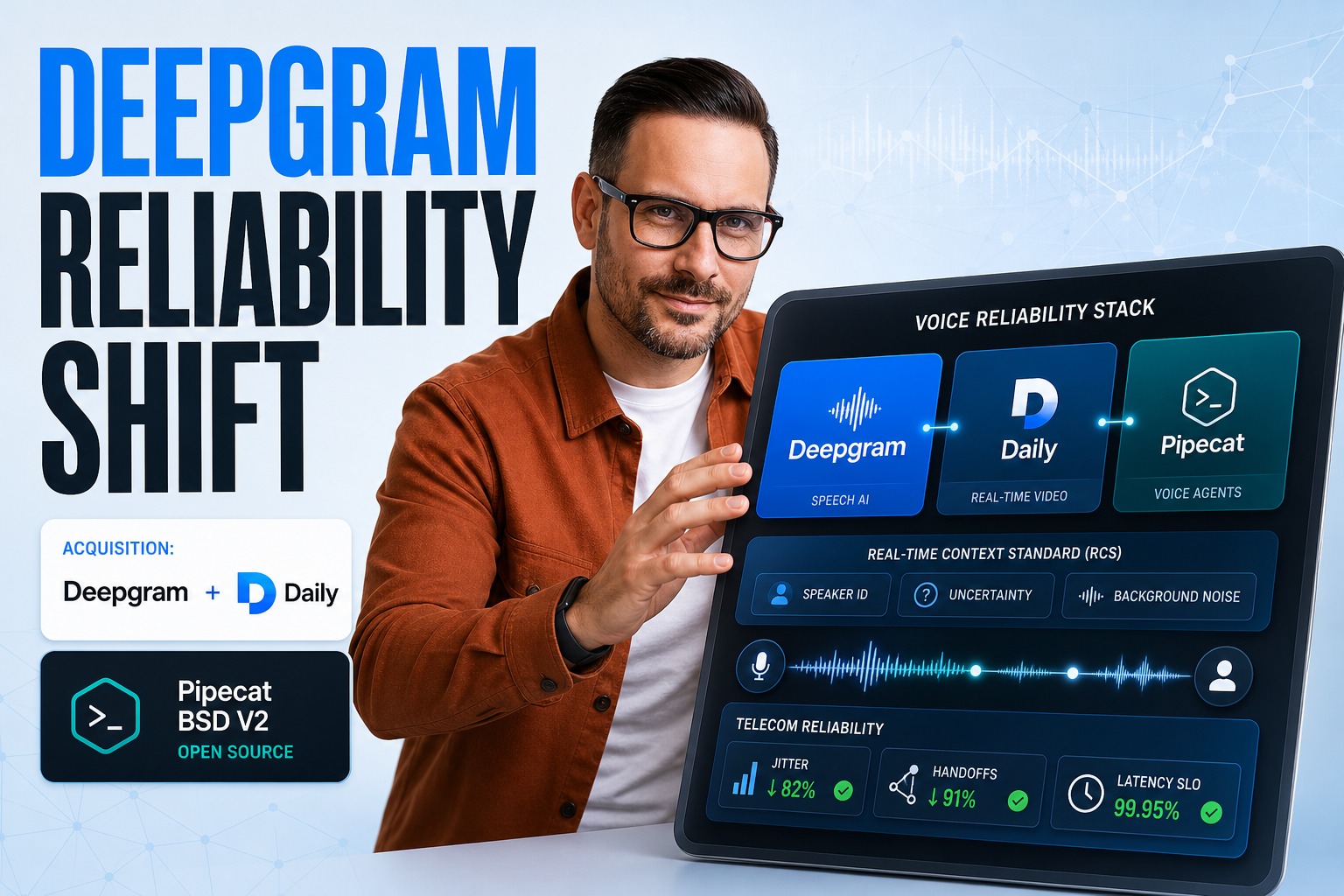
What changed for voice stacks? → Deepgram agreed to acquire Daily, bringing real-time comms and orchestration under one production roadmap.
Why should telecom care? → ai agents in telecom fail on jitter, handoffs, and missing context more than on model quality.
Is Pipecat getting closed? → No, it stays free under BSD V2, and an independent Pipecat Foundation is being formed.
What is new on protocols? → Deepgram and the Pipecat team introduced the Real-Time Context Standard to preserve audio interaction signals.
What’s the strategic bet? → Reliability improves when networking, orchestration, and speech models are engineered as one system.
Quick Answer: What This Deal Means For Telecom Voice Reliability
ai agents in telecom just got a clearer path from demo to durable production. By combining Daily’s real-time network (built for low latency and reliability), Pipecat’s open-source orchestration, and Deepgram’s speech models into a single platform direction, teams can reduce the most common failure mode: brittle integration boundaries. The key theme is not better AI, but fewer lossy handoffs, with open standards and vendor-neutral components preserved.
- Daily contributes real-time communications infrastructure designed for live voice and video AI constraints.
- Pipecat remains BSD V2 and vendor-neutral, with a new independent Pipecat Foundation planned.
- Deepgram positions the acquisition as a faster route from prototype to production.
- Real-Time Context Standard targets context loss across model and system boundaries.
- Daily’s team joins Deepgram; Daily co-founder Kwindla Hultman Kramer becomes Head of Open Source.
Why Reliability Is The Product For AI Agents In Telecom
Telecom environments punish mostly-works voice experiences: long-tail latency spikes, audio drops, and ambiguous speech become escalations and churn. The Deepgram–Daily–Pipecat combination is best read as an infrastructure move, not a features move: network plus orchestration plus speech. If you’re modernizing telecom software, this is a reminder that voice agents need SRE-grade thinking from day one, not after the first outage.
In voice, reliability is an end-to-end property: if any layer drops context or timing, the conversation breaks—even if every model is state of the art.
Stack Thinking For AI Agents In Telecom: Deepgram + Daily + Pipecat
Deepgram said it is building a complete infrastructure stack for conversational voice agents, spanning speech recognition, speech generation, orchestration, networking, and deployment. Acquiring Daily adds a real-time communications backbone, while Pipecat contributes a proven orchestration framework already used in production voice AI, with broad integrations across model providers, telephony systems, and deployment environments.
The reliability angle is straightforward: most telecom failures happen at boundaries—where audio is transported, normalized, transcribed, routed, synthesized, and replayed under strict latency budgets. Consolidating expertise across these boundaries can reduce integration glue, simplify observability, and shorten incident loops. Importantly, Deepgram says Pipecat will stay vendor-neutral, so you can still swap components without rewriting the system.
Daily’s Network Is A Reliability Asset, Not A Commodity
Daily operates a global real-time network with 75 points of presence, explicitly designed for the latency and reliability requirements of live voice and video AI. That matters in telecom because the user’s perception is shaped by timing: interruptions, talk-over, and delayed barge-in can feel like the agent is broken, even when the transcript is accurate. Treat the network like part of the product surface, with clear SLOs and failure modes.
| Layer | What Deepgram Gets | Reliability Implication In Telecom |
|---|---|---|
| Real-time transport | Daily’s global real-time network and communications infrastructure | Lower jitter risk and cleaner control of latency-sensitive voice flows |
| Orchestration | Pipecat’s open-source voice agent framework and integrations | Fewer brittle handoffs between STT, LLM, TTS, and telephony |
| Speech intelligence | Deepgram’s speech models and upcoming Voice Agent Platform | Better control of end-to-end tuning and incident ownership |
| Governance | Pipecat stays BSD V2; independent foundation planned | Reduces lock-in fear while still enabling coordinated reliability investments |
How To Implement Model Context Protocol In A Voice Agent Pipeline
The Real-Time Context Standard is Deepgram’s answer to a common production problem: as a voice interaction moves between systems, vital information gets lost—tone, speaker identity, unclear speech, and background context. Treat it like a model context protocol for voice: metadata rides alongside audio so each component knows what it is hearing and how to respond.
Deepgram says RCS defines metadata describing audio context, instructions for how a language model should interpret those signals, and guidance for how the response should sound. Adapters can translate that information for models from different providers, which is exactly what you need when vendor-neutral orchestration meets telecom-grade reliability.
Define a minimal context schema that preserves speaker identity, uncertainty, and environment signals across hops.
Enforce context propagation at every boundary: telephony ingress, STT, orchestration, LLM, TTS, and egress.
Use adapters per model/provider so context survives swaps without rewriting core agent logic.
Test lossy handoff scenarios: unclear speech, whispers, and background noise, and verify the agent reacts appropriately.
Designing An AI Agent For Customer Support That Stays Up
If you’re building an ai agent for customer support, reliability requirements are less about clever prompts and more about deterministic behavior under stress: retries, timeouts, graceful degradation, and rapid fallbacks to humans. Pipecat’s popularity in production voice AI is a signal that teams need orchestration that is explicit about routing, tool calls, and state transitions.
This is also where implementation discipline matters: treat voice as a system with telemetry, load tests, and runbooks. If you need help standing up the orchestration and operational envelope, Plavno’s AI agents development work is typically where telecom teams start when prototypes begin to touch real traffic.
Open Source Governance Is Part Of Your Risk Model
Deepgram says Pipecat will remain free and fully open source under its existing BSD V2 license, and that an independent Pipecat Foundation is being established by Deepgram and others in the ecosystem. For CTOs building enterprise ai agents, this matters because governance affects incident response: you want upstream velocity, predictable releases, and a community that can validate reliability fixes in the open.
Kwindla Hultman Kramer is joining Deepgram as Head of Open Source, which is a strong signal that the company expects open-source stewardship to be an operating function, not marketing. The practical takeaway: open, vendor-neutral foundations can still be aligned with production-grade platform roadmaps—if they are resourced.
For telecom voice, open-source freedom only pays off when it is paired with a shared context standard and disciplined release engineering.
Vendor-Neutral Orchestration Keeps Reliability Decisions Local
Deepgram stated it will continue investing in Pipecat while maintaining its vendor-neutral architecture, so developers can combine models, APIs, networking infrastructure, and tools from different providers. In telecom, that’s not ideology—it’s operational leverage. It lets you isolate blast radius: swap STT or TTS, change routing, or move infrastructure closer to traffic without refactoring the entire agent.
Pipecat’s breadth of integrations also reduces bespoke glue code, which is where reliability regressions hide. Fewer custom adapters means fewer silent failures when a provider API changes or when you introduce a new deployment environment.
- Reduced lock-in risk while still allowing standardized orchestration primitives across teams.
- Cleaner incident triage because failures can be attributed to a specific layer or adapter.
- Easier A/B and canary testing when swapping model providers or routing strategies.
- More predictable compliance and data-flow reviews because interfaces are explicit.
- Lower integration debt, which is often the true cause of voice latency outages.
From Prototype To Production: Design For Degradation
Deepgram CEO Scott Stephenson framed the core issue: too many teams treat voice AI as a feature added late, but it is a distinct infrastructure discipline with demands around latency, accuracy, and scale. Telecom should read that as a call to design for degradation. When STT confidence drops, when background noise rises, or when an LLM stalls, the system must choose a safe behavior.
This is where an ai agent for operations becomes real: not just answering users, but managing queues, routing logic, and fallbacks under load. Reliability comes from deciding what acceptable failure looks like—ask to repeat, switch to a quieter tone, or escalate—then making those behaviors testable.
| Failure Mode | What Breaks In The Conversation | Reliability-Oriented Response |
|---|---|---|
| Context loss across components | The agent responds with the wrong tone or misses who is speaking | Preserve and propagate RCS-style metadata end-to-end |
| Latency spike | Users talk over the agent; barge-in feels broken | Tight timeouts, fast fallbacks, and clear turn-taking rules |
| Unclear speech | The agent hallucinates an answer to a misheard question | Ask for repetition and surface uncertainty explicitly |
| Provider swap | Behavior changes unexpectedly after model or API changes | Adapter-based contracts and staged rollouts with regressions tests |
Building Intelligent SaaS Agents On Telecom-Grade Voice Infrastructure
Deepgram reports it provides production voice AI infrastructure to more than 5,000 organizations globally, and that more than 650,000 developers have used its technology to process more than 200,000 years of audio. Those numbers don’t prove your use case will be easy, but they do indicate operational experience at scale—exactly what telecom buyers should value when reliability is the bar.
The acquisition’s architectural promise is a tighter loop between transport, orchestration, and models, plus an open protocol for context. If you’re productizing intelligent saas agents that must survive real-time voice, invest early in deployment and observability: controlled rollouts, multi-region thinking, and deterministic failure handling. Many teams underestimate the platform work here; this is where strong cloud software development practices turn voice demos into systems operators trust.
- Ask where latency budgets are enforced: network edge, orchestration, model calls, and TTS playback.
- Require a context-preservation story across vendors, not just within a single platform.
- Validate open-source governance: release cadence, security posture, and how critical fixes land.
- Insist on failure-mode demos: noisy audio, uncertain transcription, and mid-call component failures.
- Plan for portability: adapters and contracts that survive model/provider churn.
AI Agent Use Cases Telecom Teams Can Operate Reliably
The best ai agent use cases in telecom are the ones with clear stop conditions and escalation paths. Start with flows where uncertainty can be handled safely: authentication handoffs, billing explanations with references, appointment scheduling, and outage status updates. An ai customer service agent should be evaluated on recovery behaviors—asking users to repeat unclear speech, staying calm under interruptions, and escalating early—more than on perfect first-pass answers.
This is also where the Real-Time Context Standard’s intent is pragmatic: Deepgram says the approach can help agents respond more naturally, like speaking quietly when someone whispers. In production, that natural behavior is a reliability feature: it prevents misinterpretation spirals.
What To Do Next If You’re Betting On Voice Reliability
Treat this acquisition as a blueprint: pick an orchestration layer, enforce context propagation, and own your real-time network assumptions. If you’re rolling out ai agents in telecom, prioritize incident-ready design—timeouts, fallbacks, and measurable SLOs—before you chase new model features. Done well, you get faster iteration without fragile coupling.
Author: Plavno team. Last updated: November 2026.
 Chat GPT
 Perplexity
 Claude
 Gemini

