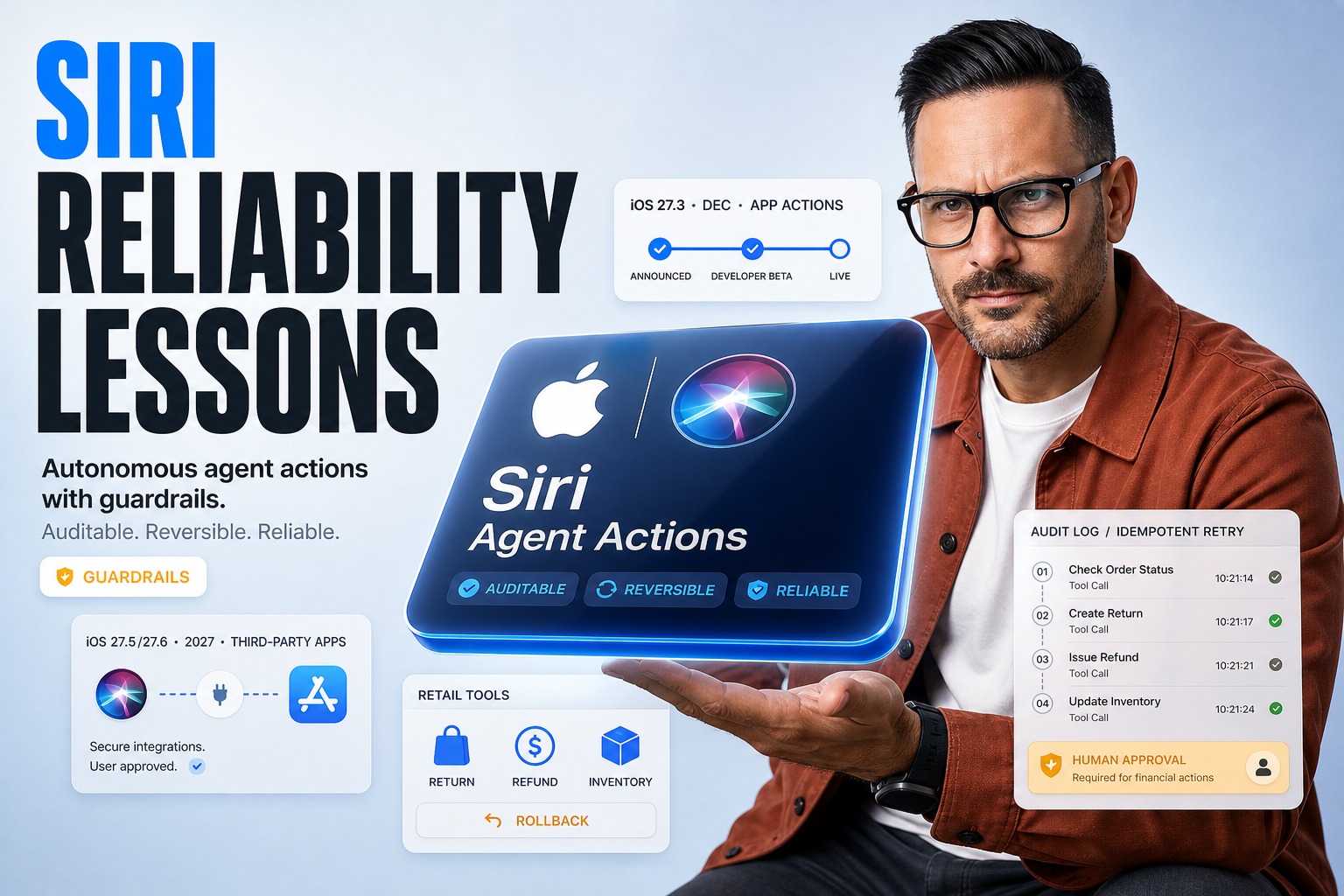
Why should retail leaders care about Apple’s Siri shift? → It previews how consumer-grade assistants become dependable enterprise agents.
What changes are being pushed? → Bloomberg’s Mark Gurman reports CEO John Ternus is pressing Craig Federighi to make Siri an action-taking agent.
What’s the reliability trap? → Autonomy without guardrails turns small errors into real orders, refunds, and chargebacks.
Where do ai agents in retail fit? → The same app-level action model can drive checkout, service, and operations workflows.
What should CTOs do now? → Design agent actions as auditable, reversible transactions, not free-form chat.
Quick Answer
ai agents in retail will only outperform scripted automation when they can safely take actions inside apps with predictable outcomes. Apple’s reported plan to evolve Siri into an autonomous agent is a reminder that the hard part is not language quality; it is reliability engineering: permissions, idempotency, audit logs, and failure handling. Retail teams should treat agentic behavior as a production workflow capability, released behind controls, not a feature toggle attached to a model upgrade.
| Siri Direction (From The Report) | Reliability Risk | Retail Analogy |
|---|---|---|
| Siri AI is improved but not fully agentic yet | Users over-trust partial capability | Associates assume the bot can complete returns end-to-end |
| iOS 27.3 may bring deeper control in Apple apps as early as December | Action side effects compound quickly | Inventory edits without strong validation create downstream stock errors |
| Spring 2027: more advanced actions inside third-party iOS apps (iOS 27.5/27.6) | Integration contracts become the bottleneck | OMS/CRM integrations fail on edge cases, not intent |
| Next year: broader agentic tasks (example: changing weak passwords) | Autonomy needs governance | Agents that can change settings must be reversible and traceable |
What Apple’s Siri AI Roadmap Signals For Retail Engineering
Bloomberg’s Mark Gurman describes Apple’s internal push to turn Siri AI into an agent that can act autonomously, with CEO John Ternus pressing software chief Craig Federighi, who is characterized as an AI skeptic. The near-term timeline matters: Gurman says more capable actions inside Apple apps could arrive as early as December with iOS 27.3, while deeper third-party app actions may not land until spring 2027 (iOS 27.5 or iOS 27.6). For teams building retail software, the message is clear: integration reliability is the product.
In retail, autonomy is only valuable when every action is bounded, auditable, and reversible under real operational load.
AI Agents In Retail Need App-Level Actions, Not Better Prompts
Apple’s reported goal is not just a smarter voice interface; it is a system that can tap into apps and do things: book a table, order food, or edit and share a photo. That app-action layer is exactly what an agentic ai assistant in retail needs to move beyond FAQs into outcomes. The reliability twist is that actions are stateful: carts change, inventory decrements, and customer records update. Your architecture must assume partial failure and retries from day one.
- Define every agent action as a transaction with preconditions, postconditions, and a clear rollback plan.
- Require explicit authorization scopes per surface: payments, refunds, customer data, promotions, and fulfillment.
- Make tools idempotent so retries do not create duplicate orders, duplicate refunds, or duplicate notifications.
- Persist an audit trail that links intent, tool calls, data inputs, and resulting state changes.
- Enforce rate limits and circuit breakers when downstream systems degrade or return ambiguous results.
Reliability Comes From The Tooling Layer, Not The Model Layer
When Siri can order food via services like Uber Eats, the model is not the point; the reliable handoff is. In retail, the equivalent is exposing a controlled toolset: create return, reserve inventory, generate shipping label, update delivery address, and so on. If you already invest in AI automation, treat the agent as a planner that selects tools, while your tools remain deterministic and testable. The agent should never directly mutate databases without a contract.
Start with read-only tools (search orders, check stock) to calibrate accuracy and customer impact.
Add low-risk writes (create a case, schedule a callback) with human approval gates.
Introduce financial actions (refunds, price adjustments) only with policy checks and hard limits.
Implement rollback and compensation flows (void shipment, reverse discount, cancel order) as first-class APIs.
Deploy progressive delivery: shadow mode, canaries, and automatic fallback to scripted flows.
Why Apple’s Caution Should Influence Your Release Strategy
Gurman argues Apple can afford to be cautious because it controls the hardware and software stack, and can stage capability gradually. Retail does not get that luxury: your stack is a patchwork of POS, OMS, ERP, CRM, WMS, payment gateways, and loyalty vendors. That means reliability must be designed as an interface discipline, not a platform promise. If your agent cannot conclusively confirm state, it should stop and ask, not guess and proceed.
AI Agent Use Cases: Which Ones Stay Reliable In Retail?
The best ai agent use cases in retail are the ones where failure is containable and outcomes can be validated. An ai customer service agent that can locate an order, explain a delay, and initiate a return is valuable because you can verify each step against system-of-record data. By contrast, open-ended tasks that touch many systems tend to fail in edge cases, which is why consumer assistants often feel capable until you ask for something complex.
| Retail Surface | Agent Role | Reliability Guardrail |
|---|---|---|
| Customer support (chat/voice) | Triage, authenticate, resolve, escalate | Verification steps before any account change |
| Order management | Cancel, re-route, split shipment, backorder handling | Idempotent order mutations with compensation flows |
| Merchandising | Draft promos, validate eligibility, simulate impact | Policy engine as final authority, not the model |
| Store ops | Task creation, incident logging, staff guidance | Human confirmation for safety and labor-sensitive actions |
Third-Party App Actions Are The Real Integration Test
Gurman reports that advanced Siri capabilities inside third-party iOS apps likely will not arrive until spring 2027. That sequencing is instructive: first, Apple can harden actions in its own apps; then it can expand to the messy world of external contracts. Retail and travel ai agents face the same reality: the hard work is aligning with third-party semantics and failure modes. If an agent can book, reorder, or reschedule, your systems must expose consistent intents and deterministic responses.
- Tool contracts must specify what happens on timeout, partial success, and duplicate requests.
- Every action needs a validation endpoint to confirm final state independently of the agent.
- Standardize error taxonomies so the agent can choose retry, alternate path, or escalation.
- Keep a human-readable receipt of actions for customers and support staff to reconcile.
- Version tools like products; breaking changes are reliability incidents, not refactors.
Testing For Agents Means Testing The Edges, Not The Average
A virtual assistant tool becomes reliable when you measure what it does under ambiguous inputs, conflicting records, and degraded dependencies. Build evaluation around incidents you already know: address mismatches, fraud flags, out-of-stock substitutions, and charge disputes. Then test end-to-end with your real tool layer, not mocked happy paths, because agents fail where systems disagree. The win condition is boring: predictable outcomes and clear escalation, not clever dialog.
How To Implement Agentic AI For AI Agents In Retail Without Losing Reliability?
When teams ask how to implement agentic ai, the right answer is to treat autonomy as a controlled capability with explicit blast-radius boundaries. Apple’s own example from WWDC 2026 is telling: Siri can find weak passwords tied to an Apple account and change them autonomously on the appropriate websites and in the Passwords app. That is a bounded workflow with verifiable outcomes. Apply the same discipline to an ai agent for operations: constrain tools, require confirmations, and log everything. If you are planning AI agents development for retail, start by designing the tool layer and policies before expanding autonomy.
Map actions to risk tiers (inform, draft, execute) and assign required approvals per tier.
Build a policy layer that validates every tool call against business rules and customer entitlements.
Introduce state checkpoints so the agent must re-validate before completing multi-step workflows.
Create an incident playbook: rollback paths, manual overrides, and customer messaging templates.
Operationalize observability: action traces, tool latency dashboards, and alerting on anomalous patterns.
Reliable agents are workflow systems with language interfaces, not language systems that happen to touch workflows.
The Reliability Controls Retail Leaders Actually Need
Apple is reportedly trying to close the gap with agents like ChatGPT’s Dots and Meta’s Muse, which can take broader tasks and iterate toward a result. Retail should learn from that ambition, but adopt it with stricter governance. Your agent must know when to stop: if the OMS and CRM disagree, it should escalate instead of improvising. If you want a concrete next step, use a staged implementation plan and validate scope, tooling, and rollout via a project estimate before you let the agent execute actions.
- Action-level SLOs: success rate, rollback rate, and time-to-escalation for each tool.
- Change management: tool versioning, approval workflows, and release notes for agent capabilities.
- Security posture: scoped credentials, rotation, and separation of duties between planner and executor.
- Compliance evidence: immutable logs linking user intent to system changes and customer communications.
- Human-in-the-loop design: clear handoff states so staff can resume without rework or lost context.
Don’t Wait For Siri To Define Your Architecture
Siri AI becoming more agentic is a consumer milestone, but it should not be your blueprint. Your retail environment is less forgiving than a photo edit: a mistaken share is annoying; a mistaken refund is costly. Use the trend as validation that app-level actions are the direction of travel, then build your own bounded autonomy. Invest in tool contracts, verification, and escalation paths first; the model can be swapped later, but reliability debt compounds fast.
Closing: Building For Trust, Not Demos
Retail executives will see more agent claims next year as Apple pushes Siri further into app actions and broader autonomous workflows. The engineering differentiator will be reliability: can your system prove what happened, undo it when needed, and fail safely when dependencies wobble? If you answer yes, you can deploy ai agents in retail for customer service, operations, and merchandising without turning every edge case into a fire drill.
Author: Plavno team. Last updated: November 2026.
 Chat GPT
 Perplexity
 Claude
 Gemini

