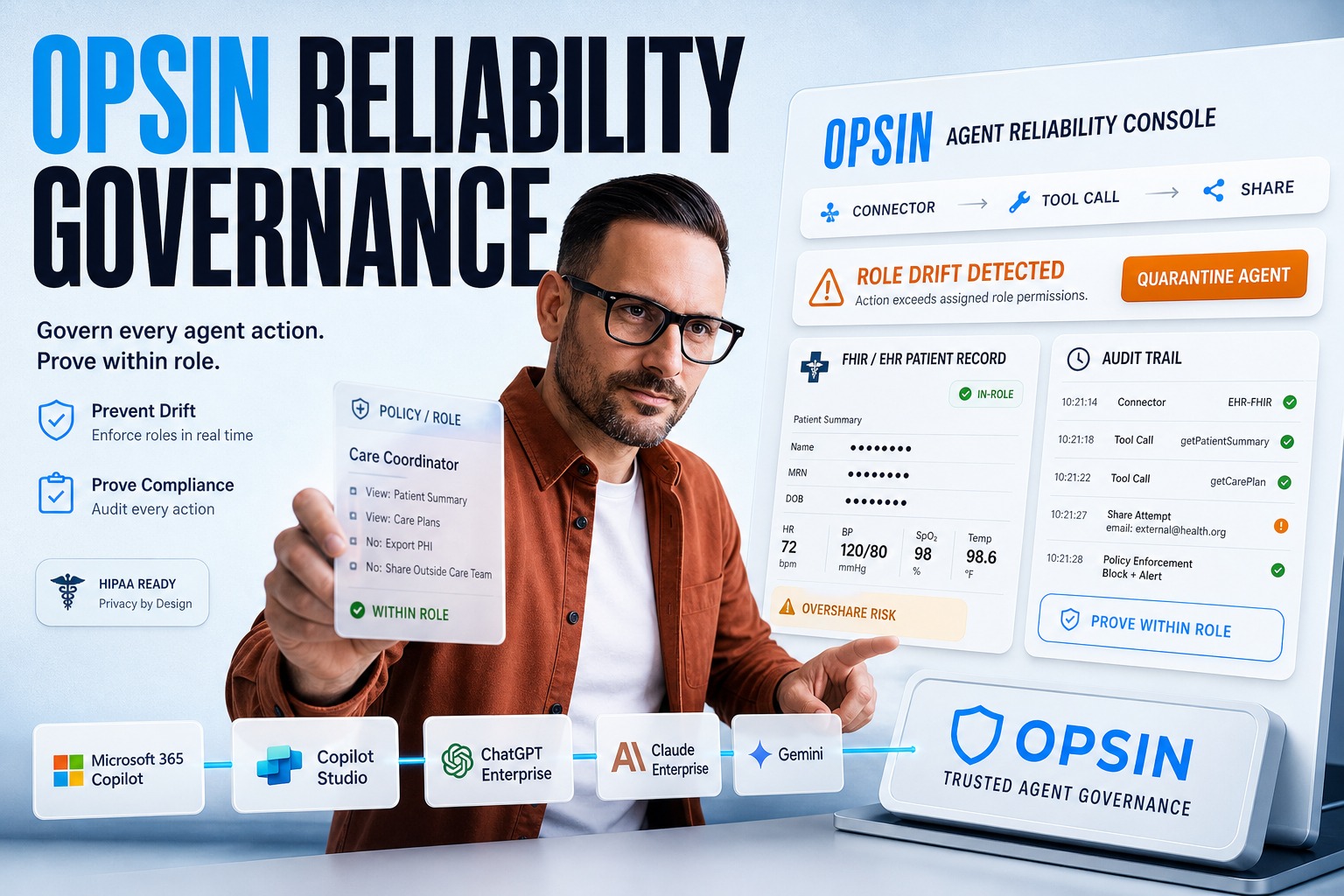
What changes when ai agents in healthcare go server-side? → They can touch core systems directly and act without a human in the loop.
Why do prompt logs and endpoint tools stop being enough? → They don’t show whether an agent’s actions still match its intended job.
What does “reliability” mean here? → The agent stays in role, shares appropriately, and behaves predictably under policy.
What’s the market signal? → Opsin raised $21m to build security designed specifically for agents.
Quick Answer: Reliability Requires Governing Actions, Not Just Access
ai agents in healthcare become risky the moment they can call tools, traverse connectors, and take autonomous actions server-side. Opsin’s thesis is that traditional enterprise defenses were built for endpoints, networks, and prompt/response inspection, while agents need governance tied to role consistency and runtime behavior. For healthcare leaders, the practical takeaway is simple: treat agents like employees—classify them, monitor what they do, and intervene when they drift.
- Agents run server-side and can plug straight into corporate data, bypassing many endpoint-centric guardrails.
- Existing tools struggle to judge whether agent conduct stays consistent with its intended job.
- Risk concentrates around connectors, tool calls, and sharing scope, not just model prompts.
- Runtime signals matter: role overreach and sensitive data passed to mismatched users.
Why Opsin’s Funding Round Matters To Regulated Healthcare
Opsin, a security company focused on governing enterprise AI agents, secured $21m in a funding round co-led by SYN Ventures and Race Capital. The company says it will use the capital to accelerate product development, expand enterprise reach in regulated sectors, broaden its risk protection layer as agents gain autonomy, and hire additional staff. The subtext for healthcare is that the security model is shifting from perimeter surveillance to agent-specific governance.
AI Agents In Healthcare Break Traditional Security Assumptions
Traditional enterprise defenses were designed to watch endpoints, networks, and the exchange of prompts and responses. Opsin argues that agents behave differently: they operate server-side, connect directly to corporate data, and can take action on their own. In a hospital or payer environment, that difference is reliability-critical: server-side autonomy can turn a small configuration mistake into a persistent, repeatable workflow that overshares data.
Opsin’s response is to focus on whether an agent’s conduct remains consistent with the job it was built to do. That framing is more actionable for a CTO than debating models: you’re validating the system’s operational reliability. If you’re building a healthcare ai agent into clinical ops, revenue cycle, or member services, you’ll need the same kind of evidence trail and governance you’d require for privileged automation. Teams implementing ai healthcare software should assume agent oversight becomes a core platform requirement, not a bolt-on.
| Governance Focus | Traditional Enterprise View | Agent Reliability View |
|---|---|---|
| Primary surface | Endpoints and networks | Connectors, tool calls, sharing scope |
| What you audit | Prompts and responses | Actions vs intended role and permissions |
| What fails first | Device/network policy drift | Role overreach and invisible server-side execution |
| How you respond | Block traffic, isolate host | Quarantine agent, block action, notify owner with guidance |
Standardization Is A Reliability Primitive
Opsin created a standardized agent model to bring consistency to how agents are classified across Microsoft 365 Copilot, Copilot Studio, Claude Enterprise, ChatGPT Enterprise, and Gemini. This is less about taxonomy for its own sake and more about enabling repeatable controls: when different agent platforms expose different concepts, your governance becomes bespoke and brittle. A unified model helps you compare posture and behavior across environments, which is how you scale controls without eroding reliability.
- Classify agents the same way across platforms so “role” has a stable meaning in audits.
- Normalize connector and permission metadata to avoid platform-specific blind spots.
- Baseline sharing scope so oversharing is measurable, not anecdotal.
- Track tool-call intent so high-risk actions are identifiable before they execute.
The New Attack Surface: Agent Posture Plus Runtime Behavior
Opsin says it identified thousands of projects and recurring patterns of data oversharing, and it made agent posture and runtime behavior the core inputs for understanding each agent. Agent posture covers connectors, tool calls, and sharing scope; runtime signals include an agent reaching beyond its role or passing sensitive data to users whose roles do not match. For reliability, posture is your static contract and runtime is your continuous verification.
Reliability for agents is not a model problem; it is a governance loop that continuously checks actions against role.
What Are AI Agent Use Cases That Stay Reliable Under Pressure?
When teams talk about ai agent use cases, the temptation is to list workflows and assume success is “it answered correctly.” In regulated healthcare, reliability has a different bar: the system must stay in policy even when it has broad data access and can take action. That includes what it shares, which tools it invokes, and whether it stays inside the role boundary you designed.
From an engineering standpoint, treat each use case as a controlled delegation of authority. A clinical documentation agent, a scheduling agent, and an ai customer service agent all have different failure modes, so you need posture baselines and runtime monitoring specific to each role. If you’re designing enterprise ai agents, plan for drift: connectors get added, tool permissions expand, and agents are asked to do “just one more thing.” Reliability comes from detecting that drift early and enforcing the contract automatically.
The Opsin Risk Graph Is About Learning New Threat Shapes
Opsin says the posture and runtime information feeds its Risk Graph, which learns continuously from agent activity to spot new threats. If an agent breaches policy, the platform can quarantine it, block the action, or alert the owner with remediation guidance. For healthcare leaders, the notable design choice is closed-loop control: detection is coupled to enforcement options, which is exactly what you need when autonomous actions move faster than human review.
Inventory agents across approved platforms, then normalize their posture into a comparable model.
Define role boundaries in terms of connectors, tool calls, and sharing scope, not just “allowed data.”
Monitor runtime behavior for role overreach and mismatched user-role data disclosure.
Apply automated enforcement: quarantine, block, or notify with concrete remediation steps.
Why “Server-Side” Changes Incident Response
With agents operating server-side, the observable unit of failure becomes an action chain: connector access, tool execution, and downstream sharing. Endpoint isolation does nothing if the agent remains authorized in the SaaS plane and continues executing tasks. Reliability-focused response therefore means intervening at the agent level—stop the agent, stop the action, and preserve enough context to remediate the role definition that allowed the drift.
- Prefer action-level containment over network containment when the execution plane is SaaS.
- Preserve connector and tool-call context so the remediation fixes the root role mismatch.
- Route alerts to owners with guidance, or reliability degrades into alert fatigue.
- Treat recurring oversharing as a design signal, not just a security incident.
From “Data In Motion” To Full Agent Governance
Opsin says it originally launched to help enterprises curb data oversharing as AI adoption grew, then widened scope from securing data in motion to overseeing identities, intents, connectors, tool calls, and permissions of agents. That expansion tracks what many healthcare engineering orgs are experiencing: once the agent is allowed to act, data protection alone is insufficient because the primary risk is mis-scoped authority.
Which Financial AI Agent Use Cases Translate To Healthcare Governance?
Financial AI agent use cases tend to be unforgiving: sensitive data, strict controls, and a strong expectation of auditable behavior. Opsin lists customers ranging from mid-sized firms to Fortune 500 companies in healthcare, financial services, manufacturing, and other regulated industries—an indicator that governance patterns can transfer. For healthcare CTOs, the useful lesson is to borrow the rigor, not the domain.
As analysis, financial ai agents often need strong identity-to-intent mapping: who initiated the task, what authority was delegated, and what actions executed. That’s the same mental model a hospital needs for an ai agent for operations that touches scheduling, inventory, or prior authorization workflows. Likewise, manufacturing ai agents emphasize repeatability and change control, which maps well to clinical operations: if behavior changes, you need to know what changed, why, and who approved it.
| Reliability Failure Mode | Example Runtime Signal | Practical Mitigation |
|---|---|---|
| Role creep | Agent reaches beyond its role | Tighten role definition; enforce at tool-call boundary |
| Oversharing | Sensitive data to mismatched user roles | Reduce sharing scope; add disclosure checks |
| Connector sprawl | New connector expands authority silently | Baseline posture; flag deltas for approval |
| Hidden autonomy | Actions happen without human visibility | Require enforceable policies with quarantine/block options |
Deployment Reality: Fast Assessment, No Specialist Training
Opsin states its platform connects through an API, requires no specialist training, and produces an initial risk assessment of agents across approved AI platforms within 24 hours. For healthcare engineering teams, that matters because reliability work fails when it requires niche expertise or quarter-long implementations; the controls never get adopted broadly.
The more interesting implication is operational: if you can get a baseline quickly, you can treat governance as an onboarding gate for new agents and connectors. This is also where security and engineering processes should converge. A lightweight start is not the same as a lightweight outcome; you still need a disciplined path from findings to fixes, and teams often pair agent governance with broader programs like cybersecurity and penetration testing to validate assumptions across the stack.
If governance can’t ship with the agent, it won’t be there when autonomy arrives.
Reliability Controls For AI Agents In Healthcare: A Practical Pattern
A reliability-first pattern starts with classification, not prompts. Decide what each agent is allowed to be: its role, the connectors it may use, the tools it may call, and the sharing scope it may expose. Opsin’s approach of combining posture with runtime behavior maps to how SRE teams already think: configuration plus observed behavior.
Next, build a control plane that can intervene automatically when drift occurs. Opsin describes quarantining an agent, blocking an action, or alerting the owner with remediation guidance when policy is breached. That’s a mature reliability posture because it assumes failures will happen and prioritizes fast containment. If you’re building or integrating agents, align security, platform, and application teams around a single operational loop; organizations often start by formalizing build standards through an AI agents development motion so agent roles, connectors, and permissions are versioned like any other artifact.
- Treat every new connector as a reliability change that expands what the agent can do.
- Encode role boundaries so runtime overreach is detectable without subjective human review.
- Prefer enforceable policies with quarantine and block actions, not just dashboards.
- Make remediation guidance part of the workflow so owners can close the loop quickly.
Three-Year Outlook: Agents Will Talk Mostly To Other Agents
Opsin expects that within three years, agents will interact with one another far more than with people, with much of that exchange never seen by a human as it happens. The company argues this calls for governing agents as organizations govern employees: judging them on actions and role requirements rather than restricting speed. That prediction is directly tied to reliability: invisible machine-to-machine workflows amplify both throughput and blast radius.
For healthcare, the strategic move is to design governance around machine-speed operations now. When agent-to-agent chains form, the unit of reliability becomes the system of agents, not one assistant UI. You will want consistent classification, posture baselines, runtime signals, and automated enforcement, because human review won’t scale to unseen interactions. If your org is planning for ai agents in healthcare beyond pilots, treat governance as a platform capability, then operationalize it with clear ownership and escalation paths; otherwise, autonomy arrives before accountability.
Closing: Build The Audit Trail You’ll Need Later
Opsin’s funding is a signal that agent-specific security is becoming its own category, driven by the gap between endpoint-era defenses and server-side autonomy. In practice, reliability comes from standardizing how agents are modeled, watching posture and runtime behavior, and having enforcement that can stop unsafe actions immediately.
If you’re rolling out ai agents in healthcare, don’t wait for the first cross-agent incident to define roles, connectors, and response playbooks. Start with classification and continuous verification, then iterate as your agents gain autonomy. When you want a second set of hands to design or harden that lifecycle, talk to Plavno via our contact page.
Author: Plavno team. Last updated: October 2026.
 Chat GPT
 Perplexity
 Claude
 Gemini

