Is agentic process automation finally faster than a pilot? → Only if it deploys inside your current TMS/ERP without a months-long integration detour.
What did Evos just prove with its launch metrics? → Speed to revenue matters: it says it crossed $1M ARR four weeks after launch.
Why should CTOs care about ‘operators,’ not chat? → Because operators aim to run a function end-to-end once they match expert decisions.
Where does ROI hide in freight ops? → In the ugly, repetitive edge cases like LTL invoice audits and accessorial disputes.
What’s the one decision you must make early? → Pick a narrow workflow where accuracy can be measured in days, not quarters.
Agentic Process Automation: Why Deployment Speed Is The Real Moat
Evos raised $9 million in pre-seed funding to build autonomous software operators for small and midsized industrial businesses, including freight brokerages—explicitly without forcing customers to replace existing software. That promise is the point: if you can’t ship value in days, not months, you lose to inertia. For teams evaluating ai automation services, the practical question isn’t model quality first—it’s whether deployment mechanics (data access, permissions, and review loops) are designed for 24-hour traction.
If your ‘AI project’ needs a new system of record or a 9–18 month rollout, you didn’t automate work—you bought a replatforming program.
Quick Answer: Agentic Process Automation—Which AI Automation Use Cases Deploy Fastest?
Agentic process automation deploys fastest when you constrain the job to a single business function, run it inside existing tools, and make ‘go/no-go’ measurable within a week.
Evos’ announcement is a clean signal about what ‘fast’ can look like in practice. The company says the round was co-led by Uncork Capital and Field Ventures, with participation from Crosslink Capital, Utopia Capital Management, Sandwith Ventures, and angel investors. It also says it surpassed $1 million in annual recurring revenue four weeks after launching (it did not disclose valuation or customer count). Reported metrics aside, the engineering bet is straightforward: minimize implementation and maximize reuse of the customer’s systems.
Here’s the CTO-level takeaway: speed of deployment is not a PM timeline problem. It’s an architecture problem—specifically, how quickly you can (1) observe the decisions experts already make, (2) replay those decisions with guardrails, and (3) graduate the system from ‘copilot’ to ‘operator’ without breaking auditability.
Evos describes operators that learn how employees make decisions and carry out specific functions within a company’s existing systems. Instead of requiring a human to prompt an AI tool each time, the operator is meant to manage an assigned function independently once its decisions consistently match those of experienced workers. That ‘consistently match’ clause is the hidden deployment lever: it suggests a measurable acceptance test.
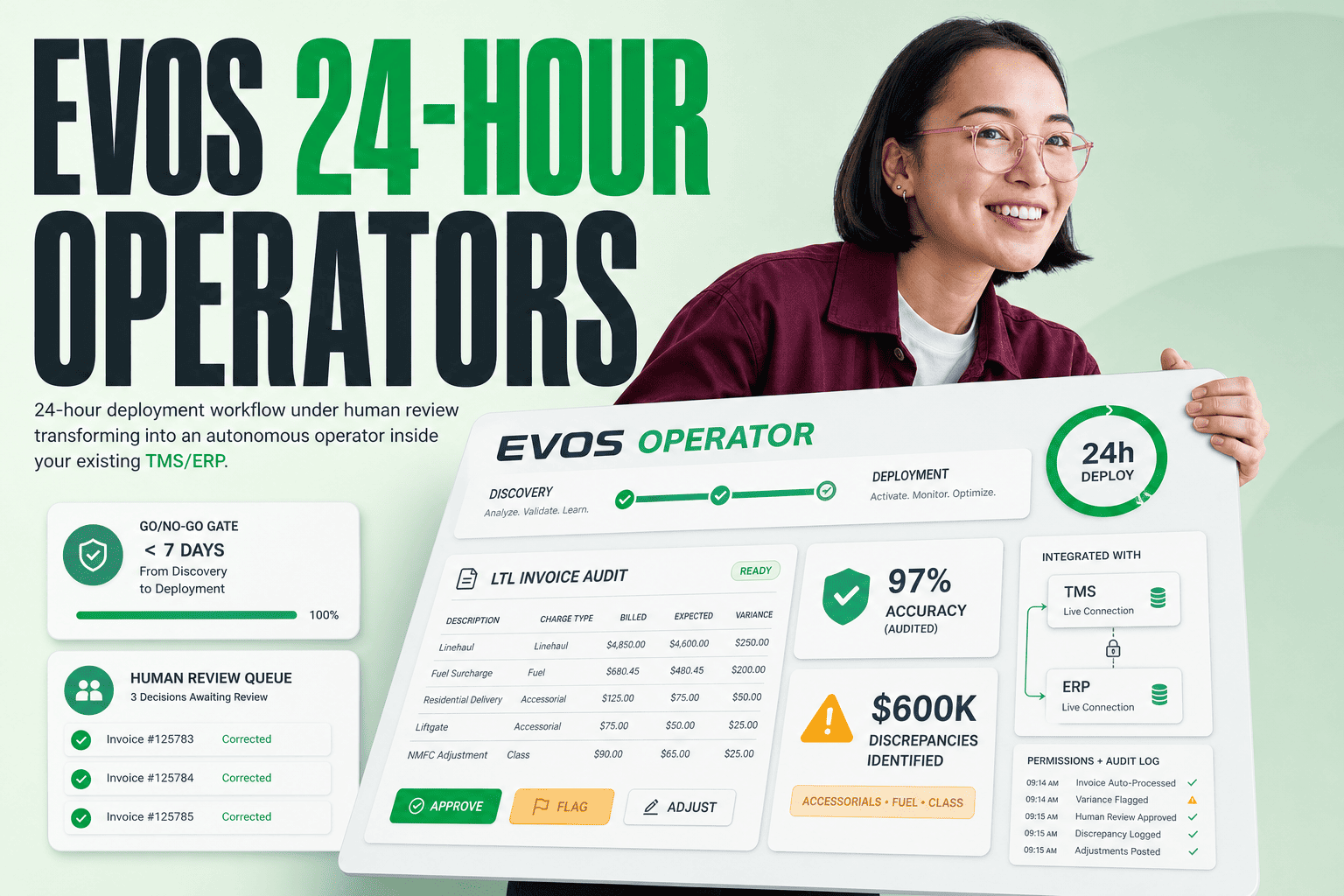
Two quotes from the release capture the product thesis you should pressure-test during vendor evaluation. First, Evos CEO Urav Shah: "The most capable system in many of these businesses is the person who has been there 20 years, and what they know has never been written down." Second, the company’s deployment claim: "The platform is fully self-serve: work that would take a consultant or an implementation partner 9 to 18 months to deliver, an Evos operator takes on in 24 hours from discovery to deployment." Treat that 24-hour number as an aspiration, then ask what the platform must be doing to make it plausible.
The 24-Hour Deployment Pattern
Analysis: if you want a 24-hour path from discovery to deployment, you need a workflow that is (a) already digital, (b) already executed inside a limited set of UIs/APIs, and (c) already judged by a small set of decision rules—even if those rules aren’t documented. In those conditions, ‘learning from behavior’ can be reduced to capturing decision examples and building a review loop.
The fastest ai automation use cases look boring: the work is repetitive, the surface area is small, and the human already follows a stable pattern. In freight operations, that often means audits and reconciliations—because the inputs and outputs already exist in systems of record.
Evos shared one concrete example: freight brokerage MyFreightWorld is using an operator to audit less-than-truckload (LTL) carrier invoices against its transportation management system. Evos says the operator made nearly 3,500 audit decisions over two months with 97% accuracy and identified billing discrepancies valued at more than $600,000 over the most recent five-week period. Two important caveats were also stated: the $600,000 is the value of discrepancies identified between invoices involving MyFreightWorld and its end customers (not money recovered or savings realized), and the company did not explain how it calculated the 97% accuracy rate or specify the sample used.
So what do you do with this as a buyer? You use it as a design pattern, not as proof. The pattern is ‘automated invoice processing with a measurable decision stream.’ Invoice audits are basically classification and exception-handling at scale. They lend themselves to staged autonomy: start with suggestions, move to decisions under thresholds, then go hands-off on low-risk cases.
A useful sanity check is how much discrepancy volume exists even before you automate. The article notes that LTL invoice audits can uncover billing errors involving accessorial fees, fuel surcharges, and freight classifications. It also cites a 2024 AFS Logistics analysis: 11,881 errors found in a review of nearly 250,000 invoices, with inaccurate accessorial charges at 42.8% of errors, fuel surcharges at 14.4%, and freight misclassification at 12.3% (those findings reflect AFS’s review, not the entire market). That’s exactly the kind of high-frequency, low-glory work where an operator can earn trust quickly.
If you’re comparing rpa vs ai agents, the deployment-speed question is: what breaks first when reality deviates from the happy path? Traditional RPA can be fast when the UI doesn’t change and the rules are crisp. AI operators can be fast when you can observe decisions and handle messy exceptions—without turning exception handling into a new software program. If you’re scoping a build, a specialized AI agents development effort should be judged by the same standard: connectors, review queues, and governance that let you ship safely in days.
To make that comparison actionable, use a simple scoring rubric before you run a pilot.
| Workflow Attribute | Fast With RPA | Fast With Operators |
|---|---|---|
| Stable screens and fields | Yes | Yes |
| Exceptions require judgment | No | Yes (if trained with reviews) |
| Changes weekly (rates, rules, partners) | Painful | Manageable (if monitored) |
| Audit trail required | Possible | Required by design (must log decisions) |
Notice what’s missing from the table: ‘the model.’ For speed, your bottleneck is almost always data access, identity, and safe rollout mechanics.
Here’s the fastest path I’ve seen teams take when they want to validate operator-style automation without waiting for ‘enterprise readiness.’
Pick one function with a clear decision output (approve/deny, classify, match, flag).
Capture a week of expert decisions, including edge cases and reversals.
Stand up a review UI where humans can correct decisions quickly.
Add hard guardrails (thresholds, allowlists/denylists, escalation triggers).
Promote autonomy only for the lowest-risk slice, expanding by measured confidence.
This is where automated software training becomes more than a marketing phrase. The training loop is your deployment loop: the shorter you can make ‘observe → predict → review → correct → redeploy,’ the closer you get to that 24-hour claim.
Governance That Keeps Speed From Becoming Risk
Speed without governance just moves the failure earlier. The BCG context in the news is the warning label: an August 2026 Boston Consulting Group report found that only 13% of executives surveyed at 30 leading global logistics companies said AI was delivering measurable financial results, despite two-thirds reporting a dedicated AI budget and strategy. That gap is not because AI ‘doesn’t work.’ It’s because many deployments can’t tie outputs to outcomes.
For operator-style automation, you need to connect three layers quickly:
- Decision accuracy (did it match the expert?)
- Process impact (did it reduce cycle time, touches, or errors?)
- Financial result (did it recover cash, reduce leakage, or increase throughput?)
Evos’ MyFreightWorld example is honest about this distinction: it reported discrepancy value identified, not savings realized. That’s the right framing for early deployment—identify value first, then prove capture and recovery second.
From an engineering governance perspective, treat an operator as a privileged integration, not as a chatbot. The moment it can change records, approve charges, or send communications, you must design for least privilege and traceability. If you can’t explain what it did, when, and why, you won’t ship it broadly.
A pragmatic guardrail set that preserves speed looks like this:
- Scope limits: one function, explicit boundaries, explicit ‘out of scope’ behaviors.
- Permission tiers: read-only first, then constrained write actions, then broader write access.
- Review SLAs: humans can override and the overrides feed the learning loop.
- Rollback plan: a switch that returns execution to humans without losing context.
This is also where hyperautomation becomes real instead of aspirational. Hyperautomation isn’t ‘more bots.’ It’s a pipeline that connects sensing (ingest), reasoning (decision), action (write back), and compliance (audit). If you can’t assemble that pipeline quickly, you won’t scale past the pilot.
Now zoom out to why Evos is aiming at smaller industrial businesses. The news cites two stats from the company announcement: 99.3% of U.S. motor carriers operate fewer than 100 trucks, and 93% of U.S. manufacturers have fewer than 100 employees. In that segment, speed isn’t a nice-to-have. It’s the difference between adoption and ‘we’ll do it next year.’ These businesses often don’t have the technical resources—or the patience—for long implementation projects.
So, what should a CTO or VP Engineering ask a vendor that claims ‘24 hours’? Ask questions that map directly to time-to-deploy:
- What system access do you need on day one (APIs, UI automation, email, files)?
- What identity model do you support (SSO, service accounts, per-user tokens)?
- What is your minimum viable audit trail (decision logs, source artifacts, diffs)?
- How do you handle exception queues and human corrections?
- How do you measure accuracy, and what’s the sample definition?
Those questions are more predictive than a model demo.
If you’re planning business process automation use cases beyond invoice audits, apply the same ‘tight function’ discipline. Operators are a better fit when the process knowledge lives in experienced staff behavior, not in documentation. Evos explicitly targets that: the operator learns from employee behavior and decisions, with the goal of reproducing their work before taking on tasks autonomously.
At this point, most orgs run into a predictable internal friction: the automation is technically feasible, but the operational team fears loss of control. The fastest deployments solve this socially and technically by making the operator’s work inspectable. That means every decision should be replayable with the evidence attached—invoice line items, classification inputs, historical rates, whatever drove the outcome.
If your roadmap includes ai process automation across multiple teams, avoid the trap of building a bespoke integration per function. You want a shared substrate: connectors, identity, policy, and observability that you can reuse. That’s the difference between ‘one cool bot’ and a program.
Plavno’s perspective (analysis) is that deployment speed is primarily an integration and governance exercise, not an LLM exercise. If you can standardize those foundations, you can stand up new operators quickly—whether you buy a platform or build internally. Teams that need extra hands for this phase often use a flexible staffing model like outstaffing to push connectors, logs, and review tooling over the finish line.
One more nuance: operator automation does not mean ‘full autonomy from day one.’ The fastest real deployments look like phased autonomy:
- Phase 1: recommend (human executes)
- Phase 2: execute low-risk actions (human monitors)
- Phase 3: execute most actions (human audits)
- Phase 4: exception-only human involvement
The 24-hour story fits Phase 1 or Phase 2 for a narrow function. If a vendor claims Phase 4 in 24 hours, demand proof of controls.
Where does this leave you if you’re deciding between building and buying? Use speed as the forcing function. If a platform can’t integrate with your existing systems quickly, it will never deliver compounding returns. Conversely, if it can deploy rapidly, you can run multiple experiments until one produces measurable financial results—addressing the exact gap BCG highlighted.
If you are early in the journey, don’t start with ‘AI everywhere.’ Start with ‘one decision stream with money on it.’ In freight brokerage, automated invoice processing is a strong candidate because it naturally produces: volume, labeled outcomes (approve/deny/adjust), and downstream financial reconciliation.
Finally, keep your CFO honest and your vendor honest with the same metric: time-to-first-verified-impact. Not ‘time to demo,’ not ‘time to pilot,’ but time to an audited report you can sign.
If you want to explore broader automation that still ships fast, frame it as a digital operating system upgrade, not a series of bots. That’s the point where digital transformation work becomes practical: common data access patterns, event pipelines, and policy enforcement that make each new operator cheaper and faster.
Use Evos as a prompt to tighten your own bar. A pre-seed startup can claim 24-hour discovery-to-deployment because it’s designing for it. Enterprise teams can meet that bar too—but only if they treat deployment speed as a first-class requirement.
- Use agentic process automation only where you can define a ‘correct decision’ and measure drift weekly.
- Demand deployment mechanics: identity, permissions, and audit logs matter more than a polished demo.
- Prefer workflows with existing digital footprints: invoices, rate sheets, accessorials, and exception queues.
- Ship fast, then expand scope: autonomy should grow with verified impact, not confidence.
Author: Plavno team. Last updated: October 2026.
 Chat GPT
 Perplexity
 Claude
 Gemini

