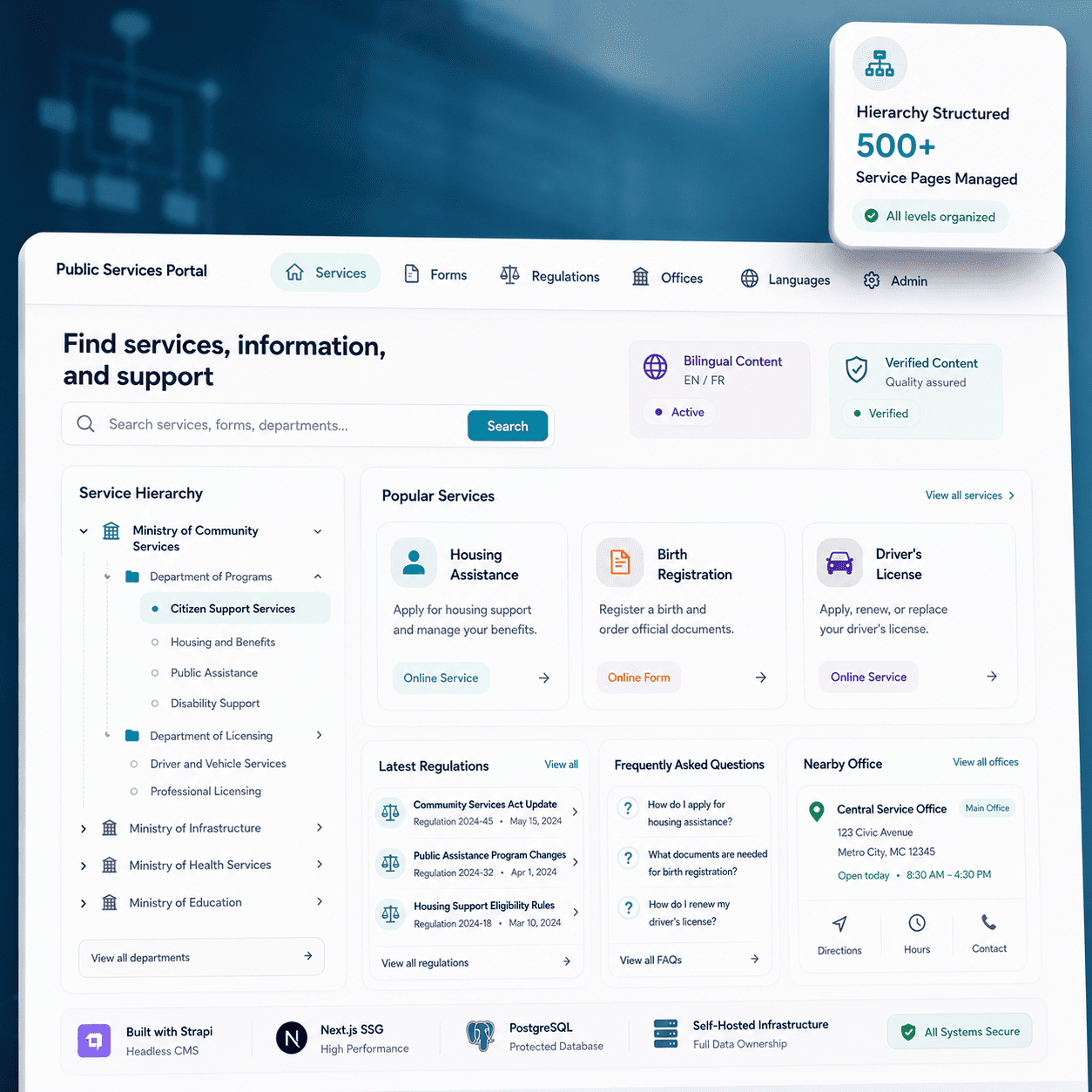
Plavno developed a self-hosted digital public services portal for a regional government to unify service information, news, regulations, office directories, and online form workflows in one secure platform.
Overview
The client was a regional government launching a unified public services portal. The platform needed to include a service directory, public news, regulations, office information, and online application forms, while meeting strict requirements for open-source technology, self-hosted deployment, and high security standards.
The portal supports digital access for up to 2 million citizens
More than 500 service pages can be updated independently by non-technical editors
Better operational control over public content, forms, and service information
Stronger resilience under high traffic through static page generation
Full data ownership and infrastructure control remained on the client side
The regional government needed a single digital access point for citizens, but public information and service workflows were fragmented across departments and outdated systems.
Common challenges included:
Service information spread across multiple government units
Difficult access to regulations, service descriptions, and office contacts
Poor usability for citizens trying to find the right service
Dependence on technical teams for routine content updates
Strict infrastructure and data sovereignty requirements that ruled out many SaaS platforms
For public institutions, these limitations affect both service quality and trust in digital delivery.

The new platform needed to:
Centralize services, news, regulations, FAQs, and office information in one structured system
Support hierarchical government content structures
Provide secure online form submission workflows
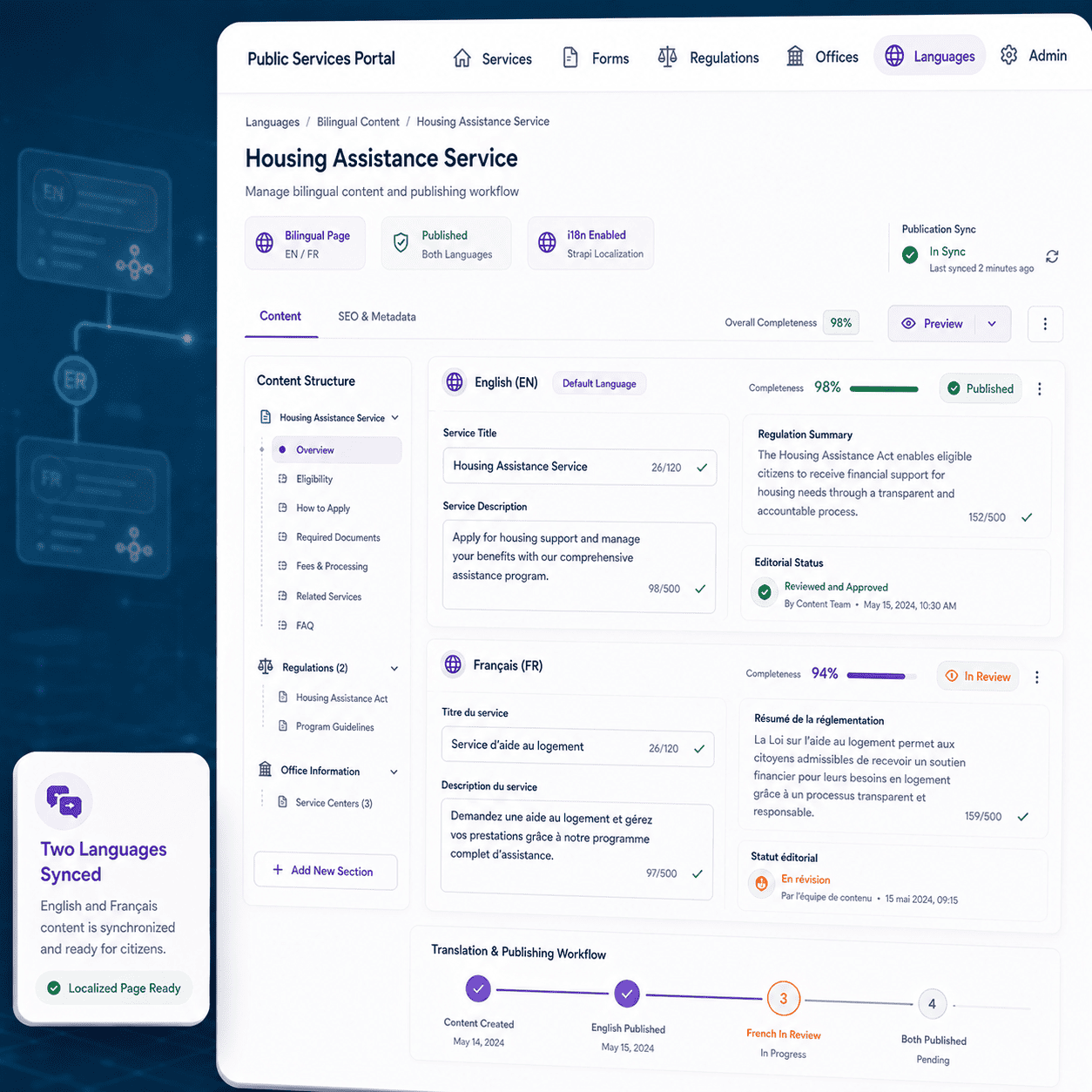
Support two official languages
Remain stable under high public traffic
Run on infrastructure fully controlled by the client
There were also important constraints:
The platform had to be open-source and self-hosted
Data could not be stored in third-party cloud environments
Citizen-facing forms had to store data securely and trigger internal notifications
Editors without technical skills needed to maintain large volumes of public service pages

Solution
Leveraging Strapi as a self-hosted headless CMS with structured collections, a custom plugin for secure online application forms, bilingual content management through i18n, and a Next.js frontend powered by static site generation — all integrated with government authentication to create a unified, scalable public services platform.
Self-hosted public services portal
Collections for services, news, regulations, FAQs, and offices
Hierarchical content structure from ministry to department to service
Custom plugin for secure citizen application forms
Bilingual content workflows with Strapi i18n
High-performance Next.js frontend with statically generated pages
Government authentication integration via a custom auth provider
Browse Public Services: Citizens search or navigate through service pages, regulations, FAQs, and office information.
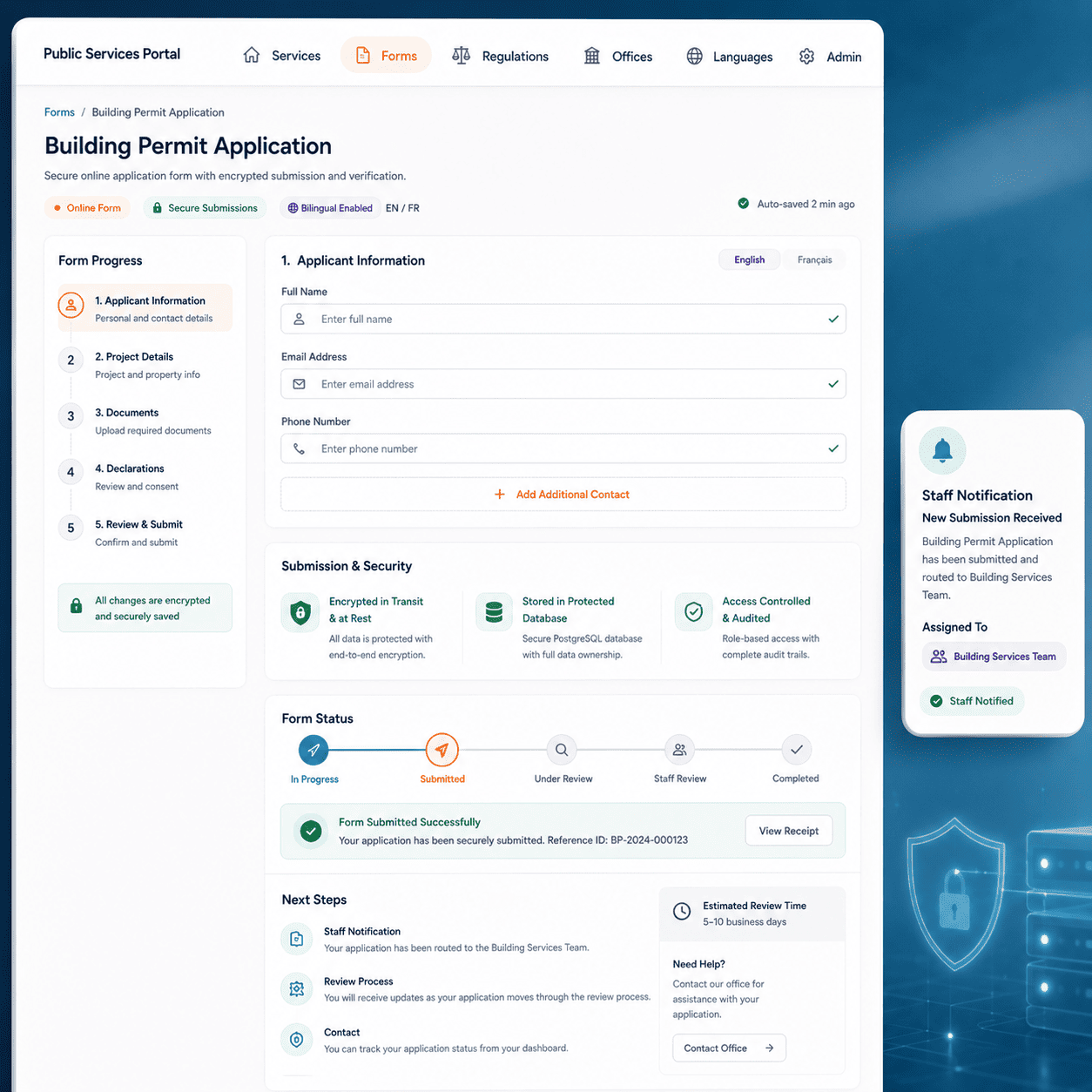
Submit Online Requests: Users fill out online forms, and the submitted data is stored in a protected database.
Route Internal Notifications: Relevant government staff receive notifications when new form submissions require review.
Update Public Content: Editors manage service pages, public information, and bilingual updates through the Strapi admin panel.
Supports service access for up to 2 million citizens
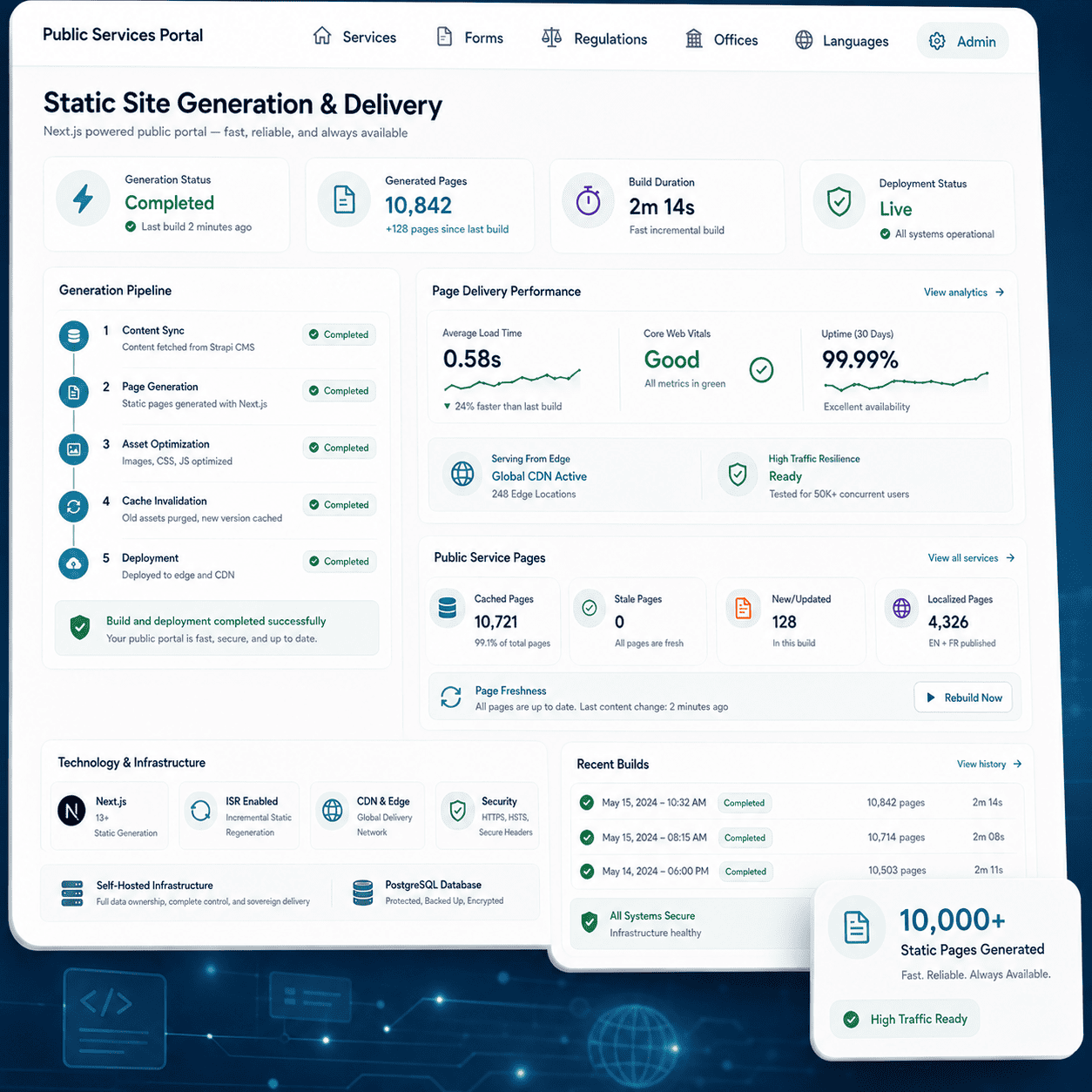
Handles more than 10,000 statically generated pages
Suitable for bilingual public sector content operations
Enables non-technical editorial teams to update service content independently
Designed for self-hosted, security-conscious public infrastructure
Architecture Overview
Content Collections Layer: Collections were created for services, news, regulations, FAQs, and offices, with a hierarchical structure reflecting ministry → department → service relationships.
Form Workflow Layer: A custom plugin allowed citizens to submit applications, store the data in a protected database, and trigger notifications for internal staff.
Localization Layer: Strapi i18n supported parallel editorial workflows in two official languages.
Frontend Delivery Layer: A Next.js frontend used static site generation to pre-build more than 10,000 pages and ensure strong performance under heavy traffic.
Authentication Layer: A custom auth provider integrated the portal with the government identity system.
Infrastructure Layer: The platform was deployed in a self-hosted on-premise environment with PostgreSQL, giving the client full control over data and hosting.

Value
Delivering structured public information, bilingual content operations, and secure digital service workflows
The platform organizes public service information in a clear hierarchy that reflects how government services are actually delivered.
Editors can update service pages and public information without technical intervention.
The portal supports parallel content maintenance across two official languages.
Online forms and related notifications are handled through controlled backend processes.
Benchmarks
Built to support large public audiences, secure self-hosted deployment, and high-volume service access
The portal is designed to serve up to 2 million citizens.
More than 10,000 statically generated pages help keep the portal responsive under heavy load.
The platform runs on infrastructure fully controlled by the client.
More than 500 service pages can be maintained by non-technical editors without developer dependency.
Data Protection
Enterprise-grade protection for citizen data, public content workflows, and government-controlled infrastructure
All content and citizen-submitted data remain on the client’s own infrastructure.
Citizen applications are stored in a protected database with controlled internal notification logic.
The platform supports secure access through a custom integration with the government identity system.
Innovative Experience
Strapi development for secure public portals, citizen services, and self-hosted government platforms
Delivery Crew
High-performing developers for growing companies

Eugene Katovich
Sales Manager
Plavno builds Strapi-based digital service platforms for governments and public institutions that need structured content, secure forms, bilingual workflows, and full control over their data.
Talk to an ExpertCompetitive Ability
Demonstrating how Plavno transformed fragmented public information into a secure, scalable digital services portal
Structure Public Service Content
Model services, departments, offices, regulations, and FAQs in a hierarchical content architecture.
Manage Bilingual Publishing
Editors maintain content in two official languages through parallel editorial workflows.
Deliver Fast Public Access
Publish more than 10,000 statically generated pages through a high-performance Next.js frontend.
Handle Online Service Requests
Capture citizen form submissions securely and notify the appropriate government staff.
Hierarchical Content Modeling: Structured collections for services, news, regulations, FAQs, and offices to reflect actual government hierarchies (Ministry → Department → Service).
Editorial Independence: Empowers non-technical editors to manage over 500 service pages without developer intervention.
Secure Form Automation: Custom plugin captures citizen applications, stores data in a protected database, and automatically triggers internal staff notifications.
Bilingual Workflows: Parallel editorial workflows using Strapi i18n to manage content in two official languages simultaneously.
Static Site Generation (SSG): Next.js frontend pre-builds more than 10,000 pages to ensure resilience under heavy public traffic.
High-Volume Citizen Access: Architecture designed to support digital service access for up to 2 million citizens.
Self-Hosted Infrastructure: Full data ownership and infrastructure control maintained on-premise (PostgreSQL), meeting strict data sovereignty requirements.
Open-Source Foundation: Built on Strapi to avoid vendor lock-in and ensure transparency for public sector operations.
Government Authentication Integration: Custom auth provider connects the portal securely with the existing government identity system.
Unified Service Directory: Centralized platform eliminates fragmented information, improving usability for citizens searching for regulations and office contacts.
Protected Data Handling: Secure form submission workflows ensure citizen data is stored safely, enhancing trust in digital delivery.
Structured Content Quality: Hierarchical organization ensures consistent, high-fidelity presentation of complex public service information.
Measurable outcomes delivered by a self-hosted Strapi public services portal
All infrastructure and data remain under the client’s control in a self-hosted environment.
Citizens can find service information, regulations, and office details more easily in one place.
Editors can manage more than 500 service pages independently without relying on technical teams.
Static generation helps the portal remain responsive even during high-traffic periods.
The portal meets requirements for open-source software, self-hosted deployment, and controlled data handling.
Tools We Used
Project Estimator
The estimated time to launch the product
Clear vision of functionality you need
15% discount on your first sprint

Frequently Asked Questions
Find answers to your common concerns
Strapi is open-source, self-hosted, and well suited to environments where the client needs full control over infrastructure and data.
Yes. The platform was deployed in a self-hosted on-premise setup, so all data stayed on the client side.
Yes. Strapi i18n was used to manage content in two official languages.
A custom plugin captured applications, stored them in a protected database, and triggered notifications for the responsible government staff.
About Plavno

Senior engineers + proven AI components to accelerate time-to-value.

From MVPs to enterprise platforms at global scale.

From extension UX to GPU pipelines and global scale.
Testimonials
Contact Us
We can sign NDA for complete secrecy
Discuss your project details
Plavno experts contact you within 24h
Submit a comprehensive project proposal with estimates, timelines, team composition, etc
Plavno has a team of experts that ready to start your project. Ask me!

Vitaly Kovalev
Sales Manager
Fill in the form to access the case study.