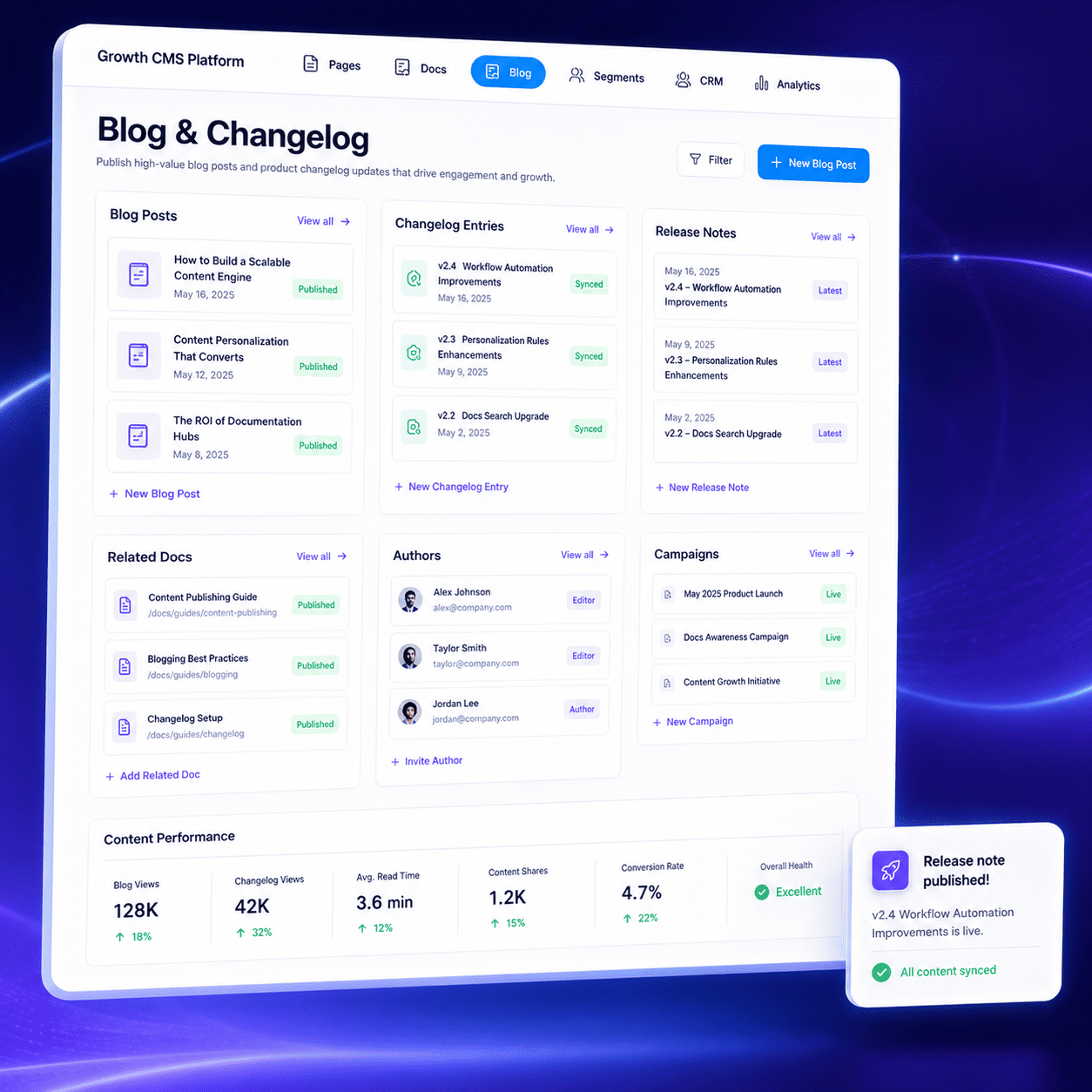
Plavno rebuilt a B2B SaaS company’s website on Craft CMS to unify marketing pages, product documentation, and blog content in one structured platform with personalized segment-based experiences.
Overview
The client was a fast-growing SaaS startup that had reached $10M ARR. Its legacy WordPress site had become a sales bottleneck: landing pages were hard to customize for different ICPs, documentation was scattered across Notion, and the blog was disconnected from CRM workflows. The goal was to turn the website into a scalable growth platform for marketing, product, and sales.
Marketing team can launch new landing pages in around 20 minutes without developer support
Faster rollout of personalized pages for industries, integrations, and company segments
Better alignment between content journeys and CRM activity
Stronger conversion performance after introducing segment-based page personalization
Improved website performance with Lighthouse scores reaching 98/100
As the SaaS company grew, its website stopped supporting the pace and complexity of go-to-market execution.
Common challenges included:
WordPress limitations for structured, reusable page creation
Inability to quickly personalize pages for different ICPs and verticals
Fragmented documentation spread across Notion
Disconnected blog content with no meaningful CRM linkage
Weak scalability for marketing experimentation and segment-specific messaging
Instead of helping sales and marketing move faster, the website created operational friction.

The new platform needed to:
Support multiple page types with different content structures
Allow fast creation of industry- and ICP-specific landing pages
Bring marketing site, documentation, changelog, and blog into one content system
Connect website engagement to CRM workflows
Deliver a much faster frontend experience
There were also important delivery constraints:
Marketers needed autonomy without losing content structure or consistency
Documentation had to become easier to maintain and more connected to the rest of the site
Page personalization had to be scalable, not manually rebuilt for every segment
CRM integrations needed to reflect meaningful content interactions, not just generic form fills

Solution
A scalable platform combining Craft CMS as a structured content backend, Astro as a high-performance frontend layer, custom entry types, related entries for dynamic personalization, and webhook-based CRM automation — enabling unified management of landing pages, case studies, changelog entries, docs, and blog content, plus personalized pages via structured relationships.
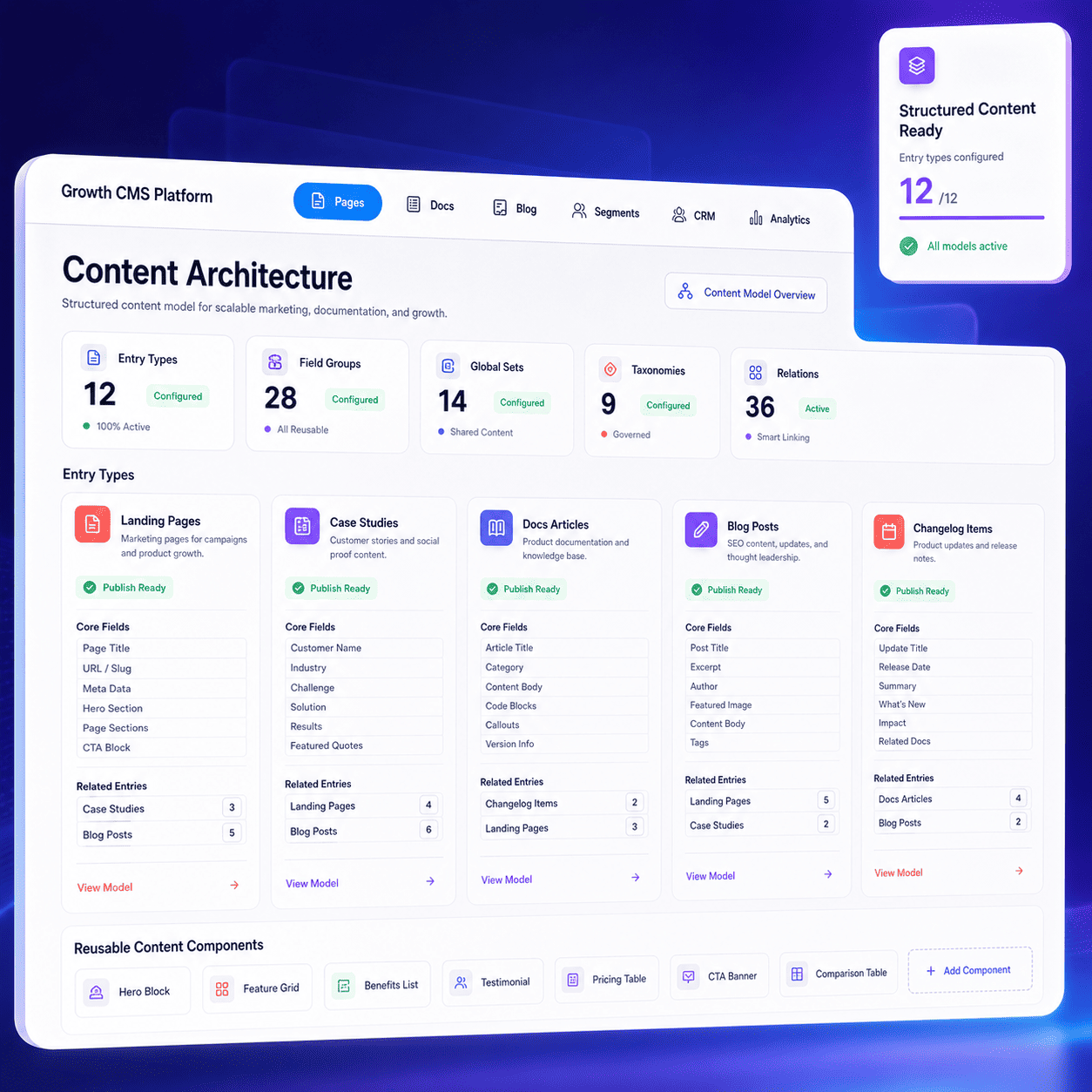
Custom entry types for landing pages, case studies, changelog, docs, and blog
Headless Craft CMS architecture
Astro frontend with strong performance scores
Related entry logic for dynamic segment pages
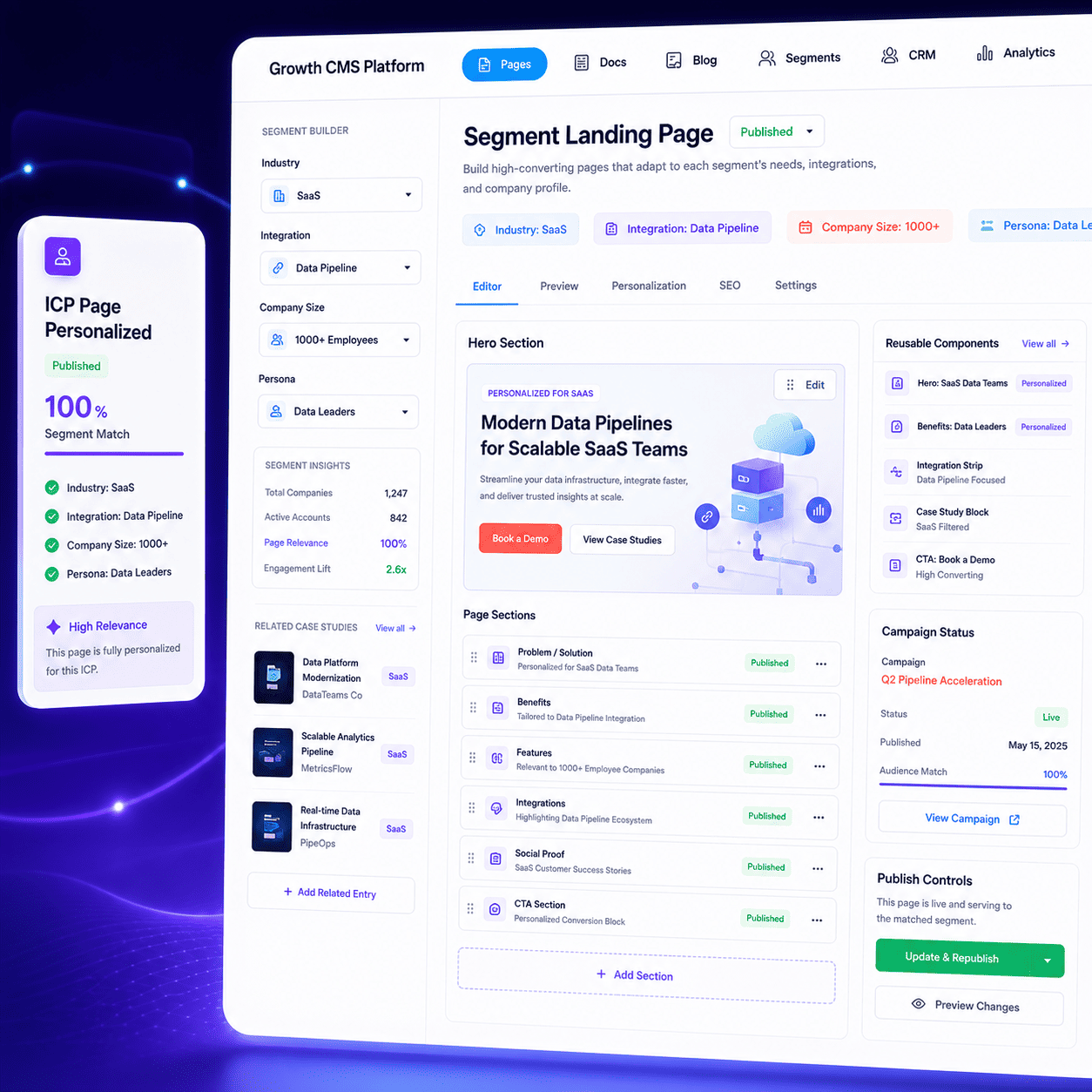
Personalized landing pages by industry, integrations, and company profile
CRM-connected content interaction tracking
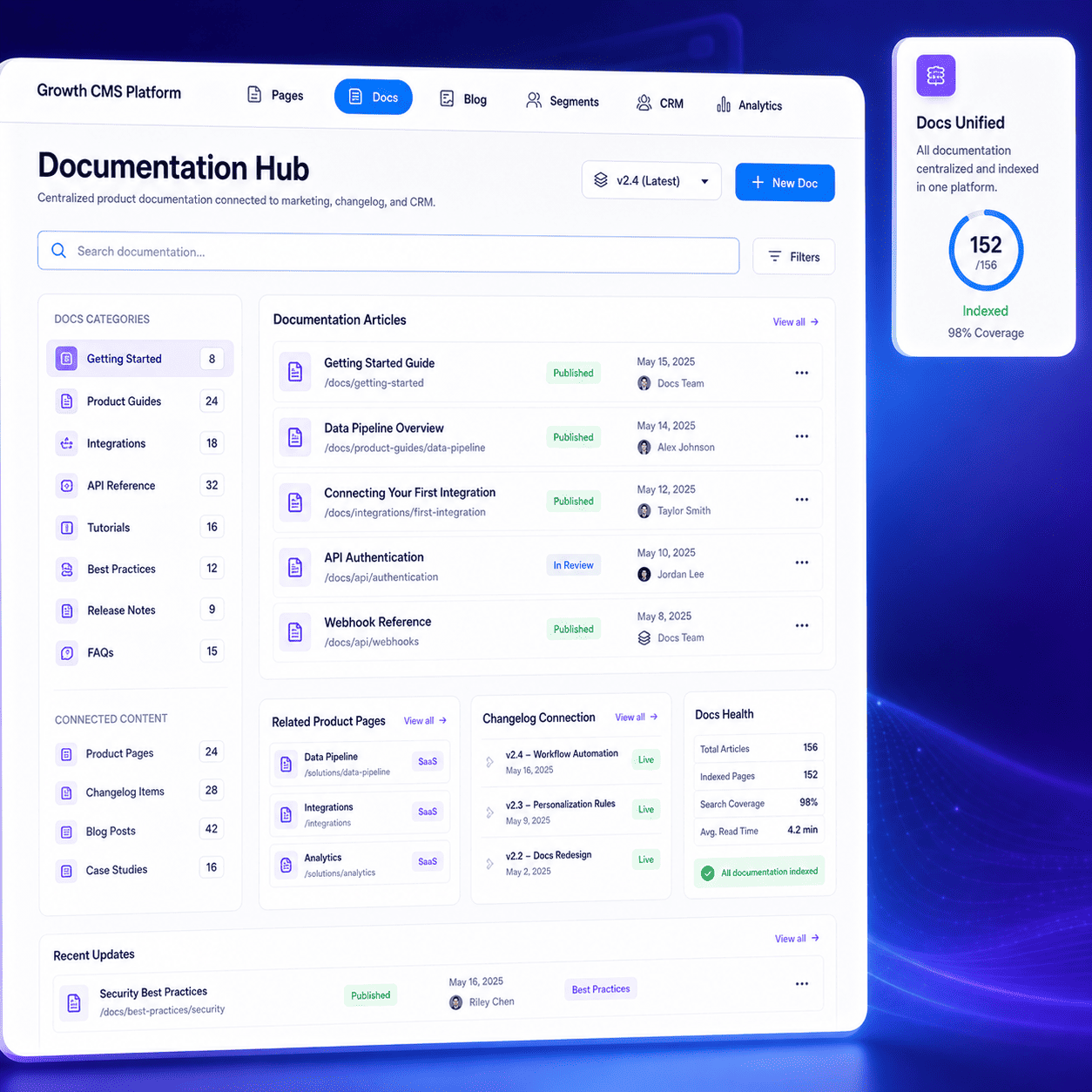
Centralized documentation and content publishing workflows
Create Structured Content: Marketers and product teams manage landing pages, documentation, changelog items, and blog content inside Craft CMS.
Build Personalized Experiences: Case studies and pages automatically pull related integrations, industries, and company-size data to support segment-based personalization.
Publish Fast: The marketing team launches new campaigns and landing pages quickly without relying on developers for every content change.
Send Signals to CRM: Website engagement events trigger downstream workflows through webhooks, Zapier, and HubSpot.
Supports multiple B2B SaaS content surfaces in one platform
Suitable for product marketing, demand generation, and documentation operations
Enables structured page reuse across verticals and ICPs
Designed for marketing team autonomy
Scalable for content-led GTM growth
Architecture Overview
Content Architecture Layer: Craft CMS entry types were defined for landing pages, case studies, changelog entries, docs, and blog content.
Personalization Layer: Related entries connected case studies with integrations, industries, and company-size attributes to build more relevant segment experiences.
Frontend Delivery Layer: Astro provided a fast, lightweight frontend with Lighthouse scores of 98/100.
Documentation Layer: Previously fragmented documentation was brought into the same structured content system as the marketing website.
CRM Automation Layer: Webhooks triggered Zapier flows into HubSpot, allowing page engagement to become a CRM signal.
Infrastructure Layer: The platform was deployed as a scalable headless website architecture for growth-oriented SaaS operations.

Value
Delivering structured SaaS content operations, faster page launches, and more relevant personalized experiences
Each content area has its own entry type and field structure, reducing chaos across the site.
The team can launch new landing pages quickly without waiting on developers.
Related entries make it easier to build pages aligned to industry, integrations, and company profile.
Content engagement becomes part of the go-to-market signal layer, not just a passive website interaction.
Benchmarks
Built to support fast-growing SaaS marketing operations, documentation publishing, and segment-based page scaling
The platform supports marketing pages, docs, changelog, and blog content from one backend.
Segment-driven content can be launched repeatedly without rebuilding structure each time.
The Astro frontend improves page speed and overall experience quality.
The site is connected to revenue workflows through CRM-triggered content events.
Data Protection
Secure handling of structured website content, user engagement signals, and connected CRM workflows
Marketing, content, and admin teams work inside permission-aware publishing workflows.
Website events are passed into downstream systems through managed automation flows.
Content changes and publishing logic remain traceable across the platform.
Innovative Experience
Craft CMS development for SaaS businesses that need structured marketing, documentation, and content personalization
Delivery Crew
High-performing developers for growing companies

Eugene Katovich
Sales Manager
Plavno builds Craft CMS platforms for B2B SaaS companies that need structured growth content, fast marketing execution, and stronger segment-based conversion journeys.
Talk to an ExpertCompetitive Ability
Demonstrating how Plavno transformed a fragmented SaaS website into a personalized, CRM-connected growth platform
Model GTM Content Types
Create structured entry types for landing pages, docs, changelog entries, case studies, and blog content.
Connect Audience Signals
Link pages with integrations, industries, and company segments through related entries.
Publish Personalized Pages
Launch reusable, segment-aware landing pages and content journeys through a fast Astro frontend.
Send Engagement Data to CRM
Use webhooks, Zapier, and HubSpot to turn case study or page activity into actionable CRM signals.
Marketing team launches pages in ~20 minutes without developers
Webhook + Zapier → HubSpot CRM automation
Content engagement becomes CRM signal layer
No manual rebuilds for segment-specific pages
Headless Craft CMS + Astro frontend (Lighthouse 98/100)
Supports marketing site, docs, changelog & blog from one backend
Scalable personalization by industry, integrations & company size
Built for content-led GTM growth at $10M+ ARR
Custom entry types for landing pages, docs, changelog, case studies & blog
Structured content relationships across all surfaces
Centralized documentation + marketing content operations
Reusable page components for GTM consistency
Measurable outcomes delivered by a modern B2B SaaS Craft CMS platform
Marketing can publish new pages in around 20 minutes without relying on developers.
Pages now adapt more effectively to industries, integrations, and target company profiles.
Personalized vertical pages help improve relevance and conversion across segments.
Website engagement is now tied more directly to CRM workflows and revenue signals.
The faster frontend improves user experience and supports stronger website performance.
Tools We Used
Project Estimator
The estimated time to launch the product
Clear vision of functionality you need
15% discount on your first sprint

Frequently Asked Questions
Find answers to your common concerns
Craft CMS provided the structured content architecture needed for landing pages, documentation, changelog, and blog content in one system.
The platform used related entries so case studies and pages could automatically pull integrations, industry data, and company-size signals.
Yes. Webhooks triggered Zapier automations that passed content engagement signals into HubSpot.
After launch, the marketing team could create new landing pages in about 20 minutes without developer support.
About Plavno

Senior engineers + proven AI components to accelerate time-to-value.

From MVPs to enterprise platforms at global scale.

From extension UX to GPU pipelines and global scale.
Testimonials
Contact Us
We can sign NDA for complete secrecy
Discuss your project details
Plavno experts contact you within 24h
Submit a comprehensive project proposal with estimates, timelines, team composition, etc
Plavno has a team of experts that ready to start your project. Ask me!

Vitaly Kovalev
Sales Manager
Fill in the form to access the case study.