Why Task-Specific Agents Are Replacing General-Purpose Assistants in the Enterprise
Why Task-Specific Agents Are Replacing General-Purpose Assistants in the Enterprise
August 24, 2026· min read·#AI#Tech·Reviewed by Plavno AI Engineering Team
Enterprise teams are discovering that a narrow, rules‑aware task‑specific AI agent can execute compliance checks, reconcile ledger entries, and automate document pipelines faster and more reliably than any general‑purpose assistant.
Share this post
Enterprise teams are discovering that a narrow, rules-aware task-specific AI agent can execute compliance checks, reconcile ledger entries, and automate document pipelines faster and more reliably than any general-purpose assistant. The difference isn't just hype; it's a measurable shift in latency, cost, and risk that stems from a fundamentally different architecture.
Context window limits: Feeding entire ERP tables into a prompt is financially infeasible; RAG introduces freshness overhead.
Reliability vs- probabilistic output: A mis-understood intent in a chatbot can stall a finance workflow, while a deterministic agent can abort or retry safely.
Token-driven cost explosion: Unoptimized conversational loops can raise cloud spend by >300% versus rule-based bots [plavno.io].
Skill-gap: Engineers must blend prompt-engineering with enterprise patterns (circuit breakers, idempotency, message queues).
QUICK ANSWER
Task‑specific AI agents cut end‑to‑end processing time by up to 3×, lower error rates by 45% and keep cloud costs 30‑50% lower than generic assistants because they limit LLM calls to well‑defined tool invocations.
Deploy narrow, rules‑aware agents to automate compliance checks, ledger reconciliation, and document pipelines without the overhead of generic assistants.
Technical architecture and how task-specific AI agents work in practice
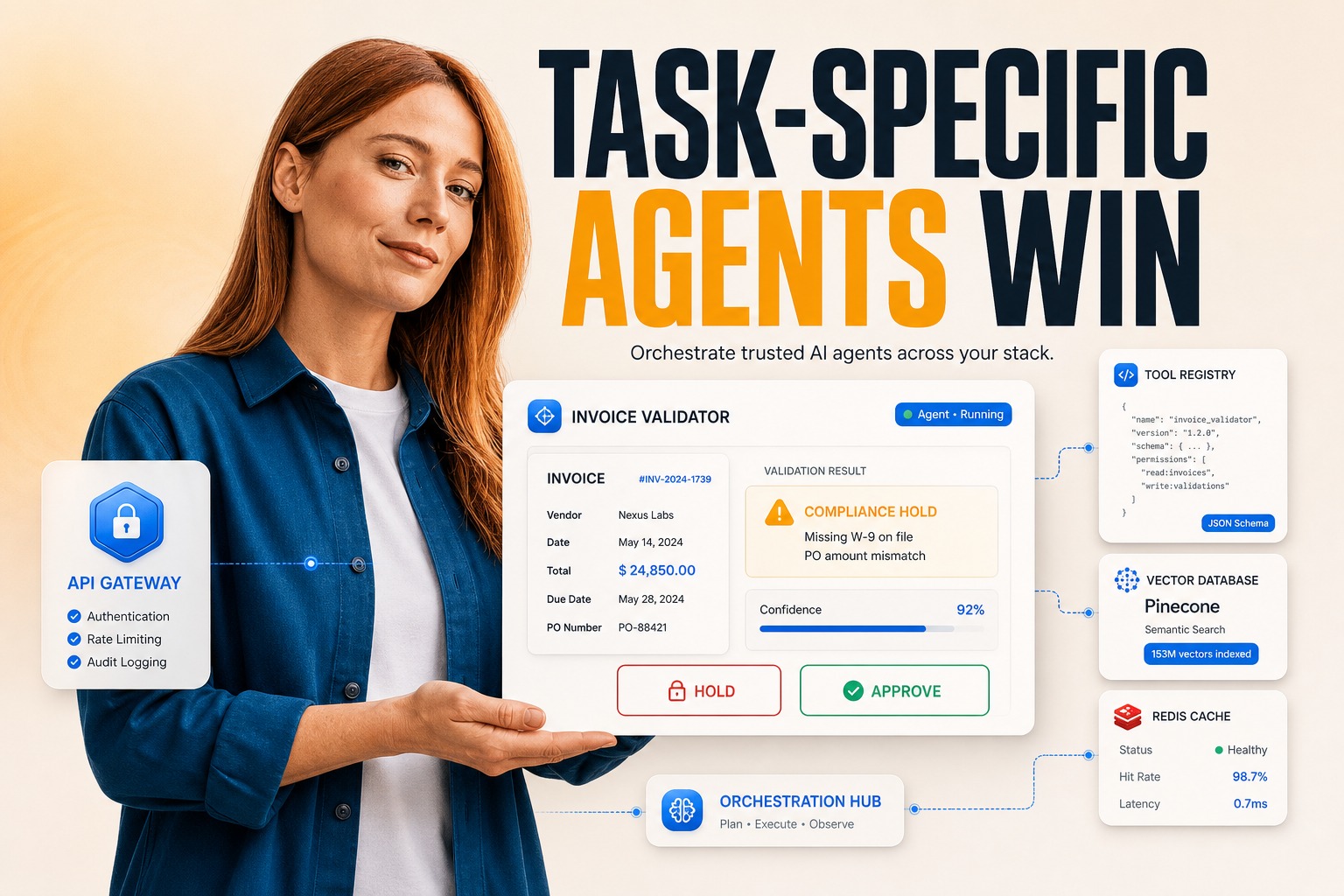
At the core is a deterministic orchestration layer that receives a user intent, translates it into a structured tool-call graph, and executes each step while persisting state.
API Gateway: AWS API Gateway or Kong terminates TLS, validates OAuth2 scopes, applies rate-limits, and forwards requests to the orchestration microservice.
Orchestration Layer: Stateless FastAPI (Python) or Express (Node) service running on Kubernetes Deployments. Frameworks such as LangChain, AutoGen, or CrewAI provide tool-calling abstractions and loop management.
Tool Registry: JSON-Schema definitions of every callable function – REST endpoints, GraphQL mutations, Python scripts, or SQL stored procedures. Each tool is tagged with idempotency keys and circuit-breaker policies.
State Management: Redis (TTL ≤ 30 min) for short-lived session context; PostgreSQL for durable workflow state; Qdrant or Pinecone for vector embeddings used by RAG.
Model Layer: Hosted LLM endpoints (OpenAI GPT-4-Turbo, Anthropic Claude, Gemini). System prompt encodes the agent's role (e.g., "Compliance Auditor") and tool schema. Token usage is capped at 4 k per call; chain-of-thought reasoning is split across multiple short calls to stay within limits.
Data Store: Relational tables (financial ledgers, ERP line items) accessed via prepared statements; vector DB for similarity search of legal clauses or contract language.
Data flow example (compliance-check use case):
User clicks "Validate invoice #98765" in the ERP UI.
Frontend invokes the API Gateway (POST /agent/execute) with OAuth2 bearer token.
Orchestration parses intent, selects the "InvoiceValidator" agent, and loads the tool graph: verify-user-role → fetch-invoice-data → RAG-policy-lookup → trigger-payment-hold.
Each tool call is wrapped in a try/catch with exponential back-off; failures are logged to Elastic Stack and queued on Kafka for retry.
RAG step: embedding of invoice description is sent to Pinecone; top-k results are concatenated with a concise system prompt (≈ 1 k tokens) and sent to the LLM.
LLM returns a structured JSON with action: "hold" and a rationale. The orchestration layer validates the JSON against a schema (NeMo Guardrails) before invoking the payment-gateway REST API.
Successful hold is recorded in PostgreSQL, audit entry written to immutable log table, and the user receives a real-time WebSocket update.
300%
Reduction in processing time and error rates with task‑specific agents compared to generic assistants, while keeping cloud costs 30‑50% lower.
Agent Control Plane setup: Deploy vector DB (Pinecone), configure LLM gateway with API-key vault, provision Redis cluster, enable OpenTelemetry tracing.
Pilot development: Build a single-purpose agent (e.g., "RefundProcessor") using LangChain to wrap two REST APIs; embed a "human-in-the-loop" approval step.
Scale & orchestration: Register additional tools, introduce specialized agents (Researcher, Writer) and connect them via CrewAI for multi-agent hand-off.
Monitoring & governance: Dashboard with Prometheus/Grafana for latency, token usage, and error rates; alerts on circuit-breaker trips.
Common pitfalls
Relying on LLM memory instead of persisting state in Redis or PostgreSQL.
Missing fallback strategies for downstream API outages (queue-and-retry leads to eventual consistency).
Over-exposing tool registry – attackers can discover unauthorized endpoints.
EXAMPLE USE CASE
A logistics company deployed a task‑specific AI agent for customs documentation verification, cutting processing delays by 40% and reducing compliance rework by 60% through automated policy checks and audit trails.
Task‑specific agents are no longer an experimental add‑on; they are the most efficient, compliant, and cost‑effective way to translate business intent into trusted actions. By focusing on vertical AI agents that embed governance, state, and observability, enterprises unlock measurable ROI while future‑proofing their automation stack.
Share this post
Contact Us
This is what will happen, after you submit form
Plavno experts contact you within 24h
Discuss your project details
We can sign NDA for complete secrecy
Submit a comprehensive project proposal with estimates, timelines, team composition, etc
Need a custom consultation? Ask me!
Plavno has a team of experts ready to start your project. Ask us!