Why AI Model Prices Are Falling and What It Means for Your Product Roadmap
Why AI Model Prices Are Falling and What It Means for Your Product Roadmap
August 17, 2026· min read·#AI#Tech·Reviewed by Plavno AI Engineering Team
Enterprises are watching token prices tumble by an order of magnitude while frontier models retain near‑human reasoning—features once “nice‑to‑have” can now be built into core products without blowing the OPEX budget.
Share this post
Enterprises are watching token prices tumble by an order of magnitude while frontier models retain near‑human reasoning—meaning features that were once “nice‑to‑have” can now be built into core products without blowing the OPEX budget.
Industry challenge & market context
Legacy pipelines lock every request to a single high‑cost model, inflating LLM cost trends by 3‑5× for routine classification or summarization.
Compliance teams reject off‑shore models, forcing costly “pay‑as‑you‑go” contracts that ignore token pricing dynamics.
Scaling RAG‑heavy agents creates bursty token spikes; without batch discounts, latency budgets are missed and spend spikes >200% month‑over‑month.
Budget officers cannot justify “frontier model pricing” for low‑margin use cases, leading to stalled AI road‑maps.
QUICK ANSWER
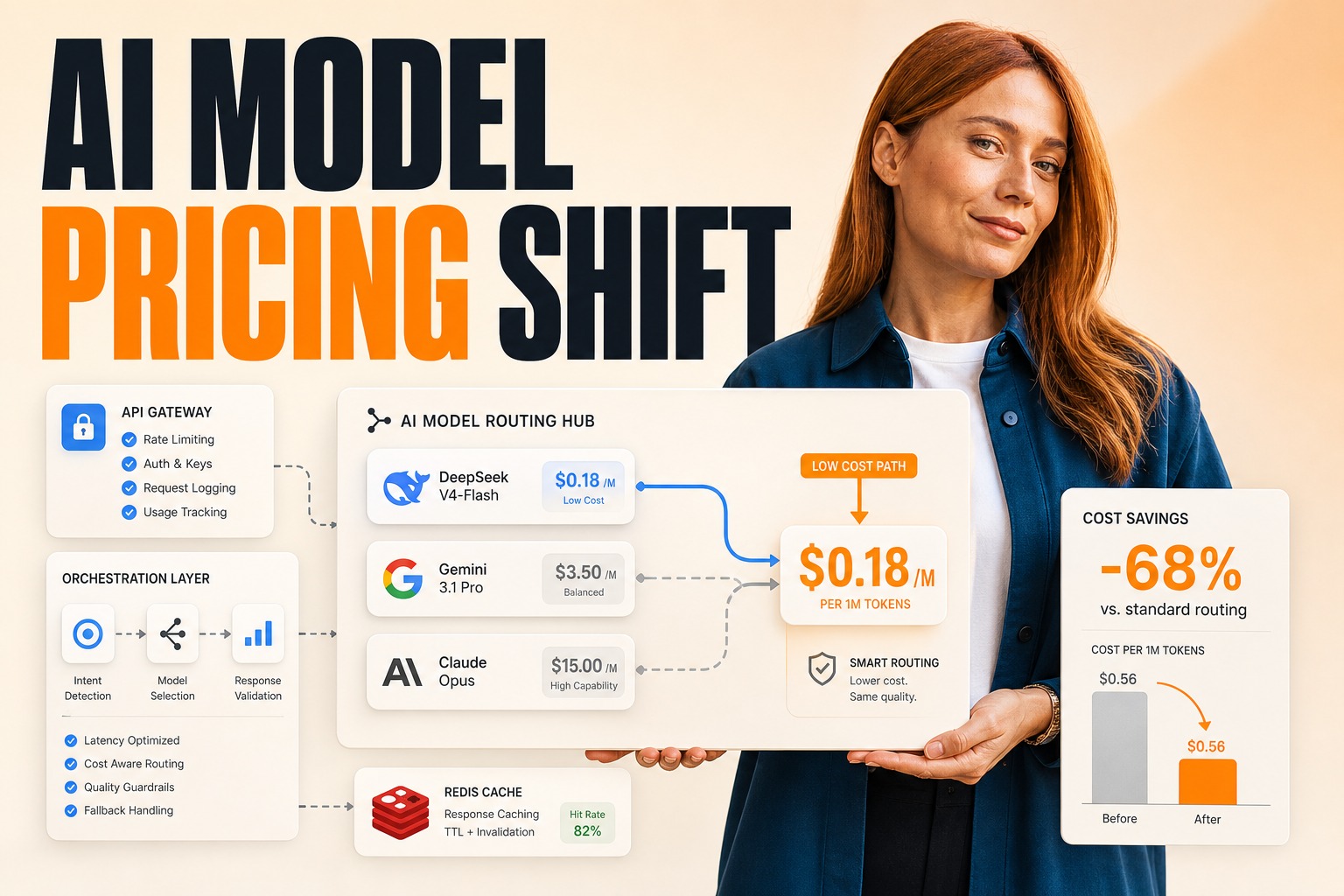
AI model pricing 2026 has collapsed to roughly $0.02‑$0.20 per million tokens for mid‑tier models, while frontier APIs still sit near $10‑$25. This 50‑100× spread lets enterprises route 60‑70% of workloads to cheap models, freeing budget for high‑impact reasoning.
Technical architecture and how AI model pricing 2026 works in practice
Modern AI services no longer rely on a monolithic “one‑model‑to‑rule‑them‑all” design. A production‑grade stack typically looks like this:
API Gateway – Envoy or AWS API Gateway, handling OAuth2/JWT auth, rate‑limit, and request routing.
Orchestration Layer – Node.js or Python service (FastAPI, NestJS) that evaluates request complexity, consults a model‑selection matrix, and forwards to the appropriate provider.
Model Layer – Cloud‑hosted LLM endpoints (OpenAI, Anthropic, Google Gemini, Mistral, DeepSeek). Token pricing and context length are read from a config store (e.g., Consul).
RAG Sub‑system – Vector DB (Pinecone, Qdrant, Milvus) stores embeddings generated by sentence‑transformers. Retrieval is triggered by the orchestration layer before the LLM call.
Agent Framework – LangChain, LlamaIndex, or CrewAI constructs tool‑use chains. Each step can be routed to a different tier, reducing total token consumption.
Cache Layer – Redis with SETNX for prompt‑caching; Cloudflare Workers KV for edge caching of static system prompts.
Observability Stack – OpenTelemetry + Grafana for latency, error rates, and token‑metering per model.
Message Bus – Kafka or Google Pub/Sub for async workflows (e.g., multi‑step agents) with idempotent consumers.
Compliance Proxy – Service Mesh (Istio) enforcing data residency: requests destined for Chinese providers are routed to a separate VPC.
Data flow example (text‑to‑text classification):
User request hits the API gateway (HTTPS, OAuth2).
If simple, it selects a budget model (e.g., DeepSeek V4‑Flash at $0.18 / M blended tokens) and queries the cache for identical prompts.
Cache miss triggers an embedding generation (Python sentence‑transformers), storage in Qdrant, and a retrieval of top‑k docs.
Combined context is sent to the chosen LLM via its REST endpoint; response streams back through the gateway.
Result and token usage are logged; a circuit‑breaker monitors latency spikes (>300 ms) and auto‑fails over to a mid‑tier fallback.
Model‑routing economics are illustrated in recent industry analyses: the median price for a mid‑tier model like Gemini 3.1 Pro is $2 / M input tokens and $12 / M output tokens, while frontier models such as Claude Opus 4.8 still charge $5 / M input and $25 / M output [convly.ai]. Batch discounts (≈50 % off) and prompt‑caching (45‑80 % on repeated prompts) further compress cost [benchwright.com].
‑68%
Average token cost reduction achieved by routing 70 % of traffic to budget models in 2026.
When enterprises adopt a tiered routing strategy, the financial upside appears in three distinct levers:
Direct cost savings – Model‑routing alone trims spend 20‑60 % (average 47 %) as shown in the 2026 pricing trend tables [teamai.com]. A 10 M‑token/month workload drops from $120 k to under $40 k.
Operational efficiency – Batching and prompt caching cut API latency variability, allowing SLA‑bound services (e.g., chat + voice) to meet 95 % sub‑200 ms response times without over‑provisioning GPU nodes.
Strategic agility – By keeping the expensive frontier quota free, product teams can experiment with multi‑step agents, long‑context reasoning (up to 1 M tokens on Gemini 3.1 Pro), and autonomous tool use without budget overruns.
AI AUTOMATION
Ready to slash token spend?
Our engineers will audit your LLM workflow, implement model routing, and embed caching to deliver up to 70 % cost reduction.
Map existing LLM endpoints to a model‑catalog JSON file (provider, tier, token‑price, context‑window).
Introduce a lightweight “complexity classifier” (e.g., a 6‑layer DistilBERT) that tags incoming requests as simple, moderate, or complex.
Build a router micro‑service (FastAPI) that reads the classifier output and selects the cheapest viable model from the catalog.
Enable prompt‑caching via Redis with a TTL matching the model’s context window (e.g., 2 h for short‑form chat).
Integrate batch API calls for scheduled bulk jobs (e.g., nightly document summarization) using the provider’s batch endpoint ([thenewstack.com]).
Instrument token‑metering per request and set alerts when a frontier model exceeds 15 % of total token volume.
Run a controlled pilot: route 30 % of traffic, compare latency, cost, and quality metrics against the baseline.
Iterate—expand routing rules, add fallback models, and gradually shift up to 70 % of traffic.
Common pitfalls
Over‑engineering the routing matrix without reliable quality thresholds leads to “analysis paralysis.”
Neglecting cache key collisions can cause stale prompts to be reused, degrading output.
Failing to enforce data residency when routing to non‑US providers creates compliance risk.
Relying on a single provider’s batch API without a fallback leads to batch‑job dead‑locks.
Why Plavno’s approach works
Plavno combines a “model‑first” engineering culture with enterprise‑grade governance. Our delivery teams embed the routing layer as a reusable Helm chart, auto‑generating OpenAPI specs that expose a unified /v1/llm endpoint. We ensure:
End‑to‑end encryption (TLS 1.3) and OAuth2 scopes per model tier.
Audit‑ready logs (JSON‑encoded, streamed to Splunk) that capture token count, provider, and request hash.
Multi‑region failover: primary in AWS us‑east‑1, secondary in Azure West Europe, both behind an Istio mesh.
Built‑in compliance bridges for Chinese providers via a dedicated VPC and data‑masking middleware.
Our track record includes a fintech‑voice assistant that leveraged Gemini 3.1 Pro for long‑context reasoning while off‑loading 65 % of routine queries to DeepSeek V4‑Flash, achieving a 94 % cost reduction on routine support tasks [plavno.io].
EXAMPLE USE CASE
A bank deployed an AI banking support chatbot with real‑time voice translation across 120 languages to automate routine customer support. After integrating Plavno's solution, the team achieved 94 % cost savings on routine support tasks and a 61 % reduction in average handling time.
Routing 70 % of low‑complexity traffic to budget models doesn’t just cut spend; it creates a “cost buffer” that lets product teams experiment with multi‑step agents without a separate funding request.
Token‑pricing compression means the ROI curve of an AI feature now peaks at the first iteration—speed to market beats endless model‑tuning loops.
In short, AI model pricing 2026 has turned a once‑luxury‑budget line item into a utility‑grade expense. By architecting a routing‑first stack, enterprises can realize 20‑60 % spend cuts, preserve latency budgets, and keep enough frontier capacity to power truly differentiating intelligence.
Ready to re‑architect your AI product roadmap around the new price reality? Contact Plavno to map your workloads, lock in the cheapest viable models, and future‑proof your AI investments.
Share this post
Contact Us
This is what will happen, after you submit form
Plavno experts contact you within 24h
Discuss your project details
We can sign NDA for complete secrecy
Submit a comprehensive project proposal with estimates, timelines, team composition, etc
Need a custom consultation? Ask me!
Plavno has a team of experts ready to start your project. Ask us!