The Agent Stack Explained: Execution, Memory, Identity, Access, and Communication Layers
The Agent Stack Explained: Execution, Memory, Identity, Access, and Communication Layers
August 20, 2026· min read·#AI#Tech·Reviewed by Plavno AI Engineering Team
Enterprises are deploying AI agents faster than they can reliably scale them, resulting in fragile demos that crumble under real‑world load, compliance checks, and cost scrutiny.
Share this post
Enterprises are deploying AI agents faster than they can reliably scale them, resulting in fragile demos that crumble under real‑world load, compliance checks, and cost scrutiny. An agent that can answer a single user query but cannot persist state, enforce access policy, or recover from a failed API call is a liability, not a competitive advantage.
Industry challenge & market context
Legacy wrappers around GPT‑4 or Claude lack deterministic execution, leading to hallucinations that violate financial or regulatory policies.
Context‑window limits (e.g., 128k tokens for GPT‑4‑turbo) make it impossible to feed terabytes of enterprise documents into a single prompt, forcing costly truncation.
Integrations with monolithic ERPs, on‑prem SQL servers, and SOAP APIs introduce latency spikes that break synchronous agent flows.
Security teams reject public endpoints for PII, demanding on‑prem or VPC‑isolated inference and full audit trails.
Token‑based pricing creates unpredictable spend; a viral internal chatbot can exceed budgets by 300% in days without throttling.
QUICK ANSWER
The agent stack architecture consists of five interoperating layers—execution, memory, identity, access, and communication—each responsible for state, security, tool use, and observability, enabling production‑grade AI agents that reliably replace bespoke scripts.
Technical architecture and how agent stack architecture works in practice
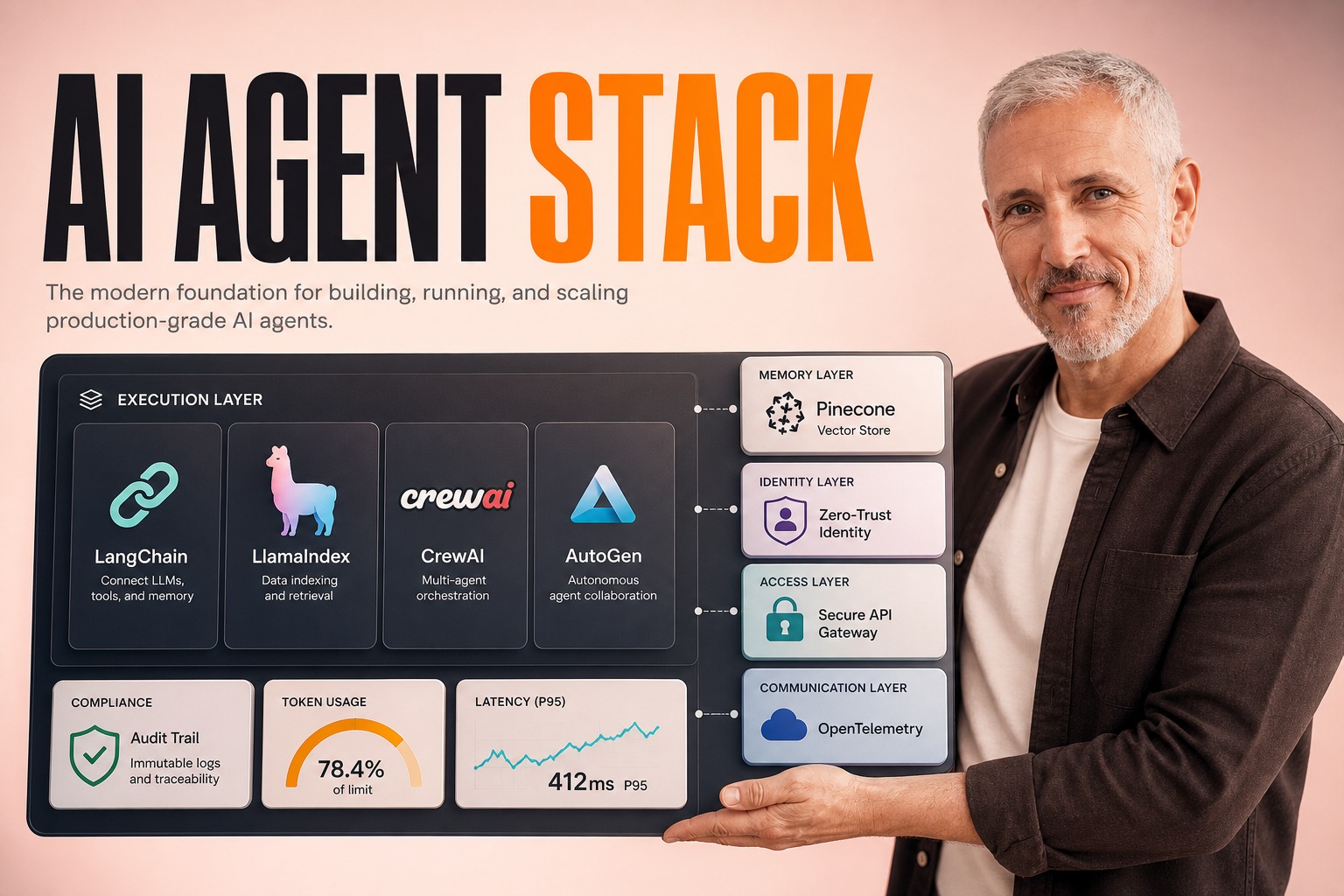
The production‑grade agent stack is a disciplined assembly of five layers, each with its own contracts and failure modes. The diagram below (conceptual) shows where data lives and how requests traverse the system.
Execution Layer (the nervous system) – Managed by an orchestration engine such as LangChain, LlamaIndex, CrewAI or AutoGen. It receives a goal (REST request, GraphQL mutation, webhook, or scheduled event), validates permissions, and drives a ReAct loop (reason‑act‑reason) that decides which tool to invoke.
Memory Layer (the hippocampus) – Short‑term context lives in Redis or Memcached; long‑term knowledge lives in a vector DB (Pinecone, Weaviate, or pgvector). The layer implements a sliding‑window summarizer that keeps the active prompt under the model’s token limit while preserving logical continuity.
Identity Layer (the self) – Agent identity is expressed via service‑account tokens. OAuth2 scopes, API‑key rotation, and Zero‑Trust network policies ensure the agent only calls authorized endpoints. Identity claims are attached to every tool invocation for audit.
Access Layer (the hands) – Typed tool definitions (e.g., get_user_balance(user_id)) are exposed through an internal API gateway (Istio or Kong). The gateway enforces rate limits, circuit breakers, and retries (exponential back‑off) to protect legacy back‑ends.
Communication Layer (the voice) – Handles inbound/outbound protocols (REST, GraphQL, gRPC, webhooks, Kafka/SQS streams). A uniform request envelope carries correlation IDs for end‑to‑end tracing via OpenTelemetry, feeding into observability stacks like Datadog or LangSmith.
Data flow example: A sales rep clicks “Generate proposal” in the CRM. The UI sends a GraphQL mutation to the API gateway, which forwards the intent to the Execution Layer. The orchestrator runs a ReAct loop: it first queries the Memory Layer for the latest client contract (semantic search in Pinecone), then calls the Access Layer’s price_calculator() microservice via a secure gRPC call. The result is stitched into a prompt, sent to GPT‑4‑turbo (128k token window), and the final document is stored back in the vector DB and returned to the UI. All steps are logged with timestamps, token counts, and outcome verification.
EXAMPLE USE CASE
A logistics company deployed AI agents for quoting, shipment tracking, and customer communication, achieving 70% faster response times and a 60% reduction in support tickets. The solution fused LangChain orchestration, Pinecone vector search, and a secure API gateway to expose ERP data.
Even a single missed permission check can cost a regulated enterprise millions in fines; embedding identity checks in the execution layer is non‑negotiable.
Key implementation details extracted from leading industry analyses:
Execution layers must persist a full audit trail (action, input, output, policy decision) for compliance plane.so.
The memory layer should separate short‑term caches (Redis, 5‑minute TTL) from long‑term embeddings (Pinecone, 30‑day TTL) to balance cost and latency plavno.io.
Agent stack architecture demands a “brain‑hands‑eyes” separation, mirroring the five‑layer model described by the AI Agent Stack guide fast.io.
A well‑engineered agent stack turns a flaky prototype into a service that can handle thousands of concurrent journeys without supervision.
Business impact & measurable ROI
Cost predictability – Token gating and intelligent caching cut average monthly spend by 40% for agents that serve >10k requests per day.
Operational efficiency – Automating approval workflows reduces human hand‑off time from 12 minutes to under 30 seconds per transaction, a 96% speed‑up.
Risk mitigation – Centralized identity and audit logs lower compliance violation risk, shaving potential fines from $5 M to under $100 k.
Scalability – Containerized execution layers on Kubernetes auto‑scale based on queue depth (Kafka or SQS), supporting bursts of 5× request volume without latency spikes.
Customer experience – Agents that persist context across sessions increase NPS by 12 points, as users no longer repeat information.
Implementation strategy
Phase 1 – Prototype core loop: Use LangChain in Python, connect a single tool (e.g., CRM lookup), store session snippets in Redis.
Phase 2 – Introduce memory tier: Deploy Pinecone, implement semantic chunking (200‑token windows), add summarization lambda to keep prompts under 8 k tokens.
Phase 3 – Harden identity: Switch to OAuth2 client credentials, enforce scopes per tool, log every invocation to an immutable audit DB (PostgreSQL with pgAudit).
Phase 4 – Scale execution: Containerize the orchestrator, run on GKE/EKS with Horizontal Pod Autoscaler, add circuit‑breaker middleware (Istio).
Phase 5 – Observability & governance: Wire OpenTelemetry to Datadog, enable LangSmith trace visualizations, set cost alerts on token usage.
Common pitfalls to watch:
Relying on ad‑hoc scripts for state – leads to inconsistent context and token blow‑up.
Hard‑coding API keys – breaks when rotation policies change.
Skipping outcome verification – agents can silently fail and return stale data.
Neglecting back‑pressure – unbounded queues cause memory exhaustion under load.
Why Plavno’s approach works
At Plavno we treat the agent stack as a first‑class system, not an afterthought. Our engineers build the “brain‑hands‑eyes” layers on top of proven open‑source frameworks, then wrap them with proprietary controls that address enterprise pain points:
Custom orchestration controller that enforces rate limits, retries, and policy evaluation before any tool call.
Hybrid memory architecture: Redis for session cache, Pinecone for semantic search, and pgvector for audit‑ready embeddings.
Zero‑Trust identity management integrated with existing corporate IdPs (Azure AD, Okta) to satisfy audit requirements.
Built‑in observability pipelines feeding LangSmith and Datadog, giving CTOs real‑time cost and latency dashboards.
Modular service contracts that let you swap LLM providers (GPT‑4‑turbo, Claude 3.5, LLaMA 3) without touching the surrounding code.
From day one we align with your existing delivery models – whether you need out‑staffed developers, a managed services team, or a dedicated AI‑focused product squad. Learn more about our AI‑agent services here and explore our broader solutions here.
Ready to move from brittle scripts to a resilient agent stack architecture? Let’s discuss how to blueprint, build, and scale a production‑grade AI agent platform that delivers measurable ROI.
In summary, the five‑layer agent stack—execution, memory, identity, access, and communication—provides the structural discipline needed to turn experimental LLM wrappers into enterprise‑ready services. By investing in each layer, organizations eliminate hidden costs, meet security mandates, and unlock the true productivity gains of autonomous AI.
Share this post
Contact Us
This is what will happen, after you submit form
Plavno experts contact you within 24h
Discuss your project details
We can sign NDA for complete secrecy
Submit a comprehensive project proposal with estimates, timelines, team composition, etc
Need a custom consultation? Ask me!
Plavno has a team of experts ready to start your project. Ask us!